
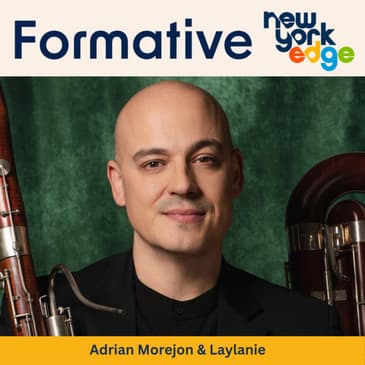
Bassoonist, Adrian Morejon, joins us on today’s show! 8th grader and co-host, Laylanie, asks Adrian about the appeal of the bassoon to him as a young child and how he’s been able to maintain his dedication to the instrument. Adrian tells Laylanie about his strategic career planning in the beginning of his career. He explains why it’s important to seek financially rewarding work with the added benefit of allowing you to add skills related to your passion while you are in pursuit of gaining traction in your desired field.
Downloadable transcript here
INTRODUCTION
Welcome to Formative, the show where today’s leaders are interviewed by the leaders of tomorrow.
Formative is brought to you by the generous support of Macy's Inc. whose purpose is to create a brighter future with bold representation from underrepresented youth so we can realize the full potential of every one of us.
GUEST INTRODUCTION
We have Adrian Morejon with us today. Adrian is a New York-based bassoonist who has established himself as a soloist, chamber and orchestral musician. Adrian has performed with the Philadelphia Orchestra, Dorian Wind Quartet, Talia Ensemble and many others. Adrian is also currently on faculty at SUNY Purchase College Conservatory of Music, CUNY Brooklyn College and CUNY Hunter College.
INTERVIEW
Rachael: Hello and welcome. I'm Rachel Gazdik, CEO of New York Edge, and my co-host today is Laylanie from I.S. 663K. Laylanie, can you tell us a little bit about yourself?
Laylanie: I go to a school called the School of the Future. It's a middle school. I'm an 8th grader. I'm 13. I enjoy performing and learning choreography, and I consider myself a good listener.
Rachael: That’s great! And who are we going to be speaking with today?
Laylanie: Today we're going to be speaking to Adrian Morejon. I’m actually pretty excited to learn about him.
Rachael: I’m also really looking forward to it. So, let’s welcome Adrian to the show. Adrian, thank you so much for being here today.
Adrian: Thank you for having me.
Rachael: So, Laylanie, I’m going to turn it over to you. What’s your first question for Adrian?
Laylanie: My first question is, tell me a little bit more about And what actually makes the bassoon a little bit special?
Adrian: That's a great question. So, the bassoon is interesting. It’s a double reed instrument. So if you know the oboe, the bassoon is the lower partner of the oboe. Something that drew my interest is that it has a sound that can relate to the voice. Or it blends well with strings. I like that it has a very nice mellow sound that can be very expressive. A lot of people know the bassoon in a different character, right? Sometimes people call it the, I hate using this term, but some people call it the clown of the orchestra. But because of pieces like Sorcerer's Apprentice, if you remember from Fantasia, both iterations, it has the bass instrument qualities, right? Short, low notes that can dance around. So, it does have that character, but there's a lot of repertoire out there. And if you listen to it in film scores, you would hear it has a very expressive quality in the middle to high range as well. It’s not as commonly used in pop music. Um, But I think film is an entry point for non-classical musicians to learn about the bassoon.
Rachael: So the bassoon is one of the instruments that makes up an orchestra. Can you tell us a little bit more about life in the orchestra?
Adrian: As an orchestral musician, you would convene regularly for rehearsals, preparing for concerts, and you kind of, um, organize your schedule around the orchestra's season calendar. And you really commit yourself to the orchestra. And that was very exciting for me as I was growing up and learning more about the bassoon and music world. And I was lucky enough in my undergraduate years in Philadelphia to be a sub in the Philadelphia Orchestra, which was incredible to get to play with a lot of my idols in the woodwind world and I appreciated every moment of it. Eventually, I started realizing that I wanted to do more than just that. So when you're an orchestral musician, you have to really commit yourself to one group, and you really learn how to play like a family. You know, really working well together, and really getting to learn each other's playing in an intimate way so you can create the best product. I decided at some point that I wanted to go into chamber music and do the same thing, know other musicians but on a smaller scale. So, I slowly shifted away from the path of trying to audition for an orchestra and I learned how to really think about what I wanted to do and create a path for myself
Laylanie: Oh, okay. That's good. How did you know you wanted to be a musician?
Adrian: That's a good question. I was born and raised in Miami, Florida by my parents who came to the U.S. from Cuba in the 1960s. And by word of mouth in my family, I heard stories about how my family, previous generations in my family, there were many people who were involved in the orchestral and opera scenes in Cuba. My mother played piano in Cuba before moving to the U.S.. So there was a little influence from my mother for me to get into music, and then that was enhanced by having one of my older brothers play the flute. So from an early age, I was exposed to wind instruments and piano. And so in my elementary school years, I played recorder and piano. And then by middle school, band started, and so I started playing saxophone, clarinet, and eventually bassoon. And bassoon kind of stuck, and then by high school, I auditioned for the New World School of the Arts in Miami, Florida. And once I got in, I think that started cementing this path for me.
Laylanie: I'm kind of curious about, like, were you really interested in the bassoon?
Adrian: Yes, I definitely was. So, it’s an interesting question. This goes back to middle school when I first selected the bassoon. I had been playing the clarinet and alto saxophone for the previous year and change, perhaps, and our band director, she pulls out this instrument that no one was currently playing and she presents it to us like, here's this instrument, everyone. We really need someone to play it. Everyone's just kind of looking at it like, what is that? And so when people ask me, why'd you pick the bassoon? My short one word answer is pity. Because at first I was just like, aw, like no one's playing it. And so, in the beginning, I had to go into the back room while rehearsals would happen with the ensemble and self teach myself the bassoon so I could really quickly join the ensemble. And so I enjoyed the challenge. I think it was exciting to teach myself an instrument, and also play an instrument that not many people were playing at that time.
Laylanie: What are three things you like about yourself and the bassoon?
Adrian: Three things that I like about myself? And I will think of those three things in ways that I connect with the bassoon or what the bassoon brings into my life. I'm a very gregarious person, and I like connecting with people. The bassoon and the world of music is a great facilitator of that. A lot of what I do is about getting people together, not only musicians coming together and making music, but also going to the community and providing the music for them. So, that's one thing that I like about myself, is the ability to connect people and the ability to find a way to communicate to people who maybe don't even speak my language, you know, English or Spanish, like music is a universal language. And so, I love that about the bassoon and music in general.
A second thing I like about myself is that I chose to go in the direction of my own path. I had reasons not to, based on what other people might have said, and I always stuck to my gut or the path that provided the most passion for me, or the most reward. And, sticking with it, I am really happy with the career that I've created for myself, so I try not to doubt myself. Of course, there are challenges and obstacles along the way, but I went forward regardless, and I'm proud of that.
And then the third thing that I would say I like about myself is I guess a little related to the second, but more about music in general and the bassoon, is I always gravitate towards the more difficult challenge. Like, I always like finding the music that’s more challenging. I like challenging my listening skills, whether it's genres of music I wasn't familiar with. A lot of my career is oriented in contemporary music so, of course, that's a lot of, it needs a lot of open ears and a lot of creativity to listen to things maybe once upon a time I didn't think of as music, but now I do. And so, this ability to be flexible and go for the extra challenge.
Laylanie: Did you have any mentors while you were learning to play this instrument?
Adrian: Mm hmm.
Laylanie: If so, who were they?
Adrian: Yes. I think I have three mentors throughout the development of my music-making that really influenced me. The first one was at New World School of the Arts. It’s my bassoon teacher, Manny Zegler. He was the former principal bassoonist of the New York Philharmonic back when Leonard Bernstein was conducting. And so for me, it was interesting to have that exposure into the larger classical music scene. And coming from Miami, I wasn't really aware of the New York, Philadelphia, Boston, like a lot of the traditions in orchestra playing or wind playing. And so, Manny Zegler introduced me to a lot of that. And he was the one who really pushed for me to audition for the Curtis Institute of Music, which is where I did my undergrad. So if it weren't for him, the beginning of my path wouldn't have been so defined. In addition to him, I have to bring up Robie George, who was our wind ensemble conductor. And so, he also influenced me in just learning about various genres, ensembles, different things that one could do in music. So, those were my early mentors.
Once I went to Philadelphia for undergrad, my teacher there, Bernard Garfield, was the former principal bassoonist of the Philadelphia Orchestra. And he was the one who helped me really develop and learn about the industry and kind of set new standards for what I wanted to achieve, so really kind of pushing the bar up for me and making me really think about what exactly I wanted to do.
After undergrad, I went to the Yale School of Music, where I studied with Frank Morelli, and he was my private teacher. He is the one who helped me really find my voice in my career. He helped me realize that, you know, as much as I respect the symphony orchestra and musicians who played in the orchestra primarily, Frank Morelli helped me realize that I wanted to do chamber music and solo repertoire and contemporary music, Baroque music.
And so, I think that the order of these mentors really helped define my trajectory and helped me land in New York where I created a career for myself.
Laylanie: Okay, well, my next question is, what challenges did you face while learning the bassoon?
Adrian: In the very beginning I think my main challenge was that it took me a couple of years before I had a private teacher. And so, having to teach myself and take time away from my middle school band to go into the side room and go through etude books, learn fingerings. It was a challenge. And also in that beginning period, it was also tricky because I had to figure out reeds, which, for double reed instruments, is a whole other challenge compared to clarinet, saxophone, the single reeds. And so, it wasn’t until I got into my high school years where I even thought about reed-making, and I really didn't learn those skills until I was in college. So, I think those were the early challenges I had to face.
Rachael: Adrian, I think a lot of children, when they say they want to be an artist or they want to be a writer, whatever it is, they’ll sometimes feel in an adult’s face without even saying it, that they’re telling them, like you know, come on kid, be realistic. Like, you have to have a back up plan. So, I’m wondering, did you ever feel that? And if so, how did you navigate it?
Adrian: Yeah, it's a great question. And I think that's something that's important to talk to younger people about in general, regardless of what the industry or the field is. When I first moved to New York, I finished school, I left Yale and I moved to New York with fellow musicians who were trying and were starting a chamber group. And then, I was going to start freelancing but that's a challenging period, transitioning from school to professional life. And so, I was fortunate enough that my last teacher, Frank Morelli, helped me get some work right away in the city and helped me meet people and network a little bit.
However, it's hard to make enough money to live in New York City. And so, I acknowledged the challenge. I had family members who were just like, you know, you're really good in science and math and all this stuff. Do you have a backup plan? And I said, no, I'm going to go for this and I really want to put all my energy into this.
And so, what I ended up doing is, you know, I would take part-time jobs in the city my first couple of years. But I made sure that they were all related to music. My first, immediate one that I remember was at the Barnes and Noble that used to be at Lincoln Center. I was in the music department. I still wanted it to be related to music. I wanted to be somewhere that maybe I would learn something from the work. And I made it through one holiday season and I was just like, oh great, I can't do this. It's too much. But I respect those who work in that industry.
And then, after that, I joined the marketing team at the Chamber Music Society of Lincoln Center, which was really valuable because I got to meet some of the people who were doing chamber music in New York. And fast forward a couple of years, I would eventually play some of the concerts through CMS of Lincoln Center and a lot of the people there would become colleagues of mine.
And so, my solution to your original question was I accepted the challenge, but I tried to find a solution to pay the bills, but using the skill set I have and trying to find jobs that were temporary, but would enhance or help me learn more about the industry. And so eventually, I think after the CMS job, that was the last job that wasn't related to the things I'm focusing on now, which are performance, teaching, and running an ensemble.
Rachael: Wow, that's very creative and really sound advice. Laylanie, do you have more questions for Adrian?
Laylanie: Yeah, um I actually have a question. If you weren't a musician, what would you be?
Adrian: I had moments where I thought about it, I have two answers to it. The first answer comes from my high school years. I talked about the other jobs I took in New York as I adjusted to New York life. But in my high school years and undergraduate years when I’d go to Miami to visit family for the summers, I would do some work at the local hospital. I did work that was related to medical records or things that were more entry level for someone like me who wasn't focusing on it. And I do think that the medical field is something that I would have considered had it not been for music. As I mentioned earlier, math and science were my strong subjects in school and I still feel that way, although I've forgotten a lot of it. But, of course, math is important with music for the sense of keeping time, rhythm, you name it.
But I think it would have been something either medical or engineering-oriented, maybe in the math direction. And then, I think the second answer is, it's a little unfair. Maybe it's a little bit of cheating since I do teach, but I have a love for teaching. Of course, I teach music now. But, I could see myself having gone to any level from K through higher ed, just teaching at some level if I weren’t in music as well.
Rachael: So our last question for you, Adrian. If you could go back to speak to your 13 year old self, what would you say?
Adrian: I would say don't doubt yourself, trust your gut and make your path regardless of what you think is expected of you.
Rachael: Oh, thanks so much for that. This has just been an absolute pleasure.
Adrian: Thank you.
Rachael: And thank you for being such a wonderful co-host, Laylanie.
Laylanie: No problem!
Adrian: Yeah, thank you Laylanie.
Laylanie: Thank you.
CREDITS
Thanks for listening to Formative, a production of New York Edge. I’m your host, Rachael Gazdick. Brought to you by the generous support of Macy’s, Inc. Our production partner for this series is CitizenRacecar. This episode was produced by Hager Eldaas, post-production by Alex Brouwer, production management by Gabriela Montequin, original music by Garrett Tiedemann. Thanks to the whole team at New York Edge for making this series possible. Never miss an episode by subscribing to the series at newyorkedge.org/formative or wherever you get your podcasts.