
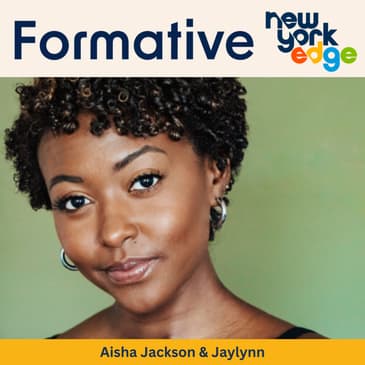

Season 10 kicks off with Aisha Jackson, a Broadway actress who’s lit up the stage in shows like Waitress and Frozen, joining middle schooler Jaylynn for a conversation about life in the spotlight. Aisha shares what it really takes to be a theater performer, beyond just singing and acting, and reflects on the importance of representation on Broadway. She also lets us in on the best career advice she’s ever received. This is a conversation about talent, perseverance, and using your voice.
Downloadable transcript here
Rachael: Welcome to Season 10 of Formative. I'm so grateful we've been able to make 10 wonderful seasons of this show. Here's to many more! Today, to kick off this season with us, we've got Aisha Jackson. Aisha is a theater actress and performer who's also worked in TV and film. You may have seen her in the original off-Broadway cast of Invisible Thread or in the original Broadway casts of Waitress and Frozen. In this conversation, we asked Aisha about the skills theater performers need beyond singing and acting, about representation on Broadway, and she tells us the best advice she's been given in her career.
—-
Rachael: Hello and welcome. I'm Rachael Gazdick, CEO of New York Edge, and my co-host today is Jaylynn from I.S. 522K. Jaylynn, can you tell our audience about yourself?
Jaylynn: Hi, my name is Jaylynn. I'm 13, I'm in the seventh grade. And I'd like to pursue art when I get older.
Rachael: That's great. And who are we speaking with today?
Jaylynn: I'm speaking with Aisha Jackson. She is a Broadway actress and singer, and I'm very excited to speak with her.
Rachael: Aisha, thank you for joining us. We're very happy to have you on the show.
Jaylynn: Yeah, happy to be here.
Rachael: Jaylynn, the mic is yours. What's your first question for Aisha?
Jaylynn: So, my first, uh, by the way, it's very nice to meet you, Ms. Jackson.
Aisha: Nice to meet you too.
Jaylynn: Um, my first question is, when you were in middle school, did you dream of doing what you're doing now?
Aisha: So I was a part of choir in middle school and my parents both sing, and my father's a pastor, so we would sing in church together as a family. My siblings sing, we all sing. But I think in middle school I was still desiring to either pursue being a teacher or a veterinarian. My mom is a teacher, so I always saw her growing up, you know, teaching. She was a substitute teacher at first, so sometimes she would sub in our classes. And I just thought that was so cool and, um, yeah. And I've always enjoyed being a leader in that way and also helping others on their journey, so I feel like teaching and mentoring is, has always been a love of mine.
But when I was in the sixth grade, I did my very first musical at my brother's performing arts high school. It was called Once On This Island. I auditioned for it and I didn't really know what it was, but I knew my brother was doing it and I was like, it must be cool. And I auditioned and I got the part and I think that was my first introduction to what musical theater was. And I enjoyed being in that space. And I went on to go to that exact same performing arts high school. And that was when I realized that I wanted to pursue musical theater and a career on Broadway as an actress, singer, dancer. Um, that was when I realized it, not until high school.
Jaylynn: Hmm, okay.
Aisha: Yeah.
Jaylynn: Um, my next question is, can you describe a typical day in your life when you're performing a show?
Aisha: So I am primarily a Broadway actress, but I also work in, um, voiceover and on TV and on soundtracks for different films. I also produce my own concerts for myself and my family. I have a production company called Love and Light Productions. And I also perform in concerts, like worldwide, and I've performed in Thailand, in China, and Qatar and different places. So my day to day can look very different.
But when I am in a Broadway show, we have shows eight times a week and we have one day off. We only have Mondays off. So Tuesday through Sunday, I am either at the theater or I'm preparing to go to the theater. So because most of our shows are in the evening, we have the whole day to do what we need to do for our personal lives. But you know, as you're doing that, you're also figuring out how much energy you need to save so that you can do your show at night. So I'll wake up and I have a devotional time to start my day. You know, have breakfast, feed your body, feed your mind. But sometimes I work on developing other shows during the day. So I'll be in workshops for rehearsals and different things like that for a show that's being developed for the stage. Um, yeah. Some days I'm teaching workshops and different things like that, and some days I'm just resting and making sure my body's good to go for the show at night.
But when we show up for work, we have what we call a half hour call, so you have to be in the building 30 minutes before the show starts. That's when I clock in. I usually go to the theater about an hour to an hour and a half before the show starts. Because I wanna warm up my voice, I wanna warm up my body. I wanna check in and see, you know, how am I feeling today? Do I feel a hundred percent? Do I feel 80%? Do I need to change anything I'm doing on stage? And then I do my own makeup for the show, so that takes a little while. Um, and so, yeah, so then I go to the theater. I get ready for the show. We do the show, it's about two hours to two and a half hours, depending on what the show is. And then we finish the show. I go out, I like to greet the audience members at the stage door. I meet a lot of people that way, and we get to meet a lot of different type of people that come to see the show. I connect with them and then I get on the train, I go home, I steam, I turn on my humidifier, I cool down my body and my voice, go to sleep, and then we wake up and do it all again.
Jaylynn: That's very nice to hear how much you take care of yourself. So any day you're not feeling well, what do you try to do to brighten your day up?
Aisha: Yeah, I'll say being outside brightens up my spirit. I love the sun. So the sun's shining today so I walked outside and I was like toodoodoo. I also, you know, enjoy being near bodies of water. They kind of bring me a little bit of peace. So if I'm having a down day, I go and walk by the pier and take some moments to breathe and settle. And I think writing out like words of gratitude just about life and where you are, focusing on the good things that are happening, as opposed to putting too much focus on the negative things, that always helps to shift my perspective for the day to focus on gratitude.
Jaylynn: I like to hear that. Um, what's the difference between performing on stage to performing in television or shows?
Aisha: Oh, yeah. So I think the biggest difference is, so when you're in a theater, your audience is the entire, it could be anywhere from, like, one or 200 people to 1700 people, right? And everyone in the audience needs to feel what you're feeling. They need to see your expressions on stage. You have to enunciate very clearly so they can understand everything that's coming out of your mouth. Energy, you kind of just have to fill the space a lot more to reach the audience, right. And I think when you're on film, the camera's right there so you don't have to project as loudly. The audience comes to you, so you don't have to be as theatrical or large or big or all these different things. But you still have to enunciate, you still have to tell the story. You still have to be invested and connected. So, those are the similarities, but I just think the audience, you have to go to the audience when you're in the theater, but when you're on the screen, the audience is like right there in your face, so you can turn it down a little bit less.
Jaylynn: So what skills besides acting and singing do you think a performer should have for things like, um, performances and shows?
Aisha: Yeah, I think versatility. The schedule can always change. And our bodies, you know, every day we wake up in a different mood. Every day I wake up, my voice is at a different capacity, uh, for the day. So I might not be able to do all of the different options. So I need to figure out different ways to access healthily, the different notes that I have to sing that day. So I think, yeah, versatility is always being able to go with the flow and not allow like an audience that is more active…Sometimes we have audience members that are loud and they let us know that they are loving the show, and sometimes we have audience members that are completely silent, but that doesn't mean that they're not enjoying the show. Sometimes it just means that's the way that they take in art. So I think you have to be able to just go with the ebb and flow of the energy that's given to you on stage and know, uh, believe in what you're doing on stage and believing your talents and know that you're capable, you're doing your work, the audience is going to respond how they respond.
Jaylynn: I like how you mentioned how people react because for me personally, I don't like to react much to things I find interesting. Instead, I like to observe it or listen to it closely so I can learn more about it.
Aisha: Yeah, yep. Those are how some of our audiences are.
Jaylynn: So what's the best piece of advice you've ever received?
Aisha: Ooh. Sometimes when I get afraid and I get there, I have a friend who says, God didn't bring you here to embarrass you, and so that's very important to me. It's kind of like, well, yeah, you're here because you deserve to be here. Those were good words of encouragement that helped me over the summer when I had a bunch of different projects that were huge and I was like, oh my goodness. I was a little afraid.
Um, this is kind of advice that I, I give to myself actually. When I audition for certain roles, there's a lot of rejection in this industry. But when that happens, I try not to beat myself up. I'll critique myself and be like, okay, you could have done this better, but also you did this great. And I remind myself, that's not my blessing. So sometimes other people deserve to have that opportunity for whatever reason and we don't always know why. But I say, it's not my blessing, it's their blessing. And when they win, I want to celebrate them, right? Because when I win, I want them to celebrate me, right? And so it's a two part thing of just respecting, it's not your time, that's not your blessing, it's theirs, and make sure you celebrate others because it's just, it's a nice thing to do. And you're gonna want them to do the same for you, so…
Jaylynn: Do you have any words of encouragement for our listeners who want to follow their dreams?
Aisha: Oh yeah, it's gonna take a lot of hard work, but don't allow that hard work to deter you from going after what you want, right? Because along the journey you're gonna have twists and turns and setbacks and jumps forward, and victories and failures, but every single part of the journey is teaching you something. So I would say keep your eyes peeled for the lesson in the experience, whether it's joyful or negative or positive. Each step, it helps you in some way. It's been really helpful to be like, okay, what am I learning from this? Or, okay, how was that show? How was that audition? How was that experience? What did I learn? What was negative? What's something that I can work on myself? What's something that I did well? Like, I think it's important to, to just look for the silver lining in everything and continue to challenge yourself to, to keep growing and keep learning 'cause that's the only way you're gonna continue to move forward.
Jaylynn: On your website, you talk about your role on Broadway, Frozen, and how did it feel to get that role?
Aisha: Oh, it was really cool. Um, I auditioned for the part, and there was a woman who had been developing the part, Patti Murin, in workshops and different things like that. So she actually got the role of Anna. So she originated the role, but I was the standby, which is the offstage cover. So whenever she didn't feel well or she needed to be out of the building for whatever reason, I got to put on the shoes of Anna. And it was really important to me because I got to represent my little chocolate drops, as I call them, um, in the role of Anna. There are so many young kids of color, and grown adults, that enjoy Frozen and enjoy those characters, and I think it was really cool to be able to embody Anna in my beautiful brown skin and show my chocolate drops that they can be princesses too. And I remember the very first time I went on a patron came to me and was like, oh my goodness, this African American girl was sitting next to me and when you came out on stage, she like screamed to her mom. She was like, mommy, she looks like me. And so I always hold that near and dear to my heart.
Representation is very important. I think that you have to see someone who looks like you or comes from where you come from, or you know, shares a commonality. You have to see that so that you can go, oh, okay, I could do that too. And so I held that position with honor and I thought it was a privilege to be able to be a goofy, quirky, little funny Anna, and, and bring her to life, and hopefully show some other people that they can do that too.
Jaylynn: I love how you describe so much representation within the performance community.
Aisha: Yeah.
Jaylynn: And I would like to ask you if, are there any roles that you think should have more diversity?
Aisha: Yeah, there are a lot of them. Um, when I was cast as Anna, a lot of people said it was non-traditional casting. And that means the tradition was for her to be a white person, which I think is important, but I think it should be a tradition to have people of color in these roles. I don't think it should be non-traditional just because we pop them in there. And as we continue to do it more and more, it will become normal and it won't be this big, oh, this is for the first time, yada, yada, yada.
But I also think it's important not to only focus on shows that have been done and bring in aspects of different religions, cultures, ethnicities, races. I think it's important to write new music and new theater and new TV shows and new whatever that focus in on those demographics, those different demographics. So I think it's definitely important to continue to cast people because they're great for the part and they just so happen to be a different race than you would normally put in that part. But there are so many parts on Broadway that could be occupied by people of color, and I hope to see that more.
Jaylynn: If you could perform any role in any show, past or present, what would it be?
Aisha: Okay so, I have a two part answer for this. Um, so the first part is I would like for somebody to write a role specifically for me, for my voice, and for my gifts and my skills. So someday that's gonna happen. But a show that's already been done on Broadway, it's a show called Aida. And Heather Headley brought it to life on Broadway the very first time. I'm hoping that they revive it at some point soon on Broadway and that I get to do it. But yes, Aida in Aida, the musical. Yeah.
Rachael: We all make mistakes at our jobs, but for most of us, if we're having a really bad day or we're underperforming, we can pick up the next day and be fine
Aisha: Uh-huh.
Rachael: But for you failing is just very public.
Aisha: In front of 1700 people on a stage, yeah.
Rachael: Exactly. So how do you deal with that and, like, what do you tell yourself in those moments?
Aisha: Yeah, I mean, I have to be graceful. I have to be gracious to myself, right. Live theater, we mess up. It happens, mistakes happen. You crack, you slip, you fall, you forget a line, all these things. And it's happening right now in front of people. And so I often have to remind myself, like, the people in the audience, this is a lot of their first time seeing the show, so they don't necessarily know what’s supposed to happen anyway, unless they are avid listeners of the album, or they've seen the show 50 million times. They're sitting there having this experience for the first time. So you kind of just give yourself that freedom of it's gonna be different every single night and if I make a mistake, it's okay. To some people, they might not even notice.
In Frozen I was the standby, so that meant I wasn't on every night. I was up in my dressing room standing by just in case I was needed. And there was one night that I was on and, you know, whenever I hadn't gone for like a week or something like that, that information still has to be in my brain. So I'm kind of sitting on all of the words and the blocking and the music and everything. And I went on that night and we got to a solo of Anna's called True Love, and I'm singing it, and Anna's like dying in that scene. So she's like shivering and she's freezing, and I forgot the words. And I started to sing the second verse. I sang the first line of the first verse, and then I sang the like second line of the third verse, and I was like, wait a minute. What part am I on? What am I singing? And so I just acted like I was, you know, dying. And I like took a beat and I, my, my music director, you can see him, the conductor. He's in the pit, like conducting and he kept going, he's okay. And so I took two lines of music to get my brain together and then I, I jump back in. But I was acting like, you know, oh my goodness, I'm so cold or whatever. After the show, I get to the stage door and there was a patron that was like, oh my God, I loved True Love, it was so beautiful. And I was like, that's hilarious, because I messed up. And she was like, what? So she didn't even know.
So sometimes, you know, we just have to be like, okay, I made that mistake. Some people figured it out, some people didn't. But you keep going. You know, sometimes if you mess up very, very badly, you feel bad about it, you go home. You figure out what you need to do to not make that mistake again. But being a swing and a standby, it has taught me to forgive myself for different mistakes a bit more quickly, and to just strive to not make that same mistake again the next day because you're gonna do something different the next night that might not be, you know? So I just have to be like, okay, tonight's goal is to not mess that up. And then you keep going and then you mess something else up. Okay, tonight's goal is to not miss that up or that. And yeah, but you just have to be kind to yourself 'cause it's live theater. It happens and everybody knows that.
Rachael: Love that story. You know, lastly, this is a question we ask everybody on the show. If you could go back and speak to yourself at 13, what would you tell yourself?
Aisha: Ooh, I would say you are going to be fine. Keep going. Don't doubt yourself too much. You're on the right path.
Um, when I was in middle school, my middle school and high school, my voice was a lot more raspy. I hadn't had voice lessons until I got to college. But I'd always sung. So I knew how to sing, but I didn't necessarily know how to take the healthiest care, like with tech, technique and everything. I learned that later on, but I also had a very raspy tone and people didn't know what to do with it. And so sometimes I would get lost in the sauce or they'd be like, oh, you can't sing that 'cause it's too high. Like I've had people say crazy stuff to me about the texture of my voice and I had to remind myself like, this is your voice. This is how it's made. Yes, you can learn how to sing healthier with the gift that you have, but your tone is beautiful, your texture, that's a part of your voice. Some people don't have that, so they might not know how to react to it or how to work with it, but it doesn't mean that it's a bad thing. So I had to continue to encourage myself to keep going. It's fine. You have a different sound and that's okay. So that's what I would tell my younger self is like, you're gonna be fine girl. People gonna love that voice. They gonna be like, oh, I love the rasp. I love the tone, I love the textures. Um, it's just a couple people you're meeting on your journey that don't know quite what to do with it. And that's okay. We gonna move past them. We'll get to people who do know how to work with what you got.
Rachael: Thank you. This has been such a pleasure. I really enjoyed it. And thank you, Jaylynn, for being such a great host.
Aisha: Woo, woo woo. Thank you, Jaylynn!
CREDITS
Thanks for listening to Formative, a production of New York Edge. I’m your host, Rachael Gazdick. Our production partner for this series is CitizenRacecar. This episode was produced by Hajar Eldaas, post-production by Alex Brouwer, original music by Garrett Tiedemann. Thanks to the whole team at New York Edge for making this series possible. Never miss an episode by subscribing to the series at newyorkedge.org/formative or wherever you get your podcasts.