
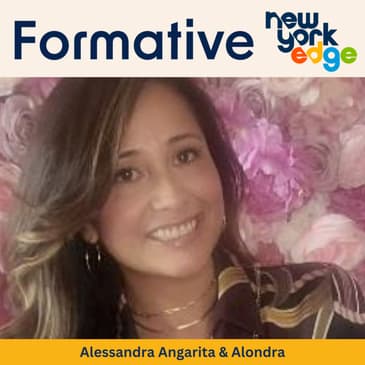
Alessandra Agarita, Director of Volunteerism at United Way of New York City, joins middle schooler Alondra to share how she built a career focused on helping others and making a difference in our communities.
Alondra learns from Alessandra how confidence grows by stepping outside your comfort zone, why saying yes to opportunities matters, and how volunteering can create real impact.
Downloadable transcript here
Rachael: Welcome to a new episode of Formative, the podcast where today's leaders are interviewed by the leaders of tomorrow. Today, we're joined by Alessandra Angarita, Director of Volunteerism at United Way of New York City. She tells us about how she built a career centered on community impact and what it really means to show up for others.
She also shares with us how she found her confidence and about the power of diving in even before you think you're ready.
Rachael: Hello and welcome. My name is Rachael Gazdick, and I'm your host and CEO of New York Edge. On every episode of Formative, a student from our afterschool program joins me as co-host, and today I'm joined by Alondra from M.S. 42Q.
Alondra, can you tell our audience a little bit about yourself?
Alondra: Hi, my name is Alondra, and I am from MSPS 42Q. My favorite subject is math and writing. My favorite colors are purple and gold. I like to go to the pool in the summer because my birthday is in the summer, and my favorite show is Bring It!
Rachael: That's awesome. All right, Alondra, I think we're ready for our interview with our guest.
Alondra: Yeah, let's go.
What got you into volunteering?
Alessandra: So I will say that I got into volunteerism honestly kind of accidentally. So I was in social work for about 10 years when I started. I worked for Administration of Children's Services, and then I worked many years in a foster care agency. And so I've really been a social worker at heart, right?
And so I had my son, I was home for three years, and then I went back out to the community and I said, "You know what? I wanna try something different. I wanna try, like, impact not on an individual level, but, like, on a community level." So I started working for a community center in the Bronx and at United Way, where I am today.
And initially, I was part of United Way to really support these, like, community organizations that I used to work for, like be on the other side. And there's a volunteerism department at my job. And at the time, with the pandemic, a lot of people had to leave and people weren't volunteering. And so because I saw volunteerism at United Way, you know, really kind of like taking a pause and going through so many changes, I really took the initiative to, like, jump in, help the team, and then I blinked, and, uh, here I am two years later leading volunteerism at United Way, and I love it.
Alondra: Okay, thank you. What step did you take after graduating to get to where you are now?
Alessandra: Oh, well, I actually started talking to a lot of people who were already in the nonprofit field. So, you know, chatting everyone up and talking to everyone you know. Um, a friend of mine's parent happened to have a very big position at the Administration for Children's Services.
And so I just started talking and going on interviews, and honestly, I interviewed everywhere where someone gave me a chance.
Alondra: Okay. What is the most important part of volunteering?
Alessandra: Ooh, I would say impact, right? What does volunteering do? I think especially in this amazing big city like New York City, that when you volunteer, whether you are in a food pantry or in a park cleanup, even though you don't see it at that moment, you may not...
You impact so many people in a positive way, and these are your neighbors, your residents. You're able to find out what these communities are doing and what they're struggling with. Definitely that.
Alondra: Okay. What is the most challenging part of your job?
Alessandra: I think, if I could be silly, I almost wanna say time.
I think there's so many... because I have so many amazing relationships with my community partners, and I love to stay connected with them, not only about what they're doing and servicing their communities, but their needs, 'cause that's where we come in and try to solve those needs. I'm surrounded by so many amazing people who wanna do change and want to have New Yorkers be resilient and thrive, that there's not enough time in the day for all of our ideas.
There's not enough funding. I just, you always wanna do more.
Alondra: Mm-hmm. What was the time in your life where you made a mistake?
Alessandra: Ooh. Oh my God, so many. I would say that a mistake I've made in general, here and there, is when I first started working, I was very afraid to take big chances. So for...
I love where I am today, right? At United Way of New York City. It's like my dream job. It was my goal. And a few years ago, I had the opportunity to work at a community center very far from home. It was in Mott Haven. I lived in Brooklyn, in the South Bronx. And because I didn't know anyone, and I was thinking of how to get there and all of these cons, I convinced myself it wasn't a good idea.
Long story short, I said no three times, and United Way was at that center, and I feel that if I would've said yes sooner, I would've been at United Way sooner, if that makes sense. But that's just one example. I remember being in school where teachers would give me the opportunity to speak somewhere or be part of a big presentation, and I would get so scared and I would say no.
And I think those were huge mistakes 'cause I never wanted to be on a stage. I never wanted to be attention. Those are little regrets I have from when I was younger. I wish I was more confident.
Alondra: What made you so successful in life?
Alessandra: Ooh. I think a few things. I think initially, ever since I was young, they teach you that hard work pays off, and it does.
I think being consistent and going that extra mile in everything I do. I always try to meet my goals and deadlines ever since I was younger. But I think as I got older, one of the reasons I'm more successful today than maybe even 10 years ago is I'm more confident.
And so that means I'm not as shy anymore, which means I'm talking to people that maybe 10 years ago would've made me very nervous to be in a room with.
And the power of networking, going up to people, chatting them up, finding out what they do,being curious and meeting people has really gotten me honestly everywhere.
Alondra: Okay. You said that you weren't confident. How did you become confident?
Alessandra: Yeah. I think it's honestly just throwing yourself in it. If you don't go for it, it's not gonna happen, right? You are your worst enemy.
And I will say I all of a sudden got very confident and no longer get nervous speaking in public. I can speak off the fly. And that's because I had a supervisor who, I'll never forget, my first VP.
My first day on the job, it was 10:00 AM, I had only been at the office for an hour, and she put me on a call with seven corporate partners on one of the biggest initiatives they had. And honestly, I thought I was gonna vomit.
But putting me in there and forcing me to have that conversation the first day, then I was like, "This is just what it is, and let's keep going."
Alondra: What advice do you have for someone who wants to start volunteering?
Alessandra: Yeah, I would really say take a look around your community, right? What community centers are there? What resources are in your community?
I think whether you walk into a community center or not, you'll be surprised to know that the resources that leave that community center trickle down in some way or form.
But for people who really wanna impact their own community, really see what's in there and walk in. You will be surprised how much need is out there in every neighborhood.
Alondra: How old were you when you started volunteering?
Alessandra: Um, I remember my first time volunteering was actually in high school. So I went to Brooklyn Tech High School. I was born and raised in Brooklyn, stayed in Brooklyn pretty much my whole life.
And I'll never forget when I was in Brooklyn Tech, at the time they had these three levels of high school diplomas, and I was on track to getting the highest one.
And you were able to get that diploma, but the only thing I was missing was volunteer hours. And now that I'm older, I can't believe it took me, as a high school student, to volunteer for the first time.
But I'm grateful that although at the time it didn't seem great, that requirement opened my eyes to the power of volunteering.
Alondra: Okay, next question. For the first time that you volunteered, what did you volunteer for?
Alessandra: Yeah, it was a few things. At first, I went to a senior center around my house here in Park Slope, and I was helping distribute food and things like that.
I remember there was music, and at the time there was a large Latino population, and it was Spanish music. And I was like, "Wow, it's like a party in here."
I remember thinking that.
And then this may not have felt like volunteering, but they took us bowling. And I think, I don't remember how it was, but as many strikes or something you got, people were donating to a nonprofit, and it all depended on our bowling game. So yeah, that was really fun.
Alondra: How was your personality when you were young?
Alessandra: Oh my gosh. My personality when I was young, I would say that upon meeting, I probably came off very shy. I probably would not be the type of girl that would go up and say, "Hey, my name's Alessandra," where I feel like I'm like that now.
But when people came up to me, I was super friendly.
I would say I took my education seriously,my classes, homework, exams, and passing. But I will admit I was also a bit rebellious. I didn't break too many crazy rules, but I had my moments.
Alondra: When you were younger, what did you think you wanted to be when you grew up?
Alessandra: I really thought I was gonna be an engineer. I actually went to school for engineering for like two years and switched my major.
I was very into building and loved doing things with my hands when I was a little girl. I loved LEGOs, blocks, anything like that. I'm an only child, and I remember anytime my parents bought furniture, I was my father's helper and would put things together.
Then as I got older, I majored in civil engineering, but I just wanted LEGOs for real.
But then I fell in love with sociology and psychology, and then I became a social worker.
When I look back, it's like I had no plan. And I think it's that when I was younger, I enjoyed learning so much. In college, I got exposed to so many different things, and I would fall in love immediately with subjects and conversations. Learning was always satisfying, but it was distracting because I wanted to do a little bit of everything.
Alondra: I wanna be a nail tech. I love doing nails.
Alessandra: Ooh, I love that. I love the creativity there. I see those things on social media. I'm very plain Jane,I always have a French manicure. But when I go online and see those designs, they're works of art and very expensive, and those technicians are very well paid.
Alondra: I started. I have a business now. I started last year, and I do good work.
Alessandra: That's amazing.
Alondra: Okay, last question.
Alessandra: Mm-hmm.
Alondra: Where do you think you would be if you were not volunteering?
Alessandra: If I was not leading volunteerism at United Way of New York City, I think when I look at myself younger and the hobbies I loved, I loved to draw and paint.
And I think I would've taken something completely different, like a creative, artistic path,I would've loved to paint and show things at a gallery. Totally different than what I'm doing now.
Alondra: My sister's in fourth grade and she loves to draw and paint.
Alessandra: Yeah, I honestly used to love it in elementary school, and it was one of the things I was known for.
Like I remember how teachers do bulletin boards in the hallway. The teachers knew I loved to draw and decorate, so they'd call me.
And I'll never forget a girl in my class named Eva. She drew so amazingly. She drew a horse that looked so realistic it looked like it was going to jump off the page.
And anyway, we were like the little painters of our school.
Rachael: Lastly, our final question. If you could go back and speak to your 11-year-old self, what would you say?
Alessandra: I would say, "Do not ever be scared. Don't listen to that fear, that little voice inside your head."
Time passes by so quickly. Just being in the spotlight when people want to reach out and talk to you, just say yes. Even socially.
I can't imagine how many people I probably missed out on connecting with because I wasn't talking to anyone.
Rachael: That is absolutely excellent advice for a teen to hear. Thank you so much. This was so great.
Alessandra: Of course. This was so much fun. Thank you.
CREDITS
Thanks for listening to Formative, a production of New York Edge. I’m your host, Rachael Gazdick. Our production partner for this series is CitizenRacecar. This episode was produced by Hajar Eldaas, post-production by Alex Brouwer, original music by Garrett Tiedemann. Thanks to the whole team at New York Edge for making this series possible. Never miss an episode by subscribing to the series at newyorkedge.org/formative or wherever you get your podcasts.