
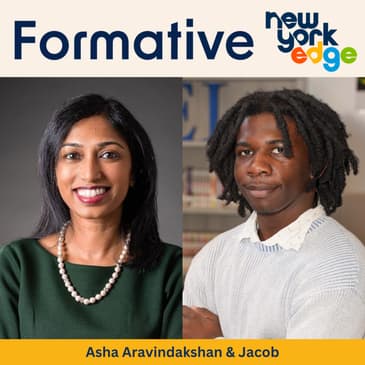

Author Asha Aravindakshan joins Jacob for a conversation about discovering what you’re good at, and knowing how to show it. We talk about the power of transferable skills, how to overcome imposter syndrome, and why being a student can be a superpower. Whether you're just starting out or already chasing your goals, this episode is packed with insight on how to step into your strengths.
Downloadable transcript here
Rachael: Welcome back to Formative. On the show with us today we have Asha Aravindakshan. Asha is the author of the book Skills: The Common Denominator. We spoke to Asha about identifying our transferable skills and showcasing them to reach our goals. We also talked to her about imposter syndrome and the perks of being a student.
Rachael: Hello and welcome. I'm Rachael Gazdick, CEO of New York Edge. And my co-host today is Jacob from the Community School for Social Justice. Jacob, tell us a little bit about yourself.
Jacob: Hi, my name is Jacob. I aspire to be a musician and a singer, and I would like to be a human rights activist through my music in some way or shape or form. I basically wanna be the next Kendrick Lamar or Beyonce, I guess.
Rachael: Very nice. Today we're talking to Asha Aravindakshan. Asha, welcome to Formative. How are you?
Asha: Good. How are you both doing?
Jacob: I'm doing good.
Rachael: Fabulous. Jacob, what's your first question for Asha?
Jacob: All right, so can you tell me a little bit about what your career entails?
Asha: Thanks, Jacob. I have a couple of different ways that I help people. And so one of them is yes, I do help with startups and I advise founders of those companies on their business model, on their potential customers and partnerships. I am also an author.
Jacob: Yeah.
Asha: And I'm an author of a bestselling book. It's called Skills: The Common Denominator. And with the book, I get to speak to a variety of audiences ranging from middle schoolers to retirees about how they can use transferable skills to find career success. Sometimes I speak to them in a classroom setting or sometimes one-to-one.
Jacob: What inspired you to write your book?
Asha: I made a presentation about how to use LinkedIn for personal branding and job searching. And every time I gave this presentation, which I was doing about one to two times a year at this point, people loved it. They're like, this is so easy for me to understand. I don't really understand LinkedIn, and you made it really simple. I'm gonna follow the steps that you wrote in your presentation. You know, please share that with me. And so I was like, wow, like it's so heartwarming to see how many people really enjoyed this presentation. And they said they're gonna do the work to update their profiles, that I feel like if I could turn this content into a book, I could help a lot more people.
And so when the pandemic hit in 2020, that gave me a really strong reason to finally put pen to paper. So at the start of COVID 19, 19% of Americans lost their jobs due to companies restructuring or closing completely. And I knew that's the moment that I, like, really wanted to help. And I wanted to share the stories of real people like me who had made dramatic career pivots because I knew the people that had lost their jobs would have to make dramatic career pivots also. And so I talked to people from all over the world, all different walks of life, and I collected the stories of 25 people and that's what went into the book. And I highlighted in each of their stories three transferable skills.
Jacob: And when you say transferable skills, you mean like, oh, like how to be a writer, how to take your speech skills, how to… Like what exactly do those skills entail?
Asha: Yeah. I can give an example, you mentioned you are studying music. So I know people that study music are very disciplined. Because you probably have a music class every day, or you probably practice your instrument or your writing skills and writing a song on a near daily basis. And you become very disciplined when that happens. And so that discipline skill is something that you can take into this other career that you wanna have in being an activist. Because that also requires discipline, right? As far as the outreach that you're doing to the community, potentially government relations, um, to corporations in the area, depending on who the ecosystem is of the issue that you're fighting. And so that's a really good transferable skill between your interest areas.
For example, one of my transferable skills is focus. I'm very focused when it comes to a project, whether it's at work or if I'm doing volunteer community or even preparing for today's podcast. And so for me, I take that skill of focus and I use it in all these different ways in my life and it helps me. Like people know like, oh, if you give Asha something to do, she'll get it done because she's really focused.
Jacob: So going back to what you said about transferring skills from one thing to another, could you give a general summary of how I would go about transferring my focus, my discipline, and so on, so on, onto another thing? 'Cause isn't the reason why you develop that focus, that discipline, is 'cause you develop the habit of doing it within that category.
Asha: That's right.
Jacob: The thing that you do.
Asha: So at first is identifying it, right? And I think even taking a step back is what you're saying is we compartmentalize the skills based on what we're doing. What I do at work may be different than what I do on the weekends in my volunteer activity. I show up differently. Even say we show up one way at school, one way with our families. And so it's like looking at that and saying, what are the skills that I thrive in and that you can identify. Some, you can identify yourself. For some people, it's really hard actually to identify their skills. And so I recommend asking the people around you, what skills do I exhibit? What do you see? And so I know when I ask my friends and my family when they think of me, what, you know, what skills they see, the first one they all say is organized. And that was like everyone, like the first thing they say. And so one reason I wrote the book is that people can help themselves identify their skills. So I have 42 skills in the book. And so as you're reading the stories, like if you read my story and you read that I have the skill of focus, you are like, you know what, actually I'm like, Asha, I have the skill of focus. Or you may read the story about Lauren, the lawyer who has the skill of discipline, and be like actually I'm more like Lauren with how I'm more disciplined with my work, right?
And so I want you to put yourself in the stories of the characters and then make that skill list and the skill list, it could be 1, 2, 3, it could be all 40 skills. After I wrote the book and I looked at how many skills I had of the 42, I had 30 of them. But I expressed them at different times in different places, right? And so, just that awareness helps us understand that, oh, I can use this skill in different places. And so I always give the example, you know, a lot of people, they sometimes get really stressed about like, why haven't I become a manager yet? And I'm like, maybe you haven't displayed your leadership skills at work, but maybe you've displayed them outside of work. And you can share those examples with your manager, right? And I see you smiling here and so that probably makes sense, like maybe you have more, you know, and I think about my time in school at your age, you know, I was president of the Foreign Language Society and editor of the yearbook, and so I had these like leadership skills that I was building right through my extracurricular activities. But maybe when it came to like classroom activities, I didn't always raise my hand. Because I was a shy student. But if I think about, I'm okay making a decision, you know, on where, what, where the picture and the text is gonna go out on the yearbook page, but I, I'm not ready to raise my hand over here, I could think about what makes me comfortable in one situation with another. It could be that I have a really good relationship with the faculty director who I'm working with in the afterschool activity, but maybe not as well as a relationship with the teacher who's teaching the course where I don't raise my hand. And so what can I do to fix that? Maybe I can go to office hours and get to know that teacher better, right? So I feel more comfortable raising my hand. I'm making it sound really easy. It's really hard.
Jacob: Mm-hmm.
Asha: Um, but it's doable. And that's the thing that everybody needs to realize.
Jacob: I honestly might have to actually read the book myself 'cause it might actually be really helpful for me right now.
And the reason why I was smiling is 'cause as you was saying that, I kept…It, it basically is leading me onto this next question.
Asha: Okay.
Jacob: Do you think the reason why people aren't able to identify their skills is because of imposter syndrome? That they actually think that they don't have those skills?
Asha: Oh, interesting. I think it's interesting the way you phrased it 'cause I, I was, you know, the, what I would've said if you hadn't used the phrase imposter syndrome, is it's just really hard to recognize the skills within ourself.
Jacob: Yeah.
Asha: And that's why I said take that moment to ask other people around you, because they'll be able to tell you two, three skills off the top of their head. And so that's why it's almost easier to have the conversations first and then like use like the, you know, I wrote the book with the stories. I wrote them with stories because that's also easier for you to identify like, oh, I'm like Wassim, or I'm like Justin, right? I can see myself in the stories that Asha wrote and I can start to make a list.
And so I think there's so many different ways, and people, like, learn differently also, right? So to provide different opportunities for people to learn about their skills and how they're expressing them, and then where they can focus on, which ones are their strengths, is why I like put the stories together and encourage people to do this.
Jacob: Yeah. Um, so me as of right now. Right now I'm dealing with imposter syndrome where, oh, I'm not used to people actually complimenting me and my skills. I'm used to people like shutting me down immediately. And so me, as a result of that, I've always been like someone who just always took a step back and just never thought that I was capable of being on a pedestal. And I realized that was because of imposter syndrome. So could you tell me how exactly is it that you deal with imposter syndrome. And if you have, like, how do you overcome that?
Asha: Yeah, I'm… One, I'm sorry that's happened to you. That sounds terrible. Especially at such a young age to have experienced that.
Jacob: Yes.
Asha: So I hope that I can give you some guidance here. One is, uh, I feel when I come into a situation, I bring my credibility. And that may be from my previous work experience or I'm very involved in my different communities I'm in, where I went to school, very connected with people there, or the referral of someone that's putting me, uh, into a conversation. So I try to lean on that. When I'm communicating something that's really tough, I pull back from these other experiences. And so people can see that, oh, she's speaking from a place of like, she's done this before or she's seen it before and that gives them some reassurance that I am giving, you know, valid advice. I know when you're younger it's harder 'cause you have less reference points, right.
Jacob: Absolutely.
Asha: And that's where looking at your like holistic picture of pulling from school or extracurriculars or the community or time with your family, right, can help you build that credibility.
And it's also, you know, a lot of people have told me, like even former managers, they see that I trust my gut in situations. And when I advise them, they like trust that I'm trusting my gut and my gut is leading me in the right way. And so that's something also that if you know, depending on whether you're pulling from something that's like coming from fact and data or like leaning on your gut to make a decision, just like having that confidence to do that will show people they can trust you.
Jacob: So when you say rely on your gut, is it literally when you feel in your stomach that if you don't do this and that, then you're gonna fail? Or is it like more, like, intuition where your mind knows what's gonna happen?
Asha: It's both right? And I think a little bit of that, like maybe, you know, trends or patterns up here in your mind, but your stomach is also telling you like, oh, that doesn't seem like the right decision right now, right? Or, you know, maybe we can wait, or, yes, we should do this. And I think it, it's the combination of all those things. And it's sometimes when you are missing data.
Jacob: Yeah.
Asha: And missing information that you, and you have to make a decision that your gut may fill in that void of this is the direction you need to go in. And I guess I've been like, knock on wood, lucky that my gut has led me in right places. And I've had managers who've trusted me to make gut decisions, and they followed them.
Rachael: When you were in high school and middle school, did you have a strong sense of what you wanted to be when you grew up?
Asha: So when I was in middle school, I went to a very special middle school in New York City, specifically in Brooklyn. It was called the Mark Twain School for the Talented and Gifted, and Mark Twain was different from all the other schools because each of us as students, we had a talent or a major in any interest area. So we had like athletics, dance, singing, math. And my major was creative writing. And every day we had a class period dedicated to our talent. And so in the creative writing talent, we learned different writing styles. Then our teacher would give us feedback on what we were good or not good at, things like that, different class projects. We even got to all work on the student newspaper. We did like a poetry book one year. I worked on the yearbook, starting in middle school, things like that. So I had been developing this talent for a long time.
But it wasn't until high school that I started taking business classes and it really clicked for me like I wanted to do business. I took like a accounting class and a business law class, and I was more interested in those topics than I was in all my other classes. And I was like, okay, this means I should go study business when I go to college. And that helped me decide that I was gonna major in finance and pursue a business career. And that's what I've done, I've worked in business since then. I haven't used the finance part of my degree, but I've used all the other elements of it. And I've been focusing specifically on business operations, that's where I'm the most successful. And then five years ago, I had the opportunity to spend the time to write the book, and that really pulled from my interest that I developed while I was in middle school.
Jacob: Can you tell me about your parents' expectations versus your own expectations for what you was gonna do? Did your parents want you to do something completely different from what you wanted, I guess.
Asha: So I think early on, my parents were very much interested in me being a doctor, which I did not have any interest in doing. And I think by the time I took the accounting class, which would've been 10th or 11th grade, then I started to be able to articulate what I wanted to do versus what I didn't want to do.
And my dad, uh, he's in business. He had been an accountant, so he understood that, and so it just made things easier when I was applying to college and I was focusing on business school specifically for that reason, that I would do the business degree and study finance.
Rachael: Is there anything that surprised you about finance when you entered the career?
Asha: Absolutely. So I graduated during a recession. And so I initially thought when I studied finance that I would like go to Wall Street and be an investment banker 'cause that's what you saw on tv. But when I graduated, there weren't interviews. These companies weren't hiring, and so I had to pivot. And the pivot I made was to accept a job offer in the nonprofit that I was working in, which was a membership association for entrepreneurs. I had already been working there for a few years. I really enjoyed it. I knew what needed to be done for the next year or so, and so I said, yeah, this is a great idea. I'll stay here. And so it was a complete change from what I had imagined I was going to do, you know, four years prior when I entered college to what actually happened when I graduated.
And then after that role pivoting into the private sector and I pivoted into the public sector. I had a lot of different experiences, but I started to realize like this idea of transferable skills helped me succeed in every single one of these pivots, which is why I'm like a huge proponent of it.
Rachael: You know, lastly, this is a question we ask everybody on the show. If you could go back and speak to yourself in your senior year of high school, what would you tell yourself knowing what you know now?
Asha: If I could go back to Asha in her senior year of high school, I would tell her to stay fearless. I think, you know, especially as a young adult, you have more excitement to trying new things than as you start to get older. And so to stay with that, like that fearless energy, I think is really important as you grow up because it's hard to relearn as a skill later.
Jacob: Yeah. I'm a, I'm gonna take that to heart, the fearless synergy thing cause when it comes to interacting with people, I'm sort of a scaredy cat 'cause like I'm in my head thinking, oh this person, I should avoid them.
Asha: I think, Jacob, you have the most four powerful words in your vocabulary right now. I am a student. You start any interaction with, I am a student and somebody will want to help you. And I say that after learning that when I was in graduate school. And that was not that long ago, it was eight years ago. And starting out, we would outreach to different companies, different business people, different executives for conversations about our student projects or you know, our startup activities. And we would start the email with, I am a student and I'd like your help, you know, dot dot dot. And I'm telling you, I got a hundred percent of those messages responded to. And so take advantage of that while you're still a student.
Rachael: Wow, that's such good advice. We really thank you for sharing with us today and thanks for being on the show.
Asha: Yeah, absolutely. Thank you for the opportunity.
CREDITS
Thanks for listening to Formative, a production of New York Edge. I’m your host, Rachael Gazdick. Our production partner for this series is CitizenRacecar. This episode was produced by Hajar Eldaas, post-production by Alex Brouwer, original music by Garrett Tiedemann. Thanks to the whole team at New York Edge for making this series possible. Never miss an episode by subscribing to the series at newyorkedge.org/formative or wherever you get your podcasts.