
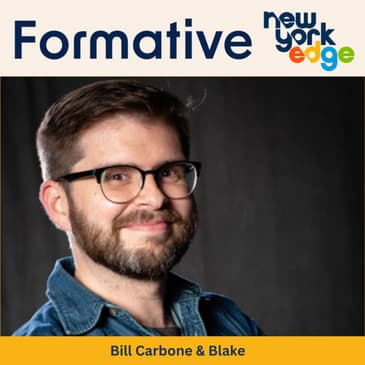
On this episode of Formative, Bill Carbone and middle schooler, Blake, talk about how we have to protect our greatest joys from becoming chores. Bill is the Executive Director at Teachrock and he’s loved music his entire life. He shares with us the importance of remaining flexible in your career and how walking through the open doors can lead to beautiful unexpected experiences.
Downloadable transcript here
Rachael: Welcome to another episode of Formative, the show where today's leaders are interviewed by the leaders of tomorrow.
On Formative today, we interview Bill Carbone. Bill is a musician and the Executive Director of TeachRock. We talked to Bill about the importance of remaining open to opportunities and pivoting within your life and career. He also shares with us his love of jazz and the experience of being in two bands. We are very excited for this conversation with Bill.
Rachael: Hello and welcome. I'm Rachael Gazdick, CEO of New York Edge and my co-host today is Blake from M.S. 61K. Blake, can you tell me a little bit about yourself?
Blake: Hi, my name is Blake. I'm 11 years old. My mother's from America. My father's from Guyana. Some of my favorite hobbies are playing basketball and playing video games. And today I'm here with Bill Carbone.
Rachael: Very cool. Okay, let's welcome Bill on the show.
Bill: It is my pleasure.
Rachael: Take it away, Blake. What's your first question for Bill?
Blake: So, Bill, can you tell me about what TeachRock does?
Bill: Sure, TeachRock creates curriculum for schools that uses music to teach every subject area. So we see music as an exciting gateway into any kind of learning you can think of. So if we're talking about history class, we can think of music as a primary source, right? What does the place and time that a song comes from tell us about American history in that moment? And how can starting a history class with Beyonce be more exciting than starting a history class by saying, ‘today, we're going to talk about an act of Congress.’
And the same for math. Like, one of my favorite examples for middle school math is a lesson plan that introduces the concept of ratios by comparing record sales of, uh, Rihanna and Beyonce, I think. And then you have a chance to find your own favorite artist's record sales and start to compare them. But really, it's a math lesson, right? It's about doing that. And so the idea is that there's always a fun way to do the things we need to do that makes them feel like it's our life and not somebody else's thing that they're telling us to do. I think that's at the core of who TeachRock is.
Blake: What does a day as a director for teachrock.org look like?
Bill: Well, Blake, let's see. Usually I wake up, uh, I'm going to give you more than just the executive director side. So I like to wake up, um, I don't like to wake up early, but I wake up early because I have to, and try to get a little exercise in the morning because I know that a lot of the day is going to be spent usually at my computer. A lot of it is on zoom. There's usually about 14,000 emails that go back and forth. But I would say the, the real thing that I do all day is make connections between people. So I work with our staff connecting with schools, trying to come up with the coolest curriculum ideas and the most useful curriculum ideas. But I'm also in charge of connecting us to the outside world. So, um, for instance, we work a lot with New York Edge. And I'm the one who talks to New York Edge about, the first conversations about how we might work together in the next year. That's actually my favorite part of it, is talking and meeting people and making just kind of friendships, professional friendships and connections that lead to doing really cool work, but fun work together.
Blake: That's great. Okay. So, did you have a different dream when you were younger or did you always aspire to be a director?
Bill: I didn't even know there was such a thing as an executive director, Blake. Um, my dreams, I think my first career aspiration was definitely to play for the New York Yankees, but I'm a five foot seven on a good day. And, uh, it didn't take me long to figure out that probably…also I couldn't even hit a fastball in seventh grade. So forget about, you know, later, but I still, you know, it was my first dream. So now I just like watching the Yankees.
But music came soon after. And as far as I was concerned, I was just going to be a rock star. That was definitely what I was going to do. But I just also think the favor that I did myself along the way was be curious.
Blake: Mm-hmm .
Bill: And open myself to lots of possibilities and to lots of different mentors. So somewhere along the way, uh, when I was in high school, I read a book that my favorite drummer at the time, who's a Mickey Hart from the band, the Grateful Dead, had written this book called Drumming at the Edge of Magic, and it was all about the cultures of drumming all over the world, and about how drumming can be spiritual, and it just opened me to all these other kinds of thoughts around what it could be to play music other than just to be at a big concert that people buy your tickets.
But the big thing that it introduced me to was this word ethnomusicology, which is a, um, it's a graduate degree, basically. It's a type of study. And what it means is the study of music as culture. So every music is connected to culture and what does that mean? And that's really the basic question. And it could be, you know, um, you could go to Indonesia and ask questions and learn music or you could just do it right at home and ask your parents questions and it's all ethnomusicology. And I just really got fascinated by that and fell in love with the idea of what music means to people. And so, um, ultimately I spent a lot of time in Jamaica and I was really interested in interviewing the earliest reggae musicians that were still alive about what they were doing before they were playing reggae and so how they ended up playing reggae because reggae music just suddenly starts as Ska in the early 1960s, right? But nothing comes from nowhere. It has to come from someplace. So my kind of question was I want to know, what were you doing before you played in this Ska group? And that just led me to this kind of work.
But even when I got hired here, I was a curriculum writer and I was doing research and writing lessons. But again, I just stayed really curious and interested in the various things that we do as an organization. And it just led to me ultimately becoming a bunch of different things, but ultimately the executive director. I think that the main thing was, um, not to get stuck on, not to just give up a dream, but not to get stuck on what you thought it was at first.
Blake: According to my research, I've seen that you play the drums. Have you played any other instruments besides the drums?
Bill: Yeah, I totally have. When I was a kid, I played everything. I just tried every instrument. And well, we, we didn't have the internet yet. So I had to take lessons or just kind of watch music videos. But also the, I didn't have as many distractions. I think one of the things your generation has to manage is there's a lot of competing things for your time. So, but I, I started on drums, but I also play guitar. Um, I'm a pretty bad piano player. I like to sing, but I'm happy to have all of those things in my life and it's really fun right now. My daughter who is 12 is taking guitar lessons. So I learn all her songs with her. So I'm taking guitar lessons again now and learning all these different songs and it's really fun. Do you play any instruments?
Blake: I tried to play piano once. I wouldn't say I was horrible at it, but I felt like when I started playing it, I started to get good.
But then, I don't know, I just kind of lost interest in it. Because I felt like I wasn't really starting to pick up on anything.
Bill: What kind of music were you learning?
Blake: Uh, I was learning jazz.
Bill: Oh, did you like jazz?
Blake: Yeah, I like jazz. Jazz is one of my favorite music genres so…
Bill: So, um, where do you hear jazz in your life?
Blake: I would say maybe at my grandma's house because she has a lot of old jazz records.
Bill: I think I'd get along with your grandma. We can hang out. I love jazz. I love all kinds of music, but I really love jazz. And, um, I think in New York, I really think it's the world center of jazz music. You know, most certainly plenty of places have produced great jazz musicians, but at one point, everyone who wanted to play jazz moved to New York city. It wasn't that long ago. And it's just kind of, I feel like it's, it's baked into the streets.
Blake: I definitely understand that. So are you in a band currently? And if so, what is the name of that band?
Bill: Yeah. Uh, I'm in two bands right now that work with some regularity. One of the bands is called Max Creek. And believe it or not, they were formed before I was born. They've been around 50 years, and it's so much fun. That band, they have 50 years worth of songs that they've written and learned. I mean, there's probably 300 songs in the rotation and we usually play one weekend a month, but lots of people come. Um, there's kind of a community around the band of people that will travel all over, wherever we play a certain number of the same people will always be there and they've been around so long that there's multi generational communities of people that come. Uh, there's even some families that are grandparents, kids, and grandkids will all come to the show at the same time. And it's, it's what people call now a jam band. They are older than that term. But what it means is that we play songs, but we improvise a lot and it's not like all planned out ahead of time. We let the, let things happen. And it's an incredibly fun band to be a part of and the people, especially the guitar player who I've gotten really close to is a mentor, somebody that has much more experience than me that I've learned a lot from, which is really one of my favorite things about music is, throughout my life I've gotten to partner, play for and with older musicians. And I think there's this beautiful mentorship thing built into music where if you're willing, you can play with an older musician who can teach you a lot, you know, and it's not the same as going to your piano lesson every week. It's, it's on the job learning and different people have it different ways.
So I used to play, um, with this guy from, actually from Mount Vernon in New York city, Melvin Sparks, and, um, he would just turn around on stage and say, don't do that. You know, like he was, he would give it to you a little bit, but with love. And you just learned so much from him and he had done so much. So it’s incredible. Fine, tell me what not to do. You know, you've been doing it for so long. And like, there's not, you know, sports teams, you have coaches. And music, you kind of have to go find your people and just be with them. That's one of the things I love.
Blake: So you said you were in two bands. So what about the second band?
Bill: The other band is called The Z3 and it's organ, hammond organ, guitar, and drums. I'm the drummer. We all sing. And we have a really weird concept, which is that we take all the music of this one person, Frank Zappa, who was a guitarist and composer and kind of American rock icon from the mid 1960s until the mid 1990s when he passed away. Um, but he always had large ensembles and he wrote really wild, crazy music with orchestration, but we just take it to the three of us and do it our own way. And we started the group for fun. There's no reason to believe anybody needs that group to exist. It doesn't, it doesn't really serve a purpose, but it turns out that people love it. And so we play, we just played the Iridium, which is on 51st and Broadway. And we played the Bitter End down in the village in New York city. Tomorrow night we're playing in New Haven, Connecticut. So we get around New England and New York and just, we probably play once or twice a month at most, but we have a really good time.
Blake: That's really cool. So two bands. It's very ironic, like I’m asking you about your bands and you actually have like, like something tomorrow with The Z3.
Bill: If we were live, you could promote it for me, but like, like live radio, make sure you get out to see Bill tomorrow night with The Z3. Yeah.
Blake: Have you been a part of any popular bands?
Bill: Yeah, sure. Um, I think, how would you define popular, Blake?
Blake: I would say, like, bands that are well known around more than five states.
Bill: More than five states. Well, I guess, um, well you mentioned you like sports, right?
Blake: Yes.
Bill: So, uh, before you're in the major leagues in baseball, what are you in?
Blake: College.
Bill: College. But then there's the minor leagues, right? So there's a lot of really good baseball players that never get past the minor leagues and are professional. I think I'm a minor leaguer, I would say. So I've been in, I still play a lot of shows and draw hundreds of people to them. But I've never been nationally famous. You know, um, I've toured and played all over the country and actually outside of the country a lot too, and done some really incredible things. But ultimately I think, you know, I never played for the Yankees. I played for the Yankees affiliate in a small town someplace.
Blake: Still cool. You get to do what you love.
Bill: I totally agree. So do you think you'll be playing, um, well, do you play sports too?
Blake: Yes. I play basketball.
Bill: Right. Do you think you'll just stop playing basketball when you get a job?
Blake: I wouldn't say I would stop playing, but I don't think I'll be as, I think I'll have the same amount of interest that I do now as a kid.
Bill: I see that, you know, that's how I feel about music. There was a period in my life where I pursued it full time. And, uh, well, an interesting thing happened, right? So I love music so much and it's all I ever wanted to do. But then as I got older and all of a sudden I actually needed to support myself by making money from playing music. So then I started finding myself, um, playing music that I didn't really want to play very much just because I was getting paid for it. And the ratio of music I wanted to play versus music I was playing just to get paid started to get to almost around 50-50. And I thought, that's not really what I signed up for. You know, like I, I love the joy of music. So, why don't I figure out how to keep music in my life, but not have to kind of grind? And, and a great thing has happened. I still play probably four or five gigs a month and they're just so joyous, like in the same way that getting to play a pickup game of basketball can be with some friends, you know.
Blake: So that's, that's really cool.
Blake: What was it like for you in middle school at my age?
Bill: See, I was at Brown middle school in Madison, Connecticut. I can only see it through my eyes. I can still picture it. I can still picture what the school looks like. And it was a funky school that was designed, uh, at the time in an experimental concept of open classrooms about 20 years before I was there, which by the time I got there, people had decided, yeah, that was a bad idea. Like a lot of the classrooms didn't have walls. And they've now torn the school down and they have a different one, but it wasn't like a bad place. It was just really weird. There was a lot of classrooms that were on the inside of the building and had no windows.
But what I remember is I was very into music. When I was in middle school, I was into heavy metal. I definitely had a haircut that I can't believe is back in style, which is short in the front and long in the back, but everybody has it now and they're shaving the sides.
Blake: It's like a mullet?
Bill: Yeah, we called it a mullet and definitely had one of those. Have you ever seen Beavis and Butthead?
Blake: Yes, I have.
Bill: I feel like I was a little bit like Beavis and Butthead, like I liked heavy metal. I always had the shirt on and I don't know, I like to think I had a little more aspirations than Beavis and Butthead, but I have fond memories. One of my favorite memories is my art teacher let me, for a major project, do a painting of my favorite drummer at the time. That really jumps out and one of my least good memories is social studies. I just felt like it was all about memorizing things, the years that things happened and I just couldn't. I couldn't do it. I don't know. I just, I, I, I remember struggling with that a lot, which inspires me to make cool social studies curriculum now, but yeah, so I was a work in progress.
And I was always a kid that they said he's really smart and if he tried a little harder, he'd do great, especially in middle school. How do you feel about middle school, Blake?
Blake: It’s definitely a new experience, especially from elementary school, because, you know, you're starting to get more responsible. But it's not like how I expected it to be in the movies. It's actually kind of better.
Bill: What were your expectations based on what you saw in movies?
Blake: Um, I thought we were going to get to pick our own classes, but we just have a schedule that we go to. Luckily, some of my friends from my elementary school are here, so it's not like I'm stepping into a completely new environment. At least I have, like, some people with me.
Bill: That's pretty cool. Is there a time ever when you guys have a class that you just get to talk about yourselves? Or what it feels like.
Blake: Yeah. So you have, we do have an SEL class. So, where we just learn to make better decisions and we actually have a time capsule for the next history class coming in this year. So, it's just some advice I would give to the younger kids on what to do, what not to do, how to improve.
Bill: Do you like that class? Do you like spending that time thinking about those things?
Blake: Definitely, because it's like relaxing, but it's definitely, it definitely just gives you time to reflect on what you've done the past school year, so…
Bill: Excellent.
Blake: So my final question is, if you could say one thing to your 13 year old self, what would it be?
Bill: Mmm, I love that question. Chill out a little bit. Like, it's going to be okay. And you're going to get worked up sometimes and feel like the thing that you really wanted didn't happen but there's usually something good that happens because of that, right?
And I would also say, I wish I could tell my young self to be a little bit more confident. And I think they're tied together. But, um, less concerned with other people's thoughts about what I'm doing, you know, um, you're really seen by so many people when you're 13 and all the way through your school, right? Like you live in this group. And so the group opinion is, feels really weighty and important. But in the end, I think you follow what's important to you. And if you have a good conscience and you make like moral decisions, you should feel confident about it, right? And follow your heart through those things instead of hedging your bets based on what you think someone might say about what you're going to do. Whether it's a decision you make about clothes or a decision you make about what friend group you're in or what music you like or what you do on Friday night. It's okay. Like somebody's going to make fun of it. Somebody else is going to think it's great, but in the end, don't let the person who's going to make fun of it. Stop you from doing it. That's what I would say to my 13 year old self.
Blake: Okay, so I'll definitely take that into consideration. I think confidence is key. And when you're confident in yourself, and you carry yourself like you are, I feel like it honestly just pays off. Because other people will see that and it'll just get you more opportunities and more doors open.
Bill: Do you feel pressured by the group around you ever to make certain decisions?
Blake: I wouldn't say I'm pressured but when I do think back about the decisions I make, sometimes they're really good, sometimes they're really bad. So I just have to, before I even respond to what they say, I've, I have to think to myself, what would be the consequences if I did go through with this?
Bill: Hmm. I love the process that you just said, you know, and sometimes it's easier said than done for sure. But I think it's a good process. It's a good approach.
Blake: Definitely. So thank you for being on. This is actually an honor to meet you. So thank you so much.
Bill: Thank you, Blake. It's an honor to be on your podcast. I love New York Edge. I love Formative. I love what you guys are doing. So I'm honored to be invited.
Rachael: This was a pleasure and thank you so much.
Blake: Thank you so much also.
CREDITS
Thanks for listening to Formative, a production of New York Edge. I’m your host, Rachael Gazdick. Our production partner for this series is CitizenRacecar. This episode was produced by Hager Eldaas, post-production by Alex Brouwer, production management by Gabriela Montequin, original music by Garrett Tiedemann. Thanks to the whole team at New York Edge for making this series possible. Never miss an episode by subscribing to the series at newyorkedge.org/formative or wherever you get your podcasts.