
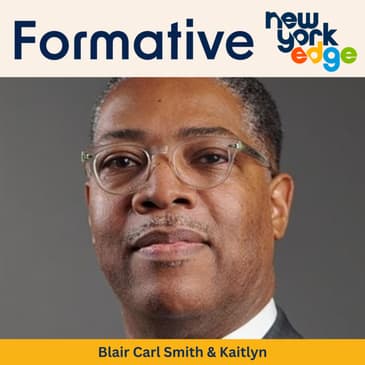

Blair Carl Smith, Senior Director of the Center for Financial Markets at the Milken Institute, joins middle schooler Kaitlyn to talk about career challenges, accomplishments, and what drives his work. Blair also talks about how he sets goals, works hard to make them happen, and proves anyone who doubted him wrong. Kaitlyn learns from Blair how perseverance, purpose, and believing in yourself can help you tackle any challenge.
Downloadable transcript here
Rachael: Welcome back to Formative, the podcast where today’s leaders are interviewed by the leaders of tomorrow. Today’s guest is Blair Carl Smith, senior director of the Center for Financial Markets at the Milken Institute. Blair tells us about his proudest accomplishment, the challenges he’s faced in his career, and what continues to drive his work and purpose.
Hello and welcome. My name is Rachael Gazdick, and I’m your host and CEO of New York Edge. On every episode of Formative, a student from our afterschool program joins me as co-host. Today we’ve got Kaitlyn from IS 109Q. Hey, Kaitlyn, can you tell our audience a little bit about yourself? Two.
Kaitlyn: Interesting facts about myself is that I’m 11 years old, and one of the extracurricular activities I do, I like to do is step, and my team’s name is Beacons Far.
Rachael: Wow, that’s really cool. Okay. Before we go talk to Blair, we want to remind our listeners that you can support us by making a donation at newyorkedge.org/donate. It would be very much appreciated. All right, Kaitlyn, I think we’re ready to go talk to Blair.
[END OF INTRO]
Rachael: Blair, welcome to Formative.
Blair: Thank you.
Rachael: Kaitlyn, what’s your first question?
Kaitlyn: Um, what’s your favorite part about what you do?
Blair: I am a, uh, policy policymaker, so my job is to develop ideas for what policies should be for businesses and governments and other institutions. I love thinking of ideas that might help people. That’s my favorite part.
Kaitlyn: Um, what drew you into that field?
Blair: Oh, the opportunity to use finance as a tool to help people. Finance is a force for good, is what brought me into the business. I was in my late twenties and my life was all about music and, uh, I was running a job training program for homeless persons.
At the time that I was approached about working in finance, I met a whole bunch of friends and they were in finance. And they asked me, they said, “Blair, what do you want to do with your life?” And I said, “I’m not sure.” And they said, “Do you want to design cereal boxes?” I said, “No.” And they said, “Do you want to use finance as a means to help people?” And I said, “Yeah. I’d love to do that.”
They said, “Do you get tired of seeing artists and athletes get taken advantage of financially?” I said, “Yes.” They said, “Well, you know what, Blair, you have the type of personality that might help people.” And I said, “Yeah, I like helping people.” They said, “So why don’t you learn finance and learn how to help people avoid the problems that a lot of folks that are artists and entertainers get, a lot of the problems that they have with some of their financial woes?”
And so that’s how I got into doing what I was doing. That’s how I got into finance.
Kaitlyn: Have you ever made a mistake at work? If so, how did you get out of it?
Blair: Yes, I have made several mistakes at work. The way that I got out of it was by being honest and saying, “Hey, I made a mistake,” and coming up with a solution for correcting it.
Kaitlyn: What advice would you give to someone in your field?
Blair: Hmm. The advice I would give is, uh, to focus. I would tell them to learn all of the learnable and the programs that they have out there that will enable you to learn. Take advantage of those, because I did not take advantage of them when I was young.
Rachael: What’s something you’ve learned as you’ve gotten older in life and in your career that surprised you?
Blair: I think what I learned is that when you get older, you have to be prepared for all the things that life will throw at you, and that being young, the experiences that you have will not prepare you for what experiences you might have when you’re older.
Rachael: So what are some of the challenges that life threw at you, and how did you overcome them?
Blair: I’ve met with several challenges. The way that I overcame them was with attitude and just being optimistic. I was, uh, crazy enough to believe that I could do anything when I was younger.
So when I was 11 and, uh, I faced a challenge, I was surrounded by people that said, “Glenn, whatever challenge you face, you can overcome it.” And I believe that I took that very seriously.
And they were surprised that I took the advice seriously because they used to give that advice to people all the time, because it sounds like it’s something you should tell somebody. But I took it to heart. I really believed that I could change things, that I could do things.
And I was always optimistic about the outcome. Always believed that I’d be able to do whatever I said I would do.
So one specific challenge was the first time that I had to fire somebody. And I wrote about it and I memorialized that person, and I explained in the write-up that I was sad I had to do it and I thought it was unjustified.
It was my first leadership position. It was the first test. They said, “All right, Blair, we’re going to put you in charge, but we want you to fire somebody.” And I was like, “I don’t want to do that.” But that’s the test of being a leader.
So I did it, and then I went to that person and I realized that the reasons they wanted me to do it was because they didn’t have the guts to do it themselves.
So I wrote about it and I used it in an application to graduate school. So a lot of people saw it, and that helped me. It didn’t help the person that got fired, but it immortalized their story, and they appreciated that I did that. I did tell them about it. I went back to that person and I told them about what had happened.
Rachael: Wow, that’s incredible. So what helps you stay motivated when times are tough?
Blair: Um, history. And believe it or not, you can look back at history and find times when things are not great, and then after that times get a lot better. What goes down eventually comes up, always, just like water in a swimming pool or a beach, or if you sink something, it always rises to the top. That’s the same as life.
Kaitlyn: Okay. That’s nice. What’s a personal achievement you’re really proud of?
Blair: So, my favorite accomplishment is creating the HBC initiative and fellowship program for the Milken Institute. That’s my favorite thing that I’ve done. And one of the reasons I did that is because I went to an HBCU, and I thought that was important to create something that would support all the folks I went to school with and all the folks after me.
Rachael: You’re very established in your career, but is there anything in your life that you still want to learn or achieve?
Blair: Yes, I want to, uh, make sure that everybody understands that finance is a language that’s important to me. Finance is a language just like English and Spanish. That’s all you have to remember.
And once you learn the language, then you know finance. And, uh, teaching is important to me. I want to make sure that the things I’ve learned, that I pass that on. That’s important to me.
Kaitlyn: What were you like when you were my age?
Blair: All I cared about was, uh, Star Wars. I was not as mature as Caitlyn. I did not have vision when I was 11. All I cared about was riding my bike and getting outside and Game Boys.
My buddy had an Atari 2600, and all I could think about was getting over to his house to play it. That’s what I thought about when I was 11.
There’s an 11-year-old. What do you care about the most?
Kaitlyn: Um, what I care about the most is getting good grades and helping my family.
Blair: Good. The most important thing is making sure you help your family, and you achieve that by getting good grades, and you also achieve that by learning goals that’s learnable at your age.
Kaitlyn: Did you know what you wanted to be when you grew up when you were my age?
Blair: No. I had no idea.
Rachael: Caitlyn, do you know what you want to be when you grow up?
Um, I have no idea. Oh, that’s okay. You still have a lot of time to figure that out.
Blair: Yes. And don’t let anyone tell you that you can’t do what you want to do. That’s important, too.
Kaitlyn: Did you have people in your life who doubted you?
Blair: A lot of people taught me that I couldn’t do what I wanted to do. A lot of people in school, they thought I was crazy. They were like, “You want to do what?” And I was like, “This is what I want to do.” And they were like, “There’s no way you’re going to be able to do that.”
But I had that personality where I love to prove people wrong, so that’s why I ended up doing what I do.
Kaitlyn: Okay. Um, what advice would you give to a person my age?
Blair: Let’s see. I would tell someone that is 11 to focus on what you love and take advantage of the time you have in this world to focus on the things that you love.
If you love sports, then to play sports. I’ll take the advice that my dad gave me, which I didn’t listen to. He said, “If you’re going to work in a dentist’s office, be the dentist. If you’re going to join the Air Force, be a pilot. If you’re going to work at a racetrack, be a racer.” That was his advice.
Kaitlyn: Okay. If you could go back to your younger self, what advice would you give yourself?
Blair: Oh, that’s a good one. Well, if I could go back in time in the DeLorean, or I guess you wouldn’t be in a DeLorean now, it’d be something else like a Porsche or Tesla or something like that, if I could go back and tell me anything, I would say invest in these stocks.
Rachael: I love that. Thank you so much for sharing. This has been great.
Blair: It was a pleasure to meet you all, and thank you all very much for having me.
CREDITS
Thanks for listening to Formative, a production of New York Edge. I’m your host, Rachael Gazdick. Our production partner for this series is CitizenRacecar. This episode was produced by Hajar Eldaas, post-production by Alex Brouwer, original music by Garrett Tiedemann. Thanks to the whole team at New York Edge for making this series possible. Never miss an episode by subscribing to the series at newyorkedge.org/formative or wherever you get your podcasts.