
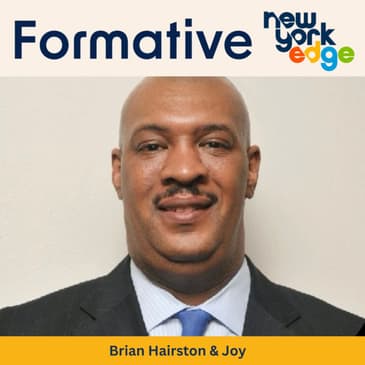
From working in the kitchen and on the register to owning and operating seven McDonald’s franchises, Brian Hairston joins our co-host, Joy, to talk about growing up in an entrepreneurial family. Brian tells us about why his parents, despite owning McDonald’s franchises themselves, taught him the business from the bottom up, along with the importance of taking our time to grow and succeed.
Downloadable transcript here
Rachael: Welcome to another episode of Formative, the show where today's leaders are interviewed by the leaders of tomorrow.
Brian Hairston is the franchise owner-operator of seven McDonald's restaurants. Brian joins us today to talk about his family history owning McDonald's restaurants and what he's learned working so closely with his family for decades. He shares with us what he's observed about young employees throughout the years, often being a teenager's first employer. We are so very excited to talk to Brian.
Rachael: Hello and welcome. I'm Rachael Gazdick, CEO of New York Edge, and my co-host today is Joy from I.S. 45K. Joy, can you tell me a little bit about yourself?
Joy: So, my name is Joy Brewer, and my hobbies are riding, volleyball, and helping my father out with his businesses. When I get older, I would like to be a robotic engineer, and the school I would like to go to is Brooklyn Technical High School.
Rachael: Fabulous. So, who will we be speaking with today?
Joy: Brian Hairston. I believe he owns seven McDonald's franchise stores.
Rachael: Well, let's bring him in. Brian, thank you for being here today.
Brian: Thank you for having me.
Rachael: So, Joy, what is your first question for Brian?
Joy: Well, the position that you are at now, what is your job? Like, what do you do?
Brian: I am the franchise owner of seven restaurants, seven McDonald's restaurants, along with my mother. She's not only my mother, she's my business partner. So we own and operate seven McDonald's restaurants. So every day I wake up, my job is to enforce the standards of the McDonald's brand. I want to make sure that I'm providing you with a quality product as quickly as possible in a clean environment at a very affordable price. That's my job every day. But I don't do it all by myself. I have over 500 employees that help me do that every day.
The second thing that I do is I have to make sure that we are profitable so I can pay those over 500 employees every week and then I could pay my bills every month.
And then thirdly, you want to make sure that you're in the community and you're the face of that McDonald's restaurant in the community so the people know who you are and you're giving back and you're assisting those people in the community. So that's what I pretty much do every day.
Joy: So were you ever like actually working in the store, like a cashier or like a self, like a service, anything like that?
Brian: I have worked in every aspect of this business. I started working in the restaurant at the young age of 13 years old. I've worked cashier, register, production area, grill, whatever you want to call it, I've worked every aspect of this business. So there's nothing in the restaurant that I don't know or don't know how to do because it's been in my blood for a long time.
Joy: Did you encounter any struggles with opening your first store?
Brian: Not so much struggles, but you always have concerns. The biggest concern is do you have enough money? Cause any business that you want to get into, you need money, you need capital. And if you don't have it, you need to go borrow it from a bank. So you need to make sure you have credit. And so those are the two things that you need to have, money and you need to have credit. When it comes to McDonald's, you also worry about the location. Is the location in a good area that people are going to frequently come to and, and help you grow the sales of that business. And so those are the three challenges that you kind of deal with. Uh, McDonald's is pretty spot on most of the time when it comes to picking locations, but when you buy a new location, it's always based off of projection. When you buy in an existing location, it has a history where, you know, the sales that the restaurant has been doing year after year. So that's the challenge that you deal with when you buy a new restaurant.
Joy: Can you tell me about a mistake that you made and how did you fix it?
Brian: I've made some mistakes of maybe hiring the wrong person or promoting the wrong person at times. So it was situations where you thought this person was ready for this position, but they did not pan out for you and you ended up having to release them and, and hire someone else. So you end up just making sure, you take your time and make sure you're picking the right person. I've also made mistakes in life of picking restaurants that didn't quite pan out to what we thought they were going to be and we end up selling them later on down the line. So I've made some business mistakes here and there, but it didn't cost me too much. So you live and you learn and you make sure you don't make the same mistake twice.
Joy: What's your like, what's your mindset for the future? Do you have anything that you want to do to improve yourself or your businesses?
Brian: My, my mindset for the future is we're probably, you know, we're going to have to become a little bit more automated at McDonald's, using our kiosks and mobile order pay and a McDelivery systems. Uh, those things are going to be become very important parts of our business moving forward because everybody is becoming technology sound and that. It's just that the business model is just changing some that people like to use their phones. They're on their phones all the time. They're on their tablets. They're on their computers and people order a different way. They don't just come to the restaurant anymore and stand in line or come to the drive thru. They like to sit at home. They like convenience. So that's what I see the future being in McDonald's is that we're going to become a more of a digital, a digital business. And I look forward to that.
Rachael: Brian, you know, as you're saying, McDonald's now looks very different than it did decades ago. With new technologies, um, we expect it to continue to advance and change. Despite all of this, do you ever think of how most people in the world have McDonald's as part of their childhood memories? And what does that mean to you?
Brian: It's an honor. It's an honor to be a McDonald's franchisee. Um, not a lot of people get this opportunity and I don't take it lightly. And I see little kids that come into the restaurant every day for a happy meal. And you think it's the greatest meal in the world to them and they don't even want the meal, they look at the toy. So, but yeah, it's free to put smiles on people's faces. It's just great that people come to you and these young kids, they are begging their parents to come to you and they're so happy when they come there and they just want to play with their food and fries, but they really want to play with these toys and they just love the brand and love being there. And I love being a part of that.
Joy: Who are some of your role models?
Brian: I have so many role models. My biggest role model is my mother, Linda Dunham. And my stepfather, Lee Dunham, uh, Lee passed away about 12 years ago, uh, but he was my role model because he opened the very first McDonald's in the borough of Manhattan in 1972. And I never knew that a black person could open up a McDonald's. I didn't even know McDonald's were owned by individuals. I thought it was just McDonald's ran all the stores. So that was my first role model outside of my mother. And plus my grandparents, I have aunts and uncles. We, you know, we always talk about how it takes a village to raise a child. I think I'm that child. So much of my family has played an important part, a role in my life, and they are my inspiration.
Joy: So was that your information to start your first store?
Brian: Well, it gave me the idea that if my stepfather can do it, I think I can do it as well. So because it was a family business, I was able to get into it at a very young age, working in the restaurant, learning all aspects of the business, able to go to school, go to college, learn about business administration, learn about marketing, things like that, that will help me in business.
So I started at a young age. working in this system. And it did inspire me to one day become an owner operator. And I have been very fortunate to be able to be one.
Joy: Do you view yourself as a role model for anybody?
Brian: I try to live my life where I am considered a role model. I have former employees that have gone out into the world and some are policemen, some are teachers, some are nurses and doctors, and they come back and tell me how much I meant to them in their lives and how important what I am to helping them get their career started. So I try to be a role model. I try to be a good corporate person in the community, giving back to the community, giving back to those who support me and who patronize the business every day. So I try my best to be the very best role model that there is every day.
Joy: So what are some things that you think people misunderstand about you a lot?
Brian: One of, the first thing that people misunderstand is they think that because you own a McDonald's restaurant that you're rich and that's so far from it. You're not rich. You do very well. You make a nice living. You live a comfortable lifestyle, but you're not rich. A person like Jeff Bezos is rich. Oprah Winfrey is rich. There's a big difference. So when people say that you're rich, you're not rich.
But it's not so much a misconception about me, it's more so the misconceptions that you hear people say about the brand when they talk about McDonald's of,oh, you don't want to grow up and be working in McDonald's. There's nothing wrong with working in McDonald's. There's so many opportunities in working for McDonald's. It, most of the time, people only see what they see in the restaurant. They do not realize that this brand is a global brand, probably one of the top five recognized brands in the world that you can go anywhere you want in this brand and work. You can be an accountant. You can be in construction. You can be a lawyer. You can work in marketing. You can work in PR. You can work in HR. So, every type of profession that there is, McDonald's has that around the world.
So when people say it's a dead end job, that is the biggest misconception of McDonald's. And even if you decide you just want to stay and work in the restaurant, that's okay, because you can go into management, you can move up the ladder. And I think people will be very surprised when they see what our managers make, what our supervisors make, what our director of operations make, they will be very surprised.
And a lot of people do not realize that one out of eight Americans started their very first job in McDonald's, the most famous one being Jeff Bezos. He started his very first job in McDonald's. We used to be America's first job. That's where people went to work for their very first job. So we have tons of things that we offer people that this is not a dead end job. We offer to help people get their GED. We help people with English as a second language. We give tuition assistance to any of our employees that are going to college. We try to help our people better themselves so they can go out into the world and if they don't want to stay with McDonald's, they can go get other jobs in other areas.
Joy: So where do you see yourself in 5 years or 10 years? What do you see yourself doing?
Brian: I hope I'm still doing the same thing. I hope that I'm still running restaurants with my fabulous team, and we're still doing well, and hopefully gaining some more locations. But I see myself doing the exact same things that I'm doing now. I have two young daughters. Hopefully they will want to join the business so I hope in the next five to 10 years that they have joined the business and help carry on the legacy.
Joy: So you love working at McDonald's. You love working there?
Brian: Yes, I do. I love it. I'm loving it. Yes.
Brian: Did you say you wanted to go to Brooklyn Tech?
Joy: Yes.
Brian: Yes. Why Brooklyn Tech?
Joy: Well, when I was in sixth grade, I had this teacher who always used to bug us about finding high schools. So I went searching for high schools because I found out that I was like into technology and robots and stuff like that until I found Brooklyn Tech and I saw all the services and things like that. And the other day I went to this armory track where they had robots trying to make goals and stuff like that and I was helping them try to fix it or control them and I think it was fun. And I think it'd be a fun and nice thing for me to do.
Brian: Okay, good. I know it's a good school. I've heard a lot of great things about it so that's a great choice, and I'm sure you'll do well there.
Joy: What were you like in middle school? Since I'm in middle school, I want to know.
Brian: Well, when I was younger, we didn't call it middle school. I went to what they call junior high school, which was 7th through 9th grade. Elementary school was K through 6, so I was in 7th through 9th. And actually, my 7th grade year was the year that I actually started working in McDonald's. I was 13 years old. Uh, was the very first year that I started working. But I was a good student. I was a very good athlete at the time. I never got in trouble much. I did the right things and I was a good kid. I wasn't a bad kid who did things wrong, but I was always driven, wanted to work, enjoyed having money in my pocket. That's why I enjoyed working at the restaurant so much.
Joy: How is your view of the youth of today? The youth of today?
Brian: Well, they're definitely different than when I was a youth. Um, they're a lot more tech savvy. Um, they're very quick to, how can I say it? They, they like things now they're not to kind of sit back and wait and say, Oh, I'm going to wait my turn. They're very aggressive about the things that they want in life. They don't mind jumping from job to job if that means that they're going to get better pay or a better situation. Um, they like being entrepreneurs, not so much I want to work for somebody. They like to be in charge. And so I have two Gen Z's at home myself so I know what I'm talking about, that the youth of today is totally different than the youth of yesterday, but I think we're in good hands moving forward.
Joy: But do you think there's anything you could change about their mindsets, what they could do different, better?
Brian: I wish that they wouldn't so much have the mindset of I want it now, that sometimes things take time. They don't happen as as quickly as they would like, like me working over 30 years in McDonald's I don't ever see my kids doing that because kids today don't seem to want to work a job that long. They don't mind jumping from job to job So if I could just give them one tip is that be patient things doesn't happen as quickly as you want them to. But they will happen if you stay persistent and work hard just not as quickly as you want
Rachael: Yeah, I agree with you, Brian. I'm also seeing young people really gravitate towards entrepreneurship. They're really excited about it. So I'm wondering for young people today who want to go into business, what's some advice that you would give them if they were starting out right now?
Brian: Gain all the knowledge that you can get. And if you know what type of business you want to go into, if you have any idea of what that is, why don’t you start trying to work in that business, start from the ground floor up, uh, just don't try to come in and be the owner. I didn't get that opportunity, like I had to work my way up from a crew person all the way to the position that I'm in now. Um, my parents didn't give it to me easily. I had to prove to them that I was worthy and capable of doing this job. So my advice to them is be patient. It's not going to happen overnight and make sure that you don't do things that's going to hurt you later on, ruin your credit, have things on social media that can come back and hurt you later on. So that would be my advice.
Rachael: Brian, we always end on the same question, but before we get there, I have to ask you, what is your go to McDonald's order?
Brian: My go to order is a quarter pounder with cheese, fries and a drink. I have always loved the quarter pounder with cheese. It's been my favorite sandwich since I ever could remember. I am now probably eating probably more chicken nuggets than I do quarter pounders with cheese as I get older, but it's still my favorite sandwich.
Rachael: Yeah, I would agree. Yeah.
Brian: But everybody loves our french fries though. That's, that's the thing. Yeah. That's the go to for everybody. Some french fries.
Rachael: So our last question is one that we ask everyone we speak to, and it's, if you can go back and speak to your 13 year old self, what would you say?
Brian: If I could go back and speak to my 13 year old self, I would say, you did a great job. You picked the right profession to be in. Keep working hard. It's going to pay off for you in the long run.
Rachael: That's just awesome. Brian, thank you so much for speaking to us today.
Brian: Thank you so much for having me. I really enjoyed it. I wish you the best. And remember, you can come work at McDonald's when you get old enough, okay? Cause we've got a job for you, okay?
Joy: All right.
CREDITS
Thanks for listening to Formative, a production of New York Edge. I’m your host, Rachael Gazdick. Our production partner for this series is CitizenRacecar. This episode was produced by Hager Eldaas, post-production by Alex Brouwer, production management by Gabriela Montequin, original music by Garrett Tiedemann. Thanks to the whole team at New York Edge for making this series possible. Never miss an episode by subscribing to the series at newyorkedge.org/formative or wherever you get your podcasts.