
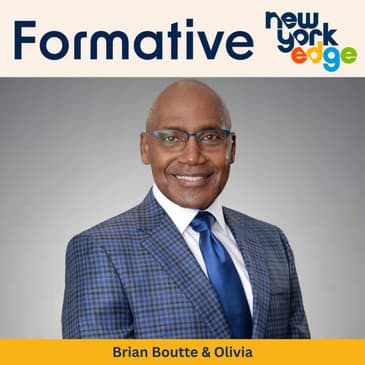

Brian Boutte, Director of Government Relations at Chick-fil-A, joins middle schooler Olivia to talk about the power of relationships, the importance of staying connected to family even during busy times, and how early life experiences shaped his voice and confidence.
Olivia learns from Brian why being patient, listening more, and putting others first can make a lasting impact, and how leading with kindness can enrich both your career and personal life.
Downloadable transcript here
Rachael: Welcome back to Formative, the podcast where today's leaders are interviewed by the leaders of tomorrow. Today's guest is Brian Boutte, Director of Government Relations at Chick-fil-A. Brian tells us what it's like working with lawmakers in Washington, D.C. He also shares lessons on staying connected to family, leading with kindness, and why listening can be just as important as speaking.
Hello and welcome. My name is Rachael Gazdik, and I'm your host and CEO of New York Edge. On every episode of Formative, a student from our after-school program joins me as co-host. Today we've got Olivia from IS125Q. Olivia, can you tell our audience a little bit about yourself?
Olivia: I'm Olivia, like she said. I live in Sunnyside, and I'm Irish and Italian. I play the violin. Definitely my favorite period is absolutely lunch.
Rachael: That's very cool. Honestly, my favorite time is lunch too. Okay, I think we're ready to go talk to Brian. I bet he loves lunchtime too.
Olivia: So my first question for you is: what exactly does your role at Chick-fil-A involve, and what does a normal day look like?
Brian: So today my role is Director of Government Relations, and I spend most of my time, almost all my time, focused on the federal government.
A typical day for me might include a call with a trade association, like the National Restaurant Association, the International Franchise Association, or the American Trucking Association. These are all organizations that represent companies not unlike Chick-fil-A, and they have common interests and concerns.
So we get together collectively to find ways to influence and leverage members of Congress to pass legislation that supports our industry. That’s kind of what it looks like.
Then when I go to D.C., which is once, maybe twice a month, I’ll spend three days on the Hill meeting with members of Congress, their staff, and senators. A full day might be 10 meetings on the Hill.
Often, Olivia, I’m introducing Chick-fil-A to some of these members who’ve never had a conversation with anyone from Chick-fil-A before.
And in between all that, there are meetings internally with Chick-fil-A. Our owner-operators, menu team, public affairs team, and philanthropy team all have concerns about things that might impact the business. So that’s how I spend my day.
Olivia: Okay. What’s your favorite part of your job at Chick-fil-A?
Brian: I may have a couple favorites, but one of them is definitely meeting with members on the Hill and sharing the history and story of who we are. Most of them don’t know our story.
Connecting with people is probably the best part. I think I’m a bit of an extrovert, so I spend a lot of time connecting with folks. I get to meet new people every day in my work, which is pretty cool.
And honestly, I’m a big fan of eating, so I try to do that quite frequently, Olivia. I try to eat every four hours, whether I’m hungry or not, and lunch is pretty important to me.
People know they can plan a meeting during lunch, but if I’m not fed, that meeting’s going to be cut short. I’ll come back, but if I don’t eat, I won’t show up as my best self.
Olivia: So then what made you be in the Army and then transfer to being at Chick-fil-A?
Brian: The reason I was in the Army, Olivia, is that I went to the Military Academy at West Point. The requirement is that you go to school for free, they actually pay you a little bit to be a student.
After four years as a cadet at West Point, you get commissioned as an officer in the Army. So my first job was already decided when I was 18, because when you graduate from a service academy, you have to serve five years.
That’s kind of crazy if you think about it. At 18, I signed a contract that basically decided where I’d be until I was 27.
After that, I had a couple jobs. I worked for Mobil Oil, now known as ExxonMobil, as a salesperson on the West Coast in Sacramento. Then I worked for Coca-Cola here in Atlanta, and after that I spent almost 20 years with General Electric.
I traveled all around the world working on power plants, and then later in life I came to work for Chick-fil-A. I originally came in to help with community affairs work, and more recently I took this role helping tell our story to government officials.
Olivia: But what made you want to work for Chick-fil-A?
Brian: When I was working for Coke years ago, I met a guy who later became the president of Chick-fil-A. He recently retired.
We became really good friends, and over about a 25-year period we probably had hundreds of cups of coffee together. He’d always say, “Brian, one day you’re going to work for Chick-fil-A.”
I loved the brand. I ate there all the time. And one day he said, “Listen, we have an opportunity. Would you like to come help us?”
So I came on board about five years ago.
Olivia: Okay.
Brian: Yeah.
Olivia: Can you tell me about a challenging part of your career and how you overcame it?
Brian: My wife and I have two children, they’re adults now, but one challenging time in my career was when they were little, under five years old, and I traveled a lot with GE.
Sometimes I’d leave on a Sunday night and not come home until Friday or Saturday morning. I might be in Asia, Africa, anywhere.
The challenge was figuring out how to stay connected to them.
One thing I did was call my wife and kids every single day, no matter where I was in the world. And every time I traveled, I’d buy postcards and write notes to my kids, Matthew and Marilyn.
My goal was always to get home before the postcards did.
Sometimes I’d call so often they’d say, “Dad, we’re watching our favorite show.” But I made a real effort to stay connected.
Olivia: So tell me about yourself when you were my age. I’m 11.
Brian: Okay, let me take you back a little bit. I’m the seventh of 10 children, three girls and seven boys.
Olivia: You have siblings?
Brian: Yeah, there are 10 of us.
When I was 10, six of us were still sleeping in the same bedroom.
That’s important because I had to learn how to maneuver to get the things I wanted. Mom would make breakfast, 20 biscuits, and I made sure I got my two if I could.
I wasn’t the biggest kid in the room, so I had to learn to get my voice heard. I think growing up in a house with 10 kids made me more extroverted.
I got really good at negotiating and being heard.
Olivia: Now I’m happy that I’m an only child.
What mistake did you make at my age?
Brian: Girl, how much time do we have?
Honestly, probably not being honest enough. With 10 kids in the house, if my mom asked whether something had been done, I might say, “Yeah, it was done,” even if I didn’t do it myself because I knew one of my siblings had.
I think when I was younger, I focused more on taking care of myself than taking care of others.
But I got better at that later in life, especially in the Army. I learned the team is better when you put others first.
The world is better if we lead with kindness. If you do nothing else, Olivia, just be kind. That’s different from being nice. Be kind.
Olivia: Yeah. What was your favorite subject in school, and how did it help you get where you are today?
Brian: It may have been geometry, and honestly it has nothing to do with what I do now.
I had an amazing teacher named Mr. Andropot. He built pegboards with strings and little figures to demonstrate geometry problems physically.
He loved geometry, especially proofs and theorems, and his enthusiasm made me excited about proving things with evidence.
I think that sparked my intellectual curiosity: can you solve the problem? Can you prove something with evidence?
That curiosity has stayed with me ever since.
Olivia: All right. So when you were 11 or 12, what did you want to be when you grew up?
Brian: I wanted to be an anesthesiologist.
Olivia: What’s that?
Brian: They’re the doctors who sedate you and put you to sleep during surgery.
I didn’t know anyone who did that job. I just thought it was fascinating that you could put someone to sleep deeply enough that surgeons could operate and they wouldn’t feel it.
Clearly, I didn’t end up doing that.
Olivia: If you could go back and speak to yourself at my age, what would you say?
Brian: Great question.
I’d tell my 11- or 12-year-old self to be patient. I moved fast, talked fast, and was always in a hurry.
I’d also say: listen more and talk less.
Not that I’d ever stop talking entirely, that’s not happening, but I think I would’ve learned a lot more if I’d slowed down and left more room for other people to teach me things.
Rachael: Okay, this was so much fun learning about you. Thanks for being on the show.
CREDITS
Thanks for listening to Formative, a production of New York Edge. I’m your host, Rachael Gazdick. Our production partner for this series is CitizenRacecar. This episode was produced by Hajar Eldaas, post-production by Alex Brouwer, original music by Garrett Tiedemann. Thanks to the whole team at New York Edge for making this series possible. Never miss an episode by subscribing to the series at newyorkedge.org/formative or wherever you get your podcasts.