
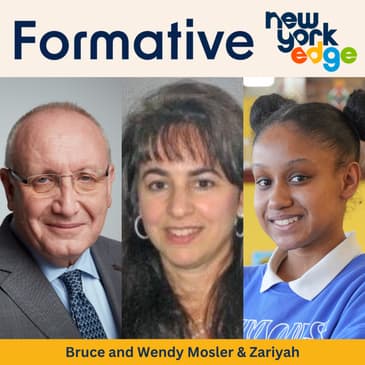

In this episode of Formative, Bruce Mosler of Cushman & Wakefield and Wendy Mosler of Global Holdings Management Group sit down with middle schooler Zariyah for a candid conversation about careers in real estate. They share the moments that shaped their paths, the hard choices that built their confidence, and what keeps them motivated every day. This episode is about how every choice, big or small, can move you closer to the career (and life) you want.
Downloadable transcript here
Rachael: Welcome back to Formative. Our guests today are Bruce Mosler, chairman of Global Brokerage at Cushman & Wakefield, and Wendy Mosler, executive VP at Global Holdings Management Group. We talk to each of them about their distinct journeys in real estate, what they love most about their work and the tough decisions that helped define their careers.
Rachael: Hello and welcome. I'm Rachael Gazdick, CEO of New York Edge, and my co-host today is Zariyah from M.S. 61K. Zariyah, tell our listeners a little bit about who you are.
Zariyah: I am Zariyah. I am in seventh grade. Some hobbies I like to do is art, and I'm trying out basketball right now. Um, I have a good amount of friends in school right now. And I'm just really happy to be interviewing Ms. Mosler and Mr. Mosler.
Rachael: Welcome, Wendy and Bruce. We're so very excited to have you here. Bruce, we're gonna kick off the conversation with you.
Zariyah, what's your first question?
Zariyah: Uh, do you mind explaining to me what your job is?
Bruce: I'm Chairman of Global Brokerage at Cushman & Wakefield, and I'm a former chief executive of my company. Uh, when I took the company over, which is a long time ago now, in 2005, we grew it to a company of 17,000 people in 62 countries. Today, Cushman & Wakefield is a real estate service company, which means we help companies relocate, we manage buildings, almost 5 billion square feet around the world, and we appraise buildings, so we do a lot of things. That's why we're a global real estate service company. And my specialty happens to be real estate brokerage, which means I concentrate on clients and their portfolios who wanna relocate from one building to another all over the country.
Zariyah: So another question I have is how did you get to where you are now? Like, what are the steps that you had to do to get to this job that you have?
Bruce: That is a really good question, and I'm gonna tell you why. Because I don't believe that there are ways to short circuit hard work. Hard work means that you have to take each step. You have to do things in a methodical fashion, in a thoughtful fashion. You can't look to shortcut and to find quick ways to get to the top of anything. You have to a) put your time in, learn every aspect of your business. My company has six or seven service lines. To be a leader, you have to know what those businesses do and you have to put your time in to do it.
So my first overarching comment is, number one, you have to put the time in. Number two, you can't skip steps. Number three, you can't be in a hurry, in a hurry. You have to be patient. You can be ambitious, that's great, but you also have to take it step by step. And if you do those things and you work hard and you collaborate, you help other people along the way, and you bear in mind that success doesn't happen without putting the effort in, both in your workplace and also in your community, then I think you're destined for success.
Zariyah: Oh, that's very interesting. Um, another question I do have is what's your favorite part of your job so far right now?
Bruce: If you're in real estate services, which is different than being in the ownership side, then I think you have to enjoy interacting with people. So as Wendy, my wife will tell you, I can talk to anybody anywhere, on the street or in a boardroom, I enjoy interfacing with people. For me, the most exciting part of my job is helping a company overcome a challenge. So, many businesses today aren't sure to, whether to grow or to shrink or to right size or to plan for the future. Business is changing, technology is having a huge impact on how people use space. So I enjoy bringing a lot of other talented people today because today to do business it's a teamwork approach that wins, collaboration and bringing other people in with skills. I enjoy doing that. I enjoy bringing other people to the table to help us, a problem for a company, large or small.
Zariyah: Have you ever had to make any hard decisions, like in your job frame or like just in life in general, and what type?
Bruce: So the answer is yes. And as you grow and mature, you're by the way incredibly mature for your age, I have to say. But as you grow and mature more, you'll find that there are always difficult decisions you make. And for me, I think one of the most challenging, and I am, I'm gonna date myself, but I will say that there were two very difficult points that I had to make difficult decisions on. One was the, in 2008-9, we call the, we call it the Great Recession, we had an economic meltdown. It was a very difficult time and many businesses had to determine if they were going to take on debt and continue to grow or whether you, what we call right sized or, in simpler terms shrunk, your company and avoided debt. I had to make a very difficult decision and I made the decision to shrink the company, which meant that we had to lose some employees, but we did it I think, in a very, very humane manner. We provided what we call at the time severance. We also provided counseling. We also told people that it wasn't their personal performance, it was that the company needed to ensure that it survived because in 08-09, the financial impact was so severe on many businesses that if you didn't make a decision soon, you could find yourself upside down. So I made that decision as the leader of the company. It was very difficult, but I'm very proud to say that we hired back many of the people back into the company, as in the, in 2010 we recovered.
Zariyah: So going back on what you just said, what do you think is the most important qualities of a leader?
Bruce: I would say three things. Compassion, first and foremost. I think you have to be compassionate as a leader and understand that different people have different skills. And compassion also allows you to understand that leadership takes all forms, but most, most importantly, you have to understand your people and in that way you make better decisions. Beyond compassion, I would say hard work. You can't ask other people to work hard if you're not willing to put the effort and the hours in yourself. And thirdly, I think it takes vision. At the end of the day, you have to have a vision for where you see the business, where it fits, where it can add the most value. And the last comment I'll make is you cannot do it alone. The best leaders seek advice, surround themself with smart people that support them in areas where it's not their core strength, and recognizing that makes you a better leader, in my opinion.
Rachael: And lastly, for you, Bruce, if you could go back and speak to yourself at 12, what would you tell a 12-year-old you?
Bruce: The 12-year-old me, um, I would've probably said that, um, not to be in such a rush, slow down. I wanted to be all things to all people. I think that you gotta be yourself and true to yourself. And I would also say you have to shut the noise out from the outside. In the end, pleasing everyone usually ends up pleasing no one. So be true to yourself and slow down and know that you have time to make decisions. The 12-year-old me wanted to rush to make every decision in a minute, and I think you need to take a minute. Taking a minute usually, in fact, I can say this from experience, always lends itself to a better result.
I am just so grateful to spend this time. This was a lot of fun. I enjoyed every second of it, and I wanna just say thank you. Thank you all so very much.
Rachael: And now on to you Wendy. Uh, Zariyah, what's your first question for Wendy?
Zariyah: So, what's your favorite part about your job, like, right now?
Wendy: So, I like to solve problems. There are always problems that we confront every day, whether we're in school or in a job. And it always involves people and sometimes, you know, other skills that we've learned like math and talking to each other, and a lot of times, a lot of those skills are involved. But I feel like when we've come to a resolution of a problem, that's when I, I feel like we've accomplished something during the day. Does that make sense?
Rachael: Love that. Um, so I was wondering, I feel like real estate is just one of those careers that people have a lot of misconceptions about. So what is a misconception you would like to correct?
Wendy: You know, I think that when I started, and I've been in this for decades now, but when I started I would have said that, you know, and I didn't really know it at the time, but became aware of it, um, there weren't so many women in real estate at all, and I don't feel that's an obstacle or an issue today. In fact, I find that within real estate, there are many, many women. We have established organizations now that didn't exist three decades ago, where we actually support each other. You know, I do my best to mentor other women in the business now that I'm kind of at the tail end of it and, you know, try to create opportunities for them, particularly the young women in the business. And with my colleagues who are women, I really make a, an extra effort, um, to spend a lot of time with the women and help to advance their careers. And I, I think that happens more with women now. But I would have said years ago, certainly when I was starting out, I didn't know how difficult it, it was. And it was more difficult at that time to break into what was previously a pretty male dominated industry.
Rachael: That actually ties in with a question I wanted to ask next. So what advice would you have for a young girl who wants to go into the real estate business one day?
Wendy: One thing that I have done always is to have integrity and be courageous, right? Don't sort of give into, you know, what you think other people, and now there, there are certainly political considerations, but I think that honesty is what works. Even in discussions or negotiations, I feel like what served me the best in those situations is that, um, and I think this, you know, speaks to my husband's career as well, people trust him because he's honest. You know, he's honest, he has integrity, they know that they, whether it's his clients or his colleagues or, or anybody. In my case, with, with banks that I'm working with, where we're looking for a loan on a property, for example, they can count on me for giving them…Uh, and you can still sell, but be honest about it and you, you won't get caught having to backtrack or fill in gaps that you shouldn't have to. Be honest, have courage, say the things that you believe in and are right.
Zariyah: Ms. Mosler, what were you like when you were my age?
Wendy: Like anybody in middle school, I think I spent a lot of time trying to figure out, like, what kind of paths to select, what kind of options were available. Meaning in terms of social groups, you know, like as a teenager that's kind of a universal thing, right? You try to figure out where you belong, you know, who you are. And where I grew up, it was, like I said, a small town. I didn't grow up in a city. There weren't a lot of social options, so it was more of trying to figure out, okay, where do I belong the most? Where do I think I can grow and feel a part of the most, and I wound up ultimately choosing kind of a straight down the middle. Meaning, you know, there was one group that was sort of not really socializing and not really, um, getting to know other people. And then there was the other extreme group that was more interested in extreme exploration. And I said, no, no, I kind of feel like I fit in the middle. I really like people. I wanna get to know people. And if I can find a group that's somewhere in the middle, that's kind of moderate, where I can still be a good student, I can learn, I can grow, but I can have friends because, right, we all wanna have friends because we learn from each other. And even as teenagers, we all learn how to make decisions at that early age and it's about social decisions as much as it is anything else. And all of those things I learned in making choices as a teen, you know, help me today and trying to make choices now.
Zariyah: Did you have a dream career when you were young?
Wendy: Uh, you know, I thought about that and I don't think I ever did. I grew up in a family that didn't have a lot of social means. So I guess what I really thought about from a really young age was about how do I…I, you know, I knew that my family was wonderful about ensuring that I was gonna be educated and they would always support, um, educational endeavors, but they weren't in a position to support more than that. So it was gonna be up to me to make choices that would enable me to, to be financially independent. So that always colored how I thought about things, both, you know, from, I would say late teens onward, being able to make educational choices and work choices that would allow me to support myself independently.
Rachael: So I'm curious then, at what point did you realize that you did wanna pursue a career in real estate? Like what inspired you?
Wendy: Two things, number one, I think that throughout school, the things that were easier for me rather than harder was math. It wasn't as hard as it was for others that I was growing up with. Um, and so I always knew that it probably would be something that involved math, number one. And beyond that, I think it was just you know how life progresses and evolves, and it didn't necessarily have to be real estate, but I followed, I would say my husband a bit. We were married pretty young and he moved into real estate at a pretty early age, so those are the people that I met and I got to know. And turns out that there is sort of a match between being in real estate and being able to use a mathematical aptitude in that. So it's it.
Rachael: And our last question for you, if you could go back and speak to yourself at age 12, what would you say?
Wendy: I would say, in fact, I've had this conversation recently and repeatedly with my 25-year-old daughter, is I continue to sort of reinforce, you know, where she is in her career is, it's a marathon, not a sprint, okay? That, that whatever you're doing, your decision making and your thinking is, is for the long term, you know, not, not for what's gonna happen tomorrow.
Rachael: Oh, I absolutely love that. I think we all need to hear that, and so, thank you so much.
CREDITS
Thanks for listening to Formative, a production of New York Edge. I’m your host, Rachael Gazdick. Our production partner for this series is CitizenRacecar. This episode was produced by Hajar Eldaas, post-production by Alex Brouwer, original music by Garrett Tiedemann. Thanks to the whole team at New York Edge for making this series possible. Never miss an episode by subscribing to the series at newyorkedge.org/formative or wherever you get your podcasts.