
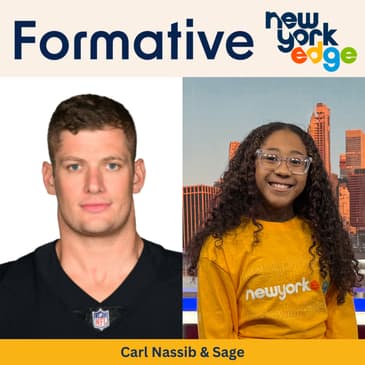

Today, we’re joined by Carl Nassib. Carl is a former NFL player and currently the founder and CEO of Rayze, a social media app that connects nonprofits with donors and volunteers. With his career transition, Carl has learned a thing or two about reinvention and the imposter syndrome that comes with it. He talks to middle schooler, Sage, about that, plus the misconceptions of being a professional athlete and why it’s never just luck that gets you far in your life and career.
Downloadable transcript here
Rachael: Welcome back to another episode of Formative, the show where today's leaders are interviewed by the leaders of tomorrow. On our episode today, we've got Carl Nassib joining us. Carl is a former NFL player who played defensive end and linebacker for teams like the Cleveland Browns, Tampa Bay Buccaneers, and the Las Vegas Raiders.
Today, Carl is the founder and CEO of Rayze, a social media app that connects nonprofits with donors and volunteers. In today's conversation, we talk about the misconceptions people have about athletes, the value of reading and the importance of being prepared.
Rachael: Hello and welcome. I'm Rachael Gazdick, CEO of New York Edge, and my co-host today is Sage from I.S. 45K. Sage, tell us a little bit about yourself.
Sage: Okay, well, I live in Brooklyn, New York. My hobbies are dance and step. I have two sisters. I love talking and meeting new people. I want to be a physical therapist, a photographer, or a teacher when I grow up.
Rachael: That's really cool. Now, Sage, who do we have on the show today?
Sage: We're speaking to Carl Nassib and I'm so excited to be speaking with him.
Rachael: Well, Carl, welcome to our show. We're excited you're with us.
Carl: Thank you for having me. I'm excited to be here. This is so fun.
Rachael: Alright, the mic is all yours, Sage.
Sage: Well, my first question is, what inspired you to be in the NFL?
Carl: So it was my dream to play in the NFL pretty much my whole life. I learned football from my dad who played football in college. I have two brothers, Ryan and John, who also played football. So growing up, the three of us would, you know, would wake up on Saturday morning, go play our games. Um, it was really fun.
And then when I was in high school, I loved playing with my teammates. I loved being just a part of a team and competing. I'm a very competitive person, so I always wanted to be the best. And I was really lucky I got to play at Penn State University, uh, the Nittany Lions. And as soon as I got there, I was a walk-on, but I still wanted to play in the NFL.
So it had been a dream of mine since I was your age, and I was very, very lucky to make that dream come true.
Sage: What was your least favorite and favorite thing about being in the NFL?
Carl: My favorite thing about being in the NFL was I was constantly surrounded by very, very hardworking individuals. I tell people all the time that if you want to be successful in life, that you have to surround yourself with the right people, and it's very, very rewarding when you get to go to work with people every day who are trying to be the best that they can possibly be. Um, so that made me want to be the best I could be. And there were days where I was super tired and super frustrated, but when you're around other players who are picking you up, you pick them up, um, it's a really positive thing.
I think my least favorite part about the NFL was playing in the snow in Buffalo. We played in the snow in Buffalo and we played on turf, and the turf felt like concrete. So I do not miss playing in the snowy weather at all.
Sage: Oh, that's probably, that hurts when you fall.
Carl: Oh, it absolutely hurts. And I'm a tough guy and you know, and it, and it really, really hurt.
Sage: Yeah, if I was playing football, I would probably be very scared of getting thrown or anything.
Carl: Yeah but you would be fast. I feel like you'd be fast and nobody could touch you.
Sage: Yeah, I used to play basketball.
Carl: Okay, nice.
Sage: But then, then I had to, I had to focus on one thing 'cause basketball was outside of school and it was taking up all of my weekends.
Carl: Gotcha.
Sage: And my dad wanted me to, like, go on bike rides with him and stuff. I narrowed it down to just dance and step, and those are school activities. So it's mostly, like, after school and then I'll have, like, competitions on the weekends and stuff.
Carl: Okay.
Sage: And I like that better than just squeezing everything.
Carl: I tell people, you can do anything in life, you just can't do everything.
Sage: Yes.
Carl: So sometimes you have to pick what you like the most and stick to that.
Sage: Um, what was it like, like your college experience?
Carl: So, I played football at Penn State. I got my degree in biology. I love science, and I wanted to be a doctor. Um, but like I said before, you can do anything in life, you just can't do everything. And so I got really good at football at Penn State, and I ended up going to the NFL. But if I never made it to the NFL, I wanted to have a good backup plan. And so I got my degree in biology, which was very hard. I took top level organic chemistry classes, microbiology, neurobiology, all these different, you know, symbiosis classes. But I still had so much fun. I still, you know, my best friends are from Penn State and we always hung out together. We cooked meals together. I'm a much better cook now than I was in college, but college was really fun. I am now on the board of trustees at Penn State, so I get to get very involved with the school and help, you know, advocate for the students who are there and make sure that they're having the best experience, making sure that they can go on into the real world and, you know, be the most prepared students ever. So Penn State was really great. It's a great university.
Sage: That sounds fun. I wanna have a really fun college experience, but I don't wanna stay in New York when I go to college. I wanna like go out of state to travel but…
Carl: Go to Penn State. It's a great school. I'll put in a good word.
Sage: Thank you.
Carl: Yeah, of course.
Sage: But what are some, like, misconceptions that, that people know a lot in the NFL.
Carl: I think there are some misconceptions that football players aren't that intelligent. And if normal people had to learn the playbooks as we do, understand schematics like we do, I think they would be very surprised about how much time, practice and energy goes into being a very fine oiled machine that is coordinated and effective.
So going from the NFL where I felt like I was surrounded by very high processing people to now in the corporate world, where sometimes I think to myself, how did you get this job? You know what I mean? And so that's a misconception that people think football players aren't very smart. But I do think that they are very smart.
Sage: Yeah, like in the, in the shows, sometimes when they have like high school athletes, they'll make 'em, like, they'll make the characters like stupid and stuff, like have them say dumb stuff.
Carl: Mmmm, mmmm,mmmm. I don't like that.
Sage: That's not always true. With, like, all the sports, they do that. And I don't think, like, it depends on your case. If you're doing, if you're like not very good at school, that's a reason why some people play, like, sports and stuff, to get a scholarship into college like that way. But I don't think that's always the right way. You could be intelligent and play sports too.
Carl: Totally.
Sage: It's not that hard.
Carl: I agree.
Sage: And a lot of the times, like when you don't get good enough grades, they'll take you off the team. So you lowkey have to have good grades to be on a team.
Carl: That’s true. You’re right.
Sage: You can't be like failing school and on the team.
Carl: I agree.
Sage: Can you tell us about your company and how you started it?
Carl: Yes so, now that I'm retired from football, I own a small software company. So my company's called Rayze, R-A-Y-Z-E. Our goal is to help nonprofit organizations find and connect with individual philanthropists, with businesses. We want people to get more involved than ever. Not enough people volunteer, not enough people give back to charity. And in life, you know, we really need to look out for the people who are less fortunate than us. And so we make that super easy. You can download it on your phone. Companies and nonprofits can, you know, get it on their laptop. And it's a great way for everybody to get connected, it's kind of like the LinkedIn of philanthropy. And our goals are to, you know, really turn the tides on those trends of less and less people getting involved and to find ways to get people connected.
Sage: Can you tell me about some of the challenges you faced and how'd you dealt with them?
Carl: So I think I, you know, I tell people I'm a routine oriented person. I think that, like, consistency in life is stability, and when you have that, you can be a machine and accomplish a lot of things. But when that gets, you know, whacked out, it's hard to center yourself, get back to work.
Some of the challenges are where you're a football player, you have to travel a lot, your schedule changes. And when you're the CEO of a company, you have to travel a lot to meet people, to go to different places. So one of the things that I've learned that helps me with my challenges is a routine. And when I get taken out of my routine, that's when it's difficult. I think that I like to get up in the morning, get up early, make my breakfast, go to work, go to the gym, come home, make my dinner. So the challenges that come just with being in any profession is getting knocked outta your rhythm.
Sage: Do you know what imposter syndrome is and have you ever dealt with it?
Carl: Um, what's funny, so imposter syndrome is a term that I learned this year and that's kind of feeling like you're not prepared enough, you're feeling insecure about if you're good enough to do the job right. And when I was at Penn State, when I was in the NFL, I never really dealt with it that much because I worked harder than everybody on my team. I put in so much time and energy. I knew so much about football. I felt really confident.
But when I moved on from football and I started building a software company, and I have a degree in biology, I dealt a lot with imposter syndrome because I didn't have a degree in business. I didn't have any experience. So I had to really take time, put in the extra work, listen to some business podcasts, read some books, educate myself. And so I've been doing this for about a year and a half now, and just that last year and a half, my imposter syndrome has gone from like a 99 to maybe like a 15. It was very high a year ago.
So if you're dealing with that, you're feeling a little bit insecure, you're feeling not as confident as you possibly can be, just take the time on your own to put in the work, to listen to some people who you admire, to listen to some of their quotes, and that can help you out a lot.
Sage: What's some, what's your favorite quote?
Carl: My favorite quote, I dunno if it's a quote. It is, success is when preparation meets opportunity. It's a good quote. It's something I say all the time, that life is crazy. Life can be punishing. But one thing you can always control is how you prepare. And if you control how you prepare, any, and you prepare you the best way you possibly can, when opportunities come your way, you will be ready to execute. So people think, oh, success is like, it's luck. The opportunities can be lucky, but your preparation is hard work. It's dedication, it's consistency, its determination. It's all these different things that when the lucky opportunities come up, you're in a position to capitalize on them because life is very, a lot of things happen by chance. It's very fickle and you never know when things are gonna come your way, but you can know how you're gonna prepare every single day. So studying in school, working hard outside of school, being a good friend, being a good person, and that all those things kind of line up and you can, um, make the most of every opportunity.
So, success is when preparation meets opportunity.
Sage: What, what were you like in middle school, like stuff like that?
Carl: I was a very good student. I. I studied very hard. My grandmother was a teacher, my sister is a teacher, and my mom was very, you know, strict. She made sure that we got good grades and I would come home with a 99 and she said, that's great, but why couldn't you get a hundred?
And so I was a very good student. I took a lot of honors classes, but all my teachers would tell you. I was always chatting, you know, they would be like, Carl, zip your lips. And I would just say, I'm sorry. I can't help it. So some things never changed. I have tried very hard not to be as chatty as I am, but all I do is talk.
So I studied hard and then I got really good grades, but sometimes I did talk a little too much in class.
Sage: You know, the talking thing sounds just like my little sister. Like she gets great grades, but she will not shut her mouth in class.
Carl: Her brain is running quickly. She's got things to say. For real. Yeah.
Sage: I love, I just, like in general, I like school. Sometimes the work gets hard, but my parents, they're not as strict. It's not like they're gonna punish you if you come home with a failing grade. Okay. But it's not like they if, like they encourage you to get good grades, but if you come home and you fail, they're not gonna be like.
No devices for a week. They'll tell, they'll work with you and they'll be like, oh, you got it. No, you gotta fix that.
Carl: That's amazing. I love that. So
Sage: I think the more chill environment helps me work better. Some people like when it's when your parents are strict, my parents are strict, but they just like, not with everything, like they figure out what they wanna be strict with.
Carl: Got it.
Sage: So that makes me think, how did you like to be coached when you were in the NFL?
Carl: Yeah. When I was a player, I was very coachable when the coach would tell me what to do, but he would tell me why. I always wanted to know and understand, Hey, we're doing this technique. I wanna understand why we're doing it.
You know what I mean? I want to know. I. This is the best reason because of X, Y, Z. So a coach could yell at me, he could be calm, but as long as I understood and felt confident in the why behind everything, then I was, you know, really good to go. You know, I could, you could be yelling at me, you could be really nice to me, but I just, it all that mattered to me is if you did a good job explaining why we're doing it the way we're doing it.
Sage: Yeah. I, I also, I like asking a lot of questions and stuff to get, to break it down and understand why, like, you can't just be like, oh, go do this. Why? Because I said, so my mom, that's like her catch phrase. Don't, that's her catch. Oh, well your mom bro. That's a,
Carl: that your mom's getting mom's shut. Moms are different.
Yeah.
Sage: Yeah. No, you cannot talk back. We're talking about coach. Yeah. Coach at the end. Yeah.
Carl: Sometimes it's because I said so and Yeah, but most times you should be able to say. Why you're doing what you're doing.
Sage: Yeah. Like teachers and stuff. You have to be able to explain why you can't just be like, oh, go do this.
Carl: Totally.
Sage: But like who was the most influential person in your life and how did that impact you?
Carl: I think the most influential person in my life was my grandmother. She was a teacher and she was my number one fan after a lot of my football games in college and the NFL, she would always call me and leave a really nice voicemail saying, congratulations, you were.
Fantastic. You know, she was the best. She had very good style. She always dressed to impress. She never left the house, you know, without being put together, which I always admired. She. Grew up in South Philadelphia and really just worked her entire life and her work ethic is something that I think about a lot.
Her capacity to love people is something I think about a lot. So she is, you know, got a lot of good legacies that I try to carry on.
Rachael: So our last question is this. If you could go back and have a talk with your 12-year-old self, what would you say?
Carl: Oh, great question. My first, this isn't what of my answer gonna be, my answer's gonna be, but I would say be quiet in class.
That is definitely what I would say as like a 31-year-old to a 12-year-old. Be quiet in class. But if I. Were to be nicer and more fun. I would say read more. I would say read a lot of books. If I could go back to when I was your age, I would have found more books that I liked. I would have read books with friends because reading is one of the best things that you can do in life.
I wish I could have read more when I was your age.
Sage: Well, that's the thing. Some people think it's a chore. 'cause like when it's at school, you kind of don't wanna read the book 'cause that's not the type of book you're interested in. If you find a book like you have interest in, then it's not gonna feel like a chore.
It's not gonna feel like, Ugh, I have to read this.
Carl: Yeah, I agree.
Sage: Because it seems like, oh, I'm excited to go read this when I get home. I wanna see what happens next. Stuff
Rachael: like that.
Carl: Yeah.
Rachael: Well thank you so much for spending time with us today.
Carl: Thank you guys so much. Sage. You did such a great job. I'm very impressed.
Thanks. You are so funny, so smart. So this was my favorite interview I've ever done.
Sage: Thank you.
Carl: Yeah, you crushed it.
CREDITS
Thanks for listening to Formative, a production of New York Edge. I’m your host, Rachael Gazdick. Our production partner for this series is CitizenRacecar. This episode was produced by Hajar Eldaas, post-production by Alex Brouwer, production management by Gabriela Montequin, original music by Garrett Tiedemann. Thanks to the whole team at New York Edge for making this series possible. Never miss an episode by subscribing to the series at newyorkedge.org/formative or wherever you get your podcasts.