
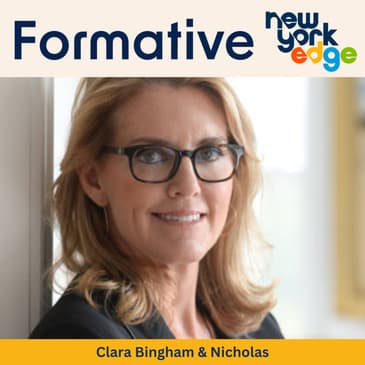

Award-winning journalist and author, Clara Bingham, joins us to kick off the season with a powerful conversation about truth-telling. Clara shares with us what first pulled her toward journalism, why the work can be both demanding and deeply rewarding, and how her focus on social justice and women’s issues has shaped her career. She also reflects on the difference between seeking fame and seeking purpose, and why she believes doing meaningful work matters most.
Downloadable transcript here
Rachael: Welcome to Season 11 of Formative, the podcast where today's leaders are interviewed by the leaders of tomorrow. This episode also marks our 100th episode. This podcast is just one of many programs New York Edge offers to help kids grow and succeed. If you'd like to support our work this holiday season, consider making a donation at newyorkedge.org/donate. Thank you. We sincerely appreciate it.
Alright, we're kicking off the season with award-winning journalist and author, Clara Bingham. She's the author of Women on the Hill, Class Action, and most recently, The Movement. Her work has centered on social justice and women's issues. Today, Clara talks with us about what first drew her to journalism, why the work can be challenging, and why she believes it's more important to do meaningful work than to be famous.
Rachael: Hello and welcome. My name is Rachael Gazdick, and I'm your host and CEO of New York Edge. On every episode of Formative, a student from our afterschool program joins me as co-host. And today I'm joined by Nicholas from P.S. 42Q. Nicholas, can you tell our audience a little bit about yourself?
Nicholas: Hi, my name is Nicholas. I'm 12 years old. I like to play PE and I like to play basketball and track. There's actually a basketball practice happening next to us at New York Edge.
Rachael: Well, thank you for taking the time to do this when you could be playing basketball. So, let's get right into it. Here's our conversation with Clara Bingham.
Nicholas: Can you tell me like what were you like as a kid?
Clara: As a kid, Nicholas, I grew up in New York City, actually just like you on the Upper West Side of Manhattan. And I also loved PE. I played basketball. I was really tall, which when I was a young girl like 12 and 13, I didn't really like that because I felt awkward, but it was great for basketball. So I was really sporty and I played basketball and baseball, and I played ice hockey. But back then, just so you know, I'm telling you more than you wanna know, Nicholas, girls were not allowed to play baseball in little league and they weren't allowed to play ice hockey 'cause it was the 1970s and um, it was considered like a boy sport. So I was always frustrated by that.
Nicholas: I get that too.
Clara: Do you like baseball? What kind of sports do you like?
Nicholas: Basketball. I only play basketball, but in the future I think of playing more sports than basketball.
Clara: Yeah, it's always good to try everything out.
Nicholas: What was your first, like, story or, like, a writing?
Clara: When I was in high school, so a little older than you. Starting in ninth grade, my high school had a newspaper that came out once a month. You know, I wrote news stories about my school in my high school newspaper, and I really loved it. And I remember even, we had to print them out and then take them to the printer and glue the story onto a big board. This was before computers were very advanced, of course, back in the old days. And get the paper printed at the printer and bring them back to school. I loved that whole process.
Um, I don't remember the first story I wrote, but I just remember how much I loved writing about my school and interviewing my teachers or whoever the class president was or writing about whatever the controversies were at the time. And that sort of is what got me interested in then later on becoming a journalist. 'Cause I was always curious and I wanted to know about all sorts of different things and it gave me an excuse to ask a lot of questions.
Nicholas: Why did you wanna be on your new, school newspaper?
Clara: I knew early on that I thought I wanted to be a journalist, and I'd say it was for two reasons. One was, my dad died when I was really young. I was only three, and he died in a car accident. And he was a journalist. And so, I always thought that I wanted to be like him, and that I wanted to remember his memory by doing something that I knew he really loved to do. So that was always in the back of my mind, that it was something that my dad did and I wanted to be like him, and I never got to know him.
But then when I was young, when I was around 10, the Watergate scandal happened. And so these two reporters, Bob Woodward and Carl Bernstein, they covered this crime. And this was an example of how journalists could have a huge impact on making sure that politicians told the truth. So I was very idealistic. I just thought, well, this is a really cool job to have that's important and can make lives better for other people.
And then I realized that I liked writing, that I liked the process of telling a story. And so, once I started doing that and I realized how much I liked it, I thought, wow, this isn't even a job. This is just a really fun way to spend my day.
Rachael: Do you still think it's really fun?
Clara: Yeah, I love it. And now I'm 62 years old, so I've been doing this for 40 years, and I still think it's really fun.
Nicholas: What's the hardest thing like about your job?
Clara: I think what's hard about it is sometimes people don't wanna talk. They don't wanna tell me their stories that I wanna know because they're embarrassed or it's something that's secret. And so then I have to encourage them to talk to me even if they don't want to. And that's hard. And sometimes I have to put myself in kind of embarrassing situations, calling somebody on the phone and they don't know who I am and they don't trust me. That's the kind of thing about being a reporter, being a journalist, that can be, be really hard because not everyone opens their door.
And so, it requires being tough and deciding that if people reject you, that's okay. That took me a long time to get used to. And when I was younger, I would be really embarrassed and upset and I'd be really shy about calling people up and pursuing a story, but I've gotten over that. But it took me a long time to not be shy about it.
Rachael: In those early days as a journalist, when you were, you know, still learning, was there ever a time you made a mistake or perhaps went through something really challenging?
Clara: I remember a big mistake I made, one of my first mistakes as a journalist, which is, I was an intern on a newspaper in the summer, and it was 4th of July. And my job was to write an article about all the things that were going on in that town, it was in a town in Kentucky called Louisville, for the front page of the paper. Here's what you can do on 4th of July. And I had been given a bunch of stories that had been in the paper the day before and some press releases, and so I just wrote everything down. And one of them was that there were gonna be fireworks on the Belvedere, which was this part of town that was near the Ohio River. So I, I put that in the story too, and I didn't check, double check it. The story ran on 4th of July morning, and then fourth of July night, hundreds of people went to the Belvedere to see the fireworks and there were no fireworks. And those hundreds of people all called the newspaper that night going, where are my fireworks? The newspaper said there were gonna be fireworks here, and there are no fireworks.
And I came to work the next day on July 5th, and everyone at the newsroom was staring at me, and I had just made a huge mistake. And it was one of the most embarrassing, I still remember it, I'll just never forget it. It was awful, awful. And it was because I didn't double check my facts. And I really learned my lesson that when you publish something, when you put it out there for the world to read, it's really good to double check. And that was something I, I tried not to ever do again.
Nicholas: So like, how do you, like, decide what to write about?
Clara: Back when I was younger, I used to work for a magazine, a news magazine called Newsweek that still exists. And I worked in Washington, DC and I had an editor who would give me assignments and I would just go do whatever my editor told me to do and write stories about all sorts of different topics in Washington, DC, what people in Congress were doing and what people in the White House were doing and different agencies…Or I'd, I'd follow a political campaign and write about whatever the politician was saying, 'cause my job was to be a political news reporter. So that, that made it a little easier when I had a job with an assignment.
And then later when I got older and started writing books, I had to come up with my own ideas. And that was always a lot harder. Because I had to think, okay, what's a topic that no one's written about yet and that I'm interested in enough to do it for three or four or five years. You know, something I really care about. I always chose something I was really interested in, and that was, I thought was, important for the public to know, and that would make a difference in people's lives.
Rachael: Could you tell us, uh, about a story that you picked to cover that really sticks out or had a lasting impact on you?
Clara: Gosh, so many of them.
One of them actually was my, um, my second book, which was called Class Action, and it was about a class action court case trial up in Minnesota in the iron mines, a group of women who worked there as iron miners, um, were not being treated well by the men who they worked with in their iron mine. And they filed a lawsuit against the mines saying we have been treated unfairly. We've been harassed. Our human rights and our civil rights are not being respected by the people who work with us. And it was the first time that women had ever done this as a group, and so I went up to Minnesota and I interviewed about 10 of them over the course of a year while they were in the middle of this really important trial, and they told me all of their stories and it was very exciting. They won their trial and they ended up changing the workplace for other women who were in jobs that weren't typical jobs for women to have. So that was a really exciting story for me to write about.
Rachael: Your book, Class Action, was later adapted into a movie. How did it feel seeing famous actors play out your work?
Clara: It was sort of the real, the ultimate dream come true. It really was because I wrote that book with a friend of mine. We wrote it together and we spent four years on it and it didn't get a lot of attention when it came out. It got a few good reviews and it sold a few copies, but it wasn't a big deal at all.
And so we were a little disappointed 'cause we thought it was such a great story and we wanted more people to read it. And then it was made into a movie. That was just amazing because then millions of people could see it and got to know that story. And for me to see this story that I worked so hard on be on the big screen, when movie stars like Charlize Theron and Frances McDormand and lots of other ones, but those two got Oscar nominations…It was just so exciting to see that something that I dug up that was very obscure, like not a lot of people knew about this case. Then to have it be a, a big popular Hollywood movie was really gratifying, you know, because it felt like I was able to get this story that was important story for women's rights out into the world, and that more people would know about it.
Nicholas: Do you know, like, what year, like, you became, like, famous and, like, popular?
Clara: What year I did?
Nicholas: Yeah.
Clara: Oh, well, I'm not famous. I guess, you know, when that movie was made, I'll never forget, it was 2005 and I was living in New York City and the ads for the, for the movie were all over the bus stops, and there was even those big posters. And on the poster at the bottom it said “Based on the book by Clara Bingham and Laura Leedy Gansler.” And so I would be waiting for the bus and there would be the poster right there next to me and there was even a billboard in Times Square and that was, that just was huge. That was really a moment.
But I'm, I'd never been famous and that's okay. I just like doing what I do, and my goal is always just to have people respect the work that I do and have the work that I do matter and help people in some way. And I think that's more important than having celebrity.
Nicholas: What's your favorite author?
Clara: Let's see. I'm gonna pick this writer named Gloria Steinem, who wrote a bunch of books, and a lot of them were about the topic that I wrote my book about, which is the Women's Liberation Movement, which is a period in history back in the 1970s when women managed to change the laws that had stopped them from having jobs that were equal and being able to play sports and being able to make money the same way that men could.
And so, she's a really amazing writer and she tells incredible stories about what she did to try to change those laws. So she's one of my favorite, favorite writers.
Nicholas: Do you have, like, any connections with other authors and writers?
Clara: Yeah, I definitely have a lot of friends who are authors and writers 'cause that's what ends up happening. You meet people who do the things you do. And I have friends who write for newspapers, I have friends who write books, who are poets. And in a way we all have a lot in common, which is our jobs can be kind of lonely. I sit in this office all day long. And so, I'm always looking for other people who understand what it's like 'cause I don't have colleagues that I work with, you know, in an office every day. It really matters to me to have friends who, who like to do what I like to do.
Rachael: Yeah, community is so important. Um, so what's the best advice you've ever received?
Clara: Let's see. I would say the best advice is never make up your mind about somebody, you know, you never know. They might surprise you. And so, I always try not to judge. And that works in my job, but it also works in my life and my friendships. Unless it's someone who's been violent or hurtful or something, I always try to find out why it is that they're doing what they're doing, instead of judging them and just thinking they're bad people.
Rachael: Oh wow, that's great advice. Lastly, if you could go back and talk to yourself at the age of 12, what would you say?
Clara: I would tell myself to do my homework. I didn't do as much work as I wish I had, and I look back now and I just, I really wish I'd taken, really embraced everything I could about being in school, and I know like everyone hears that from their parents and their teachers. But if I were your age, Nicholas, now I would've spent more time realizing this is the last time I'm gonna be in sixth grade and seventh grade. I'm never gonna be in middle school ever again for the rest of my life. And pretty soon I'm not gonna ever be in school ever again, and I'm just gonna be working. And this is my last chance. And even though I hate math, and boy did I hate math and I was really bad at it, I wish I tried harder to, like, just do everything. Because that's like the only time I, you have to learn. And that learning gives your life so much more value, gives your life so much more kind of richness.
Rachael: Clara, this has been such a pleasure. Thank you so much, and we learned a lot.
Clara: Well, it was really fun talking to you. Thank you, Nicholas.
CREDITS
Thanks for listening to Formative, a production of New York Edge. I’m your host, Rachael Gazdick. Our production partner for this series is CitizenRacecar. This episode was produced by Hajar Eldaas, post-production by Alex Brouwer, original music by Garrett Tiedemann. Thanks to the whole team at New York Edge for making this series possible. Never miss an episode by subscribing to the series at newyorkedge.org/formative or wherever you get your podcasts.