
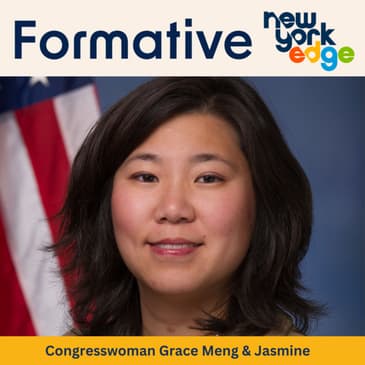

Grace Meng is the U.S. representative for New York's 6th congressional district. Today, Congresswoman Meng is joined by Jasmine, an eighth grader whose favorite subject in school is U.S. History and Government. Congresswoman Meng tells Jasmine about her upbringing in Queens and how growing up as the daughter of immigrants showed her the importance of accessibility and representation. Together, they discuss their vision for solutions to some of the biggest issues teens face today, such as climate change, gun violence and public school funding.
Downloadable transcript here
Rachael: Welcome to Formative, the show where today's leaders are interviewed by the leaders of tomorrow.
Grace Meng is a lawyer and politician serving as the U. S. representative for New York's 6th congressional district since 2013. On today's episode of Formative, we speak to Congresswoman Meng about her upbringing in Queens and about the challenges she believes her district faces today. We're so very honored to be speaking with her.
Rachael: Hello and welcome. I'm Rachel Gazdik, CEO of New York Edge. And my co-host today is Jasmine from M.S. 61K.
Hey, Jasmine, how are you? Can you tell the audience a little bit about yourself?
Jasmine: Hi, my name is Jasmine. I go to M.S. 61 in Crown Heights, Brooklyn. My favorite school subjects are math and U.S. History & Government. And when I grow up, I want to be a dermatologist.
Rachael: Awesome. So Jasmine, who are we going to be interviewing today?
Jasmine: So today we're going to be interviewing Congresswoman Meng, and I'm really excited to be speaking with her today.
Rachael: Well, we're very honored to have her on today's show. Congresswoman Meng, thank you so much for joining us.
Congresswoman Meng: Thanks for having me.
Rachael: All right, Jasmine, take it away. What's your first question?
Jasmine: So my first question is, what inspired you to be a congresswoman?
Congresswoman Meng: To be honest, I never thought that I would be a congresswoman. I didn't think that I would even run for office. Uh, I was a very shy kid growing up and I didn't even like talking in class, but I was just volunteering here in the community. I realized that government can be a really good way to help a lot of people at once. If you pass a bill or you get funding for a project at home, there can be a lot of good done through government. And so I started to get involved and ran for office.
Jasmine: That's a very interesting story. I liked how it made you want to become what you are today.
So, do you think that the era you grew up in inspired the laws that you have passed today or over time?
Congresswoman Meng: I think, definitely. I grew up my whole life in Queens. Uh, I am the daughter of immigrants. My parents came to this country when they were young adults. My mom didn't really know English. So she didn't even know when it was, like, parent-teacher conference or when there was a field trip. I had to fill out all the forms for her. And so, I really saw how they needed to depend on their own kids and friends to help them translate and interpret when they needed help.
So, it's my experience like that and many people around me with a similar experience that encourages me and motivates me to focus on issues like language access and whether people, because of language obstacles or because they're senior citizens or disabled and have a hard time being mobile, uh, or whether they're too young, wanting to make sure that everyone can understand and access what government provides for them.
Jasmine: I agree with that. How would you rate your job on a scale from 1 to 10 so far with 1 being the worst and 10 being the best?
Congresswoman Meng: Well, on some days it's a 10 and some days it's maybe even a 5. It's never too low. I don't think I would ever go below a 5. But some days, like when we get money to be able to help our community and local organizations, our students, our seniors, those are days that I like the best because I feel like I did something to help people in the long term. Bad days are when a constituent may be upset at me or they don't like the way I vote or something like that, but that's okay because I represent almost 800,000 people and we're not going to be able to agree on everything, but it's my job to hear everyone's opinions.
Jasmine: So, what is your favorite part of your job?
Congresswoman Meng: My job is very interesting. No two days are ever the same. Literally every day I get to meet new people. I hear about new projects that they're working on. I hear about problems that I didn't know about the day before. And the favorite part of meeting these people is trying to go to Congress in Washington, D.C. and trying to think of a way that we can solve their problem from the federal and national level, because if something is happening here in New York, that's probably something that's happening in another part of the country, too, and trying to find other Congress members to work together to try to solve these problems.
Jasmine: So in your opinion, do you think that global warming has gotten better or worse in the past couple of years?
Congresswoman Meng: I represent an area in Queens where we have seen the effects and the results of global warming. We have seen so much flooding, for example, on a day like this where rain is falling at a faster pace than our sewers can handle. This is not something that I thought I would work on in Congress, sewers and catch basins and flooding. But the truth is 10-20 years ago, the families in my district did not suffer from flooding in the way that they are suffering today. And so, we are seeing direct effects of global warming affecting our families. And I think two years ago, when Hurricane Ida hit, we saw many people in New York City die, even in their basements because they weren't able to get out fast enough to avoid the flooding, and that's because the water accumulated so quickly, too quickly.
Jasmine: So, what is one thing that New York is doing to combat global warming?
Congresswoman Meng: I am proud to have just, this is like breaking news for New York Edge podcast, just last week announced that we secured funding to help deal with the effects of global warming and flooding here in Queens. We are trying to revamp the way, and we're working with the city, revamp the way that rain is falling and absorbed in our grounds. So we want to make sure, like, when there's rainwater in a playground, when there's rainwater on your block, that we are building the field in a way that can absorb the water more quickly and efficiently. And then that water is pooled together and in a reserve being able to be reused in the future. So this is called a cloudburst system, but we're working with the city so that more of our space, especially in certain neighborhoods where they get flooded all the time, we're trying to change the way that the material that absorbs the rain more quickly.
Jasmine: Okay, I think that's really good. I think it'll make a big difference in what's going on with the weather.
Rachael: Congresswoman, I'm wondering if you could tell us if there's been any plans to change anything in the way schools are run in order to combat climate change.
Congresswoman Meng: Some of the ways that we've been working with our school system is to make it easier for us to have school buses, which so many kids ride on, to make them more climate friendly. We want a situation one day where our school buses can be clean and green, um, electric. And that of course is not something that's gonna happen overnight, but that is a goal of many of us here in New York City.
Um, we know that there are so many programs every day teaching kids how to advocate for better and healthier and cleaner legislation on, not just the federal level, but the state level and the city level as well. Um, so, you know, we're even making small changes, um, and there's a lot more work that we can do.
Jasmine: I agree with that. So, do you think public schools are being affected by charter schools?
Congresswoman Meng: Yeah, my kids both attended public schools here in Queens growing up. One of them actually attended a New York Edge program. Um, it was a great experience, uh, for us. And I think that while charter schools definitely serve a purpose and I understand why they exist and why families may like their kids attending, my concern is always that funding and resources are being diverted away from our public schools and away from our afterschool programs that rely on so much of this funding that goes to and through our public school system.
Uh, obviously if I had a magic wand, I would want a lot more funding for our public schools, especially at the middle school level when it really is the most formative years of your life. Uh, some kids are lucky to have a family support network to help guide them. Some kids don't have that support and that's why they really depend on the teachers and the administration and the afterschool programs like New York Edge.
Jasmine: I agree with that. My next question is, what are your thoughts on gun control and do you think anything will be done about it?
Congresswoman Meng: Gun control is one of the hardest issues and deadly issues, unfortunately, that our children, your generation, Jasmine, have had to face. Your generation is dealing with it in a way that my generation, when I grew up in New York, we never had to think about it like that. We did not have have lockdowns. We didn't know what it was like to have to practice hiding under a desk or making sure that you are out of the line of sight of a shooter in your school or church or wherever you may be. Um, it is really frustrating because even people who own guns legally, the polling shows that most of them actually want stronger gun safety measures and legislation.
It is easier in some cases to get a gun than it is to get a certain prescription drug that you may need. It's easier to get a gun than it is to get a car, and that should not be the case in the United States. This is a problem that the United States sadly is unique in leading around the globe. This is not the case in most countries around the world. And it's heartbreaking, for me as a parent especially, to have to worry if my kids every day will come home safely.
Jasmine: So how do you think we can stop teenagers, especially people around my age, from using guns?
Congresswoman Meng: We need to make sure that we are protecting our young people, and this is not just the stories that we see most often in the headlines on TV, like mass shootings. It's also in dealing with gun violence in our urban areas, in parts of New York. Those are the stories and the tragedies that we don't always hear about. And so, we know that our local law enforcement, police departments, and district attorneys, for example, they, you know, have events like gun buyback events, trying to get the guns off the streets. I was proud to secure some federal money to organizations like Life Camp, which is headquartered right here in Queens, but they do a lot of work all throughout the city to promote peace and to reduce violence. They work extensively with young people.
But there's a lot more that Congress can do. Uh, the House, which is the side where I serve, we have passed legislation in the past, but we have not been able to get legislation signed into law.
But I just want to also applaud the efforts and the energy of our young people, many in your age group, Jasmine. It is because of our young people that President Biden and Vice President Kamala Harris and the White House started the first ever office to deal with and to fight back against gun violence in this country. That is historical. And that is because of young people's voices.
Jasmine: I really do think that our voices make an impact on all the laws that are being passed.
Jasmine: When you went to school, I read online that you went to Stuyvesant High School in Manhattan. How was your experience there?
Congresswoman Meng: So, it was hard because I had to take the subway for almost two hours each way. Stuyvesant was a very large school and I had gone to a very small school in elementary and middle school. And I still remember to this day going into the lunch room not knowing anybody, just walking around with my lunch tray. Hoping that I could find someone to let me sit down with them, probably something almost every kid can relate to. And luckily, I asked someone if I could sit down with her and she let me and we became friends.
But I think, just a school that was really large and far from my house was difficult. But I did meet a lot of people, interesting people from all over the city, where some of us are still friends to this day.
Rachael: You know, I'm just curious at that age, what did you think you were going to grow up to be?
Congresswoman Meng: Oh, so actually for most of my life, I spent a lot of time teaching Sunday school at my church and I really enjoyed that.
I think for most of my high school life and even at the beginning of college, I wanted to be a teacher and to teach maybe elementary or middle school kids. Although middle school is hard because I feel like students are really going through so much and I never knew if I would be good enough. But I definitely wanted to be a teacher.
Um, by the time I went to college, you had to decide really early whether you were going to transfer to a different program to become a teacher and I felt that I was not ready to make that decision yet. So I didn't end up applying to the teachers, the education program. But, yeah, I still think about, that was really my original and first choice and first love.
I did, for the first time ever, teach a small course at NYU last year, which was really cool.
Jasmine: Are there any, like, principles or things you learned teaching at sunday school or attending church that you applied to your personal life or even your work life?
Congresswoman Meng: Definitely. It's a great question. No one's ever asked me that question.
So, a lot of people ask me who my political mentors are, and I don't really have political mentors, right? I didn't grow up reading about politics or government. I didn't know anyone growing up who was a politician, but I always talk about my grandma who is 99 years old today. Uh, we spent a lot of time with her because my parents worked in a restaurant and weren't around for most of the day or after school and evenings.So, we always went to my grandma's house.
And even though she didn't go to high school or college or anything like that, she always reminds me that to be a good leader, you have to be a good listener. And she tells me that my job as a congressperson is not just to tell people what I think, but to be a good listener and to try to solve their problems. So that's something that I really try to use every day.
Rachael: Oh, I love that. And lastly, our question that we ask everyone is if you could go back to your 13 year old self, what would you say?
Congresswoman Meng: Oh gosh, I was so timid. I was so shy I didn't like talking in class and I was always so nervous.
Sometimes, it's because I felt like I looked different from other people. Um, there weren't a lot of Asians in the classes, and I always felt, you know, out of place. Uh, as a kid, I thought American meant blonde hair and blue eyes, right? And the dolls never looked like me. The people in the storybooks and the movies never looked like me. So I always felt, oh, maybe I'm just strange or weird.
But the one thing that I've learned from that is instead of viewing that as a weak weakness or something negative, and I always tell young people when I see them now, what you think might make you different or weird could be a strength. Um, that's what makes you unique and that's what allows you to represent more people's views and to make sure that, in government, we're speaking up for everyone, not just a few people.
And so I would tell my 13 year old self to be confident in who I am and to be proud of myself, even if I'm different from someone else. And that I have very valuable stories and experiences to bring into almost any conversation.
Rachael: That's wonderful, absolutely wonderful advice. Thank you so much for sharing.
Congresswoman Meng: Thank you for having me. Great job, Jasmine.
Jasmine: Thank you, you too.
CREDITS
Thanks for listening to Formative, a production of New York Edge. I’m your host, Rachael Gazdick. Our production partner for this series is CitizenRacecar. This episode was produced by Hager Eldaas, post-production by Alex Brouwer, production management by Gabriela Montequin, original music by Garrett Tiedemann. Thanks to the whole team at New York Edge for making this series possible. Never miss an episode by subscribing to the series at newyorkedge.org/formative or wherever you get your podcasts.