
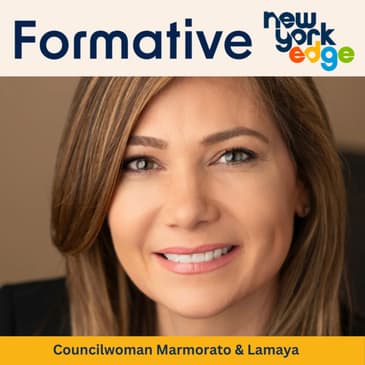
Kristy Marmorato joins us on Formative today to discuss her journey from being a radiologic technologist to now serving as the Councilwoman for the 13th District of the New York City Council. In conversation with Councilwoman Marmorato, 8th grader and co-host, Lamiya, learns about the importance of taking matters into our own hands and how far we can go as long as we foster a strong community around us.
Downloadable transcript here
Rachael: Welcome to Formative, the show where today's leaders are interviewed by the leaders of tomorrow.
Kristy Marmorato serves as the councilwoman for the 13th district of the New York City Council, representing the Northeast Bronx. She holds the distinction of being the first female Republican elected in the borough of the Bronx. We're honored to have her join us on Formative today to speak about her upbringing and her ambitious goals as Councilwoman.
Rachael: Hello and welcome. I'm Rachael Gazdik, CEO of New York Edge, and my co-host today is Lamiya from I.S. 663K. Hey, Lamiya. Can you tell me a little bit about yourself?
Lamiya: Hello, my name is Lamiya McClellan. My school is School of the Future Brooklyn in East New York. I'm in 7th grade. What I want to be when I grow up is a certified nurse. I love doing hair and participating in dance.
Rachael: Amazing. So Lamiya, who are we interviewing today?
Lamiya: Today we're speaking to Councilwoman Kristy Marmorato, and I'm so excited to speak to her.
Rachael: Yes, we're very honored to have Councilwoman Marmorato here. Thank you so much for joining us.
Councilwoman Marmorato: Thank you. Thank you for having me on today.
Rachael: Okay, great. So Lamiya, take it away.
Lamiya: My first question is, can you let me know a little bit of what a councilwoman does?
Councilwoman Marmorato: As a Council Member, I am in charge of a district, which is a portion of the city, and it's in the North East Bronx. And on an everyday basis, people who have problems with either, like, housing or HRA applications, if they need any kind of assistance, there’s a pothole, there's a street light out, they call my office and we try to get in touch with different agencies and we try to help solve these problems. Quality of life issues, any kind of problems they have on their city street, on their block. And when I'm downtown and I'm down at City Hall, we work on legislation, um, to make the city a better place. And we also have a budget that we try to help fund certain programs for the community.
Lamiya: My next question is, what does your typical day look like as a council member?
Councilwoman Marmorato: So my typical day, I get up in the morning, I help my daughter get ready for school. I drop her off at school, and then I head over to my office, and then I start my day by having meetings either in office on Zoom or sometimes I have to go to a location to meet with people.
Lamiya: How often do you interact with the community that you serve?
Councilwoman Marmorato: I deal with them every single day, every day I meet people. Even if I'm online at the store or in the deli, you know, I introduce myself to them, I ask them how they feel the community is, if they have any concerns. I'm very interactive with the people, my constituents.
Rachael: What is one of the biggest issues that you think your community is facing right now? And what do you think are some potential solutions?
Councilwoman Marmorato: We have the housing crisis here in the city where we need as many houses as we possibly can. We have a lot of people who are homeless and we need to try to fix that. We do have some projects coming to our community. Um, these large buildings and, you know, some people push back that the buildings are too big. We know that we're going to have them, but we just want to make sure that it fits for the community.
Lamiya: How did the environment you grew up in affect the way you operate as a member of city council?
Councilwoman Marmorato: Well, I just started the role, so I'm only doing this for 30 days and I hope to be the best council member I possibly can be for my community and my district.
I'm born and raised in the Bronx. I felt like there was always organizations and they provided a lot of programs for the kids in the community. It's a very family oriented neighborhood. And I just hope that I can fight to maintain that. I always loved my neighborhood and I just wanted to ensure that it's a place that I can raise my child. I didn't want to leave. I didn't want to feel like it wasn't an environment that I can be in. And I wanted to really stay here and stay here for a long time.
Lamiya: Okay. Did you, like, ever think of becoming a councilwoman? Like, how did you know that you wanted to become a council member?
Councilwoman Marmorato: Well, to be honest with you, I never thought I would ever be here. I never thought that this was going to be my path in life. I love taking care of people, that was always my calling. I had a career in healthcare. I was an x-ray technologist. And one day, I had this project come to my home and I reached out to my elected official and she was not being responsive and she didn't have to have the right answers for me. I just wanted her to be there to be compassionate and say, we're going to get through this together and we're going to work on it together. And I didn't feel like I got that response. So I said, you know what, I've lived in this community my entire life. I genuinely care about the people in it. This is the place I want to raise my child, and I really want to step up to be in this role. And I put everything I had into it.
Lamiya: What steps did you take to get into this field of work?
Councilwoman Marmorato: What steps did I take? So, do you want to know the whole process that I went through?
Lamiya: Sure.
Councilwoman Marmorato: All right. So, to start, and I know this sounds silly, but I had to start to raise money. And that was the first step, is to try to raise money to help myself get, uh, a team together. And I called every single person in my phone list, I went through A, B, C, D, and I asked them if they would help donate towards my campaign. And they did. And I was very honored that they believed in me and they did that. The second step is you have to get signatures from people in the community. I think it was 450 signatures from the people in my community in order to get on the election ballot. So I had to go out and knock on doors and introduce myself to people, let them meet me, let them know a little bit about me just in order to see if they believed in me enough to sign my petition so I can get on the ballot. And once I got on the ballot, I had to really put myself out there and meet as many people as I possibly could in my community and let them know about me, who I am and what I stand for.
Lamiya: Was there people who, like, really believed in you, thought that you had a purpose and really wanted to get you into this position?
Councilwoman Marmorato: There were a lot of people that believed in me, and I think that that was the biggest honor in this whole process, that people really believed in my message and they saw how hard I was working and then wanted to join my team and they, they helped me.
Lamiya: My next question is, what challenges did you have to overcome as a member of the New York City Council?
Councilwoman Marmorato: So, I had some challenges to get here. I have a 24 year career in healthcare, and I didn't have much of a political background. I've always helped out on campaigns and within our party, but I really felt like I wanted to run, and I just really put myself out there.
Lamiya: Now that you're in politics, do you think that you want to pursue national politics?
Councilwoman Marmorato: My focus is my community and getting through these next two years and doing the best job I possibly can. And hopefully in two years I get elected again. And then we can do that process one more time in four years. And then after that, I don't know where my life will take me. I just want to focus on my role right now, one step at a time.
Lamiya: What did you think that you wanted to be when you were growing up?
Councilwoman Marmorato: I did not know what I wanted to be when I got older. I just knew I had to make it through school because it was challenging. You know, school wasn't easy for me as a child. You know, I wanted to have a family and I wanted to be able to work full time. That's one thing that my dad always instilled in me is just to make sure you have a job and a career that you could always fall back on no matter what you want to do, you could be anything you want to be in the world, you just got to just put hard work in into achieving it.
I commend you for knowing what you wanna do at 12 years old. I know that you wanted to become a nurse. I think that's amazing and I hope you follow your dreams because we need good people in healthcare.
What kind of nursing do you think that you would be interested in?
Lamiya: Mmm…
Councilwoman Marmorato: You wanna work with babies, older people…?
Lamiya: Babies.
Councilwoman Marmorato: Babies? Yeah. And, like, where you deliver the babies or when they're little kids and they go to the doctor?
Lamiya: Um, probably both because I love kids and they're really fun to hang around.
Councilwoman Marmorato: Okay, do you have any brothers or sisters?
Lamiya: No, but I have little cousins, like, I have a little cousin. She's, I think, nine months.
Councilwoman Marmorato: Oh, so she's a little baby?
Lamiya: Yeah.
Councilwoman Marmorato: Did you change her diaper yet?
Lamiya: Yeah.
Councilwoman Marmorato: Oh, that's awesome. That's very good.
Lamiya: In your healthcare career, what challenges did you face and how did you overcome them?
Councilwoman Marmorato: So in my healthcare career, there were a lot of changes over time. I had 24 years, so when I started there was a lot of changes in technology. And, you know, the internet was new, instead of taking like a regular x ray, everything became computerized.
So, just learning the different pieces of equipment and trying to acclimate myself with them, sometimes they were challenging at times. And you just keep practicing and you lean on your co-workers and you just ask for help, you always gotta ask for help if you don't know.
Rachael: Is there anything you miss about doing that, day to day?
Councilwoman Marmorato: I love caring for people. I'm blessed where I can do the same thing but in a different role as a council member, but I miss the one on one interaction with my patients.
Lamiya: What are some words of wisdom you would have for me?
Councilwoman Marmorato: Follow your heart, put yourself out there. When people get to know you, the real you, it's a good thing, and that's when people start believing in you. Just give it everything you've got and at the end of the day, you could say I gave it my best shot.
Lamiya: Thank you.
Councilwoman Marmorato: You're welcome.
Rachael: So the question we ask everybody is if you were to go back to your 13 year old self, what would you tell yourself?
Councilwoman Marmorato: At 13 years old, I would tell myself, you can accomplish anything you put your mind to. Have the confidence and just work as hard as you possibly can.
Rachael: All right. Well, thank you so much for doing this. It was such a pleasure.
Councilwoman Marmorato: Thank you very much. I appreciate the time. Bye, Lamiya!
Lamiya: Bye!
Councilwoman Marmorato: Lamiya, thank you so much. I'll see you soon.
Lamiya: You're welcome.
CREDITS
Thanks for listening to Formative, a production of New York Edge. I’m your host, Rachael Gazdick. Our production partner for this series is CitizenRacecar. This episode was produced by Hager Eldaas, post-production by Alex Brouwer, production management by Gabriela Montequin, original music by Garrett Tiedemann. Thanks to the whole team at New York Edge for making this series possible. Never miss an episode by subscribing to the series at newyorkedge.org/formative or wherever you get your podcasts.