
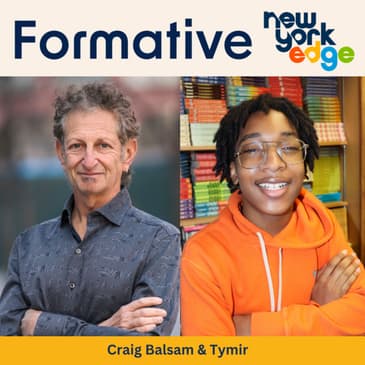

Craig Balsam joins us on today’s show! Craig Balsam is an American entertainment industry entrepreneur and Tony Award-winning producer. He is the co-founder of the children's music brand, Kidz Bop. Student co-host, Tymir, learns that businesses run on grit and reinvention. In this episode of Formative, Craig shares the origin story of his company, Kidz Bop, and how it was able to maintain its success across decades and through changing technological advancements.
Downloadable transcript here
INTRODUCTION
Welcome to Formative, the show where today’s leaders are interviewed by the leaders of tomorrow.
Formative is brought to you by the generous support of Macy's Inc. whose purpose is to create a brighter future with bold representation from underrepresented youth so we can realize the full potential of every one of us.
GUEST INTRODUCTION
Today, we’re talking to Craig Balsam. Craig is an American entertainment industry entrepreneur, Tony award winning theatrical producer and film producer. He is the co-founder of the New York City based independent company, Razor & Tie. As well as the children's music brand, Kidz Bop.
INTERVIEW
Rachael: Hello and welcome. I'm Rachel Gazdik, CEO of New York Edge, and my co-host today is Tymir from I.S. 318K. Hey, Tymir! Can you tell us a little bit about yourself?
Tymir: Hi, I’m Tymir. I’m an African-American he/him male. I speak English and I’m learning Spanish.
Rachael: So, today we’ll be interviewing Craig Balsam. Hey, Craig, welcome to the show!
Tymir: Craig Balsam?
Craig: Hi, nice to see you.
Rachael: Tymir, I’ll hand over the mic to you. What’s your first question for Craig?
Tymir: So, what was the draft of Kidz Bop? Like your starting idea for Kidz Bop.
Craig: The starting idea was, my business partner and I, at the time we created Kidz Bop, we had young kids. And we really noticed that there wasn't good music for them to listen to. We were playing them music that we liked from when we were younger. But the current pop music really didn't seem completely appropriate for them, and the only other option really was very kiddy type music like Barney or Sesame Street or something like that. And so, there was nothing in between pop music and that. And it was one of the reasons that we decided that we would try to record music for kids and use pop music as a base. That's the creative idea behind it.
Tymir: How exactly does a song become a Kidz Bop song?
Craig: Well, Kidz Bop was really created with the idea that we're going to take current pop music and put it out there so that kids can, kids and parents can feel comfortable listening to it and engaging with it. And so, there really weren't a lot of rules about what songs would go on a Kidz Bop record except, was it a hit? And could it be put out there for kids to listen to?
Tymir: Interesting.
Craig: When you were a kid, did you listen to Kidz Bop?
Tymir: Yeah, mostly.
Craig: And at what point did you decide you didn't like Kidz Bop anymore?
Tymir: Probably in fifth grade.
Craig: Sounds about right.
Tymir: So, did your group receive feedback from the makers of those songs your group would, like, adapt to be more for kids?
Craig: Very often we received feedback and it was mostly positive. When an artist makes a song, no matter who they may be, whether it's a big song, not that successful a song, their hope is that it's going to go to their audience, that people are going to listen to their music. Well, Kidz Bop was basically a vehicle for artists to have their music heard by people who might not have heard it otherwise, the kids market. So most songwriters and artists were really happy when we pick one of their songs and put them on Kidz Bop because it gave them a new platform to introduce their music to. So, 90 percent of the time that was the case. Occasionally, we would get an artist or a songwriter who was not happy that we changed the lyric or we changed the word or whatever it may be, but it was very rare when that happened
Tymir: Okay, well, how exactly would your group approach the balance between artistic creativity and commercial success?
Craig: It's an interesting question. It really is a question about where kind of commerce and art meet, and commerce and art meet at pop music. So, if it was a pop hit it was a song that was, as far as we were all concerned, eligible for Kidz Bop. And there were times where we did themed Kidz Bop records that were not based on the current pop chart. So, we did holiday records, I think we did a Kidz Bop Broadway record, we did a Kidz Bop Beatles record. We did things that were not necessarily just only pop-based, but right now Kidz Bop is very much focused on the pop world.
Tymir: What role do you see in technology playing with the future of music exactly?
Craig: Well, technology has and always will play a role in music and in the creation of art because it is generally the way that the music gets disseminated out there, right? How do you interact with music? You listen to music on an app, right?
Tymir: Yeah.
Craig: Do you listen to music on TikTok? Do you listen to music on YouTube?
Tymir: Yeah, sometimes.
Craig: Sometimes, okay. And so, the way people heard or listened to music was always a function of technology. When people first started listening to music, they listened to it on piano rolls, then they listened to it on LPs, and then they listened to it on 8 track players and cassettes and CDs, and then digital tapes. And now, they're listening to it on their computers and their phones. And that all is a function of technology and how technology works to serve art and to serve music. What's going to happen in the future? I don't know, but I will tell you that a lot of it will be heavily influenced by where technology goes and artificial intelligence.
Tymir: Okay, so, I shall assume that your brand wasn’t always popular, correct?
Craig: Yeah, interestingly it was. I mean, we first released Kidz Bop in the year 2000, the end of 2000 or early 2001. And it really took quite quickly. People were interested in it. I think both parents and kids were interested in it. So, when we first released it at retail in the stores on CD and cassette we did exceedingly well from the outset. And the big challenges were once we started to be successful, there were a lot of other companies and brands that tried to challenge Kidz Bop for the same audience.
Tymir: Well, that’s nice. So, what inspired you to start your journey in the music industry?
Craig: Well, it's an interesting question because I never thought of myself as being someone who would be in the entertainment or music industry. But when I was young, I really did love so many things about the entertainment world. I was an avid viewer of sports, listener of music. I was lucky to grow up in the New York area and I attended theater as a kid. And all of those things, and also art museums and visual arts, all those things excited me and inspired me. I ended up going to law school and thought I would be a lawyer, but that did not happen.
Tymir: So, when you did start your business, what challenges did you face?
Craig: So, I started my business, I actually mentioned earlier that I went to law school, I became a lawyer and was practicing law and basically decided with a good friend of mine from law school, who was also practicing law, that he and I would try to leave our law jobs and start a company that was music focused. And, the biggest challenge there was basically leaving a paying job and starting one that was not going to be paying me for quite a while. So, it took some conversation between us, and also we were married. And so, both of our wives, we spoke to about it because it meant, basically, changing the way we were living because we wouldn't have the same kind of money coming in. And both of them were incredibly supportive. And we left the concerns about money aside and started a music business from scratch.
Tymir: Okay, well, how would you see yourself if you did decide to finish law and all that?
Craig: I actually liked practicing law but I didn't really see it as the job that I wanted to have as I grew older. I didn't associate it with who I was or who I wanted to be. And so as a result, my buddy and I started this music business because we felt more comfortable in a space in which we were connected to art and to music and to telling stories.
Tymir: That's an awesome story, Craig. Now, how do you see Kidz Bop within the next 30 years? Do you still see it being as popular, or no?
Craig: Listen, music is a very important part of people's lives, for whatever reason, doesn't matter. Music, it means things to people. It's inspiring to them. It affects their psyche. It affects their mood. There's been a ton of research done about how music can help people heal, how it helps autistic kids. So, the fact that children will always interact positively with music, to me, is a given. It's nothing we have to worry about. If that's the case, I don't see how Kidz Bop doesn't continue to be a very successful brand long term
Tymir: So, what's your favorite form of art?
Craig: There's so many parts of art that I really like for different reasons, but I would have to say ultimately the thing that moves me the most is music.
Tymir: And what's your favoriTe genre of music exactly?
Craig: I like all different kinds of genres. I would say that I lean heavily toward liking things that are singer/songwriter-based, people telling their own stories through music. That's what I connect most with. But, I really do love listening to jazz, I like classical music and I love pop music.
Rachael: I have a question for you, Craig. It’s clear you have a passion for music. Have you ever considered being a performer?
Craig: All the time. I play music. We have a band, we play together, we perform. If you give me a mic, I'll be more than happy to hog it up all night long. I like to sing, I like to play music and I like to collaborate with other people on music. So yeah, I loved musical theater as a kid and love to be in front of the mic. If I was a better singer, I think I would have been the next Sammy Davis Jr., but I wasn't.
Rachael: So is that what you thought were going to be when you were younger? Tymir is in middle school now, so I’m curious if you had any idea what you wanted to be when you were in middle school.
Craig: Here are things that I did at that age. I wish I could tell you I'm in touch with the young me. I don't think I am. When I was younger, in sixth grade, I produced and directed a musical show. I was always writing stuff. I was always playing music and performing and having friends to my house with me. I had a number of, quote unquote, bands that I put together through middle school and high school. And even in college and law school, I was in bands. And in law school, I wrote and directed the law school show, whatever that may be. So yeah, I mean, I always did those things. I always loved doing those things. I really loved sports and entertainment so much. It really is what took up most of my time that I guess if I look backward, I would say to myself, of course ultimately I would want to be in the entertainment industry. But I wasn't thinking that when I was younger and I really wasn't even thinking that until I got out of law school.
Rachael: Totally. Tymir, do you have any idea what you might want to do when you grow up? And it’s totally fine if you don’t know.
Tymir: I'm thinking something in technology, maybe, or business.
Rachael: Do you know what kind of business?
Tymir: I'm not really sure right now.
Craig: Tymir, the interesting thing about what I ended up doing is that I actually ended up using the law degree that I had because lawyering is really about thinking a certain way and processing information in a certain way. And it gave me some business acumen as well. I took some business classes in law school so that when I started my own business, we didn't have the money to hire other people. It was just my business partner and I and we had to hire people, we were hiring people who could help us sell and market things, not people who would run our business for us. So, it really helped me learn to figure out how to run a business and I ran that business without a finance person or business person for many years. And it was interesting to learn how to do that. We made lots of mistakes. But it was, in retrospect, it was fun. I don't know, I can't tell you if it was fun then but looking back on it, it was fun.
Tymir: Interesting. So now, if you were to meet someone wanting to be like you, what would you tell them?
Craig: I think everybody should have the right and the ability to pursue what interests them and fulfill their desire to do things that connect meaningfully to who they are. And so, when we started our business, that was really what we were doing. We were thinking about who we were, who we wanted to be, what we wanted to be associated with. And then, we went out and we tried to create that for ourselves. And that's really what everybody should try to do. And it's a hard thing to do because things get in your path, they get in your way. They distract you, they move you in other directions than you want to be moved in. And there are a lot of forces that can move you one way or another, your parents, your teachers, money, change in circumstances, change in location. So, it's not an easy thing to give advice on.
But what I would say is that everyone who has desire to do something or be something should create a plan to do so and try to follow that plan. But understand that they're gonna have to, you know, stray from the plan. It's not going to go exactly how you want it to go but as long as you have an overarching idea of where you're going, the zigzags and changes you make along the way should not really affect the end goal. And so, focus is a really important part of that. And not allowing yourself to be wildly distracted by things that take you off the path that you really want to be on.
Rachael: Okay, so we always end with one question. If you could go back and speak to your 13 year old self, what would you say?
Craig: It's funny you asked that because we were just talking about how I don't think I have a very good sense of who the 13 year old me was. But I guess I would tell myself not to be so stressed and meticulous about everything. Although, I think that somehow that also helped me to be a little bit controlling and a little bit perfectionist in the way that I approach things. So, while I would advise myself to not take it all so seriously and be so intense about things, I actually think that being some kind of intensity and focus is a very positive way to be as well and it helps you move forward.
The other thing I would say to myself is I think I really could have used my time better. And a lot of older people will tell this to you but, spend more time and listen to people who you trust and who you look up to because they can be very helpful to you in shaping your life and your focus and your work.
Rachael: Well, thank you so much for joining us. It was a lot of fun learning about you. And Tymir, thank you so much.
Craig: It was nice to speak to you both, meet you both. And Tymir, good luck to you and everything that you're working towards,
Tymir: Thank you, Craig. It was nice talking to you, too.
Craig: Hopefully someday we'll meet in person.
Tymir: Yeah, hopefully
CREDITS
Thanks for listening to Formative, a production of New York Edge. I’m your host, Rachael Gazdick. Brought to you by the generous support of Macy’s, Inc. Our production partner for this series is CitizenRacecar. This episode was produced by Hager Eldaas, post-production by Alex Brouwer, production management by Gabriela Montequin, original music by Garrett Tiedemann. Thanks to the whole team at New York Edge for making this series possible. Never miss an episode by subscribing to the series at newyorkedge.org/formative or wherever you get your podcasts.