
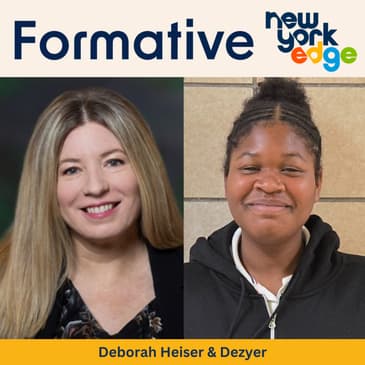

Dr. Deborah Heiser, developmental psychologist and founder of The Mentor Project, joins middle schooler Desire to talk about the power of mentorship. Dr. Heiser opens up about her most challenging moments as a CEO, how her mentors helped her along the way, and why it's crucial to have different mentors for different chapters of your life. Whether you’re the one giving advice or receiving it, this episode is about how we all need a little help to grow!
Downloadable transcript here
Rachael: Welcome back to another episode of Formative, the show where today's leaders are interviewed by the leaders of tomorrow. With us today is Deborah Heiser. Dr. Heiser is a developmental psychologist and the founder of The Mentor Project. We speak to her today about the value of mentorship and what it takes to get the most out of our relationship with people of all ages. We are very excited for this conversation.
Rachael: Hello and welcome. I'm Rachael Gazdick, CEO of New York Edge, and my co-host today is Desire from M.S. 61K. Desire, can you introduce yourself to our listeners?
Desire: My name is Desire. Uh, I'm 14, in the eighth grade. I like dance, art and singing. And yeah, I'm just happy to be here.
Rachael: Awesome. And who are we speaking to today?
Desire: Today we're talking to Deborah Heiser. I'm excited to speak to her.
Rachael: Oh, we're very excited. Deborah, thanks for joining us.
Deborah: I love your show and I'm really excited to be here. So thank you for having me.
Rachael: So Desire, what's your first question for Deborah?
Desire: Um, so can you tell us a little bit about your project, The Mentor Project?
Deborah: Sure. So it started because I was looking at why in the world would anyone wanna give back all their time and their expertise and their energy. I am an applied developmental psychologist, so I look at the lifespan from birth all the way to the end of life, and I really specialize in the second half of life. So I moved from being a researcher, looking at everything we never wanna have, like Alzheimer's disease and depression and frailty. And I started to look at all the things we want to have when we get older that make us feel really good, like how we give back to others and make our, um, make our legacy.
And so in doing so, I was talking with, um, mentors, you know, from grandmas to four star generals, to see why they like to do it. And it turned out that they all had basically the same reason for wanting to do it, and they felt really good about giving back. So when I was talking to one person, Bill Cheswick, he's one of the fathers of the firewall, he said, I really wanna get in front of students and I want to get them before they think they can't do science and math, like when they're in elementary school. And it turned out he was retiring. He lives on a farm, and he is never around younger people. So we decided to start the mentor project to get Bill and other people like him in front of students.
And so our organization went from just a few people to now having more than a hundred mentors and a waiting list of people from astronauts to well-known artists who give back their time to students around the world. We’re in more than five countries now and we've reached about a hundred thousand students around the world. And we donate, I'd say, about more than $2 million a year in mentorship hours. So our organization is all people who are really having a great time connecting with others and sharing their expertise.
Desire: All right. Uh, what were the biggest challenges you faced while you were, like, making The Mentor Project, like conflicts that you had went through in the middle of starting it?
Deborah: Oh boy, I'll tell you that. So when we started, it was August of 2019 and we had just seven people or so, and we moved up to about 10 people by the time December came around. And we were having a good time. We thought that was all that it was gonna be, was 10 people going to schools and mentoring people.
Then March came and the pandemic came, and then we thought, that's it, we're done. The schools are closed. How are we ever gonna mentor anyone? And none of us were really using Zoom at all. And so what happened was at that moment, we had 60 new people who wanted to become mentors, and we had students around the world who wanted to get connected. And I thought, oh my goodness, there aren't enough hours in the day to make this happen. I thought…first the pandemic hit and I thought, we're gonna, we're never gonna survive this because no one's gonna, there are no schools and no ability to get in touch with mentees. Then we had so many people that wanted to connect that we thought there's no way we can handle it.
So the biggest challenge that I'd say we had was pivoting when we had like a riches of too many good things that came to us and I had to reach out to every person I knew that could help to make it run. And I'll tell you, we had people come from all over the place that volunteered their time to make sure that the company ran, because I'm not a businesswoman, I'm a psychologist. I didn't know how to do a lot of the things, so I got to experience, my biggest challenge was that I had to sit and say, I need a mentor. I don't need just one. I need about 10. We got through it because of those mentors who helped me during that time, who stayed on and are now part of the company that are moving it forward. Um, so it was actually, looking back, it feels like that was a gift in a way, even though it was the biggest challenge I think I've ever faced.
Desire: Okay. So was there ever a situation that, like, a kid wasn't, like, willing to talk or like they just didn't wanna talk to you guys? And if there was, um, was there a way that you guys could, like, was there a way that you guys got the student to talk?
Deborah: Yeah. You know, I'm so glad you asked that question because so many people, myself included, feel like, oh my goodness, I have to come with questions. And I'm the first person that knows that I don't know what I don't know. So how can I ask a question about something that I don't know about? So yeah, that happens all the time. What we suggest is that you have a conversation with the person. You don't have to talk about a topic like psychology or being an astronaut or astrophysicist work. You know, you don't have to talk about any of that stuff. Just talk with the person as a person and see if you find that there's something interesting, and then the questions will follow. So yes, students come in all the time and they may not have questions that they have formulated, and they might come in feeling awkward or like, oh, someone's gonna think I'm not smart, something like that. But that never ends up being the problem.
Sometimes though, we do have people who say, “you know what? I met with that person and I wanna meet somebody else. I just…” It's not that they don't like them, they just didn't match up well. So what we do is we suggest that people meet with as many as you possibly can. We don't say meet with a mentor. We say meet with five mentors, meet with six. Because you never know, you might end up finding out that you love something like astrophysics, and you didn't even know what it was. So we suggest that students meet with as many as possible, and then you don't have to meet again with the ones that you don't think you have anything in common with. People don't get offended by that.
Desire: All right. I know you have a book coming out soon. Can you tell us more about your book?
Deborah: So The Mentorship Edge really did come from all the work that's been done with The Mentor Project and what we've learned. Um, and so the book is about what is mentoring and what isn't it. So a lot of people think that mentoring and coaching are the same thing, or that mentoring and networking are the same thing. People think that mentoring is only someone who is above you, you know, like a teacher or somebody who's a level above. But I'll tell you, Desire, I bet you mentor all the time, and I bet that you are getting mentorship all the time from people who I call lateral mentors, fellow students, people who you're friends with, family members, cousins, anybody that knows something that you don't know, that is better at something than you are, or that you are better than them at something, and then you give them advice, you guide them in a way. We're all doing that.
So I talk a lot about the different forms of mentorship as well. So hierarchical mentoring, that's the kind that we think of with The Mentor Project. Lateral mentoring, which is the kind where you're mentoring those who are around you or it's more informal. Peer mentoring. And it's talking about the stories of how mentoring looks in all of those different ways from mentors in the workplace, in the home life. So there's a story from a grandma who raised her grandchildren. Um, it's stories of astronauts and famous writers and other people who've done a whole lot of different things and where the different forms of mentorship look in each of those stories. And it gives some examples of how people can use mentorship in your life, whether it's at work or at home or at school.
Desire: All right, so you just gave a lot of details on, like, what is mentoring, but what's not mentoring? Like, what don't you do?
Deborah: So that's an amazing question, most people never ask that. Um, I'm gonna give you a quick breakdown on what mentoring is. Mentoring is, has to come from the mentor, right? The mentor has to want to give information to somebody, expertise, knowledge, values, skills, something like that. And it has to come from a desire to give that without expecting anything in return. So if I were to say, hey Desire, I'd like to share this with you but I really would like you to gimme some money, or I'd like you to do something for me later, that's not mentoring. Mentoring is, I would say, Desire, I see this potential in you.
I wanna give this information to you. I want you to have this skill so that you can go succeed in whatever it is that you're doing.
The other thing it needs is intrinsic motivation. So both the mentor and the mentee have to want to do this. And what that means is that you're not doing it to get a better grade, you're not doing it to put something on a resume to go to college. The mentor isn't doing it because their job is telling them they have to do it. And the example that I give to make it so people can understand this, um, very clearly is if I were to ask you, would you like to go volunteer your time in a soup kitchen? You might say, yes, I'd like to do that. That's an intrinsic motivation. You're not getting paid, but you're gonna feel so good when you're helping people who want food and beverage. Now, if I were to ask you, Hey Desire, would you like to go volunteer your time at Starbucks? You would probably say no, because you'd be expecting to get paid for that. You'd feel maybe foolish sitting at Starbucks giving out food and beverage to people while everyone else is getting paid. So pay is an extrinsic motivator. If you are getting paid, you are not mentoring. It has to come from within.
You also have to have a meaningful connection. If you don't care about your mentee or the mentee doesn't care about the mentor, then there's really not a relationship there. If somebody's just saying, alright, I'm gonna go meet with this person 'cause I wanna get some information 'cause I wanna get ahead. That is not a mentoring relationship. That's somebody going and trying to get information from somebody.
And the last thing you need to have is a goal. If you're just chatting, that's not mentoring. You need to have a goal that it's either to become somebody who gets information on how to get further ahead in some skill or something. Whatever it is, there has to be a goal. So a mentor is someone who is encompassing all of that, is not getting paid, is not doing it because they think their job wants them to, isn't doing it 'cause they think they'll look better in the eyes of someone else. It's someone who's doing it even if no one will ever find out that they were ever doing it.
Desire: So when you were a child, did you ever think that you would be, like, a CEO or did you ever think that you would wanna be part of something like this, like part of The Mentor Project?
Deborah: No, and I'll tell you one of the things that I'm most proud of is that, you know, I, I grew up in Iowa when I was young and all of my family was there. I don't have any other family in New York. I didn't have any family who was a CEO, I didn't know what that was. I never knew what a psychologist was until I was 20 and my grandmother was depressed. I didn't even know what that word meant. And we went to her assisted living facility and said, there's something wrong with grandma. And they said, we'll fix her. She has depression, that's fixable. And I said, I wanna be a grandma fixer. Uh, I thought I was gonna go run around and fix all the grandmas who were suffering from depression.
But no, when I was a kid, I really never thought of a career at all. Like, I didn't know what I would do. I figured I would work and that wouldn't, that just meant I would get a job and it didn't have a passion attached to it or a plan attached to it. Nothing like that. I never anticipated going to college. Neither of my parents went to college, so I didn't know that, it just wasn't in my vocabulary of what was part of my future. My future, I felt when I was young, was I will grow up, I'll get a job, and I will work. So it's very exciting to me with The Mentor Project to know that when students around the world, say in Iowa and other places where they don't see astronauts, they don't see people who have jobs that have changed the world, they might be able to start getting excited about those things earlier than I did, like 20 years earlier than I did. And that's what really excites me.
Rachael: Oh, I love that. Okay, so the last question we have for you, if you could go back and speak to yourself at 14 years old, what would you say?
Deborah: I would tell myself to look at every single thing in life as a door that is open, that you can walk through, because I did not know at 14 that, that I could walk through doors that opened. I was afraid. I had a lot of fear that I would walk through a door that would open for me and that I would somehow fail or that I was inadequate in some way. And none of us is inadequate and we should walk through every door we see that opens for us.
CREDITS
Thanks for listening to Formative, a production of New York Edge. I’m your host, Rachael Gazdick. Our production partner for this series is CitizenRacecar. This episode was produced by Hajar Eldaas, post-production by Alex Brouwer, production management by Gabriela Montequin, original music by Garrett Tiedemann. Thanks to the whole team at New York Edge for making this series possible. Never miss an episode by subscribing to the series at newyorkedge.org/formative or wherever you get your podcasts.