
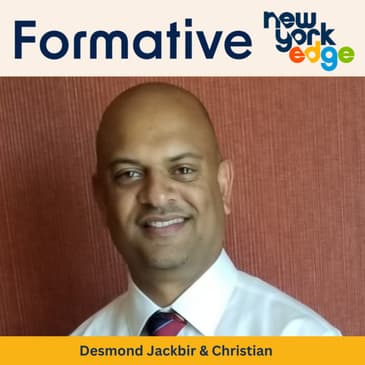

On this episode of Formative, Desmond Jackbir and middle schooler, Christian, talk about how we can merge our passions and make dream careers for ourselves. Desmond is a Director of Network Field Engineering at Verizon. He shares with us how he got to be working at Verizon for the past 25 years and why he believes technology is a reliable career that can be paired with any passion, from cooking to sports.
Downloadable transcript here
Rachael: Welcome to Season 8 of Formative, the show where today's leaders are interviewed by the leaders of tomorrow.
Today on Formative, we're joined by Desmond Jackbir. Desmond is a Director of Network Field Engineering at Verizon. He's been at Verizon for almost 25 years, and we talked to him about what it's like to grow at one company. He also shares with us what he believes can prepare young people for tech careers in today's market. We're thrilled to welcome Desmond Jackbir on our show today.
Rachael: Hello and welcome. I'm Rachael Gazdick, CEO of New York Edge, and my co-host today is Christian from M.S. 522K. Christian, can you introduce yourself to our audience?
Christian: Well, I'm funny and I love playing basketball. And I'm very smart, caring, polite, and very supportive. When I'm not in school, I love skating. My favorite game is the Legend of Zelda in Minecraft, the Legend of Zelda Breath of the Wild.
Rachael: Wow. Thank you for that amazing introduction. So who are we going to be interviewing today? And are you excited to speak with him?
Christian: We're going to be interviewing Desmond and yes, I am. I am very excited.
Rachael: Awesome. Well, let's bring him in. Desmond, welcome and thank you so much for being here.
Desmond: Hello, Christian.Hello, everyone.
Christian: Hey, Desmond.
Rachael: Christian, I'm going to hand it over to you. What's your first question for Desmond?
Christian: My first question, what do you do as a Verizon engineer?
Desmond: Okay. That is a, that's a great question. Verizon is a big company. You may have seen commercials and stores and things like that. There's lots that we do.
So one of the cool things about Verizon is you can do different kinds of jobs in the one company, Verizon. You don't have to be an engineer. You could be a finance person helping with the finance side of the business. You could be a marketing person helping with the marketing side of the business.
But for me, being on the technical side and being involved in the wireless networks, I've had probably 12 or so different jobs over 24 years at Verizon, where I've gotten the opportunity to do different things that were related to the wireless network. So if you think about your cell phone and all that it has done to get faster, to do more functionalities, to work everywhere that you want it to work.
I've been able to participate in New York, New Jersey, Texas, Arizona, and now more recently in North Carolina, South Carolina, and Tennessee on doing different things to help support the network that the phone works off of. So the ability to search what you want to search or listen to your favorite song or play games that are over the internet on your phone, if you're on a Verizon Wireless network in North Carolina, South Carolina or Tennessee, I am the ultimate responsible person that my teams are responsible for keeping that network up and running, making sure that we invest and build more network. So that people that use a Verizon wireless phone can always have the network when they need it.
So I've done a lot of different technical jobs that's positioned me to be a leader of the business today, responsible for the wireless network.
Christian: That's a great way to put it.
Desmond: Thank you, Christian.
Christian: You're welcome. What made you want to be a Verizon engineer?
Desmond: Uh, I, um, when I finished my trade school that focused on electronics, I did get a job working on circuit boards and electronics and the person that I worked for, he was the, he was an engineer and an owner of this small company. And before that, I didn't even know what an engineer was, but the fact that he could look up information and I was troubleshooting the things he created. I thought to myself, well, I could do that too. Maybe I should go back to school. So that was what inspired me to go back to school.
Um, when I was in school for engineering, I, I did a class that involved wireless communications and it felt magical to me to know that I could talk and wirelessly it would end up somewhere else and I really fell in love with that technology. So I got a chance to be an intern at Verizon towards the end of my school career and, and they offered me a permanent job and I really enjoyed wireless communications. And, um, I told them during my interview that I get bored easily, um, because I'm like you, I think I'm smart too. And they told me that I would never be bored. And I can tell you 24 years later, I've never been bored while working here. I still enjoy it.
Christian: Can you tell me some of the challenges that you think your industry will face?
Desmond: Yeah. So I think that in 10, 20 years, I wish I knew how exactly it was going to evolve. I can tell you that we experienced it during COVID, how critical communications, technology communications are to society, to the way the world functions. I don't see that being less important as we move forward into the next 10 to 20 years. I see that being an even more critical component when you look at things like autonomous vehicles and different autonomous ways of delivering things through drones. I think that technology and the way that technology allows for us to evolve, I think that'll continue to be important and I can only envision that wireless communications will continue to be a part of that.
Um, as far as what I think is equally important is while we do those things and while we evolve, how we do things responsibly, socially responsibly, responsible for the environment and do things to help protect the earth is equally important. So I think us being smart about the decisions that we make and keeping society and the environment as important as everything else, I think is going to be good for everyone. So that's kind of my vision.
Rachael: You know, Desmond, I wanted to ask, you know, it's very rare these days when someone is with one company for such a long time. You've been with Horizon for 24 years. How does that feel?
Desmond: Yeah. I've done something different at Verizon every two to three years. So because there's so much opportunity that while the entity is the same, that you don't feel like you've been doing one job the whole time.
So I think just the different amount of opportunities that you could do, you can pursue different passions without leaving the company. So I think that flexibility is encouraged and supported. So I think the tools and the mechanisms like I've lived in five different states in this country all through support from Verizon. So it wasn't my intent. I never planned on leaving New York, uh, to be honest. Um, but the opportunities were there and I had the support that I needed to do it.
So I would say that in terms of probably one more thing is the culture. The culture of Verizon as always, I've worked in different places. I'm literally six weeks into this new role in Carolina, Tennessee. And, um, one of the things that's been consistent is the culture of Verizon always feels like a family environment and maybe a different family. But the way that people interact together and work together and feel ownership and responsibility and the importance.
While we're not emergency workers, when your phone doesn't work, there's a lot of bad things that could happen. And I tell you, the people that I've worked around for 24 years. Take their job very seriously and really enjoy knowing that what we do helps people stay connected. And so, that mission has always been a value point of me and the way people work together. It felt good. So, um, so that's why the 24 years kind of felt like two years.
Christian: Have you ever thought of leaving and doing something else?
Desmond: Um, I probably have thought about it once or twice for a half a day in that 24 years, but, uh, really, and truly I've never been bored here. I've always felt, you know, what I do is valued as a person and the work that my teams and I produce feels valued. So I think I've just never really felt like I needed to do something different.
If I did do something different. I love to cook. I think I would try my hand at opening a restaurant. So not technology related at all.
Christian: What do you want your life to look like in 10 years?
Desmond: So over the next five years, I plan to make a significant impact in the leadership role that I was given the privilege to hav—the resources, the capital budget, the things that Verizon has empowered me to lead on their behalf, I plan to make great positive impacts with those, with those resources. In the five years to follow, my passion for leading people and leading business, I think it's just going to grow. So I think scaling to other larger areas of leadership and impact are things that I envision.
And then giving back, volunteerism, being able to spend time, inspiring people through my path and my story and, you know, really sharing as much as I can to help people prepare for technology careers, corporate careers. The wisdom that I've gained through life experience, I want to share that as much as I can with anyone that is willing to listen to me. I'm not waiting for 10 years for that, but starting today. So thanks for having me on with you all.
Christian: If someone like me wants to start doing something new technology, what would I need to do to prepare myself?
Desmond: So I would say the first thing you can do is marry one of your passions with that goal of being in technology because there's almost no industry out there that technology isn't important to them. You talk about basketball, you love basketball. Well, you could be a basketball player, or you could be a CTO, a chief technical officer of the New York Knicks basketball team, who's making technology decisions on the technology before the New York Knicks or for the NBA. So technology is an important part of any kind of industry. So the really cool thing about being in, uh, about having a passion for technology is that you can marry it with something that you already naturally enjoy and make a career out of it. So that would be my advice. You don't have to do one or the other. You can do technology and art. You can do technology and cooking, quite frankly. You can do technology and everything.
Christian: Where were you born?
Desmond: I was born in Queens, New York, Jamaica hospital to be exact. So I was born there, my three sisters were also born in New York. Both of my parents are from the Caribbean. They were from an Island, Trinidad and Tobago. So while I was born in New York, a lot of my family still lives in Trinidad and Tobago.
And so I grew up with a lot of Caribbean influence in my life. And growing up in New York, there's a lot of different cultures, uh, including Caribbean culture in New York. So it was very unique as I've moved around the country with different jobs, um, there really is no place like New York in terms of how many different cultures work and live together in the community.
So, um, my dad still lives in the same house that I was born in. So I'm still a New Yorker to my heart.
Christian: What was your goal as a kid before you wanted to be a Verizon engineer?
Desmond: Ah, what was my goal as a kid before I wanted to be a Verizon engineer? That is a hard question.
Instilled in my family, I always wanted to be a good person. And so no matter what I was going to do for a career, being kind and good to people has always been important to me. Um, so I would say that it starts with that, the way that I've kind of evolved as a person into a young man and now, you know, as an old man, that's never changed. I still hold near and dear the importance of treating people nice, treating people fair, helping people wherever I can. So I've just, I've always just wanted to be a good person in this world.
Christian: Did your family support your dream as a kid?
Desmond: Yeah, my mom and dad absolutely supported me in pursuing academics. So anything that I wanted to do in school, they were absolutely, uh, willing to support me with. And so I, I actually, before I went to college, I did a trade school that was focused on electronics. And my dad was very supportive and he took me down to the school and helped me find out about it and I got signed up for it and I did that course and that helped me get started. But later in my work career when I decided I wanted to go back to college and actually get an engineering degree, my family and my friends were very supportive of what I was going after and helped me in any of the ways that they could possibly help me. And to this day, I appreciate everything they've done.
Christian: What age did you start working?
Desmond: That's a great question. I started working at the age 14. My very first job was working, um, I had a working card that allowed me to work a very limited amount of hours a week at that age, but I worked stocking shelves at a health food store near the Green Acres mall in Valley stream, New York. I used to take the bus, two buses to get there and go to work on the weekends and when I had holidays. And then throughout high school, I got an opportunity to do a co-op where I could work in kind of a handy field at the same time. So I actually ended up with two jobs. But that was my very first job was stocking shelves at a health food store at the age of 14. I can tell you what my wage was as well. It was $3.35. I'll never forget it.
I'll ask you a question, which is, do you know at age 12 what you would like to do when you get older?
Christian: Uh, what I would like to do when I get older is become a marine biologist.
Desmond: Wow. If you can, what has inspired you? What does a marine biologist do, by the way?
Christian: A marine biologist studies animals and gives all that information to scientists to study about that animal more.
Desmond: Oh, nice. Very cool. Well, that's amazing. I'm sure that you will be a marine biologist and a great one at it. So keep doing all the hard work that will get you there.
Rachael: Christian, I know you have some questions for Desmond about middle school, but I first want to know what has your middle school experience been like so far as a sixth grader?
Christian: My middle school experience so far has been pretty good. I've made more friends. My grades have been going up more each time. Uh, I want to know, what is, what was your middle school experience?
Desmond: Yeah, so Christian and I are the same. I had a lot of friends in school where I'd like to laugh with them. So I had a lot of friends. The teachers always spoke positively about my behavior. I probably talked a little bit too much in class, I remember that comment. And then I probably was a little bit lazy and I could have done a little bit more to get better grades when I was in sixth grade. You could probably argue many grades, but if I could talk to myself back then, I would have tried to learn, uh, done even better. But yeah, that's where I think I was.
Christian: What was scary for you in middle school?
Desmond: So at that age, my anxiety was probably about going to high school. It was going to be with the whole new level of people, all new kids, um, that I didn't know. I didn't know what to expect. So my biggest anxiety at that age is probably about going to high school, uh, because that was the next big step that was coming in front of me.
Rachael: So our last question for you, Desmond, is if you could go back and speak to your 13 year old self, what would you tell him?
Desmond: Save and invest would be one. Um, you can have financial freedom and business ownership is possible.
Rachael: Great tips! Thank you so much for joining us today and answering our questions.
Desmond: Thank you all for the time and for hearing me and Christian, you did an amazing job. I can't wait to see what you do in the future.
Christian: Thank you. And also, thank you for your time for answering my questions and also giving me questions.
Desmond: You're very welcome.
Christian: Bye.
CREDITS
Thanks for listening to Formative, a production of New York Edge. I’m your host, Rachael Gazdick. Our production partner for this series is CitizenRacecar. This episode was produced by Hager Eldaas, post-production by Alex Brouwer, production management by Gabriela Montequin, original music by Garrett Tiedemann. Thanks to the whole team at New York Edge for making this series possible. Never miss an episode by subscribing to the series at newyorkedge.org/formative or wherever you get your podcasts.