
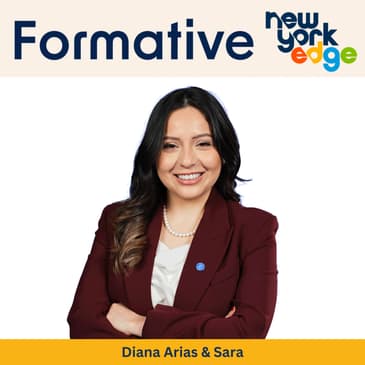

Diana Arias, Director of Communications at the New York Jobs CEO Council, joins middle schooler Sarah to share how curiosity and creativity helped shape her career. From writing and storytelling to producing videos and social media content, Diana explains how a career in communications can open doors and help people connect.
Sarah learns how trying new things, even in small steps, can lead to unexpected passions, why mistakes are part of the process, and how skills like talking, listening, and thinking outside the box can land you an exciting career.
Downloadable transcript here
Rachael: Welcome to a new episode of Formative, the podcast where today's leaders are interviewed by the leaders of tomorrow. Today our guest is Diana Arias, Director of Communications at the New York Jobs CEO Council, where she helps connect New Yorkers to career opportunities at some of today's biggest companies.
Today, Diana talks to us about her journey into communications, what it means to tell stories that create opportunity, and how creativity plays a role in her work every day.
Rachael: Hello and welcome. My name is Rachael Gazdick, and I'm your host and CEO of New York Edge. On every episode of Formative, a student from our afterschool program joins me as co-host. Today, we've got Sara from PS42Q. Sara, can you tell our audience a little bit about yourself?
Sara: My name's Sara, and what I like to do... I like to eat a lot and sleep a lot, because sleeping is my favorite thing to do.
Rachael: Same here, Sara. Same here. All right, let's go talk to Diana.
Diana, welcome to our show.
Diana: Thank you for having me on. I'm excited to be here.
Rachael: Great. So Sara, what's your first question?
Sara: What is a typical day like in your role?
Diana: So right now I am the Director of Communications at a nonprofit called the New York Jobs CEO Council. We are an organization that helps everyday New Yorkers,like you, me, people who grow up in the city,get jobs at really big companies.
So think about the Googles of the world. Think about JPMorgan Chase, where you do your banking. All these different companies that you see every day, or like Amazon, where you get your packages from. We want people like you, Sara, and me to work at those organizations and companies.
And we do that by making sure that when you are ready,like when you're in college,you get all the resources that you need. And that means anything from people coming to your class and talking to you about what kind of jobs they do every day, maybe even bringing you to their office so you can learn about all the different jobs they have at their companies.
And yeah, so that's my job. I'm lucky because I feel like every single day is very different. As the Director of Communications, I can do anything from maybe prepping my boss, who's the executive director, to go on TV and do an interview with a news person. Do you watch the news?
Sara: Yeah. Sometimes.
Diana: Yeah. So sometimes they do stories about things happening in New York City, and I get to prep my boss and have her be on camera talking about the work that we do. So I think that's pretty cool.
Sometimes I get to produce videos that tell people what we do as an organization. So I can make a script. I can write what we call talking points,basically what people say when they're in front of a camera.
And then I get to make really fun social media videos with my team. Sometimes we come up with a really fun idea, whether it be something we see on TikTok or Instagram, and we make it come to life in a way that engages you and makes you stick around and follow our page on Instagram.
So my day varies, but every day is exciting. Today I was at Google, and other days I'm just in the office on my computer writing.
Sara: Hmm. Sounds great. What sparked your interest to get into the communications industry?
Diana: So my interest started when I was younger, right? I started reading and writing a lot. I think my favorite subjects in school were always writing or English. I loved history because I feel like you read different stories and learn about different things.
And when I went to college, I picked a major that was in that space. It was something like public affairs, where I got to learn about history and policy and the rules and laws of the city and how to help people. So that kind of inspired me.
I also liked helping people. I don't know why, but I care about people and making sure that my friends are okay, that my neighbors are okay. And so that's something that inspired me in my career.
When I started my career, I actually started in social impact or program management within a company. For instance, I started out at JetBlue. Do you know what JetBlue is? It's an airline.
Sara: Yeah.
Diana: Yeah. So I worked at an airline, and I worked with the community impact team,the social impact team. Basically I was helping people like you, Sara, from kindergarten all the way through high school get inspired to become pilots or technicians.
I also ran a program called Fly Like a Girl, which is very different from what I do now. And I didn't know it then, but I really liked the communication aspect of that work. I liked writing and talking about what we did and showcasing it to different people.
Sometimes that's a picture and a write-up on a page, or literally writing a story about what happened, and I really liked it. I was interested and curious, and I was like, “What if I changed my mind? What if I wanted to do more of this writing piece? What if I wanted to do more creative work, like putting photos together from events and showing them to the world?”
And so it was a little scary at first, changing my career a bit, but I took little baby steps. You know when your mom makes you try a new dish or a new food and says, “Just try a little bit first”? I feel like I tried a little bit first, and then I got into it and found out that I really liked it.
Now that I'm older, I'm like, “What else can I try? What else would I be interested in doing?” So I'm always thinking about that. I think curiosity is a skill, and we're always thinking about, “Oh, what could I do next? What am I interested in? What can I learn that's new that I don't know?”
Those are the things I think about every day about my career and what I wanna do. Sometimes it can be scary, but you can try things in baby steps.
Sara: What are you most proud of in your work?
Diana: I am most proud when students tell me that they heard about the Jobs Council through some of the things that I do every day.
I don't know if you're familiar with Instagram ads or ads in general,like TV ads and things like that. Sometimes what I get to do is create some of those ads that you see online or on social media, sometimes even on TV.
And when students tell me,like the students today at Google,that they heard about the event through a Facebook ad or an Instagram ad, I'm like, “Oh my God, great. That was me. I did that.”
So that makes me really proud, knowing people are there at those events because of me.
Sara: What challenges have you faced early on in your career?
Diana: I think since I was a kid... actually, I'm an alumna of New York Edge. When I think back to when I was your age,maybe eleven or twelve, when I did New York Edge at my local middle school,I didn't know what I wanted to be when I grew up. I didn't know what I was good at.
Some of my New York Edge Champions Club teachers would say, “You are really chatty. You like talking to your friends.” And I didn't know it at the time, but being someone who can talk a lot is a skill. Being someone who can have conversations is a skill.
Why? Because you can captivate someone's attention, you can talk to them for a long time, and you can become friends very easily.
So something that really helped me at the time was realizing that was a skill. Some of those skills really helped me in the long term. And as I got older and was able to write more and be more creative, I was able to use some of those skills to figure out what career path would work for me.
I reflect really fondly on being able to be at New York Edge, do fun activities, and be creative, because it helps me every day in my job,just being able to think outside of the box.
Have you ever heard the term “think outside the box”?
Sara: Yeah.
Diana: Exactly. Thinking differently than other people so that we can solve challenges we see every day or help people.
Sara: I know that you're a leader in your organization. What are the skills for someone to become a leader?
Diana: That's such a good question. As a leader, I feel like some skills I've learned along the way are really understanding what's important to the organization, but also being patient. You have to be really good at listening to others, and you have to be really good at asking people for things and giving guidance.
Like, if you ask someone for a pencil and they come back with a pen, you kinda have to be patient and say, “Thank you for the pen, but I actually asked for a pencil.”
So it's about being able to talk to people, guide them, and also help them grow. If someone comes to work with me and says, “Oh, I'm really interested in taking photos, but I don't know how to do it,” I have to teach them, be patient, and guide them along the way.
I think that's something really fun about being a leader. You get to teach, help guide, and help grow the potential you see in people.
Sara: How can students learn more about your field?
Diana: I think students can do a lot of different things. I think you yourself are doing something that I would consider part of the communications world, right? You're a podcast host, so that's pretty cool. That falls into modern-day communications.
Does your school have a student paper?
Sara: Yeah.
Diana: So you can get involved with your student paper. That's another way to get involved in the communications field.
There are so many different aspects. You can also be a photographer. Photography is a form of communication. You take photos, maybe add a caption explaining what the photo is, and then you can put it in a newspaper or post it on social media.
There are many ways to get involved in this field early on. That's the cool part about communications,you can start at literally any age.
Some of the skills just come naturally to people, like talking to people, being creative, taking photos, or drawing. All of that encompasses some of the work that I do day to day.
Rachael: Yeah. A lot of students are using social media casually now with their friends. So for a student who wants to enter your field, do you have any advice for how they can leverage social media to get a head start?
Diana: Oh, that's so good. I think just be creative.
Let's say you were trying to sell cookies to your friends. What way could you use social media to sell cookies? You could take photos of them, right? You could make them look really nice. Maybe use a different background or solid color. Maybe take a picture of your friends eating the cookies and smiling.
When someone sees that picture, they'd be like, “Wow, that person must really like the cookie because she's smiling.”
So think about it in very small ways. What are small problems I can solve with social media? People also talk about building a portfolio, like an artist does. Have you heard of that?
Sara: Yeah.
Diana: So that's one way to build your portfolio,taking pictures, posting them, and building a collection of your work.
I think it always starts with: What is the problem? What is the solution? And how can I think outside the box to help fix it?
Sara: What would you want your next 10 years to look like?
Diana: That's such a good question. I always think about what I want in my career, but also what I want for my personal life.
From a career perspective, I wanna keep growing. I wanna keep learning. So maybe I keep climbing the ladder,go from director to senior director to chief communications officer or something like that.
And personally, I'd love to travel more. There are so many places I wanna see. So hopefully in 10 years I could travel to maybe 10 new countries. Maybe I wanna buy a house. Maybe I wanna get a new car. Maybe I wanna have kids. I am married, so maybe that’s part of the future too.
Things could look different. Who knows?
Rachael: Yeah, it's more fun if we don't know everything, right? So our last question: if you could go back and speak to yourself at 11 years old, what would you tell yourself?
Diana: Have fun. Have fun. Do all the things that you can. Try all the different activities.
When I was at New York Edge, when I was your age, I loved doing every single activity that I could. Anytime I could change my mind, I would. Any new activity was something I could try. If I didn't like it, I could try something new.
I remember going from doing arts and crafts to saying, “Tomorrow I wanna do basketball,” or, “Tomorrow I wanna do dance.”
At your age you have the opportunity to try all different things, and New York Edge gives you so much access to all these activities. So take advantage of it, have fun, and enjoy your time with your friends.
Rachael: Thank you for joining today's show. This was really great.
Diana: Nice. Okay, great. Well, I'm happy to help in any way.
CREDITS
Thanks for listening to Formative, a production of New York Edge. I’m your host, Rachael Gazdick. Our production partner for this series is CitizenRacecar. This episode was produced by Hajar Eldaas, post-production by Alex Brouwer, original music by Garrett Tiedemann. Thanks to the whole team at New York Edge for making this series possible. Never miss an episode by subscribing to the series at newyorkedge.org/formative or wherever you get your podcasts.