
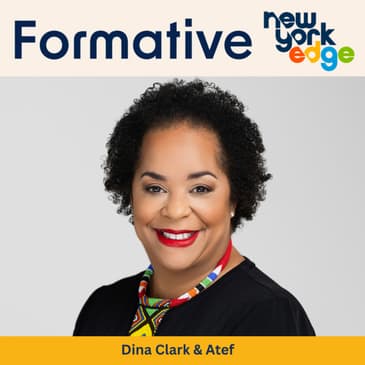
Dina Clark has always seen diversity and inclusion as a personal responsibility. 6th grader and co-host, Atef, joins Dina in conversation today to discuss Dina’s childhood pull toward inclusion and the different moments in adulthood that solidified her career path as the Senior Vice President of Diversity & Inclusion at Skanska, global construction and development company.. Atef learns that huge potential can be unlocked in a person if they feel they are given opportunities to be seen and heard.
Downloadable transcript here
Rachael: Welcome to Formative, the show where today's leaders are interviewed by the leaders of tomorrow.
We've got Dina Clark with us today. Dina is the senior vice president of diversity and inclusion at Skanska. Skanska is one of the largest construction and development companies in the world. Today, we speak to Dina about the role diversity plays at Skanska and what her work means to her. We're very excited to have her join us in this conversation today.
Rachael: Hello and welcome. I'm Rachael Gazdik, CEO of New York Edge, and my co-host today is Atef from M.S. 522K.
Hey, Atef, can you tell me a little bit about yourself?
Atef: Sure. So, my hobbies are To play soccer, basketball, or football, either one you decide. And I'm Muslim and I like to hang out with my friends and I'm kind, I'm supportive, and that's pretty much all.
Rachael: Thank you so much for introducing yourself to us. So who are we speaking to today?
Atef: We are going to be speaking to Dina Clark today. And I'm very excited to be speaking with her today.
Rachael: Okay, great. Well, let's bring her in. Dina, thanks so much for joining us. Thank you for having me. It's nice to see everybody.
Awesome. Atef, what's your first question for Dina?
Atef: So, my first question is, how would you explain diversity and inclusion to an 11 year old or any other middle school student?
Dina: Well, I'll answer that in the context of the job that I have, but know that diversity and inclusion is so big that it could be applied differently to different roles and careers.
So I work across our business, um, all the different business areas. So it might be HR, communications or risk management or tech. Training and learning and development or any of those areas. So, for example, if it's hiring, are people being paid and hired fairly? If it's communications, how are we talking about the stories of our people?
And are they represented the way they should be properly? Um, are we doing what we should do with our culture? So there's all these different things across the board. So it's. Probably a little, it's a little more complicated than I just described, but basically diversity is almost like understanding that we all are unique individuals.
If we're talking about people, we're all unique individuals that should all be heard, seen and respected. And inclusion is really connecting us with each other. So making sure we are included with each other, connected with each other, not just existing as different, but how can we work together, stay connected, learn from each other in a respectful, thoughtful, and I'll use your word, Kind way.
Um, I think a lot of people miss that sometimes. Um, and then we, you miss connecting with people. You miss the talent that people can bring or the education or learning that you would have just by connecting with someone who might have a different background or experience from you. It's not better or
Atef: worse.
It's just different. Yeah. I mean, everyone has to connect. It's just going to be complicated sometimes if you don't connect.
Dina: I agree. And I think about your, you know, you, you're connecting with me right now. I'm meeting you for the first time and I'm grateful for that. And I think about, I'm sure there's so many amazing gifts and insights and thoughts that you have that I could learn from if we have access to each other.
Right. And if that's the case. Then that opens and allows me to open my mind a little bit and then we can continue that going. So that's how I would want 11 year olds and even adults to think about the way they approach inclusion, um, or consider even people as just human beings.
Atef: Of course. Yeah. What made you want to work at Skanska?
Dina: I came from a non profit background at first, and then I worked for a German chemical company and I wanted to learn a different industry. And even though I do diversity and inclusion work, to me, applying it to a construction management company and development company would be kind of cool. It's given me an opportunity to learn about.
construction, construction management. Um, I've climbed on buildings and looked at all kinds of things that we build, which are really cool. And I hadn't had that learning opportunity before. And I'm doing work that I love in the diversity and inclusion space. I'm also a believer. That you should do what you love or at least what you like when you can.
And so I'm glad I'm able to work somewhere where not only I love the work that I do, but I love the company that I'm working for. And I feel like they're treating me fairly and supporting, um, the goals that I have not only for myself, but for the company.
Atef: Nice because it's important to feel valued because if you're not valued, then like you could have negative thoughts and you might feel like people are always judging you.
And I have a lot of friends who are like, sometimes it can be insecure, but when they're around the people they like, they feel safe, comfortable, and they feel valued. I couldn't agree with you more.
What is a mistake that you did in your career and how did you fix it?
Dina: So I've made lots of mistakes, but that's how you grow. Um, try to narrow, I've made lots of mistakes. I would say one of the mistakes that I think took me longer is comparing myself to other people. I think that you can be inspired by people around you, but you should really stay in your lane.
And be your own comparison for yourself, because sometimes you can get pulled in ways that's really not healthy for your own growth or development, whether it's a career journey or personal growth. So be proud of who you are, be proud of your journey, and stay in that moment. Sometimes I would feel like, Oh, I don't have the time.
Big job or the big house or the big this or the that. And then, you know, you start to kind of shrink yourself and you're like, wait a minute, no, no, no, no, no, no, that's not what this is. What do I have to offer? What can I share? And being humble about being proud of whatever that is. And I think also, allowing myself to not be, uh, guided by what other people think I should do.
But instead of reaching in myself and saying, what do I really want for myself? Um, what do I want to do? What do I want to dream? And, and allowing that to be. Dream it up. This job didn't exist before. And there are other jobs that haven't existed. So, we don't know what's next.
Atef: My dream. Is to be a lawyer and I want to be a lawyer because I like to debate with people and like, I know there are different types of lawyers, like state lawyers and lawyers who speak for other people and defense attorneys, but I just want to be like those car accident lawyers, because you know, when someone gets into a car accident and it's not their fault, it's like crazy because sometimes the judge would side with them and the jury, and it's just like, People deserve justice, you know, so that's what I want to do and bring justice to other people.
Very nice.
Dina: Something tells me you'd be an
Atef: amazing attorney. Thank you. I can feel it. I can feel it. So my question is, did people disapprove of your dream? Well, I'll say this. Not
Dina: everybody agrees with, um, I think the approach that sounds like we both have around connecting with people. I think some people in the world want to keep people separated and not necessarily have equality.
I think sometimes that that's part of my dream that people are seen and heard. So it makes it sometimes difficult when people People think the work that you're doing is one way when it's really grounded in another way. It's very important for me to make sure people are treated with respect, with kindness, that they have safety when they're at work, that they can grow and thrive and being treated equally and have fair work.
equal opportunities. Some people interpret that differently and may not want to see a wide range of people in certain areas, so sometimes it's hard to have conversations. I try to go into things being positive and sometimes having the patience to have conversations with people to say, why do you think that way?
Why are you trying to keep people separate? Or why is, why do you have this perspective? So at least if I understand where they're coming from, even if it feels like they're not being kind or not understanding, I can at least have a conversation to hopefully open their mind a little bit to think differently.
And then that lands me back in my dream because I've had some amazing opportunities where people had this sort of crazy outlook from my perspective and they had a different open mind by talking to me and other people and it changed the way they interact with people. So. Yeah, I think there's sometimes you start out with people not understanding your dream, so they put it down, but if you have access to them and sometimes create opportunities, sometimes that can change.
Atef: Yeah, I mean, everyone has to be positive because if we just look at stuff negative, it's like, what's the point of looking at it? If you're just gonna always look at it and think of it as negative, there's no point of thinking about it or just giving your opinion. I agree.
Dina: Someone said to me one time, you wake up, you decide, not the day, you decide what kind of day you're going to have.
You could have a positive outlook on it or you could have a negative outlook, but you have the control to decide that. And I think this work is very similar to that. We can decide if we're going to lean in positively or if it's going to be something that pulls us down. And I'd rather see something that connects people and lifts people up.
So I think we share that.
Rachael: Is there a moment that made you realize that this work is very important and you want to do it forever?
Dina: I have a story. Um, I'll try and say it briefly, but it was my career change moment. And so bear with me. And it's a true story. And I share it all the time as my why. Um, I was doing, I was doing a diversity session actually was for health and safety.
It was a training session for teachers. And I was in a room where I was the only person that had brown skin and that was fine, but I was, I was, I was teaching, but I noticed there were these two guys and they were kind of looking at me and they were whispering. And I'm thinking I was up at the board. I was going over my lessons and they were looking and whispering and I didn't want anybody in my class.
Classroom for that training that day to have any questions. So I said, let me stop the training and check on these 2. Well, when I said to them, hey, looks like you may have had a question, is the information I'm sharing okay? And they said, no, no, no, your information is fine, but we have a personal question for you.
I said, okay, what is it? They said, well, we wondered where We put your tail. I said, what do you mean? Well, where's your tail? What's your long story short? They thought because I had brown skin that I had a tail like a monkey or a horse and they were looking for my tail And they couldn't figure out where it was and I'm thinking these are Educators that are getting continuing education and I'm here in a professional capacity and they're looking for my tail So I started asking questions like have you left this town?
I was in a small part of upstate, New York You I said, have you left this town? Do you have questions? And they were answering me as if the tail discussion made sense. And finally, I didn't understand. I said, well, maybe I said I would take a break. I called my mother and she's like, I went back in and I said, this is going to be my teachable moment.
I took a deep breath. I did my best to explain that I did not have a tail like a monkey or a horse. And if you have questions about me having brown skin or being person I am in front of Let's take a few moments to talk about that. So I could dispel any myths or change any discussions. And here's the thing that scared me.
They had so many questions and they were, a lot of them were grounded in stereotypes. So as hard as that was for me to sit there. And I wasn't sure if I was singing, if I wasn't sure what would happen, but for me to sit there and have to explain in a way that I wasn't expecting to have to explain, hoping it would stick in a positive way and hoping I was still safe to lead the situation was a lot in the moment.
But I realized when reflecting back on that, it had completely changed my entire career. I always say it's, you have to look at how you see yourself. How you might see other people and how other people see you. And if you have some understanding of those three things, sometimes that's all the information you'll need.
And that inspired the work. But that incident can take, I couldn't believe that they thought I had a tail. And when I shared it with other people, I heard other stories that were similar in different parts of the country that that still exists.
Rachael: Thank you for sharing that. That's an incredibly powerful story.
And I just also want to say thanks for trusting us with it.
Dina: No problem. No problem. Yeah, it's a little, but I share it because people need to know that that type of ignorance exists. And if we don't stay connected and educate each other about the truths of who we are as people showing up differently with each other, then those types of hateful, sometimes myths will perpetuate And further separate us versus bringing us together there.
Um, and that's, that's the difference, I think. Absolutely.
Atef: Yeah. Would you say your goal of making work at Skanska accessible, um, successful? Well,
Dina: I'm still working on that right now. So I guess time will tell, but I do think You know, the world that we live in is not always fair and it's not always safe. And I think creating places where people can come together, learn about each other, helps to um, you know, not only make sure people are connected, but make sure that they're understood and can lean into some of their own dreams and their own possibilities.
When you do that, you plant seeds that allow people to continue those lessons in other areas and it can eventually have an impact. So a lot of the work that I do. I may be like a catalyst for the seed planting and getting things started, but sometimes the impact may not be felt for, you know, a long time.
Um, and other times it might be, there might be impact right away. So when I get to experience impact right away and somebody gives me feedback and says, thank you for sharing that information with me or exposing me to that person or having that conversation that I'm grateful for it. But I also have to lean into sometimes I may have a conversation, someone will circle back in years and said, what you said or what you presented to me, I thought about for years and it didn't hit me until later.
So I just hope that if I approach the work in an honest way. And continue to be authentic in what I say and what I do, that I'm confident that there will be an impact in some, in some way for some people, even if I don't see it directly myself.
Atef: So, I'm in my first year of middle school, and I would like to know what your middle school experience was like. So I can talk about that,
Dina: and I remember it quite vividly. I'm from Pittsburgh, Pennsylvania. And I went to a school that was called a magnet school where you had to have like a lottery and they brought kids in from all over.
So it was, they were trying to think, do some diversity there, but, um, it was interesting. I, I was always sort of the person who, if there was someone sitting by themself or someone left out or, you know, not connected to the group, I was the one that would go over just was. sort of in me, but I noticed it was not always that way.
It was not always easy to do that. Sometimes people didn't want that. So as people got to know me a little bit better, I think they allowed me to make connections on their behalf, but it's tough when you start middle school and you're trying to figure out friends and there's sometimes lots of clicks of groups, friends that you may not be in.
And I think that makes it hard. So I spent a lot of my time in school. Looking to make connections with people versus supporting some of the separate cliques that were, that existed in pretty much every middle school. So I tried to, I tried to be the friend or the connector and maybe that's why I'm doing inclusional work.
Who knows?
Atef: What advice would you give me as I go on with my middle school career? I would say,
Dina: and I think you're already on this path, but be true to yourself. You're already an amazing person that has a strong voice already. You have some thought around your career direction. Keep your mind open. Uh, regardless of other people, there's a lot of noise sometimes, you know, you might hear negative things or you might hear crazy things.
Stay your course, keep your heart pure, your mind open and allow yourself to learn from other people and allow yourself to have the opportunities to teach as well. Because I think that just enhances you as a person. Person and allows you to consider other things that might be part of your career journey, your school journey, your friend journey, and just your personal life.
Um, I think sometimes the things that we think we want to do can't expand or grow if we keep ourselves limited. So stay connected and stay pure to who you are as a, as an already good person.
Rachael: And our last question is one we ask every guest and it's if you could go back and speak to yourself at the age of 13.
What would you say?
Dina: Oh, wow. It's a tough one. I would probably say keep your chin up. Don't be discouraged by adults that have lost their path to their dream. Don't limit yourself and keep your mind and heart open. That's probably what I would say. And eat the cupcakes.
Rachael: Great answer. Thank you so much. We love getting to know you today.
CREDITS
Thanks for listening to Formative, a production of New York Edge. I’m your host, Rachael Gazdick. Our production partner for this series is CitizenRacecar. This episode was produced by Hager Eldaas, post-production by Alex Brouwer, production management by Gabriela Montequin, original music by Garrett Tiedemann. Thanks to the whole team at New York Edge for making this series possible. Never miss an episode by subscribing to the series at newyorkedge.org/formative or wherever you get your podcasts.