
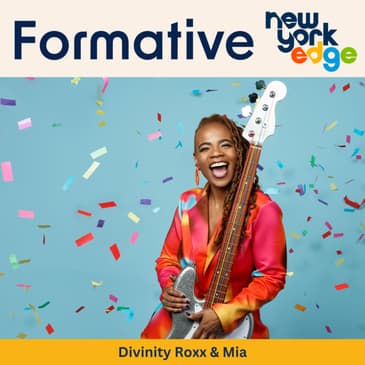
Divinity Roxx, bassist and music producer, joins middle schooler Izzy to talk about her journey in finding her unique voice as an artist.. She shares with us how she unexpectedly fell in love with the bass, the major setback that shifted her career path, and what it really takes to grow as an artist beyond what you see on social media.
Izzy learns from Divinity how staying open, putting in the work, and embracing change can lead to new opportunities.
Downloadable transcript here
Rachael: Welcome back to Formative, the podcast where today's leaders are interviewed by the leaders of tomorrow. Today our guest is Divinity Roxx. Divinity is a Grammy-nominated bassist, music director, and producer known for her dynamic career spanning hip hop, funk, and soul. Today, Divinity talks about discovering the bass, the hard work behind becoming an artist, and how a major setback helped shape her path.
Hello and welcome. My name is Rachael Gazdick, and I'm your host and CEO of New York Edge. On every episode of Formative, a student from our afterschool program joins me as co-host, and today that's Izzy from I.S. 122Q. Izzy, can you tell our audience a little bit about yourself?
Izzy: Hi, I'm Izzy, and I'm 13, and when I grow up, I wanna become a marine biologist.
Rachael: Oh, I love that. Very cool. And Izzy, who are we talking to today?
Izzy: Today we're talking to Divinity Roxx, who is a music producer and a music director. We're very excited to speak to her today.
Rachael: Let's get to it then.
Izzy: Okay. So when you were younger, did you ever imagine the bass would be your superpower, or did it kind of, like, find you in a way?
Divinity: That's a great question. When I was younger, when I was your age, I was a clarinet player in the middle school band. I started playing clarinet when I was about, uh, in the third grade, and I really wanted to play the saxophone.
And my uncle played saxophone, so I would always go over to his house and play saxophone. But he also had a little studio set up, and he had a bass guitar that he played and a little keyboard in his little makeshift studio. And he would always put the bass in my hands, but I never wanted to play it. I would always give it back to him and beg to play his saxophone.
So when I went to college to study journalism, I ended up picking up the bass guitar and falling in love with it. And no, I had no idea that it would become my superpower and be the key that unlocked my entire world. But yeah, it has been, so thank you for recognizing that that is the case.
Izzy: So how did you find your voice, and who would you say inspired you in terms of other artists or people you grew up with?
Divinity: Wow, how did I find my own voice? Well, I've been doing this for so long. When I first picked up the bass, I started playing along to a lot of the hip hop records and albums that were popular at the time. And I'm from Atlanta, so OutKast was huge, and so was a group called Goodie Mob.
And then there was this whole neo-soul movement with people like Raphael Saadiq, who was a bass player. I started rediscovering the music I had grown up listening to. My mom had music playing in the house all the time, so Bootsy Collins and Parliament-Funkadelic. I started listening to those records and playing along.
So yeah, I got to rediscover so much music when I picked up the bass guitar. I started thinking about music in an entirely different way. If I was to listen to my early stuff, I could tell you exactly who I was emulating at the time, right? When you listen to the early recordings and stuff, you say, "Wow, you sound just like MC Lyte," or, "Wow, you sound just like Monie Love."
You could tell that's who I was listening to. But I think over time we get to ingest all of this material, right? So we're like a computer. We can put all this stuff inside of us, and then we get to output through a lens that never existed before.
Divinity Roxx has never existed before in the world. I have a unique fingerprint. I'm a very unique individual. It took a lot of people to come together and a lot of crazy events to make me. The same thing is true for you and everybody we see. Everybody is so unique, and whatever comes into this lens, what comes out can be just as unique as I am.
I think part of that is time and experience. That's what is the best teacher to help you find your voice: experiences. There are so many people in the world who have loved me, deeply loved me, and wanted to give me so many incredible experiences, and those experiences have helped shape who I've become in the world.
Izzy: Okay, so speaking of different types of music and genres, if you were able to invent a new genre that fits your personality and who you are, what would it be called?
Divinity: It would be called... hmm, what would it be called? The Divvy Roxx Habba Glabba Roxxen Experience.
It'd be like a rollercoaster ride of funk, hip hop, jazz, rock, all kinds of fusion, all the music I've ever listened to, pop music, a little Jimi Hendrix, a little Bob Marley, some Erykah Badu, a little Victor Wooten mixed with some Lauryn Hill, and of course, you know, MC Lyte and Aretha Franklin. I don't know, just all the things that I love.
Rachael: I love the variety. That sounds amazing.
Izzy: So your main thing is your bass, right? So if your bass could talk, what do you think it would say about all you've been through together?
Divinity: I think my bass would smile really big and say, "I'm really proud of you for picking me up."
'Cause that's all it takes, right? The bass can't do anything. It just sits there until I pick it up and I'm able to express myself through this instrument. The bass is definitely my sword, right? So I go out in the world and it's my sword.
But I've acquired a lot of skills along the way. I'm a songwriter. I've learned how to produce music. I've learned how to use digital audio workstations. I understand sound. I've gone to school and got a degree. I am a performer. I know how to get on stage and perform in front of a group of people. I am a voiceover artist. I've just learned how to do so many different things in this industry.
Izzy: So what's something that you wish young people understood more about being an artist that doesn't show up on social media?
Divinity: Whoa. Social media doesn't really show you how much hard work goes into being an artist, and especially learning an instrument, right?
A lot of people post their most incredible work on social media. Look at me, I'm killing it. But they don't show you all the takes it took to get that one take. They don't show you how many hours it takes to practice anything.
We just see people at their best, and I think that's the case even with the music we listen to. We always see the most incredible artists at their best. When we see them on stage, they're at their best. We never see them struggling. We never see them messing up. We never see them spending hours and hours trying to get one thing right.
So everybody thinks you can just pick up an instrument or become an artist and immediately you're gonna be great. No, it takes a lot of work to be great. It takes a lot of work to be good. And as much work as it takes to be good, it takes even more work and more hours to be great.
Somebody put out a book years ago about taking 10,000 hours to become great at something. So imagine how long that is: 10,000 hours. I know to you it probably seems really long, but it usually takes about 10 years to be really great at something if you're consistent.
Izzy: I think that's really inspirational how you think of it that way. But speaking of hardships, what is one you faced that you think shaped who you are today?
Divinity: Wow. Oh man, I can think of so many. But I will say this:
I started off as a rapper, right? I fell in love with music. I was playing the clarinet, but I was rapping, and that was my biggest thing. I was gonna be a rapper. Then I went to college, and I fell in love with the bass guitar.
I'll tell you a little bit of my story. I dropped out of college. I called my parents and said, "Hey, I wanna give this music thing a real try." My dad was very upset with me. Even though he still loved me, he was very upset. My mom told me to go follow my dreams, so I did.
I moved home, and one day, after putting out a record with my rap group, we were so popular, really doing great things in the Atlanta scene, I went outside and ruptured my Achilles tendon.
It's a really bad injury. It takes you down for a year. So my group was getting ready to go on tour. We were looking at record deals possibly coming in, but I ruptured my Achilles tendon, and everything stopped.
It was the most devastating thing that could happen to me at that time. I really thought the world was over.
But during the healing time, a few things happened. My mom and I healed a tumultuous relationship, and all I could do for one whole year was practice the bass guitar. That's all I could do: sit with my leg up practicing the bass.
After that year, when I began to walk again, I went to Victor Wooten's Bass Camp. He's a great bass player. And while I was there, he asked me if I wanted to go on tour with him.
That changed everything.
So I always remember that thing that happened to me that I thought was the worst thing in the world. Because when bad things happen, we think our lives are over. But I was able to take that time, heal internally and externally, and the thing that catapulted my whole career happened out of that hardship.
Rachael: Oh, well, you said you dropped out of college because you knew you were meant to go all in on music. So how do you get the courage to do that? I also feel like a lot of people may wanna do that, but then they think, "What if I don't make it? What if I regret it?"
Divinity: Wow, that is such a great question.
I think there are a number of factors. I was always really confident in myself, and when I was young, my mom had this book called The Power of Your Subconscious Mind.
I was one of those people who devoured books. I loved to read. And that book really changed my life because it told me that I had this power inside myself. If I believed something deeply enough and could see it in my mind, then I could create it in my life.
And I think I held onto that. Even to this day, I hold that to be true. It takes a lot of work, but I believe I can output my reality in my mind.
My mom was also one of those people who constantly told me to believe in myself. She would say, "If you believe it, you can achieve it. If you can dream it, you can be it."
Now, I have to be honest with you. I didn't take it lightly that I was gonna leave school because I was at UC Berkeley, which was one of the best schools in the country. So there was a lot of thinking and questioning. I didn't just wake up one day and decide.
I thought about it for months during that last semester. And what I said to my parents was, "I'm gonna take a year off." I didn't say I was dropping out. My intention really was to take a year and see what would happen.
My dad said, "If you take a year off, you're never gonna go back." And he was upset.
My mom said, "Follow your dreams. Follow your heart. If you believe you have a shot at this, then yes, go for it. Because what I don't want you to do is regret it. Berkeley's always gonna be there. School is always gonna be there."
Now, I did not go back to UC Berkeley, but I did graduate from Berklee College of Music online because having that degree was really important to me. It took me years and years later, but I did graduate.
Rachael: That's awesome. Very full circle from Berkeley to Berklee.
Divinity: Exactly. That was my entrance essay. I think the last line was, "I've finally chosen the right Berklee." They ate that up.
Izzy: They ate it up. So on that topic, what's some advice that you would have for people who wanna follow in your footsteps?
Divinity: First of all, don't follow in my footsteps. Create your own footsteps.
Every artist is influenced by another generation of artists. As human beings, we learn by emulating. You learn how to speak by listening to your parents speak, by watching their mouths, by hearing their accents. Eventually you develop your own voice, and that's really what we wanna do as artists and as people.
So I would say study as much as you can. Learn from all the masters. Go and play like your favorite artist. But eventually develop your own sound, your own genre.
Stay imaginative. Be creative. Be outlandishly creative. Be bold. Be brave. Become something that you wish existed in the world.
Izzy: Wow. So seeing how far you've come from when you first started music to now, if you could go back in time and say something to your younger self, what would you say to them?
Divinity: Hmm.
A lot of people ask this question, and I always have different responses. I'll give you two.
One is: "You have permission to be and choose anything you wanna be. You can pivot at any time."
I think that's really important. You don't have to lock yourself into one thing that you think you wanna be. If we're lucky enough to live to 80 years old, we could have six or eight different careers. You can live multiple lives within this one lifetime.
And then another version of that answer is: "I wouldn't tell her anything, because she wouldn't listen anyway."
Rachael: Well, this has just been such a pleasure, and thank you so much.
Divinity: Thank you, Izzy. Good luck with everything you're doing. I'm rooting for you. And don't forget: you can pivot at any time.
Izzy: Thank you.
Divinity: 'Cause you got the power. Yeah.
CREDITS
Thanks for listening to Formative, a production of New York Edge. I’m your host, Rachael Gazdick. Our production partner for this series is CitizenRacecar. This episode was produced by Hajar Eldaas, post-production by Alex Brouwer, original music by Garrett Tiedemann. Thanks to the whole team at New York Edge for making this series possible. Never miss an episode by subscribing to the series at newyorkedge.org/formative or wherever you get your podcasts.