
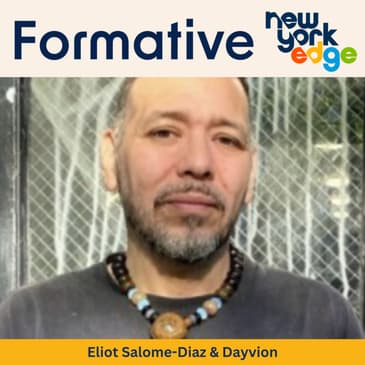
Eliot Salome Diaz, graffiti and mural artist, joins middle schooler Dayvion to talk about life as a creative. Eliot shares how he navigates his interests in both art and business, what his work teaches about creating from the heart and with passion, and his love of hip hop. Dayvion learns from Eliot how making art from a generous, expansive place can open unexpected doors of opportunity.
Downloadable transcript here
Rachael: Welcome to a new episode of Formative, the podcast where today’s leaders are interviewed by the leaders of tomorrow. Today, our guest is Eliot Salome-Diaz. Eliot is a graffiti and mural artist. He tells us about his love of hip hop, how he navigates his interest in both art and business, and what his work means to the communities he creates in.
Hello and welcome. My name is Rachael Gazdick, and I’m your host and CEO of New York Edge. On every episode of Formative, a student from our afterschool program joins me as co-host. Today, we’ve got Dayvion from I.S. 588K. Dayvion, can you tell our audience a little bit about yourself?
Dayvion: Yes. Hi, my name is Dayvion. I’m 14 years old. I go to a middle school of art and philosophy, and a few things that I like to do are draw, and I like to write poems.
Rachael: Wow. So you already have something in common with our guest today. I’m excited to hear about what you ask him.
But before we do that, we want to remind our listeners that you can support us by making a donation at newyorkedge.org/donate.
It would be very much appreciated.
All right, Dayvion, let’s go talk to Eliot. Eliot, we’re so happy you’re on the show with us today.
Eliot: Thank you for having me on your show. Honored and pleasure to be here and share my story with you guys.
Dayvion: Thank you so much. So, without further ado, let’s get in. So for my first question I have for you today, how would you feel connected with your art?
Eliot: It’s a long question, but a good one. In regards to my connection with my art, it’s part of my DNA and composition of my makeup. It’s something that comes very intimate and very deep within me. More a form of self-expression of what I believe, what I feel, and what I see.
Rachael: We’d love to hear about how you got started in graffiti.
Eliot: Um, I remember when I was little, my mom used to bring me over to the Jamaica office of Social Security whenever she had to go over there, and I used to come with her. And during those times on Jamaica Avenue, there used to be an elevated train that ran around Jamaica Avenue and no longer exists. They removed it.
But when I used to go to the office and just sit there, I’d glaze out the windows and I would see the trains pass by. I was fascinated by seeing characters and art and letters and colors just rolling by the window, and it grabbed my attention—just moving art. That was like my first taste of seeing art that had motion, and I thought it was cool because it was like a form of advertising. And I told myself I would love to see my name one day on a train, but I never did get to do that.
I was too young during that time, but I always saw my name in motion in the public eye because I always loved art and being creative. And my second introduction from that point on, I had friends of mine from the neighborhood that were a little older than me, and they introduced me to different aspects of graffiti.
Some people used to street bomb and write their names in the neighborhood, so I started more or less writing my name on the streets. I wrote my name everywhere. People started recognizing my name all over the place, and it became a thing of advertising. I was advertising my name, but it really kind of became like a hobby-slash-job for me.
And it was a chase of what later in my life presently allowed me to get into the worlds of branding and marketing and stuff like that. I was doing this at such a young age and not even knowing, by putting up my name, I was building my name and recognition.
Um, it allowed me to do other things in life. I’ve always been into business and creating things and very entrepreneurial. That was something that I was always fascinated by doing, was creating businesses, and, you know, doing graffiti stimulated that part of me. It allows me to have that fluidity and be very creative and allows me to see that vision.
Dayvion: Amazing. I know that you’re known as a graffiti artist, but is there any secret messages that you would like to share to the world about your art?
Eliot: Secret. Okay. Um, uh, I wouldn’t say secret, but more or less a lot of the stuff that I do like to share are just messages that I try to translate and connect, to inspire, to shift, to open portals of energy that kind of, you know, capture people’s attention.
You know, um, growing up here in New York City, there was a big misconception about graffiti. It wasn’t as accepted as how it is now. And even to a certain extent, graffiti itself is not 100 percent fully accepted.
And growing up here in New York City and my roots being from graffiti, people tended to look at it in a bad way. And, uh, you know, not everything stemmed from mal intentions. Graffiti was a big outlet for a lot of us individually that, growing up in New York City, was a form of therapy and self-expression and communication for us to put out to the world.
It became our vehicle to express ourselves, send out messages, interact with other people, and engage with other people, and even amongst other peers, showcasing what our talent was.
Dayvion: Um, I know that you mentioned something about people with different points of view on your graffiti art and other artists. Do you feel like in future time you can convince those people that graffiti art should be viewed differently?
Eliot: I think just as times have changed, it’s been more accepted. I grew up in a neighborhood called Jackson Heights, Queens, and graffiti wasn’t accepted at all growing up. Not at all.
So it was very hard to change that narrative and perspective of what people thought and saw it as, ’cause it was just looked at as vandalism, not even just having murals, ’cause it was very rare to have that at all.
Not until just recently, like within the last couple of years, that the neighborhood has changed and started accepting it. And more and more in New York City, you see it’s an open canvas. So I feel like having spaces where artists can fully creatively express themselves to showcase their work helps influence or change moods or send a positive message, even of inspiration, to the youth.
Dayvion: Yes. Other than your graffiti art and how people may view it or whatever, is there anything that you would find the hardest part of your career?
Eliot: I would say the hardest part would be even just in general, like not just an artist’s perspective—anybody that is doing any type of journey in life—the most important thing is working on yourself and believing in yourself.
Clearing out the pathways of things that hold you down in life and, um, accepting things for what they are. And that change always can happen, no matter how early or how late. The most important thing is doing what allows you to not hold yourself back, ’cause you can either be your worst critic or your worst enemy.
Once you do the work from within, it allows you to self-express on the outside in anything you do. I think it just makes you a better person to contribute to the people around you and society.
Dayvion: Amazing. I know where you are in your positioning right now. I know that you’re a successful man with a lot of amazing graffiti art, but how would you picture yourself in future time?
Eliot: Um, work less but smarter. What I would do, see myself as, um, eventually I want to be more on the consulting and curating end of things. I think that is my strength.
And I’m a big magnet when it comes to connecting people, and I have a lot of vision that not so recently I’ve learned to accept and saw it as an asset, opposed to it being something that I always questioned.
And I think with acknowledging those gifts that I have and helping others see theirs and helping them grow, that’s something that I want to get more involved in, especially with individuals like yourself coming up. You know, the new generation needs more people to support, help them, and guide them, and allow them to show what their gifts are, too, and give them the tools to elevate and become successful or make an impact in society.
Rachael: You’ve created murals honoring artists like Biggie and Nas. Do you feel a personal connection to the hip hop and rap world?
Eliot: So graffiti is one of the elements of hip hop, and that is my connection to hip hop. Being in that world, it’s part of the culture. And, uh, just growing up, I always had a passion and love for music.
That wasn’t my craft, but I always appreciated it and I had an ear for it. It was always a source of inspiration for me because no matter what I did, whether it was graffiti or drawing, I always needed music in my background. And I always worked to music, all types of genres, not just hip hop.
Dayvion: Great. Amazing. Um, what has been your favorite piece of art?
Eliot: I would probably say the Nas mural—the first Nas mural I did—that said Matic, and there’s a story behind that. I grew up listening to Nas since a very young age when he first came out.
And I actually had a friend of mine that I went to high school with. His name was Michael Jones. He lived in Queensbridge. And at the time, Nas wasn’t even out yet. And I remember him, when he came up, he was always talking about and bragging about, “Oh, my boy, Nasir Jones from Queensbridge, this and that. He’s about to come out. I want you to come out. We’re doing a video shoot.”
You know, he used to always tell all of us stuff in school about that. And he became one of my favorite MCs growing up. And his first album was kind of like part of my life story of inspiration, of associating a lot of stuff that he envisioned and saw that I was around.
And I’ve always wanted to do a mural for him in Queens. I just didn’t have the right location. And, um, you know, many decades later, I actually connected with a friend of a person I just met that I clicked very well with. He was an Italian artist named Jorit.
We connected in Queens, and then we were walking around Queensbridge. We were looking for a wall to paint, and we came across this bodega right in the footsteps of Queensbridge. So I asked the bodega owner if we could do a mural there, and he said sure.
So we went to Home Depot right then and there, and we started painting that same minute. We had no idea what we were going to do. We went to the wall, and we just started painting. I took Nas’ tagline of Illmatic from his album, and I made it say Queen Matic.
And, uh, Jorit put up the sketch. He started sketching, and we just started painting that mural. It took us seven days to paint, and we had people from the entire neighborhood coming up to us, asking, seeing what we were doing, and taking pictures, sending it to Nas, and talking about it.
And, um, you know, we wanted to give Nas his trophies while he’s here. And normally, the custom in New York, or all over, when people do murals for people, especially with portraits, it signifies that they’ve passed away. So I didn’t want him to have his mural when his time came. I wanted him to have it before, just as a thank you for inspiration, what he’s done representing Queens hip hop and what he’s done for the culture.
It was incredible. And that thing has been in documentaries, movies, videos. I can’t express how much exposure that it got and still gets. Nas just had a New York State of Mind world tour with Wu-Tang, and one of the songs that he performed on stage throughout his whole tour, called “Bravehearts,” he had my mural in the background on the stage throughout the entire song, throughout the entire tour, which was a great honor.
So I felt—I felt like I went on tour with him through my body of work. So yeah, when things come and opportunities come, just like in this case, you never know. You jump on it when it happens. You do it, you know, and act upon it, ’cause you never know what that thing can do or where it can even go.
Dayvion: Yes. Um, if you were able to go back in time, what would you say to your younger self?
Eliot: Don’t waste time, and indulge yourself in learning and be a sponge. There’s nothing wrong with asking questions and just seeking those that have done it before you, you know, asking them for guidance or mentorship.
Rachael: Thank you so much. This has been such a pleasure.
Eliot: Thank you again for having me. And, you know, keep on doing what you do. I love the fact that, at a young age, you’re brave. It’s such a brave thing to do that you are able to communicate like this. I would not have done that in that age group, to be put like that.
So I salute you to that.
Dayvion: Thank you so much.
Eliot: Keep doing that.
CREDITS
Thanks for listening to Formative, a production of New York Edge. I’m your host, Rachael Gazdick. Our production partner for this series is CitizenRacecar. This episode was produced by Hajar Eldaas, post-production by Alex Brouwer, original music by Garrett Tiedemann. Thanks to the whole team at New York Edge for making this series possible. Never miss an episode by subscribing to the series at newyorkedge.org/formative or wherever you get your podcasts.