
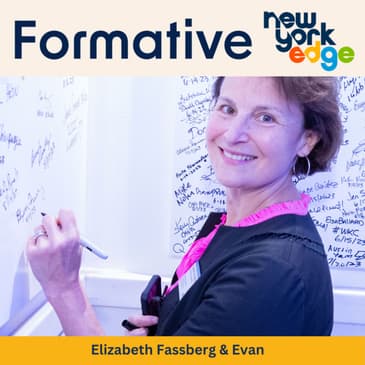
Elizabeth Fassberg joins us on today’s show! Elizabeth is the Executive Director of Life Science Cares New York, an organization that is activating the financial and human capital of the life science industry and partnering with nonprofits to disrupt the cycle of poverty in our communities. 8th-grader and co-host, Evan, learns that career paths aren’t always linear and that shouldn’t be seen as failure. In this episode of Formative, Elizabeth shares the many different roles she performed along her career, always leading with compassion, before she got to where she is now—and how in hindsight it all makes sense to her.
Downloadable transcript here
INTRODUCTION
Welcome to Formative, the show where today’s leaders are interviewed by the leaders of tomorrow.
Formative is brought to you by the generous support of Macy's Inc. whose purpose is to create a brighter future with bold representation from underrepresented youth so we can realize the full potential of every one of us.
GUEST INTRODUCTION
Elizabeth is the Executive Director of Life Science Cares New York, an organization that is activating the financial and human capital of the life science industry and partnering with nonprofits to disrupt the cycle of poverty in our communities. She's passionate about activating people to be empathetic, innovative, and solution-oriented to build a better world.
INTERVIEW
Rachael: Hello and welcome. I'm Rachel Gazdik, CEO of New York Edge, and my co host today is Evan from M.S. 382K. Hey, Evan! Can you tell us a little bit about yourself?
Evan: Hello, I'm Evan and I attend Academy for College Prep and Career Exploration. And I'm currently in the eighth grade, 13 years old. And when I grow up, I just want to be a professional basketball player or a professional football player.
Rachael: What do you learn at the College Prep Academy?
Evan: Science, history, you know, all the basics.
Rachael: Is there a particular subject that you absolutely love?
Evan: Yes, math. I'm really good with numbers. I love it a lot.
Rachael: So Evan, who will you be speaking with today?
Evan: Yes, I'm speaking with Elizabeth Fassberg, and I am excited to be speaking with her.
Rachael: Well, you know what, let’s not wait any longer. Elizabeth, welcome to the show and thank you so much for being here today.
Elizabeth: And thank you so much for having me. I can't wait to talk to Evan about our different pathways to where we want to be in the future.
Rachael: Great! So Evan, why don't you take the mic and ask Elizabeth your very first question.
Evan: What are the daily struggles that you have at your job?
Elizabeth: Wow, that's a big question. I've started a new job in the past year and it's running a philanthropy called Life Science Cares. I run the organization, this affiliate in New York City by myself. There are four other affiliates, one in Boston, one in San Diego, one in the Bay area and one in Philadelphia. And it is a lot of pressure because, you know, you're trying to, you're working with a lot of different people and a lot of different opinions and you're trying to solve a lot of problems.
I'm listening to the needs of the community and then I'm going to my resources and they're pretty big resources. They're big pharmaceutical companies, their accounting firms, their law firms, their banks, and I'm saying, okay, you said you want to help and here's how you can help. And because I'm just one person, I have a lot of different tasks and jobs but I feel like I'm pretty good at multitasking, so I can move around and do different things all day. But trying to get everything done in one day is probably the most difficult task I have.
Evan: Okay., do you ever feel like you want to quit because it's a bit stressful?
Elizabeth: It's a lot of work and you're trying to solve a lot of problems, but I'm not, I'm definitely not a quitter. Um, I used to run marathons and I always think of my work and my life as a marathon. It's not a sprint. I don't have to get there quickly. Like, I'm building an organization with Life Science Cares in New York. And I see it as a process and about building relationships with the nonprofits we work with and with the companies that we work with, because I want to solve real problems, and it's very hard to solve problems quickly.
Evan: When you were a child, did you see yourself working as a life scientist?
Elizabeth: So, I'm not actually a life scientist, but I work with people in the life science industry. So, I've had a very varied career path, which I think is interesting, um, that I ended up where I am right now. When I was in high school, I worked in a bakery because I came from a family that loved food and loved to bake. And I thought, Oh, I'm going to be a baker, I'm going to go to cooking school. And my parents were like, no way, you're not going to cooking school. So then, I went to college and I went to University of North Carolina. I got a journalism degree. I graduated from North Carolina, worked in magazines, and then I became passionate about nutrition and food and feeding people and making sure that people had fresh food and delicious food. And so I started a company called Eat Food, which connects food and nutrition and making sure that communities had access to food, knew how to use it. And then the pandemic happened, I pivoted and I moved to this job with Life Science Cares. It's a bigger job looking at all of the needs of all different types of people addressing poverty. And being able to access people who work in the life science industry to help people who are in need.
Evan: Have you ever seen yourself, have you ever wanted to be a scientist?
Elizabeth: You know, it's interesting because that's a good question. My sister is a respiratory scientist and she was passionate about chemistry from early on. And my brother worked in the life science industry for many years. And when I talk to my sister about cooking, she's always like, oh well, I do the same thing in chemistry. It's very similar type of, you know, thinking and how you put things together and you make things work. So, maybe if I were to do it again, maybe I would be a chemist because it is, science is fascinating. There's so many aspects of it. And really, it's about helping people, developing things to make people better. Do you have any interest in science? I know you said you're really good at math.
Evan: Yeah, I have a lot of interest in science. I love it a lot but it's something that I don't really partake in. Like, I really like numbers, and I know science is incorporated with math, but I just like math more and science is like right there as well.
Elizabeth: I think one of the things is people, cause I also, I have a 14 year old son and he'll say to me, like, he's a very good writer and he'll be like, Oh, I'm not really a science person or a math person. I'm like, no, it's really a lot about the teacher and then the interest of the subject. So, once you have something that's interesting and you find that it's actually, you're interested in it. Usually things you're interested in, you're good at. But you can learn it. You can learn all those things. You don't have to be naturally good at it when you start.
Evan: How would you make teaching life science fun for students at my age? Or, like, you want to teach like your jobs, anything, life science, baking, cooking, how would you, like, want to teach that for students my age?
Elizabeth: So, I've done a lot of food education and teaching and really that's how I got into nutrition. I was teaching a class with 25 kids who would come down monthly. They lived in a, um, transitional housing, and I would take them on a trip around the world and we would cook foods from different parts of the world, like one day we'd go to China and we'd cook Chinese food. And one day we'd go to Greece. And then I realized that I really needed to understand more about the health benefits of food.
And so, I love to have fun and I love to cook and I'm not that rigid about the foods I eat or the foods that I cook with people. I like to have fun and make sure that everyone likes it. And in my new role, I'm not doing the actual teaching but I'm actually finding people who are professionals in the field who are doing drug development or they're, um, making medical devices. And now I'm trying to bring those people to different schools and different, uh, different age groups of students and showing them that these are opportunities for you, like, you could do all of these things. You can make medicine. You could make a vaccine. You could develop, um, a mechanism for somebody who had diabetes. And so, now, instead of being the one to do the teaching, I'm really about how do I let students know that these are all these incredible jobs out there for people to do.
Rachael: Just out of curiosity, Elizabeth, have you ever been involved in how lunches are made in school?
Elizabeth: Yeah, I mean, I've been on some of the committees for the school lunch. I actually think that part of the nutrition issues could be solved with a really robust breakfast, lunch and food program at schools. Like, I think that's the one place where you could make a humongous difference, and I feel very strongly about that. And I think that every school should have a scratch kitchen and every school should be having food available for kids so that no one is hungry. And I also feel like sometimes we focus too much on the nutrition part and not about the deliciousness of food and where it comes from. And I know that there's been talk about like having a curriculum that talks about how bad, you know, chips and Takis and all that stuff are, but when push comes to shove, if you had a bowl of delicious New York state crispy apples when kids walked in the door, they would eat that, they would choose the apple. You know, it's what's available in some neighborhoods and I think that if we really kind of shifted the way we think about food and stopped kind of focusing on, you know, is it vegetarian? Is it vegan? You know, is it highly processed? Like, just make delicious homemade food and you wouldn't even have to think about those things.
Evan: And it's all about, like, whether making stuff look good. And I do agree with Ms. Elizabeth because that plays a huge part in it. It's 50/50, the taste and the look. So like, when you see something looks good, you're like, Oh, that's gonna taste good, because that's already what you set in your mind. And like, vice versa. If something looks bad, you're going to be like, nah, I don't want that because it might taste bad.
Evan: Also, you was talking about the marathon. Did you do it for fun, like, for an activity? Or, did you want to start something with that?
Elizabeth: Totally for fun. I'm not an athlete. Definitely not. You're probably very athletic, given that you want to be a professional basketball player and a football player. I knew that was never going to be. But I loved sports, I love to do sports. I don't really like to watch them that much, but I love to do sports. Do you play on a team now?
Evan: No, I used to but then we didn't make it to the championship for flag football. So no, I was thinking about moving into the basketball team but I'm not too sure.
Elizabeth: Is there a basketball team at your school?
Evan: Yes, yes.
Elizabeth: And do you play for fun with your friends and on the weekends or after school?
Evan: Definitely, yes. It's still fun and I see myself doing it, but it's like, I want to be around certain people, like teamwork and have friendships with them instead of, you know, somebody's bullying you or trying to mock you because how bad you are or how good you are, you know?
Elizabeth: And I think you can take that with you for your whole life, right? You want to surround yourself with people who have the similar type of feelings about how you treat people and how you, how you move through life.
Evan: Yeah, definitely.
Elizabeth: It's great that you've already learned that, like you're young to know that already. I think people don't learn that until they're much older.
Evan: Yeah. Certain people, you know. It's just like the certain people that you hang around with that persuades you and that molds you and stuff, like parents or friends or whatever.
Elizabeth: Yep, that's such an important part of life, is who you look up to and who you spend your time with. And you want to look for people who you can look to for support, whether that's a mentor or a friend or a family member. Those are all people you'll take with you for your whole life. Like for me, my friendships and the people I've known since I was a small child are the people I cherish. And there's that, I was a brownie and a girl scout, and there's that old saying, you know, make new friends but keep the old, one is silver and the other’s gold. I always think about that because I do, I have such strong friendships and it's really important for life.
Evan: Mm hmm. Yeah. Very. Very important.
Rachael: Both of you just talked about the importance of the people you surround yourself with. Do each of you have somebody specific that you really look up to?
Elizabeth: You start, Evan.
Evan: Okay. yes. I know, my mom, my mother. She has helped me through a lot of tough things, even herself. So I really do look up to her and I admire her and she's my inspiration for everything because she's just so resilient and generous. I wouldn't think that I would meet somebody as kind and generous as her. Like, whatever she puts her mind to, and she's determined, she'll do it. She's a very real person. She'll keep it straight with you. So, yeah.
Elizabeth: That's amazing that you recognize that. For me, I would say my grandmother was, I mean, I look at my parents as very inspirational, but I would say, like, my grandmother was definitely someone I looked up to. And I think a lot of it had to do with how she treated other people and how she always made an effort to make people feel comfortable in her presence. So, I think, I think we were also much more similar in a lot of ways. And I think about her when I'm in a situation and how would she react? And then I think, okay, I'm going to do the same.
Evan: Yeah, I do the same exact thing.
Rachael: All right, Evan, why don't you ask your last question and then I have one last question.
Evan: How has your whole journey on job exploration? How has it been?
Elizabeth: Yeah, I think what we're not taught when we're young is that life is a journey and there isn't one road that is the right road. So, it's not a right road and a wrong road. It's a journey. So you, as you're going along that journey, you make turns and you figure out along the way what works and what doesn't work. And I think that's the big lesson that I learned. It's like, there are no mistakes. It's just about how can I, how can I turn a different way if it isn't working right for me? And every turn that you make, you learn from that turn. It's not a bad thing. You take it with you, and then you do something differently if you didn't like it.
So, like, as a young student who's in eighth grade like you, you have to try different things all the time to see where you want to be in life, and as long as you don't stop and something doesn't stop you because you feel like, oh, I wasn't good at it or you couldn't do it right away. Like, you don't want to stop those things. You want to just keep going. Remember, it's that marathon, that resilience that you keep going and you push through things. And I would say my journey has been that. I've learned tons of things along the way and I've kind of, I've kept it all like in my head and, um, and now I'm using it in this role that I'm in, all that stuff and jobs I did, all impact how I am addressing this new role that I'm in at Life Science Cares.
Rachael: Okay, well, Elizabeth, it's been so great speaking with you today. We ask our guests all the same question at the end of the show and it’s this: if you could speak to your 13 year old self, what would you say to her?
Elizabeth: I think it's to have confidence in anything you decide to do, like, don't worry about what other people think. It doesn't matter. It doesn't matter because no one knows better. Like, only you know what you can do and just have the confidence to do whatever you want to do in life.
Rachael: All right, well thank you everyone. Evan, for being such an excellent co-host. And thank you, Elizabeth, for joining us today on Formative.
Evan: Thank you.
Elizabeth: Thank you. So nice to meet you, Evan.
Evan: Nice to meet you too. It was very nice talking to you, Ms. Elizabeth.
CREDITS
Thanks for listening to Formative, a production of New York Edge. I’m your host, Rachael Gazdick. Brought to you by the generous support of Macy’s, Inc. Our production partner for this series is CitizenRacecar. This episode was produced by Hager Eldaas, post-production by Alex Brouwer, production management by Gabriela Montequin, original music by Garrett Tiedemann. Thanks to the whole team at New York Edge for making this series possible. Never miss an episode by subscribing to the series at newyorkedge.org/formative or wherever you get your podcasts.