
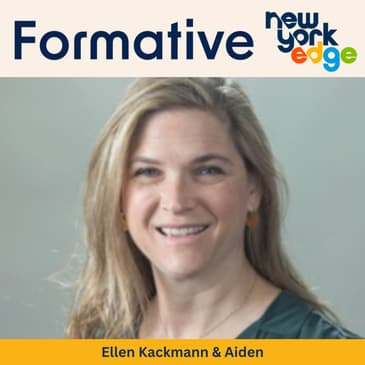
Ellen Kackmann, Senior Vice President of Affordable Housing at the Albanese Organization, sits down with middle schooler Aiden for a thoughtful conversation about what it means to build a career with purpose. Ellen talks about what inspires her to help create affordable housing, and why this work means so much to her.
She also shares how creative writing became one of her go-to outlets, and tells the story of how she finally stopped being scared of math by tackling it head-on. This episode is all about trying new things, facing fears, and finding the work that lights you up.
Downloadable transcript here
Rachael: Welcome back to Formative, the podcast where today's leaders are interviewed by the leaders of tomorrow. Today's guest, Ellen Kackmann, has built a career around purpose. Ellen is the Senior Vice President of Affordable Housing at the Albanese Organization. And today she talks to us about what fuels her commitment to housing access, the role creative writing plays in her life, and how she reclaimed her fear of math and numbers by facing it head on.
Hello and welcome. My name is Rachael Gazdick and I'm your host and CEO of New York Edge. On every episode of Formative, a student from our afterschool program joins me as co-host. And today that's Aiden from IS 109Q. Aiden, can you tell our audience a little bit about yourself?
Aiden: My name's Aiden. I'm 13 years old, and my favorite subject in school is social studies because I like learning about world history.
Rachael: Okay, before we go talk to Ellen, we want to remind our listeners that you can support us by making a donation at newyorkedge.org/donate. It would be very much appreciated.
Alright, Aiden, I think we're ready to go talk to Ellen.
[END OF INTRO]
Rachael: Ellen, welcome to Formative.
Ellen: Thank you. I'm glad to be here.
Rachael: Great. Aiden, what's your first question for Ellen?
Aiden: So, is being the director of an organization something you've imagined since you were little?
Ellen: You know, I don't know. I would say no. I think that—so I work in affordable housing development. And I can say that I've had a really longstanding interest in affordable housing in general, but I don't know that I necessarily always thought of myself as being a manager of a group or anything like that. It just happened over the course of time, and as you grow through your career, you take on more responsibility, and everything like that. For a lot of people, what that ends up meaning is that you help to oversee other people who are doing their jobs. But yeah, no, I would say that it wasn't necessarily something that I thought about when I was younger, but I know that thinking about housing issues and affordable housing is something that I had a lot of clarity about very early on.
Aiden: Okay, so my next question for you is: what was the journey like to becoming who you are now?
Ellen: Oh, well, I think a lot of people say this. I think many people feel like the journey is a straight one, but I think for most people, and probably myself included, it would be really more of a lot of different twists and turns and stuff like that. And I think that's what makes life interesting.
For me, I've been interested in housing issues for a very long time. A lot of that I think came from when I was very young. I lived in a neighborhood where there was actually a homeless shelter, and I would see the homeless population in and around the neighborhood, and it got me very interested in it. I felt very emotionally invested in wanting to figure out what were things that I could do to help solve the problem.
So I used to do a lot of volunteering when I was younger as a way to help, hopefully make a difference, and also learn things. Certainly some of the classes that I took at school were also very helpful and have been relevant to what I do at work. I also really am a big believer in the world around us being a classroom and complementing what we learn in school. So I've always tried to gravitate towards interesting opportunities to go to lectures or to talk with other people who are doing really interesting things that I find exciting or inspirational or that make me curious orr continuing to do things like volunteering as a way to expose myself to new things. So that's what I mean when I say lots of twists and turns. There's a lot of opportunity to learn from many places, and just seeking them out is what I would say.
Aiden: So on this long journey that you had, did you have any challenges that you had to face?
Ellen: Yea! Alright so, one challenge that always jumps to mind is when I was younger, I was convinced that I was not very good at math and working with numbers. I got it in my head that I wasn't good at it. And it took me all the way until I got to graduate school, right? Think of that. Like, you have elementary school, junior high school, then high school. After high school would be college, and then after college is when I went to graduate school. So it took me all the way until I got to graduate school to finally say to myself, "I've got to get over this fear of numbers."
And so, I actually ended up specifically picking a school that's very well known for being very focused on math and numbers and stuff like that. I said to myself, "I've got to just jump right in." And I found out that I actually really ended up loving doing math and playing around with numbers so much more than I ever thought I would. And honestly, I was really good at it. It made me a little bit upset because all those years I convinced myself that maybe I wasn't good at it, when in fact I was, and I wish I had conquered that fear earlier on in my life. But I would say that finally saying to myself, "Enough is enough, I've got to get over this fear," was something that was an obstacle that I had to work to get around.
Aiden: So you told me that you went to grad school, graduate school. Would you mind telling me more about what it was like there?
Ellen: So I actually, I ended up going to the University of Chicago, and part of the reason why I decided to go to the University of Chicago is precisely because there's a really long history of interesting things going on in Chicago with regard to housing. I knew already at that point in time that I was very interested in housing. And like I said before, I like to think of the world as a little bit of a classroom.
And so, I knew I was interested in going to the University of Chicago because they had that great program, but also I knew I wanted to use my time in Chicago as an opportunity to connect with interesting organizations that were looking at housing issues in a creative way, and maybe getting a student internship with them as a way to learn through doing. Sometimes I feel like with the things we do in classrooms, we're learning a system of how to think about things and how to approach problems and everything. But sometimes the most exciting thing is taking the tools that we learn in the classroom and then figuring out how to apply them in the real world. And I was really excited about the city of Chicago because there are a lot of great organizations and interesting, smart people doing wonderful things, and it was a super opportunity to work with them and alongside them.
Rachael: I'm wondering, since you said you knew pretty early on that you wanted to work in something related to affordable housing, are there any things that once you got into the field pleasantly surprised you, or perhaps disappointed you or shocked you?
Ellen: Um, you know, I grew up in New York City, and one thing that's very nice about this industry in this particular place is there's a lot of money at the local level in New York City where the government directs money and supports the types of projects I work on. Same thing at the state level, I would say New York State, coming out of Albany with the governors that we’ve had and the elected officials we've had, historically they've set aside a fairly good amount of money to support affordable housing development. It was very interesting to learn, as I got older, that that is not the case everywhere, that there are lots of states across the United States where there is very little money set aside for affordable housing development, and there are lots of municipalities, lots of towns and cities, where they are barely setting aside any money. It's just not a priority to develop affordable housing. And so that was something interesting that I learned over the course of time.
I would say also, one thing that I learned throughout my career, and this goes back to my weird fear of numbers and stuff, makes me glad that I did ultimately go to grad school and conquer that fear…is that when I was starting my career in housing, I felt like there was a tremendous emphasis on running calculations using Excel and different kinds of financial models and things like that. I even talk with young people starting out in their careers, and a lot of them feel like that's the thing they're missing. I feel like a lot of people get scared, for some reason there’s this fear of numbers and as a result, they run from them, but then realize that if they want to get ahead—especially in real estate development—that at some point in time, you just gotta jump right into it.
Ans so, for me, I don't think I realized that but as I was starting out my career it made me happy that I had said to myself, "No, you've got to get over this fear," when I did because otherwise, I probably would've been in a position where I would've been scrambling more and learning on the job to get comfortable with the numbers side of things.
Aiden: Okay so, on this journey you had through elementary, life, grad school, what was your biggest motivation? And what inspired you to be in the position you are in now?
Ellen: What was a huge motivating factor—and continues to be a big motivating factor in my life—was the inspiration I got from my mother. My mother worked in education and she was actually a guidance counselor. She worked mostly with younger children, but she was a real role model for me. Seeing her go into schools every day, you know, how important she felt it was to help the children she worked with and help them be the best they could be, I found that to be really inspirational.
And even though I didn't go into education like my mother did, I thought that her sense of purpose in life and her sense of wanting to serve the community Are things that were very inspirational to me and have served as motivating factors in my own career. I've just chosen to direct it toward housing instead of education.
Aiden: Okay, so my next question for you is, where would you wanna see yourself or where do you see yourself in the next five years?
Ellen: I have to say I feel very lucky to be working in a career that makes me feel very fulfilled. It's a wonderful thing for me to know that I'm contributing to making sure new buildings are being built to provide housing for people who need housing or maybe need to be in a bigger apartment or to move to a neighborhood, maybe they feel safer. It’s a wonderful thing.
And the other thing that I think about a lot is that housing isn't just a place we come home to at night and hop into our beds and sleep. When housing is built in a really good weay, it can also provide us with access to educational opportunities, being close to jobs. And all of these are things that inform the way that we think about ourselves and our personalities and help us grow as people. And I really love that. So I would be very happy to continue to be working in this industry and take on more responsibility, and to help our company increase the number of projects that we’re working on and the number of housing units that we’re producing for people. I would love to help continue to grow that over the next bunch of years,
But then, on a totally different note, completely unrelated to real estate and housing development, I love to write. Something I'd love to do more of in my spare time over the next five years is I’d like to do a little bit more creative writing and maybe work towards even writing a book would be really great.
Aiden: Oh, that sounds nice. So, what would you want your long-term legacy to be in the future?
Ellen: The most important thing to me is leaving behind a legacy where you've left the world a better place in some sort of way, and that you've made your mark in a positive way on the people around you that when they think about you, that you put a smile on their face and that they feel like you've contributed to their life in some meaningful positive way.
That's the most important legacy for me, and that can come in a lot of different ways. I mean, I'm very lucky to be working in a career where I do that in some way, but I also think that every day that we get up in the morning is a way that we can make positive change in people's lives. It could be as simple as folding a door open for somebody, or if you see somebody who maybe isn't having such a good day, just taking the time to listen to them and to ask them how they're doing. There's lots of opportunities to make a big difference in people's lives.
Aiden: So if you were able to go back to yourself at 13 years old, what advice would you give yourself?
Ellen: I would say: just be fearless. Don't worry about making mistakes. Sometimes the best lessons we learn are through our mistakes. And you don't have to be perfect all the time, and don't let the possibility of making a mistake scare you away from something, trying to do the things that maybe are falling outside of our comfort zone are the things that we end up learning that we love the most in life.
So, be fearless. Take chances on things. Try out a lot of things, experiment. Expose yourself to as many things as you possibly can. Keep an open mindset about things, and be curious. Be curious, ask questions, talk with people. Those are all things I would tell my younger self.
Aiden: Thank you very much. That was all my questions for today.
Rachael: Aiden, you did a great job hosting. And Ellen, thank you so much. It's been such a pleasure.
Ellen: You're very welcome. It's been so nice talking with you. I really appreciate it.
Rachael: Thanks for listening to Formative, a production of New York Edge. I'm your host, Rachel Gastic. Our production partner for this series is Citizen Race Car. This episode was produced by Haja Adas, post-production by Alex Brower. Original music by Garrett Teman. Thanks to the whole team at New York Edge for making this series possible.
Never miss an episode by subscribing to the series at newyorkedge.org/formative or wherever you get your podcasts.
CREDITS
Thanks for listening to Formative, a production of New York Edge. I’m your host, Rachael Gazdick. Our production partner for this series is CitizenRacecar. This episode was produced by Hajar Eldaas, post-production by Alex Brouwer, original music by Garrett Tiedemann. Thanks to the whole team at New York Edge for making this series possible. Never miss an episode by subscribing to the series at newyorkedge.org/formative or wherever you get your podcasts.