
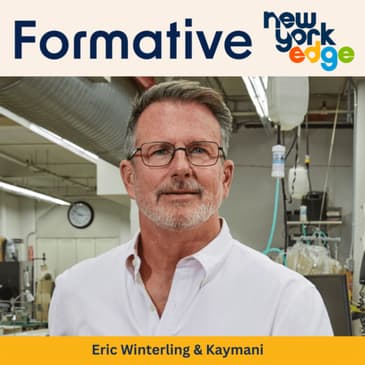

Eric Winterling is a costume maker whose life’s work is creating clothes that tell a story. You’ve seen his work on television shows like Marvelous Mrs. Maisel and The Gilded Age, as well as Broadway shows like Frozen, Beauty and the Beast and Wicked. On today’s episode of Formative, Eric joins 8th grader, Kaymani, to talk about his early love of sewing and the joys of being able to make, with your own hands, something out of nothing. Kaymani learns about the power of mentorship and how sometimes you have to learn to make your own luck.
Downloadable transcript here
Rachael: Welcome to Formative, the show where today's leaders are interviewed by the leaders of tomorrow.
Our guest today is Eric Winterling. Eric is a costume maker whose life's work is creating clothes that tell a story. Along with his team, Eric's work is to bring a costume designer's vision to life. He's made memorable costumes for television shows like Marvelous Mrs. Maisel and The Gilded Age, as well as Broadway shows like Frozen, Beauty and the Beast, and Wicked. We are thrilled to be talking to Eric today.
Rachael: Hello and welcome. I'm Rachel Gazdik, CEO of New York Edge. And my co-host today is Kaymani from M.S. 116Q. Hey Kaymani, can you tell me a little bit about yourself?
Kaymani: I'm in eighth grade. My favorite subject is math, and my least favorite subject is ELA.
Rachael: What do you like to do in your free time?
Kaymani: Probably sleep.
Rachael: So tell me, who are you interviewing today?
Kaymani: We're interviewing Eric Winterling.
Rachael: Well, let's bring Eric in then. Eric Winterling, welcome.
Eric: Thank you.
Rachael: And thank you so much for joining us. Kaymani, what's your first question for Eric?
Kaymani: Can you explain to me about, like, your work? And what do you do and how does it end up on television?
Eric: So, a show is a story, right? Uh, you have a script, then you have a director and the director is the person that hires the set designer. And then the set designer usually hires the costume designer. Costume designers are my customers. I take their sketches, and then I make them into real things.
So, we're making a story. Clothes can say a lot about people. And so that's how you come up with a costume design. And does it have to do any tricks? Like, does she suddenly have to go from her coronation gown to her ice dress, and it has to look like it's magic, right? So, I'm the person that they bring their sketches to and their ideas to and we make what that drawing is. Nobody goes out with a sketch pinned to them. They have to have the dress. I have a skill that can do that.
Kaymani: I see. So then, my question to you is, what piece that you have made most caught your attention, or a drawing that a client has given you?
Eric: I always like the next one. I don't really have a favorite. I mean, we worked on Frozen and we developed the ice dress and that transformation, which was really wonderful. It was a really rewarding experience. But sooner or later, every project I love, and sooner or later, I hate it. And then I love it when it ships. Because things get tense, you know, and sometimes people have dreams and you can't make them come true or that you have to see it in a different way.
Kaymani: I understand. How did you get into the costume making business?
Eric: How did I get into the costume making business? Well, I went to Temple University and I was a theater major and I spent all my time in the costume shop, where I wasn't studying, I should say. And I graduated, uh, and I got a job at Houston Opera as the resident costumer. That was in 1984. And I moved to New York in 1987 and got a job in a costume shop. And sooner or later, I realized that if I wanted to make any money at this, it would have to be my own business. And so that's when I started out on my own by myself with a sewing machine and slowly hired people as I needed them.
Kaymani: How did you build your team of craftsmen?
Eric: How did I build my team of craftsmen? Well, it doesn't really work like that. I mean, I've been in business for 35 years and people come and go and you meet all sorts of different people on the way. And you find what talents people have and you try to capitalize on them and you use them, uh, for what they do best. Like, do they hand paint fabric? Do they bead fabric? And so, sooner or later, they want to move on with their lives and either open up their own businesses or whatever, or they're not interested. And then you have to figure out what's the next step for how you're going to create these costumes.
Rachael: It seems like finding and keeping talented people for long periods of time can be challenging. You know, what are some of the other challenges that you were met with early on in your career?
Eric: I mean, it wasn't always easy and it wasn't always successful. I did, at times, have to go on job interviews. Perhaps I was going to have to stop what I was doing and take a job. But then something would come through, shows that I wouldn't even remember that I put a bid on, would be awarded and so I would get that contract. Um, my company was very small. It was in a 400 square foot room. That's now the size of one of my fitting rooms. And it was, I just had two machines and I would hire people as I needed them to help me. And then, just, life happens.
And, you know, I have a very good mentor in the designer, Jane Greenwood. She was one of the first people that I met in that small space. And she always worked. She always has a show going, and she always made sure I had projects to work on. And she's my friend to this day. She's still working, she's going to turn 90.
Kaymani: What's a lesson you wish you learned earlier in your career?
Eric: I'm not sure. Here's what I know, if your brain is a savings account, the things that people teach you go into your savings account at half the value. The things that you learn on your own, the projects that you take on your own and the lessons that you learn on your own are like twice the money going into your account. Those things you never forget. No one teaches you the things that you need to know. You have to figure them out yourself, like how to pace yourself and how to make a deadline, how to get things there on time. And polyester thread is better than cotton thread. Who knew?
Rachael: I'm curious to know, Eric, when you were in middle school, what did you think your life would look like at this age?
Eric: I think I wanted to be more of a performer. And then at one point I just realized that I don't think I'll ever do anything as well as sew, and I really had to own that. And that's when I really started pursuing it.
Kaymani: I wanted to ask you, who was someone in your early days that inspired you a lot?
Eric: Well, I was inspired by many people, but I would have to say it started with my mother. She was, in some ways, a great inspiration. While she didn't actually teach me to sew, she enjoyed sewing.
She would buy commercial patterns. You probably cook things, right? You follow a recipe. And so, I would start reading pattern instructions and they made complete sense to me. In the back of those books, they have toys and, uh, Barbie doll clothes that you can make. My sister had Barbie dolls. And so I started buying those patterns before I started making clothes.
And that was the way I taught myself how to sew. It was an unusual thing, but once I showed that I was able, um, my mother, she was, we sort of became buddies. We would go fabric shopping, we would talk about different things we were thinking about making and who we were making them for and how we were going to approach it. So, it was very inspiring.
Kaymani: That sounds nice, it's like a mother and son hobby.
Eric: It was, yes.
Kaymani: I also researched about you and it said that you made clothes for you and your siblings.
Eric: Yes, I did, yes.
Kaymani: Did you make clothes for, like, special occasions or just, like, clothes for them to wear?
Eric: No, um, I remember one Christmas I made, uh, shirts. It was in the 70s and it was when the cowboy style was in. I made shirts for them that sort of had some western styling and my brother John liked it. And they had to be just so, they had to have three snaps on the cuffs and all of that. And you know, there was just clothes, they weren't special occasion. I did make my sister's wedding gown. I made a lot of things. I made things for my mother when she got tired of sewing.
Kaymani: What did you like so much about sewing, like what satisfied you?
Eric: The joy of creating something is really what it comes down to, and make something that just didn't exist before you made it, and the ability to make people happy. There are a lot of different people in the world and a lot of different reasons why they would have something made. They might not be a size that they can find something special, uh, in a store. Or they want something unique and to see their face when they get what they want, it's really, it's really a way of bringing joy into the world.
Kaymani: That sounds nice and heartwarming.
Rachael: Eric, I have one last question. If you could go back and talk to yourself at 13, what would you say?
Eric: Oh, well, what I would tell myself is don't worry about it. You know, it will come together. I mean, not very many people were encouraging me about sewing or going into, as I say, showbiz. It's because no one in my family knew what that meant, but I can assure you there's always work. I mean, it's a good place to make a living at. You always think you're going to starve and nothing could be further from the truth.
Rachael: That's so awesome. Well, thank you both so much, and it's just been such a pleasure speaking with you.
Eric: Well, this has been wonderful. Thank you. Kaymani, thank you very much. Thank you very much for the thoughtful questions.
Kaymani: You're welcome, and thank you, too, for answering.
CREDITS
Thanks for listening to Formative, a production of New York Edge. I’m your host, Rachael Gazdick. Our production partner for this series is CitizenRacecar. This episode was produced by Hager Eldaas, post-production by Alex Brouwer, production management by Gabriela Montequin, original music by Garrett Tiedemann. Thanks to the whole team at New York Edge for making this series possible. Never miss an episode by subscribing to the series at newyorkedge.org/formative or wherever you get your podcasts.