
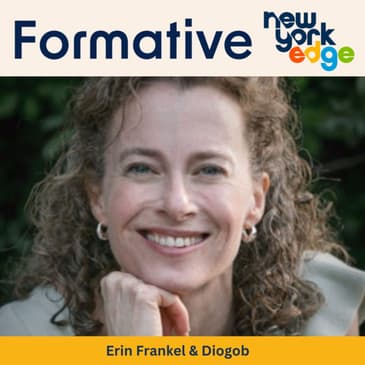

We’re closing out this season of Formative with Erin Frankel. Erin is a children’s book author, speaker and teacher. Joining Erin is middle schooler and co-host, Diogob, who learns that being weird only means being unique and special. Erin shares with Diogob how bullying played a prominent role in her childhood and how it taught her the importance of kindness and why we should all stand proud of who we are, no matter what others think.
Downloadable transcript here
Rachael: Welcome to another episode of Formative, the show where today's leaders are interviewed by the leaders of tomorrow.
Erin Frankel is with us on Formative today. Erin is a children's book author, speaker, and teacher. Her books carry messages of empathy and wonder. Erin joins us to talk about childhood dreams, song lyrics, and the importance of pushing through rejection. We're thrilled to welcome her on our show.
Rachael: Hello and welcome. I'm Rachael Gazdick, CEO of New York Edge, and my co-host today is Diogob from I.S. 27R. Diogob, can you introduce yourself to our audience?
Diogob: Hi, I'm Diogob. I'm 13 and I'm from I.S. 27. I'm currently in the eighth grade. My favorite sport is playing soccer and I'm currently a goalie on my school soccer team. My favorite subject is currently English because I like the way that we get to learn about authors, like there's many different books that we get to read through and it becomes very interesting.
Rachael: Well, then you're in luck with our guest today. Diogob, who do we have on the show today?
Diogob: Today we're going to be speaking with Erin Frankel and I'm super excited to be speaking with her.
Rachael: Well, let's bring her in then. Erin, welcome and thank you so much for joining us today.
Erin: Thank you so much. I am so excited to be here. I can't wait for this conversation.
Rachael: Great, well take it away Diogob.
Diogob: So my first question is what ultimately inspired you to be a children's book author?
Erin: That's a great question Um, it's interesting. I don't think it was, I'm sure that it wasn't a moment where I said, I want to be a children's book author. I think it was more a process of building up of seeing what I was drawn to and what I was really interested in.
And one thing over time that really never changed was that I was drawn to specifically picture books. I think my early experiences with picture books, I just, I loved reading them. I loved having them read to me. I'm very interested in trying to say as much as I can, um, in as few words as possible, and I think picture books allow me to do that. Poetry does as well. And so just over the years, I was navigating towards specifically this genre, either poetry or picture books. And every time a story idea would pop up in my head or I would be inspired for a story, it seemed to be that I always wanted to kind of fit into that box.
And so I just kept putting it into that box. And over time I decided I'd like to try to share my stories with other people. And then before you know it, you're looking at a book that you're holding in your hands and saying how did this happen, just like you asked. And when I think about it, I do think that it's like a whole journey, um, to get to that point.
Diogob: Thank you for sharing. I definitely can relate to your love for picture books. When I was a kid, I took a very big liking to picture books. And I prefer them more over just straight reading because when you have pictures, it like helps you understand the scenery or the setting around you inside the book. So I'm definitely glad you share that.
Erin: Yeah, we have a lot in common. That's exactly why…I didn't talk about that. But when you said it, I was thinking exactly. And it's so fun to meet someone who feels the same way. That combination of the text and the pictures, it's so powerful and I never outgrew that. And I hope you don't either. I still love it.
Diogob: Yeah. So my second question for you as an author is what were your other dreams as a kid? Did you always want to be an author?
Erin: So I had other, I wouldn't necessarily, it's interesting. I wouldn't call them dreams necessarily because I don't think that I was connecting the parts between what I was really interested in and understanding how that might impact what I would do in my future for my career. So I'll give you an example. I love dancing. I loved singing. I really liked writing, but I never, I didn't know how those things could develop into something that I could do as part of a career.
Um, so maybe, maybe not knowing that, not being able to have, even I'm thinking now that conversations like we're having and meeting people who are authors or dancers or, it wasn't really until high school when I would say I had, I developed a real dream of something specific that I thought, ooh, I really want to do this. And it wasn't writing at that point, it was actually musical theater. I did some theater in high school and I loved it so much that when I went to college, I started out studying musical theater. And that was the first time that I thought, I felt really excited. I had a vision of, ooh, I love to one day, like everyone thinks beyond Broadway, you know. Um, but I didn't really have that one dream until much later.
How about you?
Diogob: My dreams as a kid, I think they switched by the day. Like, whenever I listen to certain songs or anything and I look at the lyrics, it does remind me of, like, just nice, calm things that I like to listen to. And, like, when you mention poetry, the lyrics, they may not be classified as poetry, but to me, they're, like, so good. I don't know how to describe it, but it's more like, the lyrics relate to poetry but not like that.
Erin: I always think of song lyrics as poetry. I think they are. And I'm very drawn, so if you're drawn to, do you like to actually read along as you're listening to a song? Do you like to look at the actual lyrics sometimes?
Diogob: Yeah I like to look at the lyrics, like have it right in front of me.
Erin: Yes, me too. You know, my dad was a drummer. And so I spent a lot of time when I was a little girl looking at actual vinyl records like we used to say in the olden days. And they had the lyrics written right on them, almost like a little book. And that's something that I love just like you, just to follow along. And I remember thinking, how beautiful is this? I mean, how beautiful are these words and then with song. So there's a singer in you too.
Diogob: Thank you. Did your dad being a drummer ever inspire you to have a liking for musical theater?
Erin: That's a really good question. I hadn't thought about it. So growing up, my, my parents were divorced. And when I was a very little girl, I spent a lot of, a lot more time with my dad than I did as I got into my older years, but I'm convinced that the influence that he had, um, when I was much younger with going to listen to him play drums, listening to a lot of music. I think the rhythm and the beat and the pace of the drums, oftentimes I can almost hear that. It comes into my writing. If you listen to lyrics and you like to read poetry, even a beautiful sentence, sometimes it feels like it has a beat to it. And I think that pacing maybe could have come from that. My mom was also, my mom also loved music. So how about you with music in the house? Um, do other family members like music as well or are you the main music person?
Diogob: I think I would say I'm the main music person because I also have an older sister and she loves to listen to music, like she usually does it whenever she's cleaning or cooking or anything. But my mom also she has always been a big music person along with her sister. I remember car rides in them when we were on vacationing. We were on vacation listening to, um, this very popular singer from our country. And I'm from Senegal, so I feel like the music over there, it's, it just connects people together and it makes, it's just something really nice to be able to listen to all the time. So I think music has definitely been a big part of my life and I'm very glad that I'm so connected to it.
Erin: It sounds like it transports you also.
Diogob: Yeah.
Erin: Especially when you're, like you said, you're with family and listening. And I love that music can do that. All of a sudden you feel like you're transported to another place.
Diogob: Yeah. It brings back so many memories just listening to any type of music really.
Erin: Yeah. So true. I can relate.
Diogob: So, um, I know the process of becoming an author is hard. So could you tell us a little bit about your obstacles if you went through them, if you have any?
Erin: Yeah, I think like, um, so there, there are the, the obstacles that I think that, that not just writers, but if we think about it specifically in terms of writing, that you keep trying for something and even though you're trying, you're getting a rejection, right? So you might think you've got this great story. And sometimes it might not even make it past, um, you know, your agent who is then the person who's going to try to sell your story to a publisher. Sometimes it doesn't even make it past the agent. There will be times when an agent will say, I don't think that, you know, it's a cute story, but I don't think the market it's going to sell. That's hard.
Sometimes stories need to go back in the drawer. Sometimes they change shape. At first that was harder. I feel like now after that happening many times, I realize that each story that I write, even if it ends up back in a drawer, I've practiced the craft. And so it makes like the next story that I write a little bit better. I know a little bit more. So there's a rejection aspect that's involved, but I think a big obstacle that maybe a lot of people don't talk about are sometimes the obstacles that we ourselves put in our own way. Um, And that's something that I can give you a little bit of advice on for things that you want to do that maybe you have a little voice in your head saying, Oh, I don't think I could do that. You know, so and so is doing that, that, or I haven't gone to that school where I can learn how to do that. You know, there, there can be sometimes little voices that are not great for us in our head that might be telling you can't do that. And I learned pretty early on to put that little voice, just be like, hey, thanks for showing up but let's have a seat over there for a little while and just block all that out. And kind of I think of it like a protective bubble and not be as aware of like everything else, not think of everything like a competition, just get back to doing the work. So I'd say that's an obstacle. And that could have been a real obstacle for me, but I brought a little bit of awareness to it and kind of nipped it.
Diogob: That can be very discouraging for authors and I'm really glad that you were able to overcome these obstacles to get to a point where you are now.
Diogob: So what is your favorite book that you've ever written?
Erin: Out of the books that I've written?
Diogob: Yeah.
Erin: That's a good, so I have, it's funny because I have three daughters and they're always asking, what's your favorite this? What's your favorite that? And they already know my answer, because I always say, Oh, I can't pick one, I like them all. Um, and that's a question I do get a lot. I might say, if I'm allowed, that I like different things about all of them.
Diogob: Yeah.
Erin: I would say that it's always really special for an author, like that first book that you get published. And the first book I published was a book called Weird, as part of a series of books on bullying. And that was a really special process because I created that book with one of my best friends, who's the illustrator of the book. And that doesn't typically happen, um, you may not know it, but in, in children's publishing, in picture books, oftentimes authors never meet their illustrators.
Diogob: Yeah.
Erin: The publisher will pick the illustrator, but we had a really unique experience in that we decided it was something we wanted to work on together. So I think that made that book, apart from the message which I'm incredibly, proud isn't the right word, but I, it's, it's a message, I think it's so important that I love, love is probably the better word. I would say that probably Weird was that moment where, like I said, at the beginning, I'm holding this book in my hands and saying, wow, you know. Yeah.
Diogob: It's your first, like, big achievement, big accomplishment. So it's very dear.
Erin: Yeah. I think I jumped up and maybe hit the ceiling when, when someone said we want to make this story into a book. So I guess that might lean in the direction of favorite, but I do like things about all of them.
Diogob: So what inspired you to write the Weird series?
Erin: Uh, the Weird series, what inspired me was, um, one thing that made things a little harder was that bullying was a part of my childhood in different ways. So my brother was bullied a lot in the first town where we lived and it was really hard for me as you can imagine, you said you have a sister. Um, just, you know, witnessing being a bystander to someone else being bullied. So it's always been something really near to my heart. Um, when I was in middle school, like you are, I had my own experiences with being bullied.
And then years later, fast forward, we moved, we lived in Spain for a long time, my husband's from Spain. So my girls were born overseas. And when we moved back to the States, when they were in school, one of my daughters was being bullied and she came home and started telling me about what was happening at school. And it was through a conversation with her where I was suggesting things. Why don't you try this? And she said, oh, I tried that. And when I did that, she said I'm weird. And it was like a moment where I thought a couple of things. I thought first, by the time somebody comes to someone to say, this is what's happening, oftentimes they've tried a million ways to try to make it better themselves. But what I really thought was I wanted to take all the experience that I hadnas a bystander, as someone who had been bullied, and as a mother, and I wanted to try to do something to make a difference that might help.
Diogob: I think that it's really nice that you decided to turn that into a book because I know bullying can be a very heartbreaking subject and something sad to go through. So I'm very, like, happy to see that you were able to bring awareness to it through your book. And I think it's very amazing of you to do that.
Erin: Thanks so much. Thanks for saying that.
Diogob: You're welcome.
Erin: Yeah, I appreciate that.
Diogob: So you obviously told us like your experience with bullying. So like, how do you feel about it? Like, what does it mean to you?
Erin: You know, I feel like when there's bullying everybody is impacted. It's not just one person. I think that every single person, um, struggles, even if it's the person who is actually doing the bullying.
It's something when I go to schools and talk to kids a little bit about this topic, you know, I'll say to them, after showing them the first couple books in this series, I'll say, you know, we could have just stopped there. We could have just talked about Louisa, the little girl who was being bullied, or Jayla, the girl who was a bystander. And then I ask a question, if we stop there and we don't actually think about the little girl who's doing the bullying, do you think that she's going to stop doing that? And pretty much across the board, everyone said, everyone, we sit with that question and, and to answer your question, what I know is that it's complicated and that everybody needs help with their feelings. And I think that when this type of behavior happens, it's an opportunity for everybody to talk about, you know, what can I do to try to make things better, and I do know that something that gives me a lot of hope is that every single person can do something.
Diogob: It's really inspirational how you go to these schools and tell children about it. So, when you say that you go to schools and you talk to children about it, what is the message that you're trying to send to these children?
Erin: Well, I think, you know, whenever I'm talking about any of my, any books in general, really, what I like to discuss with kids, and it's an interesting conversation to have, and it's a reminder, and I remind myself of this all the time, that I think just like a story that each day when we wake up, we get to decide what our story is going to be, who we're going to be in our own story. And also who we want to be in somebody else's story that day. And I think it's really empowering to think about things that way. Sometimes it can feel like we don't have a lot of control over the things that are happening to us. And I think it shifts the focus to what are the things that I can control and how we are in the world I think is something we can choose every day, you know, meeting, meeting the world with kindness and compassion, and it isn't always easy if that's not what is coming back to you.
So I think that's part of what I want to say. Who are you going to be, you know, who are you going to be today? And then the next day and the next day and every day it's a choice. And before you know it, you're that person. I think it's something that maybe we're not even aware that we're doing with our interactions with people.
How about you? I mean, unfortunately, these types of things happen. Everybody's going to see, experience someone being unkind to someone else. How do you feel in those situations and what kind of techniques or skills, what do you use to cope or to try to help?
Diogob: I would say that I do know a lot of people who go through, um, those situations around me. And whenever they come to me to try and talk about it, because I'm grateful that it rarely ever happens to me, but at some point being mean to somebody, like it might happen to you and it does.
Erin: Yeah.
Diogob: So, whenever somebody tries to come to me about it, I want to be like, like listening ears to them to help them cope, like just to help them feel better about themselves. And when it happens to me, I'm always like able to fall back on my friends or anybody to talk to about it. But I think just in general, the concept of bullying is really sad.
Erin: Yeah. You know, what you just said, what you do is like the best thing I think that someone can do is to listen and let that other person know I'm here for you. So that's great that you're doing that.
Diogob: Thank you.
Erin: You're a really good friend. I could tell.
Diogob: Thank you. I know that you wrote a book called A Plate of Hope. So could you tell us a little bit more on what inspired you to write it and why you wrote it?
Erin: Yeah. So this book just came out. I'm really excited about it. It's my, it was my first attempt at doing a picture, what we call picture book biography, you know, so about a real person. And I had this connection, since we were talking before about how I lived in Spain for a long time. My husband's Spanish. Jose Andres, who is the chef in that story is from Spain. And so I had him on my radar for a number of years because when he was moving to the United States, I was a young 20 something moving to Spain. And so it's like we were going the opposite directions, but I was hearing a lot about him while I was still in Spain. And so over the years, I knew, wow, he's really made a name for himself. He's a pretty famous chef in the United States, but it wasn't until the pandemic, the COVID pandemic, when I started to see the shift that he had made from being this really famous chef with all these, like, really fancy and cool restaurants, which he still has, by the way, but he seemed to have made a shift into humanitarian work in helping to feed people in times of disaster and after earthquakes and hurricanes.
And I got really curious and I, I wanted to know how that happened. How did, hr=e could have just said, oh, I'm all set, right? I've got, I didn't know what I wanted to do, my dream, but something was nudging at him to do more. And when I started reading more about him, I felt like, well, he really deserves a picture book. Like if anybody deserved one, it was Jose Andres. And that's how it started.
So the story is, it's a biography. It's, you know, picture books are so short that you've got to figure out what am I going to focus on. But it was my attempt to say, what were the pieces along the way that just like you're asking me and you had to think about pieces for this interview, I was doing the same thing. What are the pieces along the way that led Jose Andres to become that humanitarian chef? So that's how I got inspired.
Diogob: I'm actually really happy that you took inspiration from him because from what you're telling me, it seems like he is a really nice man. So, um, I wanted to also ask you a question tied to that. Have you ever met Jose Andres and been able to give him your book? And how was, what was his reaction to it?
Erin: You know, sadly, I have not met him yet. And I get that, I get asked that question a lot. Um, when I was writing the book, I know that, I'm almost positive, I'm going to say, and if not, if he's listening, let me know if he doesn't, but I have made it very clear to like my publisher and to my agent and everyone along the way, um, can we get Jose Andres a copy of the book? Because really the biggest joy I can really get is having him read it and feel like I, I got it, I got him right. You know, you're really almost an actor in a way when you're trying to write a biography. When you're trying to write a new story, you try to get in someone's shoes. So I, I like to think that he would be happy with the final product. I know that he's out busy feeding the world and running all of his restaurants and everything, but I'm hopeful that he has it. And then hopefully he likes it. Yeah. I'd love to meet him.
Diogob: I'm sure if you were to ever see his reaction, it would be the most delightful thing ever.
Erin: Yeah.
Diogob: So for my last question, how do you find inspiration to write these stories? Is it like events in your life that inspire you to write these stories or does it just randomly pop up?
Erin: Yeah, it's funny. Each story I think is really something different. So with the Weird series, it was all the events in my life and then culminating like in that moment when someone I love dearly was telling me a story and I got a real, a very concrete idea that ended up being almost a sentence that goes through the whole book. So there was that moment.
Um, I wrote a story about grief and loss, um, that was based on two dogs that I had, and how sad my one dog was when the other dog died. And I was curious about, how did, how do animals feel when they lose another animal friend? And I wanted to get in that perspective. And so sometimes it's a challenge, like, ooh, I want to see if I could write something from a dog's perspective and just a challenge for myself.
Sometimes like with Jose Andres, it's I'm reading another book or I'm seeing things on TV and it sparks my curiosity. So ideas come in all different ways. A lot of times for me, I will be doing something throughout the day and it's a strange thing, but I'll get, like a sentence will come to me and I, and I always have like a little notebook and pens around the house and, and back or the back of an envelope or whatever you have. And my advice is write it down right in the moment, but oftentimes it's a seed that I feel like came to me for a reason, I can't explain why, but it starts to, it's like a, it's like a recipe, like a stew. Once it's there, if I keep coming back to it, sometimes it'll be like a dream it keeps moving forward until I can start to figure out a little bit of like, a plot, or where am I going with this.
That's a good question. Are you writing any stories right now or how do you, I know you said that you love reading, but are you doing any writing?
Diogob: No, I don't do writing because I think I don't really have anything to write about, like no, nothing that nobody else would want to know, like nothing interesting that I'm able to turn into a really good book.
Erin: I know what you mean about, like, and I go through these periods of time too, where it's like, ah, you know, like, an idea, you're not latching on to an idea.
Diogob: Yeah.
Erin: And I know that feeling of, I want to be inspired to, to write about something. What I have found helps, and just with you talking about the lyrics that you love in songs, is forget about, put aside sometimes like, oh, I don't have that idea and maybe just set some time aside and get a notebook and a pen that you really like because I think those two things are important, a really good pen that, that like glides across the gel pen and see where it goes without any pressure. It doesn't have to turn into a story. Maybe it's a little bit of a song or maybe it's a song that you like from a different perspective, or if you want to, you don't have to do it but…
Diogob: Yeah.
Erin: Cause I can tell you that I bet I, you know, I can, I can almost guarantee that when you start playing around with writing a little bit that there will be people who, who want to read it. I for one, so if you do write something, I'd love to see it.
Diogob: It's really nice for you to say that because sometimes I do like when I read other books, I'm like, Oh wait, that's a really good idea. I can incorporate parts of my life into it to make it into such a big, interesting story. But I think that the words you just said to me, they're really inspirational and they will really help me a lot. Thank you.
Erin: You're welcome. You have good questions so…
Diogob: Thank you!
Erin: Great interviewer. Journalism may be in your future here.
Diogob: I'm going to think about it actually.
Rachael: What a great conversation. We have one more question for you, Erin. If you could go back to your 13 year old self, what would you tell her?
Erin: Yeah. Okay. Wow. Going back in time, kind of, cause I always feel like I'm 13 so I don't have to go back too far. But let me think, um, if I went, if I had to go back to my 13 year old self, I would probably, um, I would probably give my 13 year old self the advice that I gave my 17 year old self when I had to come up with something to put in the high school yearbook under my picture, because everyone got like a couple of lines where they could put a quote or something that symbolized what they thought and their beliefs. Um, and mine was to be someone special, believe that you are. I saw that somewhere so it wasn't my, it's not my quote. But it's interesting thinking now, as old as I am now, looking back, that at 16 or 17, that was the quote that I chose. So I think the advice that I would give would be to believe in yourself, um, instead of the voices that we talked about before that say you can't, to really be that voice inside that says you can do it. And believe in yourself and then surround yourself with people who believe in you, who believe in you.
Diogob: That's really nice.
Erin: Yep. So I believe in you.
Diogob: Thank you.
Erin: You remember that. And I appreciate this chance to talk about books and my writing. I don't get a chance to think about a lot of these questions a lot so it was fun.
Diogob: It was really nice to meet you. And I'm so glad to have a look into your life and know the inspiration and everything about you.
Rachael: This was a pleasure. And thank you so much.
CREDITS
Thanks for listening to Formative, a production of New York Edge. I’m your host, Rachael Gazdick. Our production partner for this series is CitizenRacecar. This episode was produced by Hager Eldaas, post-production by Alex Brouwer, production management by Gabriela Montequin, original music by Garrett Tiedemann. Thanks to the whole team at New York Edge for making this series possible. Never miss an episode by subscribing to the series at newyorkedge.org/formative or wherever you get your podcasts.