
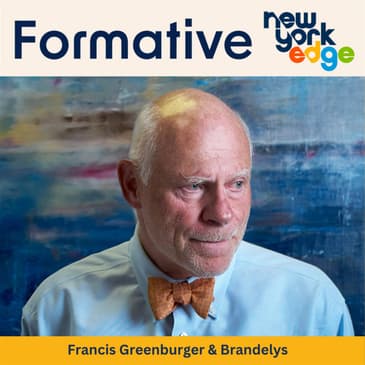
We’re landing Season 5 of Formative with New York Edge board chair Francis Greenburger! He’s a real estate developer, author, literary agent and philanthropist who’s spent a lifetime taking his multiple passions and turning them into not only a paycheck — but purpose. This episode’s co-host, 7th grader Brandelys, wants to start a business, herself, someday. She asks Francis how he got going, what he’s loved about his projects, and we learn what’s coming up for him next.
[00:00:00] [SPEAKER_00]: Welcome to Formative, the show where today's leaders are interviewed by the leaders of tomorrow.
[00:00:05] [SPEAKER_00]: Season 5 of Formative is brought to you by the generous support of Macy's Inc., whose purpose
[00:00:11] [SPEAKER_00]: is to create a brighter future with bold representation from underrepresented youth
[00:00:17] [SPEAKER_00]: so we can realize the full potential of every one of us.
[00:00:25] [SPEAKER_00]: Francis Greenberger joins us to mark the season 5 finale of Formative.
[00:00:29] [SPEAKER_00]: Mr. Greenberger is a real estate developer, author, literary agent and philanthropist.
[00:00:36] [SPEAKER_00]: He's also the current chair of the board of New York Edge. We're so pleased he could join us.
[00:00:42] [SPEAKER_00]: Hello and welcome. I'm Rachel Gastick, CEO of New York Edge and my co-host today is
[00:00:47] [SPEAKER_00]: Brandelys from PS225X. Brandelys, tell us about yourself.
[00:00:53] [SPEAKER_02]: Hi my name is Brandelys. I'm in the seventh grade. My favorite subject is ELA. I really enjoy
[00:01:00] [SPEAKER_02]: reading and writing. My favorite color, I'd say maroon red. It suits me the most. My favorite
[00:01:09] [SPEAKER_02]: thing to do is probably to go out with family by just like the time and how I just get to know
[00:01:18] [SPEAKER_02]: them better each and every minute. What I want to be when I grow up, I want to be a business owner.
[00:01:26] [SPEAKER_02]: I want to create businesses and become a multi-millionaire by that. That's pretty much it.
[00:01:36] [SPEAKER_00]: Well Brandelys, I think you're talking to the right guy today.
[00:01:39] [SPEAKER_02]: I'm very excited to be speaking with you, Francis Greenberger.
[00:01:43] [SPEAKER_00]: Okay well why don't you take it away hun?
[00:01:45] [SPEAKER_02]: I had a couple questions to ask you. I just want to get to know you better.
[00:01:50] [SPEAKER_02]: What inspired you to start doing real estate?
[00:01:55] [SPEAKER_01]: Well, you know, I think I had a little bit of the motivation that you've articulated
[00:02:01] [SPEAKER_01]: wanting to be successful and to make money. My father was a good publisher but he was not
[00:02:08] [SPEAKER_01]: great businessman. So when I grew up, we did not have a lot of money. I was a kid.
[00:02:16] [SPEAKER_01]: My friends had televisions but we didn't get a television in our house until I was 11 years old.
[00:02:22] [SPEAKER_01]: I watched my father be stressed by not having money to some degree my mother
[00:02:27] [SPEAKER_01]: and not always being able to pay their bills and things like that.
[00:02:32] [SPEAKER_01]: And I decided when I was young that I didn't want to be in that position.
[00:02:36] [SPEAKER_01]: And since I watched my father in the publishing business not be financially successful,
[00:02:42] [SPEAKER_01]: I thought that maybe it was another business that I could go into.
[00:02:46] [SPEAKER_01]: And I found that I had sort of an instinct for real estate.
[00:02:51] [SPEAKER_01]: I'm able to visualize buildings in my mind. If you told me a particular corner in New York,
[00:02:57] [SPEAKER_01]: I could see the buildings there. So I sort of had a ton of visceral connection with real
[00:03:04] [SPEAKER_01]: estate even before I began to understand the business. And then one day I kind of got into it
[00:03:10] [SPEAKER_01]: accidentally had another couple of small book related businesses that needed an office.
[00:03:17] [SPEAKER_01]: I went to rent the office. The man who had the office said, well, I have two offices for rent
[00:03:22] [SPEAKER_01]: and I want you to rent both of them and I'll give you a very, very good deal.
[00:03:27] [SPEAKER_01]: And I said, but I only need one office. I couldn't afford one office.
[00:03:30] [SPEAKER_01]: But he said, I'm going to give you the second one. That's very cheap and you'll be able to rent it
[00:03:35] [SPEAKER_01]: to somebody else for more money than you're paying me. I thought about it and said, well,
[00:03:40] [SPEAKER_01]: okay. And it just happened that same afternoon, I bumped into somebody who was looking for an
[00:03:46] [SPEAKER_01]: office. So I took and showed them the second office that I didn't need.
[00:03:51] [SPEAKER_01]: And they agreed to rent it for enough money to pay for both offices.
[00:03:56] [SPEAKER_01]: So I got one for free. So I figured this is pretty good. That's kind of how I got started.
[00:04:04] [SPEAKER_01]: So combination of just kind of instinct and a sense of architecture and the physicality of
[00:04:12] [SPEAKER_01]: buildings together with seeing it as a good business opportunity.
[00:04:17] [SPEAKER_02]: That's awesome to hear. Makes me want to be a real estate.
[00:04:20] [SPEAKER_00]: Frances, is there a real estate project that you did that you love that's something that
[00:04:26] [SPEAKER_01]: is one of your favorite projects? Well, right now we're building a new building in Chicago
[00:04:33] [SPEAKER_01]: called 1000 M because as we're building it on Michigan Avenue, it's a very big building
[00:04:40] [SPEAKER_01]: and it will change the sideline of Chicago and probably be one of the nicest places to
[00:04:47] [SPEAKER_01]: live in Chicago. And it has all kinds of special facilities in it that will make life there better
[00:04:53] [SPEAKER_01]: for people. We have an indoor swimming pool, we have an outdoor swimming pool. We have a basketball
[00:05:00] [SPEAKER_01]: court. We have children's lounges. We have teenage lounges. We have game rooms.
[00:05:07] [SPEAKER_01]: So it's not only about the life that people have in their apartments,
[00:05:10] [SPEAKER_01]: it's about their overall life. So I'm proud of that building. That's one of my newest projects
[00:05:19] [SPEAKER_02]: but I'm excited about it. What inspired you to become an author and why?
[00:05:24] [SPEAKER_01]: Well, my family was involved in the publishing business. My father was what's called a literary
[00:05:31] [SPEAKER_01]: agent and a literary agent helps writers find a publisher for their books like Wright One.
[00:05:40] [SPEAKER_01]: And also negotiates the agreement with a publisher the way sports agents represent sports figures.
[00:05:50] [SPEAKER_01]: So literary agents represent authors. So I grew up in that world and in fact spent some of my
[00:05:56] [SPEAKER_01]: early years working with my father. So I knew about the publishing business and actually
[00:06:02] [SPEAKER_01]: when I was relatively young, I was working as a literary agent. And one of my clients had an
[00:06:09] [SPEAKER_01]: idea for a book which I thought was a good idea and I encouraged her to write the book but then
[00:06:15] [SPEAKER_01]: she didn't do it. So one day she said, well you know, I really don't want to do this thing, this
[00:06:20] [SPEAKER_01]: book. So I said, well if you want to sell the idea, I'll buy it from you and write the book
[00:06:26] [SPEAKER_01]: myself. And she said, that'd be great. And so I bought the idea for the book which is a book
[00:06:33] [SPEAKER_01]: about negotiation. So that's kind of, actually I guess I was inspired by my background in the
[00:06:40] [SPEAKER_01]: publishing business where I was helping writers one day decided, oh I'll try to be one of those folks
[00:06:47] [SPEAKER_01]: that I was representing and trying to help. That's very nice to know. Thank you so much for
[00:06:53] [SPEAKER_02]: answering that question. Who in your life encouraged you to become an author? Well,
[00:06:58] [SPEAKER_01]: I wrote another book a few years ago which was a book about my life and there was somebody who was
[00:07:06] [SPEAKER_01]: a childhood friend really. And she had also worked in the publishing business and she said to me,
[00:07:12] [SPEAKER_01]: you should write the story of your life. And we would have lunch maybe two, three times a year
[00:07:18] [SPEAKER_01]: and every time she could say the same thing. And a couple of years later one day she came
[00:07:23] [SPEAKER_01]: to lunch and she said, I'm going to show you how to work on this book that I think you should do.
[00:07:29] [SPEAKER_01]: And she took out her tape recorder and she said answer my questions and then I'm going to help
[00:07:36] [SPEAKER_01]: you get started on writing the book. So I said okay, we sat there at lunch, she had a bunch
[00:07:42] [SPEAKER_01]: of questions which I answered and that sort of became the start of my memoir. She was
[00:07:49] [SPEAKER_01]: definitely an important figure in my getting started the second time. So which of your books
[00:07:54] [SPEAKER_01]: was your favorite? I think the more recent one my memoir, the one about negotiation when I look
[00:08:01] [SPEAKER_02]: back on it, I wish I'd done a better job. Did you enjoy writing the book of your life?
[00:08:10] [SPEAKER_01]: I did. It's interesting because part of it is you're revisiting your memories. And one of the
[00:08:16] [SPEAKER_01]: things that I learned as I got older was that real-time experiences, what we're doing at the same time
[00:08:25] [SPEAKER_01]: are very enjoyable. But in a way memories can be almost equally enjoyable. And so writing this book
[00:08:34] [SPEAKER_01]: brought me back in touch with a lot of my memories, friendships, things that I did.
[00:08:40] [SPEAKER_01]: And so it was a very interesting journey as I revisited so many important moments in my
[00:08:49] [SPEAKER_01]: lives. What are some big milestones about your career? Well, there have been a number of them.
[00:08:58] [SPEAKER_01]: And so I do work in the real estate and investment business. And I also do work
[00:09:06] [SPEAKER_01]: with several different not-for-profit organizations like New York Edge. And so an important milestone
[00:09:14] [SPEAKER_01]: in my career was when I was busy being a young business person, decided that I wanted to also
[00:09:23] [SPEAKER_01]: do things that were less about making money but more mission driven and decided to devote my time
[00:09:30] [SPEAKER_01]: to three areas that I was interested in. One of them is art, the second one is education,
[00:09:37] [SPEAKER_01]: and the third one is criminal justice reform, changing criminal justice system, which I think
[00:09:45] [SPEAKER_01]: is broken and doesn't work as well as it can. And I turn it around and ask you, and I know
[00:09:52] [SPEAKER_01]: you've had a much shorter life than I have, but what have been some important milestones
[00:09:56] [SPEAKER_02]: in your life? I've met a lot of people that were very helpful to me, and I've really enjoyed
[00:10:04] [SPEAKER_02]: spending time with them and making memories with them. Are there one or two favorites that
[00:10:09] [SPEAKER_02]: come to mind? Yeah, I have a few favorites. I made this recent friend and her name is Nairi,
[00:10:15] [SPEAKER_02]: and she's very like, she listens and then she also speaks to me and it always like,
[00:10:22] [SPEAKER_02]: it's something that I can relate to. So she's definitely one. I also have this other friend,
[00:10:29] [SPEAKER_02]: Jamie, been there for a minute. So I really enjoyed spending time with her. Those are honestly my top
[00:10:38] [SPEAKER_01]: two. What I've discovered is those friendships last a lifetime. The person that I was describing
[00:10:47] [SPEAKER_01]: who helped me with my book, I've known her since I was five years old. That's almost 70 years ago,
[00:10:53] [SPEAKER_01]: and we're still in touch. So some of those friends that you're making now, as later on, might be very
[00:11:02] [SPEAKER_01]: helpful to you and important to you and continue friendships for long periods of time.
[00:11:09] [SPEAKER_01]: So if you find some good friends, hold on. Glad to know.
[00:11:12] [SPEAKER_02]: Brandy, what kind of business do you want to start? I've been thinking about that and I still don't know,
[00:11:19] [SPEAKER_02]: but I want to create a business where everybody is involved in. Like anybody, I don't know,
[00:11:28] [SPEAKER_02]: but I just want everybody to be able to be part of it and just create a better environment
[00:11:36] [SPEAKER_01]: by that business. Well, I could make one suggestion because in the words that you used,
[00:11:44] [SPEAKER_01]: you know, the great challenge of regeneration is the environment
[00:11:49] [SPEAKER_01]: in the future. And we all know that there are things that the world has been doing for a long
[00:11:56] [SPEAKER_01]: time that turn out to be bad for the environment. And we have to change the world in order to
[00:12:04] [SPEAKER_01]: make it a better place. And there are many different ways to help the environment. And
[00:12:11] [SPEAKER_01]: in business, if you can solve a problem that somebody has, that's often a good
[00:12:18] [SPEAKER_01]: route to both having success as well as having meaningful impact on work.
[00:12:25] [SPEAKER_01]: You might think about that. We're reinventing a lot of the world today
[00:12:30] [SPEAKER_01]: with new energy sources and all kinds of new ways of living so that there's a good world for
[00:12:39] [SPEAKER_01]: everybody in the future. It's actually an area that I've recently gotten involved in,
[00:12:46] [SPEAKER_01]: which is called renewable energy. And I'm trying to make an impact. There's nothing to do with
[00:12:52] [SPEAKER_01]: real estate, but I decided that it's an area that I could be helpful in and find business
[00:12:59] [SPEAKER_02]: and economic success. Thank you. How were you introduced to New York Edge?
[00:13:12] [SPEAKER_01]: So one of the things that I like to do is play tennis. And I was in a tennis tournament
[00:13:19] [SPEAKER_01]: in upstate New York about two hours outside the city. And there was somebody there who I knew
[00:13:26] [SPEAKER_01]: a little bit from tennis, a couple of other places. His name is Skip Hartman and he was the founder
[00:13:32] [SPEAKER_01]: of New York Edge. And he said to me, please join my board because I'm getting older and I need
[00:13:40] [SPEAKER_01]: to retire. And so Skip Hartman brought me into the organization. Why do you think New York
[00:13:48] [SPEAKER_01]: is an important organization? Well, I think that students who don't have as much
[00:13:56] [SPEAKER_01]: sports programming, arts programming or academic help mentoring in their lives
[00:14:04] [SPEAKER_01]: can be helped greatly having the kinds of programs that New York Edge offers. It will
[00:14:11] [SPEAKER_01]: make them stronger, better young people and also help them in their regular studies during the day.
[00:14:20] [SPEAKER_01]: And I just think it's an important part of helping young people develop themselves
[00:14:28] [SPEAKER_01]: and reach their potential. So I feel very lucky to be part of New York Edge. How do you feel
[00:14:36] [SPEAKER_02]: about New York Edge? New York Edge is important to me because I've learned how to play new sports.
[00:14:46] [SPEAKER_02]: I've also learned how to set goals in my life. I feel so bonded with some staffs and I just
[00:14:54] [SPEAKER_02]: enjoy it overall. You know, those are the best possible reasons. Also, I wanted to ask if you
[00:15:03] [SPEAKER_01]: traveled to other schools and speak to children. Sure. So I have, of course, visited a number of
[00:15:12] [SPEAKER_01]: schools that New York Edge has programs in. But I also lecture real estate students who are
[00:15:19] [SPEAKER_01]: studying on a college level. So I do that at Baruch School of Business, which is part of
[00:15:27] [SPEAKER_01]: city college in New York. I've done it at NYU. So, you know, I take every opportunity that I can to
[00:15:36] [SPEAKER_01]: interact with students on all levels because not only do you get to share what you know with them,
[00:15:45] [SPEAKER_01]: they share with you what they know and very often they know things that you don't.
[00:15:51] [SPEAKER_01]: What inspired you to travel around the world? Well, I guess I started traveling at a pretty young age
[00:15:59] [SPEAKER_01]: because I was pretty mature as a teenager, sort of way ahead of my years. And I remember I went on
[00:16:06] [SPEAKER_01]: my first big trip by myself when I was 15 or 16. I actually went to Europe and I discovered that
[00:16:14] [SPEAKER_01]: when you travel, not only learn about how people live in other places and learn about their histories
[00:16:22] [SPEAKER_01]: and learn about their cultures, but you also have some distance from your own daily life.
[00:16:31] [SPEAKER_01]: And you often come to understand things about what you're doing back home differently
[00:16:37] [SPEAKER_01]: than when you're in the middle of it. So it's sort of invaluable in gaining
[00:16:46] [SPEAKER_01]: perspective. It's probably one of the most meaningful educational experiences that one can have
[00:16:54] [SPEAKER_01]: and personally enriching. So it became a very important part of my life and I began to understand
[00:17:00] [SPEAKER_00]: people differently. Francis, could you also tell us about the Greenberger Center for Social Justice
[00:17:08] [SPEAKER_01]: and why criminal justice reform is important to you? Well, it all started because one of my sons
[00:17:16] [SPEAKER_01]: got into difficulty and got involved in a criminal justice system. And even though I didn't
[00:17:23] [SPEAKER_01]: know much about how the system worked before then, once he was involved, I began to learn
[00:17:29] [SPEAKER_01]: quickly. And as I spent time working on his issues, I figured out that there were problems with the
[00:17:39] [SPEAKER_01]: system and even the people who were running this system weren't convinced that it was a good system.
[00:17:45] [SPEAKER_01]: So after I did the best I could for my son, although he ended up being incarcerated, I
[00:17:53] [SPEAKER_01]: decided to try to work on what I saw as being wrong with the system and see whether I could
[00:18:00] [SPEAKER_01]: help change it. And I began by talking with a lot of people, leaders in the field. I was talking
[00:18:08] [SPEAKER_01]: not only to people who were running the system, but I was talking with inmates who were incarcerated
[00:18:17] [SPEAKER_01]: and everybody in between. And I came to realize that a lot of people then became more aware of
[00:18:25] [SPEAKER_01]: that criminal justice system was broken, was wrong, and was not really helping the problem
[00:18:34] [SPEAKER_01]: and was in a way making it worse. And that's how I started the Greenberger Center.
[00:18:39] [SPEAKER_02]: I researched you and I came up that you were a philanthropist. You should tell me about that.
[00:18:46] [SPEAKER_01]: When I was pretty young, I decided that I wanted to work on some things that didn't have to do
[00:18:53] [SPEAKER_01]: with making money but helping people. And I chose art, education, and criminal justice.
[00:18:59] [SPEAKER_01]: And I looked for ways that I could be involved in those three fields. And my first idea was to give
[00:19:10] [SPEAKER_01]: a prize to artists who were very good but weren't well known to help them develop. So that was
[00:19:19] [SPEAKER_01]: kind of the first thing that I did that was not about making money, it was kind of about
[00:19:24] [SPEAKER_01]: helping artists establish themselves. And that was kind of the beginning of my philanthropic work.
[00:19:33] [SPEAKER_01]: Basically, I'm an entrepreneur. I like to start things and develop them into businesses or
[00:19:40] [SPEAKER_01]: organizations. And that just makes me feel good. I didn't think of myself as being a philanthropist
[00:19:46] [SPEAKER_01]: in the beginning. I just thought of myself as wanting to be helpful in different ways.
[00:19:52] [SPEAKER_01]: If you succeed in your ambition of making a lot of money, do you think you'll want to be involved
[00:19:59] [SPEAKER_02]: in some not-for-profit activities? As long as I'm earning money that I can use and enjoy
[00:20:09] [SPEAKER_02]: and definitely donate, I'll be happy to. All right. So it's something that you,
[00:20:15] [SPEAKER_01]: I've been back up your mind too. I mean, of course, you want to be able to eat first,
[00:20:20] [SPEAKER_01]: make sure that your children have what they need. But then if you have extra, being able to help others,
[00:20:27] [SPEAKER_02]: is it really a great privilege? Right. Well, that was my last question.
[00:20:34] [SPEAKER_02]: Thank you so much for having me and I'm 100% glad that I interviewed you.
[00:20:39] [SPEAKER_01]: Well, thank you so much. And thank you for answering my questions and sharing with me
[00:20:45] [SPEAKER_01]: a little bit about your life and everything. Of course. So, Francis, we have one question,
[00:20:53] [SPEAKER_00]: our final question that we'll ask our guests at the end of the show.
[00:20:57] [SPEAKER_00]: Knowing all that you know now, what advice would you give your 13-year-old self?
[00:21:03] [SPEAKER_01]: Well, I guess one advice I would give myself is have confidence in the future,
[00:21:11] [SPEAKER_01]: believe in the future and know that of course you're going to face problems. Everybody, no matter
[00:21:19] [SPEAKER_01]: who they are, has problems. So it doesn't matter where you go, but have confidence
[00:21:27] [SPEAKER_01]: that you will be able to find solutions to the problems. I mean, not the easy solutions,
[00:21:33] [SPEAKER_01]: but one of the things that we learn as we get older is that we can find solutions to most problems.
[00:21:43] [SPEAKER_01]: There are some problems that we can't solve, but a lot of things we can help and make less
[00:21:49] [SPEAKER_01]: difficult. So have confidence in your ability to solve problems and in the future. That's
[00:22:02] [SPEAKER_01]: from mentors, people that I became friendly with. In some cases they were just personal friends,
[00:22:10] [SPEAKER_01]: sometimes they were business friends, but those were the people that I learned the most from.
[00:22:15] [SPEAKER_01]: So I found it in my life that when I found somebody that I really thought
[00:22:20] [SPEAKER_01]: had some important things to say, I listened very carefully and I made an effort to spend time
[00:22:28] [SPEAKER_01]: with them. So those are the two things that have helped me enormously as I grow now.
[00:22:36] [SPEAKER_00]: Grandalise, what do you think about that advice? I'm going to take that advice.
[00:22:41] [SPEAKER_01]: Well, that's great. I think you'll find it's a good way to advance your path and likes.
[00:22:48] [SPEAKER_00]: Thank you. All right. Well, thank you both for being on today's show. It was so nice to be
[00:22:53] [SPEAKER_01]: with you. I wish you both a great day. Thank you so much, Rachel. Grandalise, I enjoyed this a lot.
[00:23:00] [SPEAKER_00]: Bye-bye. Thanks for listening to Formative, a production of New York Edge. I'm your host,
[00:23:08] [SPEAKER_00]: Rachel Gastick. My co-host today was Grandalise from PS225X in the Bronx. She was assisted by
[00:23:16] [SPEAKER_00]: Jasmine. Season 5 of Formative is brought to you by the generous support of Macy's Inc.,
[00:23:22] [SPEAKER_00]: our production partner for this series is Citizen Race Car. This episode was produced by Tasha A.F.
[00:23:29] [SPEAKER_00]: Lemley, post-production by Alex Brower, original music by Garrett Tiedemann, production management
[00:23:37] [SPEAKER_00]: by Gabriela Montiquin. Thanks to the whole team here at New York Edge for making this series
[00:23:43] [SPEAKER_00]: possible. Never miss an episode of Formative by subscribing to the series at NewYorkEdge.org
[00:23:50] [SPEAKER_00]: slash Formative or wherever you get your podcast.