
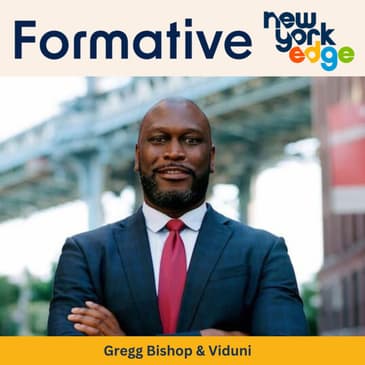
Gregg Bishop joins us today to kick off the eighth season of Formative! Gregg is the Executive Director of the Social Justice Fund, an organization with the ten year commitment to center its work around racial justice and economic mobility in Brooklyn. Joining Gregg is middle schooler and co-host, Viduni, who learns that doors close because other doors were meant to open. Gregg shares with Viduni his long curvy road to his current career and the importance of arming ourselves with necessary skills so that we’re prepared when opportunity comes.
Downloadable transcript here
Rachael: Welcome to Season 8 of Formative, the show where today's leaders are interviewed by the leaders of tomorrow.
To start this season off, we're speaking with Gregg Bishop. Gregg is the Executive Director of the Social Justice Fund. The Social Justice Fund has a 10 year commitment to center its work around racial justice and economic mobility in Brooklyn. Today, Gregg joins us to discuss his roots in Grenada, his childhood in Brooklyn, and his plans for his career after the Social Justice Fund. We're thrilled to be kicking the season off with Gregg.
Rachael: Hello and welcome. I'm Rachel Gazdik, CEO of New York Edge, and my co host today is Viduni from I.S. 27R. Viduni, can you tell me a little bit about yourself?
Viduni: Hi, my name is Viduni. I'm 13 years old and I go to I.S. 27. I love reading and singing. And I love podcasting too. I go to podcasting after school.
Rachael: Well, that's so great. Now you get to be the host of this podcast.
Viduni: Thank you.
Rachael: Now, who will we be interviewing today?
Viduni: Yeah, today we are speaking to Gregg Bishop. I'm so excited to talk to him today.
Rachael: Great. Let's bring him in. Gregg, welcome and thank you for joining us today.
Gregg: Well, thanks for inviting me. And, uh, it's a pleasure to be here. Good to see you, Viduni.
Viduni: Good to see you too.
Rachael: All right, Vinduni, take it away.
Viduni: My first question is, what are the goals of the Social Justice Fund?
Gregg: Oh, very good question. Uh, the goal of the Social Justice Fund is actually, let me give you a little bit of history. Uh, so in 2020, the owners of the Brooklyn Nets, you do know the Brooklyn Nets, right?
Viduni: Yeah.
Gregg: Yes. And I'm not gonna ask you who's your favorite team, because I know you're gonna say the Brooklyn Nets, so we'll just move on from there. Um, but the goal of the Social Justice Fund, the owners, um, at the time of the Brooklyn Nets, uh, and the New York Liberty wanted to invest in Brooklyn, and so they committed $50 million over the next 10 years to invest in Brooklyn, specifically around economic mobility. So that's a big word, but economic mobility means helping individuals to be successful, whether you own a business or if you are looking to develop a skill set, we help organizations that train you into specific skills, like in technology, to then get a job that's paying, um, you know, a really decent salary.
So for us, economic mobility is around those two pillars. Um, and so our goal is really to help Brooklyn.
Viduni: Um, my next question is, what is your work day like? What do you actually do?
Gregg: So that's a great question. Um, so it's a combination of, uh, because we give grants to organizations in Brooklyn, uh, a lot of my workday is actually meeting new and exciting organizations and learning about the work that they do, telling them about our priorities. And so, remember I told you our priorities is economic mobility, right? And so we would look, for example, for an organization that has a workforce training program. And then I would ask them a lot of questions in terms of like, what is the impact that they have? How many people have graduated from their programs? Uh, what is the salaries of those people that have graduated, right? And so part of my job is to make sure I find the right organization that's aligned with the work that we want to do. And also that has the ability to be sustainable. And sustainable is a big word that just means that it will be here after we're gone.
Viduni: Uh, what inspired you to get involved in nonprofit funds?
Gregg: Ooh, so I will tell you, uh, like I just wanted to give back to the community. You know, like I grew up in East Flatbush, right? So one of the things that I wanted to do was figure out like, okay, how do I get like my friends who grew up in the same area that I grew up in, the opportunities that I had, I always say that I'm blessed because like I had, you know, I had extra tutoring so I got into Brooklyn tech. I got into Brooklyn tech and got into a great program. And so I feel very fortunate to have that opportunity to get exposed to the things that I did and then be able to turn that into a career. And so for me, my passion is, like, I had an opportunity that others did not have, and so the work that we're doing now as part of the Social Justice Fund is to create opportunities for people similar to myself growing up in Brooklyn to actually maximize their potential.
Viduni: Uh, do you enjoy what you do for a living?
Gregg: I absolutely do. Um, and to be honest with you, I can now literally walk around Brooklyn and say, like, Oh, we invest in this program. I could talk to someone who said they got a job by attending this workforce program that we invested in. I will walk by a basketball court that we upgraded and see the investments that the city has made in addition to the work that we did, uh, or I could walk into a small business, uh, that got a loan from us and say like, you know, wow, had it not been for us, this business would be closed and these individuals would be out of work. So it gives me great joy to do the work that I do.
I'm really super excited. So remember, as you figure out what you're going to do when you grow up, make sure that it's something that you're passionate about. Because then it doesn't become work. It's more sort of like, I'm just giving back.
Viduni: I think it's amazing to see the things that you do, like the work and stuff. I think you will feel amazing when you go to shop and like you learn and then you can imagine how wonderful it is. Like you can see that you did it.
Gregg: Exactly.
Viduni: Was this what you wanted to do as a kid? What dreams did you have?
Gregg: So to be honest with you, I actually had no idea what I wanted to do as a kid. I could tell you what my mom wanted me to do. Uh, she wanted me to be a doctor. What, what did your mom, your parents want you to be what?
Viduni: Doctor too.
Gregg: Yeah. See, I knew it. So my parents are from the Caribbean. And so they wanted me to be a doctor. And when I got to high school and I had my first biology class, I knew I wasn't going to be a doctor.
But I went to Brooklyn Tech and had an amazing time at Brooklyn Tech. I was a mechanical engineer. And that exposed me to programming. And so I actually became a programmer. I majored in computer science when I was in college. But then I actually did something that I hope you don't do, but like I dropped out and worked full time for like seven and a half years. So you could only imagine how my parents were upset about the fact that I wasn't in school, right? Because I'm sure your parents would be upset too, right?
Viduni: Yeah.
Gregg: Yeah, I know. But I worked for seven and a half years and then I went back to school. So I did actually complete college.
Viduni: Uh, what was your childhood like?
Gregg: Ooh, that's a good question. Okay. First, let me ask you a question. So you, where do you live? Do you live in Brooklyn?
Viduni: No, I live in Staten Island.
Gregg: Oh, you live in Staten Island?
Viduni: Yeah.
Gregg: Wow. Okay. So I grew up in Brooklyn and so my area of Brooklyn, it was just hanging out with my friends. I loved like wrestling. So the WWF at the time, it's now called the WWE, but Hulk Hogan, all those wrestlers I used to look at all the time. I played video games. Um, and sometimes we would recreate either the video games or the wrestling matches that we saw on TV, like in our front yards, right? And so we were very physical. We would play football, uh, most of the times in the street. So that was fun. Although I'm not going to suggest that you play in the street, but we did do that.
Summers were fun in the city, but my mom sometimes would send me actually, because I'm from the Caribbean, I'm from a tiny island called Grenada. And so sometimes my mom would send me back home to hang out with family members.
My childhood was fun, but it was also, as you can imagine, I had to pay attention to my schooling. And so my mom was very focused on making sure that I did well in middle school in order to take my specialized test to get into high school.
Rachael: So Gregg, Viduni is about to make this transition from middle school to high school. Do you remember what that time of your life felt like?
Gregg: Ooh, so middle school was sort of like, you know, I felt like middle school was like, becoming of age where like I had like adult responsibilities, but I still wanted to be a kid and play, right? And so there was that tension of like, you have to wake up and you have to take out the garbage and you have to do this and you have to do all the chores. Right, Viduni? You have chores, right?
Viduni: Yeah.
Gregg: Yeah. And like, you don't have the playtime that you need and your parents are like, no, you have to work first and then you'll play after.
So middle school was like that tension. But to be honest with you, I went to a parochial school and parochial school is, you're in from first grade all the way to eighth grade. Um, so I had my friends, my circle of friends from second grade was the same circle of friends that I had in middle school, and we actually graduated together.
So, you know, the thing about high school for me was like Brooklyn Tech has like 5,000 students and I went from a school that had barely like 90 kids, right? And so it was the sheer size of like all these new people that I was going to meet. So that is going to be fun.
Viduni: Uh, I feel like I'm looking forward to like meeting new people and new friends. And I feel like high school would be like more like adult-like, and more challenging, I guess. Because I know that my, when my sister went to high school, she had to do a lot of work than she does in middle school.
Gregg: So I didn't know. And so you, how many siblings do you have?
Viduni: Two siblings.
Gregg: Okay. And you're the youngest or the middle?
Viduni: Youngest.
Gregg: The youngest. Oh, wow. Okay. So, and so both of them went to high school and you saw the work that they had to do?
Viduni: Yeah. And now they're in college and it's even more work.
Gregg: Ah, gotcha. In high school, I had to learn how to like find my way to all my classes. So it helped me, not only with direction, but also with being able to manage my own time, because I couldn't stand in the hallway and hang out with friends. I had to get to class before I'm late, but then it was cool because we would all be moving at the same time. And so it was sort of like a, I don't know, like a ballet of a whole bunch of high school kids just running from floor to floor. And so that was fun.
Viduni: And my next question is, what is a message you would like to send to students like me?
Gregg: Oh, the world is your oyster. So like right now you're at a great age, I would say cherish every single moment that you have every single experience that you have, take advantage of like after school programming, because again, you know, we as adults and parents, we think we know what we want for you, like, I want you to be a doctor. I want you to be a scientist. I want you to be a plumber. I want you to be electrician, but it's going to be you that in terms of like making that decision based on the experiences that you have, and the only way you're going to know whether you like something is if you try it, right?
And so whether you like broadcasts, well, you're doing this right now. And this might be something that you want to go into. When you find the thing that you're passionate about, uh, that's the thing that you should say like, oh, I want to actually become an expert at, and I'm going to put my time and effort into it.
Um, and don't ever feel frustrated that you don't know what you want to be, right? It will happen naturally. And it is okay if you don't know, continue to experience everything that your school has to offer. Um, and once you get into college, we want to make sure that you stay focused on your work, but also, you know, be well rounded in terms of extracurricular activities.
Viduni: Did you have to overcome any obstacles to become successful?
Gregg: And I'm still overcoming obstacles. You know, the first obstacle was when I didn't get into the major that I wanted in high school, right? So I got into Brooklyn Tech. I actually applied to the computer science program at Brooklyn Tech, and they said, no, I was so crushed. And then as a fallback, I got into make the mechanical engineering program where, guess what? All I was doing was programming computers. So it all worked out.
Viduni: I could relate to what you said because when I was applying to school for the SSAT test, uh, I wanna go Staten Island Tech, but like I, I did the test.
Gregg: Yep.
Viduni: But I wasn’t able to pass it. So I'm going to Wagner Scholars.
Gregg: Oh, okay. It's okay. Listen, everything happens for a reason. And, you know, I, when I was applying to college, I didn't get into the college I wanted to go to, but ultimately I ended up in one of the best colleges, Florida Agricultural and Mechanical University in Tallahassee, Florida.
So anytime these things happen, you feel terrible for a short period of time, but then you're like, okay. I'm going to make the best of it, right? Life is full of these bumps in the road and it's not about dwelling on the negative. It's sort of like taking that negative and turning it into a positive, right?
Like, how can I actually turn this into, as we say, turn this lemon into, do you know, the end of that quote? Turn lemons into?
Viduni: Lemonade,
Gregg: Lemonade. There you go.
Viduni: Thank you.
If you could do anything differently in your life, would you have changed anything?
Gregg: Ooh, that's a good question. Um, I'm going back to the first time I had to negotiate my salary. One of the things, and we constantly do this, especially people of color, is we undervalue the skills that we bring to the table. And so it's important that we have the confidence to recognize that we have a skillset that's valuable. One of my mentors actually taught me that.
And so I left one company. This was when I was in tech and I was negotiating my salary with another company. And I was so excited to actually be considered for this role that when I asked for the salary, it wasn't necessarily like a super big number. And of course they were like, yes, immediately. And I realized, ooh, I should have given them a higher number. They were so quick with saying yes, that I realized that I undervalued the skill that I was bringing to the table. And so that stayed with me for the rest of my career, and I made sure that when it came time to negotiate salaries, that I would be in a stronger position and have more confidence in the skill set that I had to negotiate a salary that I would feel comfortable with.
Rachael: Yeah, that's a skill we all have to learn at one point, right? So I'm curious, if you think about what your next 10 years are going to look like, do you have like a clear picture of what's next for you?
Gregg: Yeah, so it's always, you know, we go through, as I've heard, like every 10 years you change, right? So 10 years ago, I was a different person. 10 years before that I was a different person. And so I do think through like, where do I want to be in 10 years? And so part of that is the fund is only good, you know, only for 10 years. So it's one of those rare situations where you're going to be out of a job in 10 years, right.
And so for me, it's going to be more so what can I do to get back to my country? Um, and so because I'm a dual citizen, I've given a lot back to the US now I want to focus on Grenada and figure out like, what does that look like? So I'm actually pretty active in the country around economic development and tried to take the skills that I've learned and grown over the past, like 13, 14, 15 years of working and apply it to Grenada.
So that's one. Number two, I'm getting wiser and more experienced. And so I want to enjoy life. I've only lived in Brooklyn. So there's the idea of like, okay, should I, you know, spend more time in Grenada? At six months there, six months here. So those are some of the things that I'm thinking about
And certainly starting my own business, business owners don't know what they don't know. Having the experience that I have, I can take that and guide them through how to deal with government, how to set up your business, how to do a lot of the things that business owners don't know. And certainly like policy is important for me. So just like how we talked about the neighborhoods that I grew up in, there are other countries like Grenada who have like a young population and they're trying to figure out, well, how do we create mobility for, uh, you know, this, the young people in our country. The experience that I have here, we could take some of that and develop policy for Grenada to implement, to create more opportunities for young people, uh, in the country.
Rachael: So our last question is one we ask everybody and it's if you can go back and speak to your 13 year old self What would you say?
Gregg: Oof. And I feel like when people get that question, they say the cliche thing which is, you're going to be okay. You're going to turn out fine.
But you know what? I'm going to answer it differently. I would actually go back to my 13 year old self and say like, learn a foreign language and actually learn to play basketball. Those would be the two things.
Uh, I actually, um, you know, as I look at how the world is evolving, individuals that are bilingual, trilingual have more opportunities than if you just know one language. And I always feel inadequate when I travel. For example, I travel a lot to the continent, to South Africa, and a lot of my friends there. They speak four or five languages. My family in Canada, because Canada has a great system. Everyone has to be trilingual. So it's English, French, and a foreign language.
And so I feel always like inadequate that I only know one language. And I did study Spanish, but I was not necessarily serious. So I would tell my 13 year old self, be serious. Learn a foreign language and learn how to play basketball.
Viduni: Um, I'm actually going to like learn Spanish in high school.
Gregg: Nice. Yes, you should. Because guess what? A lot of my friends who have learned Spanish, they work for a lot of companies that work in Latin America and South America. There's a lot more opportunities there. And so I would encourage you definitely take it seriously and learn that extra language.
Rachael: Well, this has been such a pleasure. Thank you so much for the time you've given us.
Viduni: Yeah, thank you.
Gregg: Well, thank you for having me. Hopefully you enjoyed the conversation. I know I did. And thanks for having me.
CREDITS
Thanks for listening to Formative, a production of New York Edge. I’m your host, Rachael Gazdick. Our production partner for this series is CitizenRacecar. This episode was produced by Hager Eldaas, post-production by Alex Brouwer, production management by Gabriela Montequin, original music by Garrett Tiedemann. Thanks to the whole team at New York Edge for making this series possible. Never miss an episode by subscribing to the series at newyorkedge.org/formative or wherever you get your podcasts.