
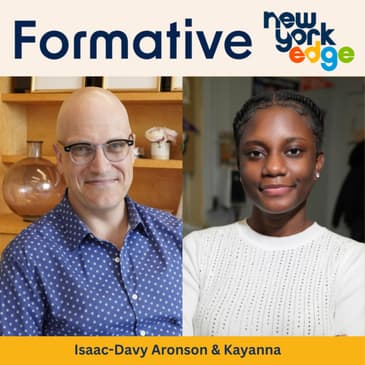

On this episode of Formative, Isaac-Davy Aronson is interviewed by 8th grader, Kayanna. Isaac is a radio and television journalist. For the last eight years, he’s been a producer on The Rachel Maddow Show on MSNBC. One of his most important pieces of advice for young people? Everyone can teach you something. Take your blinders off and become teachable because you never know who can give you your most valuable skill or piece of knowledge.
Downloadable transcript here
INTRODUCTION
Welcome to Formative, the show where today’s leaders are interviewed by the leaders of tomorrow.
Formative is brought to you by the generous support of Macy's Inc. whose purpose is to create a brighter future with bold representation from underrepresented youth so we can realize the full potential of every one of us.
GUEST INTRODUCTION
We’ve got Isaac-Davy Aronson with us today. Isaac-Davy Aronson is a radio and television journalist with experience at Air America, NPR, The New York Times, Newsweek and WNYC. For the last eight years, he’s been a producer on The Rachel Maddow Show on MSNBC. And last year, he was the executive producer and co-host of the podcast, Deja News, which was the #1 podcast in the country after its premiere in 20203.
INTERVIEW
Rachael: Hello and welcome. I'm Rachel Gazdik, CEO of New York Edge, and my co-host today is Kayanna from M.S. 382K. Kayanna, can you tell us about yourself?
Kayanna: I am 14 years old and I go to Erasmus Hall, but I go to College Prep. And I live in Brooklyn, New York. Some things that I like to do, I like to dance.
Rachael: Beautiful.
Kayanna: And watch TikTok.
Rachael: Are you excited about speaking to today’s guest?
Kayanna: Yes, excited, kind of nervous.
Rachael: Is this your first time interviewing someone?
Kayanna: I interviewed kids at my school, but it's like the first time really interviewing someone.
Rachael: Well, I think you're gonna do great. Let’s welcome our guest, Isaac-Davy Aronson. Isaac, we’re so grateful to have you on today’s show.
Isaac: Thank you, great to be here.
Rachael: Alright, Kayanna, I’ll pass off the mic to you. What's your first question for Isaac?
Kayanna: What, in your experience, is the most important quality in a TV producer?
Isaac: I would say that the most important quality in a TV producer is probably to be able to adapt to new situations and adapt to rapidly changing situations. And there's all kinds of TV producers of course. And so, there's TV producers who produce dramas and comedies and soap operas and everything on TV. And I only know about being a TV news producer, and for being a TV news producer, right, the news is different every day. And so, you have to be ready to write and produce a show about whatever is happening that day. But also, here at MSNBC, what we do in the evenings is a live show. And so, we're also covering not only what's happened that day but if there's something happening right now or something that happens in the middle of the show when we're on the air. And so, to be able to roll with it and be like, okay, something new is happening, we have to change what we are planning to do. We have to write something new. We have to learn new information and we have to get that into a form that our host can read very quickly, and to try not to be overwhelmed or panic about it. After the show is over, you can totally panic. You can have all the panic after the show is over that you didn't have while you were doing it, but while it's happening, I think you've gotta be able to absorb that new stuff that's coming at you and find a way to manage that.
Kayanna: Cool, what was the most difficult production problem that you had to solve?
Isaac: Oh, that's a good and very specific question. Alright, well, this is what's coming to me right now. So, our show goes live at 9 p.m., and a lot of times news tends to break just before that time, around 8:00 p.m., which often meant that we had planned a whole show, in fact, maybe we had written much of a show. And we would have to throw it all out and start from scratch like an hour before we went on the air.
But in particular, the one that I'm thinking about is, it was about 8 o'clock on whatever night it was and Ruth Bader Ginsburg, who was a Supreme Court Justice, died. And it wasn't a huge surprise in the sense that everyone knew that she was older and she had been ill, but we didn't know it was going to happen right then. And we had, I think at that point maybe an hour, it might have been 45 minutes, until the show started. We knew that the whole show was going to have to be about this, not just because Ruth Bader Ginsburg was a Supreme Court justice who's a very prominent and important person who has just died, but because her death was going to precipitate a huge change on the Supreme Court because there would be this opening on the Supreme Court. This is a thing that is going to change things for the country.
And I was tasked with, you have to write something for the top of the show that's like, Ruth Bader Ginsburg has died, this is why it's important. And it was a moment for me to be like, okay, I have 45 minutes so it's not gonna be great. It's not gonna be perfect. It's not gonna be the most beautiful thing I've ever written, right? We're just trying to get this on the air. I had very limited time, and so, I just had to draw on what I knew. So I did it, we got it on the air and then afterwards, that was when I had my period of feeling really freaked out. Like, whoa, okay, we just got that done and I could actually take a breath.
Kayanna: What do you look for in a script?
Isaac: So, what do I look for if I'm writing a script or if I'm looking at someone else's script?
Kayanna: I'll say if you're writing.
Isaac: The main thing that I am trying to do when writing a script is to tell a story. So, one of the things that we do, both on The Rachel Maddow Show and also on the podcast, is a little bit different from a lot of news radio and news TV that you see out there, right? A lot of news radio and a lot of news TV has a very, like, this happens, this is the story, here's the data about it and then we move on to another story. And that has its place. There's nothing wrong with that. But what I'm always thinking is, how can we start right off at the beginning of this script telling a story that will get people interested and engaged. And a lot of the time that can be, and if you ever watch Rachel's show this is actually something that people gently make fun of her for, is she will often start talking about a news segment about something that's happening today with some crazy other story that seems to have absolutely nothing to do with whatever we're getting to eventually. But we start it with this other story because that's going to grab people. What I try to do is keep going down these various paths until I hit upon something where I'm like, that is a good, fun story. That's where I want to start the script. And then everything else in the script kind of tends to flow from that.
Kayanna: Have you ever made a mistake while writing Rachel's thing for her to say on television?
Isaac: Oh my god, yes. Yes. So many times. And all kinds of mistakes. Certainly, there have been times where I have just written something that was wrong because I thought it was right. And, you know, we try to have a good fact checking process on our show to make sure that sort of stuff doesn't get onto the air because we all accidentally get things wrong sometimes but sometimes we don't catch it. And so, I've written stuff in scripts for her that was not factually accurate, and sometimes we even had to go back on the air and Rachel had to say, I'm sorry, I said something wrong and here is what's actually right. And that was because I wrote that, which is terrifying and humbling.
And then there's also just, I think more often though, the kind of mistakes that I've made, and especially at the beginning. My job as a producer was to write scripts for her that she could read on the air that would reflect the way that she was looking at things, the way she was thinking about things and emphasize the parts of stories that she would want to talk about. And sometimes, I would write scripts and she would be like, this is just, this is not, this is all wrong. This is not the way that I want to say it. This is not the way that I would have told the story. And I would have to go back and do it again. Or sometimes, if there wasn't time for that, we just wouldn't do the segment. And then I would have to just start over again the next day with something new. And that was really hard because in the 10 years before I started working on her show, I'd been working as a radio host and producer and I'd gotten very good at that. I was confident in my abilities. Then I joined Rachel's show and I had to learn this whole new set of skills. It definitely hurt my confidence a lot at the beginning, but that process of learning a new skill of how to do this was part of building that confidence back up to the point where, now, if she asked me to write something on whatever it is, I feel confident that I can sit down and I can write that thing for her and that it will be, at the very least, decent.
Kayanna: What inspired you to start podcasting?
Isaac: Well, I always had two things that I was always interested in and passionate about from when I was very young. And one was writing, and one was radio. And I was really into listening to old radio shows, which didn't make me very popular as a kid. It's not like a very popular pastime. But, I just loved that kind of experience of, like, you listen to something and you hear it and it can just be like a news show or an interview, but it could also be like, they used to do all these radio plays that were, like, mystery stories and stuff like that. And because it's all audio, you sit there and you listen to it and then you have to imagine the whole thing in your head. Like, what it looks like and what the people look like. And I loved that, that act of being able to listen to something but then being able to also use your imagination as you were listening.
So, in the last year or two, we got this opportunity to start thinking about new projects, and I had this idea for doing something about history and how history intersects with the present. And I was like, I think this would work really well as a podcast because I'd love to make this in a way that we can have conversations with people, but we can also play cool old sounds of stuff in history and people can listen to that. But they have to bring something to it, right? They have to bring something in their imagination as they listen to it. So, I love that about the form and that's the long arc of how I got to doing this podcast now.
Kayanna: That's pretty cool. What helps you create your topics for the podcasts that you do?
Isaac: I wish I had a system for this, but I don't. All I have is that I just try to read and listen and absorb as much stuff as I can. And that doesn't just have to be news, it can also be history books or fiction books or whatever. But I try to approach everything that I'm reading and absorbing, in terms of information, with the idea of, like, what connections can I make in my brain between this thing and other things that I've been reading about or things that I'm thinking about. The idea behind the podcast is where things that are happening today in the news or in culture that seem like they've never happened before, but in fact, things like it may have happened in the past.
Rachael: Isaac, can you give us an example of a story from your show about something that happened recently but relates to a story from the past?
Isaac: Yeah, so, the very first episode of the podcast was about January 6th, the attack on the U.S. Capitol by folks who were trying to disrupt the certification of the presidential election. And that was a huge news event that was constantly in the front of our minds, especially for those of us working in news and I think for a lot of people in the country. And I was actually listening to another podcast by my colleague, Chris Hayes here at MSNBC, who was interviewing an author of a book. And they weren't talking about something else and he referenced something in this guy's book and said, oh yeah, and you talked about this attack on the French Parliament in 1934 which, by the way, if you're looking for something that's like a real parallel for January 6th, that's a crazy story. And that was it. That was like the one sentence of the podcast and then they moved on to talking about something else. And I went, wait a minute. What is that? I've never heard of that. What is that story? I need to know what that is. And so, I went searching for information about that. So that became an episode about this attack on the French Parliament in 1934 which was very much alike in a whole lot of ways and different in lots of ways too, the January 6th attack and what can we Learn about how to understand what happened to us here on January 6th by understanding what happened decades and decades ago in France.
Kayanna: My other question is, have you ever gotten some hateful comments towards your show or like your podcast?
Isaac: Yes, when I'm not doing the podcast and I'm producing Rachel's show, one of the advantages to being behind the scenes and being a producer and a writer, and one of the hard things, I think, for Rachel or for anyone who's the public face of anything is that, she absorbs all of that. All of it is directed at her, like, nobody who's watching the Rachel Maddow show knows who I am, necessarily. And so, it's a difficult, fraught news and political space. Lots of people lash out. Lots of people do send nasty comments to Rachel. I think honestly, Rachel's been a really good model for all of us in that she doesn't engage with any of that stuff. She never talks about it. She ignores it to the extent that she can. She lets it roll off her back.
For the podcast, which was my first time, at least in a number of years, being the public face of something, Rachel and I were hosting it together. I was surprised and pleased to find that almost all of the feedback we got was positive. And that was really nice. I mean, that was incredibly uplifting to hear that. And, I'll be honest, the only, sort of, repeated criticism that we got was there were a lot of people who did not like the music that we had put on the podcast. And we got a lot of emails and comments sort of like, what's wrong with you? Like, I can't hear the people who are speaking. I don't want this music on the podcast. That was the main thing. And for that, I was like, okay, I respect your opinion. I like the music, but to each their own.
Kayanna: Who inspires you, like who inspired you to do what you do?
Isaac: Well, this is a cliché and latent thing to say I suppose but my boss, Rachel, does in fact inspire me. I've probably known her for about 20 years, and when I first met her, she was a radio host and I was a news producer on the radio. And I really loved watching her work and seeing the way that she talked on the radio, and she was just incredibly smart in the way that she could talk about things in the news in this really complex way that was pretty unusual to hear on radio or TV, honestly.
And,she also took a real chance on me in the sense that when we worked together very early on, she would say, I have to go away, why don't you guest host on my show? That was a real moment to be like, yeah, I don't know if I can do this. And she would say, I believe you can do it. Even if I was going to go on and I wasn't going to be as good as her, and I was going to screw up and it wasn't going to be perfect, but that was her having a vote of confidence in me, and also allowing me to go out there and fail a little bit so I could learn from it. That's an incredible gift. If someone could give you that opportunity to try something and fail at it and learn from it, and then they're there to catch you and be like, okay, this is what you did well, this is what you didn't, let's make it better. That's such an amazing opportunity and a gift that if you get that opportunity from somebody, you grab onto that.
Kayanna: If you followed your childhood dream, what would you be today?
Isaac: I would be a novelist if I followed my childhood dream. I've always loved writing, and I always wanted to be a writer. My favorite time in elementary school was, uh, I remember in fourth grade, once a week, they would give us a half an hour to just write whatever we wanted. And I loved that. I was like, this is my favorite part of the week. I’m just going to write whatever I want. And what's interesting is that for actually much of my life, I pursued that dream. I was like, I'm going to be a fiction writer. I'm going to be a novelist. That's really what I want to do. I went to some, like, summer school, summer camps where you just got to write fiction. And I majored in fiction writing in college. And then, I actually went and got a whole graduate master's degree in creative writing, and I was working on a novel. But as much as I wanted to write and as much as I wanted to be a novelist, It really made me miserable. I just was not getting any joy out of it. I was forcing my way through it and it was actually some of my fellow writers in the graduate program, who were really into their fiction writing and really were loving their novels, who finally said to me, if you hate it, you don't have to do it. And, which I was like, what do you mean? We're writing novels, like, we have to do it. And they were like, no, if you hate it and it's not giving anything back to you, then don't do it. And I said, oh, okay. I didn't realize that was an option, And so, I put the novel in a drawer and went another direction. And actually for a while, for a long time, I had this feeling of failure. And then at a certain point after being in radio and TV for a while, I was like, wait a minute, I have written so much. I've written so many radio scripts and TV scripts and I've really enjoyed writing those. And if you added all those scripts together, they'd be way longer than a novel, which is what I wanted to be doing. I just didn't realize that this was the way that I would be doing it. I didn't know that this was an option for how to become a writer. And so, now, I'm really happy to be a writer in this way, even though it wasn't exactly what I'd envisioned for myself when I was a kid.
Kayanna: That’s cool.
Isaac: I have two questions. My first is, I know you said that you like to dance. What kind of dance do you like to do? And is it just something you do for fun or is it something that you think that you might want to do professionally one day?
Kayanna: So, for me, the type of dancing I do, I like hip hop and, also, majorette. I don't really want to do dancing for all my life. I want to be, like, a specialized type of doctor. I don't really wanna be a dancer forever.
Isaac: Interesting. And, of course, no matter what you do, you could obviously keep dancing, right? In your spare time or whatever. If you have that thing that you really love to do, hopefully you hold onto that, right? Like, keep doing it. But what kind of specialized doctor do you think you want to be?
Kayanna: I wanna be an OBGYN.
Isaac: That's what my wife does. We should get her in here. You should be talking to her. That's great. Why do you want to be an OBGYN?
Kayanna: Because I just want to learn more about women and to tell other young girls, and older women basically.
Isaac: That's fantastic. That's perfect. I mean, my wife, she always knew that she wanted to be a doctor. But her path into that was she created a major for herself at Barnard, called women's health. it didn't exist. And she was like, but this is what I want to study. I want to major in women's health, it's health and it's specifically for women. And so, she created this major for herself and that's what she did. And now, she trains other OBGYNs, in addition to doing surgery and deliveries and stuff. But anyway, that's fantastic. I just think that's a great path into that kind of work, to be thinking in those ways.
Kayanna: Thank you.
David: Before we wrap, Isaac, we ask each one of our guests: If you could go back and talk to your 13 year old self, what would you say?
Isaac: I would say, Isaac, as you go forward, remember that there's no one that you can't learn stuff from. I thought I had to constantly be seeking out specific kinds of knowledge and certain kinds of mentorship and education to get to a specific place that I thought that I was going to. And for me, that was I wanted to be a novelist so that's what I'm seeking out. And there's nothing wrong with that. You may know where you want to go and you may head there and that's fine. But I would later discover that, like, looking back, I'd had all of these experiences with all of these different jobs and all of these different people. I mean, everything from, sure, being an intern at a radio station, but I also worked in a bar for six months, and the skills that I learned about interacting with and dealing with people from that job are incredibly helpful to working in an office and to producing a television show, right? And I didn't realize that I was always learning. And so, I would say just be open wherever you are and whatever situation you're in and with whatever people you're interacting with. Have that openness to be learning because you can always be learning. Even if you don't understand that you're learning something that will be helpful to you down the road, you can always be learning.
Kayanna: Thank you. And I will take that advice.
Isaac: Good. Well, I wish you all the best, Kayanna, as you go forward. And I've really enjoyed talking with you.
Rachael: Thank you both so much for being on the show with me today.
Kayanna: Thank you.
CREDITS
Thanks for listening to Formative, a production of New York Edge. I’m your host, Rachael Gazdick. Brought to you by the generous support of Macy’s, Inc. Our production partner for this series is CitizenRacecar. This episode was produced by Hager Eldaas, post-production by Alex Brouwer, production management by Gabriela Montequin, original music by Garrett Tiedemann. Thanks to the whole team at New York Edge for making this series possible. Never miss an episode by subscribing to the series at newyorkedge.org/formative or wherever you get your podcasts.