
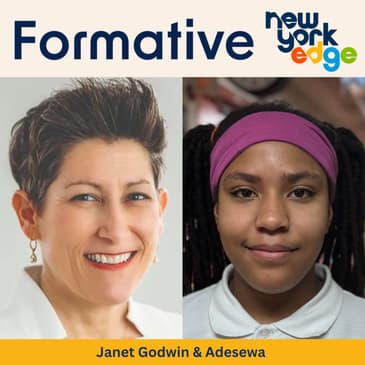

Season 9 kicks off with Janet Godwin, CEO of ACT, as she sits down with middle schooler and co-host, Adesewa! In this episode, Janet shows us that confidence doesn’t always have to be loud. She opens up about her biggest career mistakes, her ongoing quest for more patience, and how she leads with kindness and accountability. Get ready to learn how quiet confidence can make a big impact!
Downloadable transcript here
Rachael: Welcome to Season 9 of Formative, the show where today's leaders are interviewed by the leaders of tomorrow.
To start this season off, we're speaking with Janet Godwin. Janet is the CEO of ACT, the organization that develops the standardized college admissions exams. Today, Janet joins us to talk about owning our mistakes, learning how to leverage our natural strength and the importance of doing mission-driven work. We are thrilled to be kicking this season off with Janet.
Rachael: Hello and welcome, I'm Rachel Gazdick, CEO of New York Edge, and my co-host today is Adesewa from I.S. 45K. Adesewa, can you tell me a little bit about yourself?
Adesewa: I have eight siblings. This is a cool fact. Hobbies that I like to do are dancing, singing, and acting, and also drawing. And in the future I wanna be a performing artist.
Rachael: Oh, I love that. Now, Adesewa, who do we have on the show today?
Adesewa: Today I'll be speaking with Janet Godwin and I'm very excited to talk with her today.
Rachael: Awesome! Janet, welcome and thank you for joining us.
Janet: Thank you for having me today. Looking forward to the conversation.
Rachael: All right then. Adesewa, what's your first question for Janet?
Adesewa: So the first question I have is, can you describe what you do as a CEO in a way that an eighth grader can understand?
Janet: Oh, that's a great question. So I'm, I'm really honored to be the CEO of a company called ACT.
And ACT is an organization that helps students go through college and career planning activities to sort of understand and explore what you wanna be, you know, when you leave high school, when you go to college or go into the workforce.
And so, in my role as CEO, I think some of the things that are most important that I do is I create a vision for the company. Uh, I articulate, you know, what we can become and the sort of impact that we can have. The next thing is I have to have a team. I have to assemble a team of people so that we can have all the right skill sets that we need. Just think about a basketball team or any kind of sports team, you have to have all the right players in their roles to be able to, to win your games. And then we have to have a strategy for…how are we gonna play this game? How are we going to move the ball down the court? And then we have to make sure, that's something else that I do as the CEO, is I have to make sure that all of the team members are aligned, meaning they understand what our goal is, they understand what their role is in achieving that goal, and that we're working together to, to win the game, to achieve our strategy. And ACT's goal, uh, is to help more learners be ready for success after high school. And then finally, um, the last thing I have to do as the CEO is measure our performance. I have to make sure that we're delivering on our commitments and, and we're, we're achieving the goals that we set out for ourselves.
So vision, team, strategy, alignment, and performance are the things that I spend my time on as the CEO of ACT.
Adesewa: Do you get enough sleep from doing this job?
Janet: So it's such a good question, and probably not. I just started wearing an Oura ring to measure my sleep at night, and I'm, I'm averaging about five and a half hours of sleep a night, which the, my little app tells me is not enough. And so I'm trying to be better. But you, you hit on one of my things that I'm working on is to get more sleep and, and to make sure that I'm, I'm working in a balanced way because if I'm not my best self, I can't be the best person to support my team or my customers, right? I need to make sure that I'm feeling good and rested to do my job as, as best as I can. And so thank you for reminding me. I'm gonna try to get a good night’s sleep tonight.
Adesewa: Hopefully you do. So, this is something that you always wanted to do? Like even as a kid, because I know that most kids have a dream of something that they wanna be when they grow up. Was this what you wanted to be?
Janet: So, uh, no. I had no idea what educational assessment meant. You know, as a kid I was thinking about what I wanted to do when I grew up and left high school and went to college. But never in a million years did I think I would end up working at an educational assessment organization. And neither did I understand or even see myself in the role of CEO. I always sort of believed I had some leadership skills. I found myself in roles, whether it's, I was in Latin Club, believe it or not, in high school, and I loved that and I was president of Latin Club and things like that, so I kind of had a feeling that I had sort of an inclination for leadership. But I didn't have a sense of this particular career path in terms of working at ACT.
You know, I, when I left high school, I was really interested in engineering and physics and went, initially went to college in engineering and physics, thinking I was gonna maybe be a scientist or something. It was no more clear than that. But through different experiences in college, in graduate school, and then actually starting to work at ACT is when I started understanding the value of the work. And so I didn't have this big vision that I would be doing this when I was in high school or, or eighth grade for that matter. I just tried to expose myself to as many experiences and to learn from every experience and to be curious and, and to not step away from a challenge and to do things that were uncomfortable perhaps. And through those sorts of things, I found my way into this role and I couldn't be happier right now. But it was not a, it was not a linear path, Adesewa, in any means. It was not something I knew in high school that I wanted to do and I had a straight shot for it. I had to find my way.
Adesewa: You just, like, along your path, discovered it.
Janet: Mm-hmm.
Adesewa: That's nice. So what inspired you? Like, what was a moment that you realized like, this is what I wanted to do?
Janet: It's, it's such a good question and I, I've been thinking about that actually the last few days. So, I've been working at ACT since 1990. I came here out of graduate school and truth be told, I came here not because I loved what the company did, I really didn't really know a whole lot of what the company did, I took the ACT when I was in high school because I was going to college. But I came here because I had a student loan and I needed to pay off a student loan, and this was a good entry level job where I could pay off my $6,000 student loan. I was very worried about that.
And in that process of working here and getting to know the people that worked here and getting to know the stakeholders that we served, I really started finding value and personal kind of meaning in helping learners identify their goals and passions, helping learners get the experiences they need to move forward on that path of what their interests are. I just kind of fell in love with that mission.
And what really sealed it for me, Adesewa, was when I actually left the company for about a year. So I started in 1990, around 2002, um, after 12 years, I'm sort of like, I need to do something differently. This company's moving too slowly for me, they're bureaucratic. And you know, we're not moving at a pace that I, I'm very energetic. I'm pretty impatient. I wanna get things done, and we just weren't moving fast enough for me.
So I went to work for another company, didn't have the same kind of mission that ACT had. We were very commercial and just looking for our financial results every quarter, from quarter to quarter, and that's okay, but it wasn't meaningful for me. And it was in that timeframe working for that company that I realized it was the mission of helping people achieve education and workplace success, ACT's mission, that was what I cared about. Like that's what I wanted to put my energy and personal commitment into, to helping improve people's lives, helping to improve communities. And so I left that job in this corporate world, if you will, and came back to ACT, took a pay cut. Didn't matter because I cared about the work and I cared about the mission. And I decided that instead of complaining about how slow we were and how many meetings we had, and we just talk, talk and not get anything done, that I was gonna be part of the solution, that I was gonna roll up my sleeves and commit to whatever it took to improving how we functioned, improving how we communicated, improving the experience, innovating. I, I decided that I was gonna commit to doing everything I can to make ACT the very best organization it could be. And, and here I am now still…in 2024 in the role of CEO and that's what I'm still doing every day, still working really hard to make us the best company we can possibly be.
So it was that moment of really appreciating the mission, uh, I think is what really got me back and really committed to the work that I'm doing today.
Adesewa: Can you tell me about a mistake you made and how did you come your way back to it?
Janet: Oh boy, there's so many. Um, I'm trying to think of a really good example. Um, I'm a very impatient and passionate person and I also have incredibly high standards of quality. And there was a moment in our history where we were launching a new program and we made mistakes. We probably should have waited a little bit before we actually took things out to customers. And we had some customers that had a pretty negative experience. And, you know, I'm not proud of it. I, in the follow on to that, I, I lost my temper. I was a little too passionate with team members. I said some things that were not as respectful as they should have been. And it, it hurt people. It hurt people's feelings. They felt that I was not valuing all of the hard work that had gone into getting us to even be able to launch this new product. And so I was just, I was dismissing all of that hard work when in fact, you know, we had some problems, but it wasn't a complete disaster.
So, so through that, uh, a lot of soul searching, I owned it with people. I went out and, and I apologized and I acknowledged that what I had done was not respectful. And here are the things I'm going to try to do differently going forward to make sure I don't respond that way in the future. And I asked them to hold me accountable for my behaviors and if they see me doing that again, just to tell me and to hold me accountable. We're all humans, so we all have emotions and we all have reactions, but I think the biggest thing, when you make a mistake, own it. Don't hide from it. Don't blame other people. Don't blame other teams. Um, if there's a mistake and you had a hand in it, especially if you're in a leadership role, own it. Acknowledge it, recognize what went wrong, and be open about what you're going to do differently going forward. That is, for me, the very best thing to do as a leader when you make mistakes cause we all make 'em and we have to learn from them, but be open about it.
Adesewa: Do you think that anybody or me or anyone in general would need college to be as successful as you?
Janet: You know, that's a fantastic question and I think, I think college is really important, so let me start with that. It gives students an opportunity to explore different, uh, content areas, to meet different people, perhaps people that you might not have encountered in your local community when you were growing up. And I think those are very valuable experiences. It’s clear that a college degree can help people move into jobs after college that are good paying and impactful.
And having said all that, there's a lot of value in higher education, but I also know there are very strong pathways into work where people can be CEOs, leaders, high level people without a college degree. I see it all the time. There are so many occupations and career paths where a college degree is not the necessary prerequisite. And there's so many examples of folks out there who maybe started college or didn't finish college, and now they're running multi-billion dollar global companies or people who never even went to college and they are leading large organizations or even small organizations and having major impact in their local communities and broader communities. So, I think my answer to your question is you can find yourself in high levels of leadership and impact, and a college degree is not a prerequisite for that. It helps, but it's not a prerequisite.
So, I have one for you though. What's the thing that gets you most excited right now when you're going to school and thinking about your future? You mentioned performing arts, but like what gives you energy every day? What, what gives you excitement?
Adesewa: Well, since I have dance like pretty much every day, I always feel happy and excited to go because lately…I've been in dance for a while now, couple of years, but lately I've been achieving a lot that I've always wanted to achieve. Even stuff that I've been working on for a while, and even just those little things have been motivating me to wanna come every day even more happier than before.
Janet: That's fantastic, I love it. Just keep that up, that stuff that gives you energy and excitement and passion, keep finding those things. That's fantastic.
Adesewa: What were you like when you were my age?
Janet: Oh my goodness. I…Uh, boy, I liked school. I also was a little bit of a rebel. I, I found that if I did well in school, that I could kind of get away with doing some other things that were maybe a little more rebellious cause my parents were like, oh, she's making good grades, it's fine. And so I had a little air cover. Um, I was a kid that didn't have my own special little social group. I kind of dipped into different groups and had friends in different areas, so I didn't really fit into one, any kind of click or anything like that. At least that's my perception of myself. But I, I would, I just remember having lots of energy. I remember being really impatient. I mean, these things have been with me my whole life. I remember liking school a lot and finding joy in reading and history. I liked math and science too a lot too, but I liked learning. There was a curiosity, um, that I remember having even in eighth grade.
Adesewa: I agree.
Rachael:So it sounds like, Janet, you were always very daring and had a lot of energy. I come across a lot of young people who are really kind of shy and keep to themselves, and I think there's a lot of messaging from the world that to be a leader you need to be loud and outgoing. Um, what do you think true leadership skills are?
Janet: It's a wonderful question, and I'm not an extrovert by nature. I'm more of an introvert, and I need my quiet time to rejuvenate with my dogs or my books or hiking or whatever it is I do. But you have to learn when to speak up and you have to practice, I mean, that's been my lived experience. So just sitting in the back and…I don't feel like I have to be the loudest person in the room and the first person to raise my hand to answer a question. I'm observant and I'm listening and I'm engaged. I don't necessarily have to be talking to engage.
But to your point, especially when you get into college or into, and even high school classes, but college and then into the workforce, there are plenty of people that will take up the oxygen in the room and be seen and heard. And if you're more quiet and introverted like I've been, you do need to learn skills of knowing when to speak up. It could be verbally in a meeting. It could be a technique of asking for a one-on-one where it's easier to get your point across in a smaller setting than in a larger group setting. It could be your strengths are writing, and so communicating in an email or a white paper or a document of some kind, could be a PowerPoint, whatever. But use your strengths to find a way to get your voice across. Don't always feel like you have to play in the large room and be the loudest person. Once in a while, you might need to do that, but find a way to use your voice in contexts that are going to speak to your strengths, and you can absolutely find those different avenues.
Adesewa: I'm glad that you mentioned that because that's something that I also struggle with. It's a misconception that, like, I'm not really an introvert person. I'm more extroverted, but a misconception that I get is being shy or introverted because I am soft-spoken and I have a low voice. And a lot of times it's hard for people to hear me. ‘Cause isn't like, in my head, I feel like I'm talking loud ccause in my head I might sound loud, but for other people it sounds like I'm whispering. And that's something I hear pretty often.
Janet: Yeah. And people form opinions because of your soft spoken or if you don't speak out all the time. And so just being aware of that as you are and then just finding techniques and, and knowing when to apply those in a, in a specific setting. It’s a lot of self-awareness and, and knowing how to speak and, and lean into your strengths. Uh, 'cause there's different ways of getting those strengths out there. There really are.
Rachael: So our last question is one we ask everybody. If you could go back and speak to your 13-year-old self, what would you tell her?
Janet: I would tell myself to not second guess myself, not to always listen to the negative narrative in my head saying, oh, that wasn't a smart enough answer, or, oh, you should have done something differently. People have always told me, wow, you have so much confidence, Janet. How do you…? And I, and I'm like, if you could hear what I have going on in my head about myself, you would not say I'm a confident person. But I spent too many years listening to the negative reel in my head and not focusing on my, on the things that I did well. Not being arrogant or bragging about it, but just like I, I did that pretty well and that makes me feel good. And I wish I had started doing that when I was 13 years old because I'd probably be sleeping better back to that problem.
But I think I probably didn't take advantage of some opportunities that had presented themselves to me because I was listening to some of the, what I perceived to be some shortcomings as opposed to following and leading with what I saw as my strengths. And so I think it kind of held me back and I wish I had found the ability to not, you know, say bad things about myself and to really appreciate the things that I was accomplishing. I, I wish I had had that when I was 13 years old.
Rachael: Well, Janet and Adesewa, this was great and thank you so much.
Janet: It was really, really fun. Adesewa, it was a real pleasure. I wish you the very best in all of your endeavors. You're amazing.
CREDITS
Thanks for listening to Formative, a production of New York Edge. I’m your host, Rachael Gazdick. Our production partner for this series is CitizenRacecar. This episode was produced by Hager Eldaas, post-production by Alex Brouwer, production management by Gabriela Montequin, original music by Garrett Tiedemann. Thanks to the whole team at New York Edge for making this series possible. Never miss an episode by subscribing to the series at newyorkedge.org/formative or wherever you get your podcasts.