
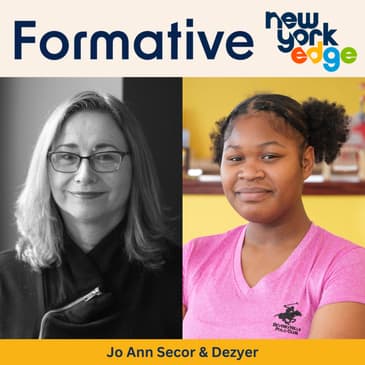

Jo Ann Secor, Director of Interpretive Services at Skolnick Architecture, joins middle schooler Dezyer for a conversation about crafting powerful museum experiences, and how her own career has been anything but linear. Jo Ann opens up about the challenges, mistakes, and surprises that shaped her journey, and how sometimes the most fulfilling careers are the ones you never saw coming.
Downloadable transcript here
Rachael: Welcome back to a new episode of Formative. On the show with us today is Jo Ann Secor. Jo Ann is the Director of Interpretive Services at Skolnick Architecture. She helps design the visitor experience for some of the most prominent museums and cultural institutions across the world. In this episode, we talked to her about the challenges, mistakes, and unexpected turns that all led to a unique and fulfilling career.
Rachael: Hello and welcome. I'm Rachael Gazdick, CEO of New York Edge, and my co-host today is Dezyer from M.S. 61K. Dezyer, can you tell us a little bit about yourself?
Dezyer: My name is Dezyer. I'm 14 and I go to M.S. 61. I'm eighth grade.
Rachael: Great. And who are we interviewing today?
Dezyer: We are interviewing Jo Ann Secor.
Rachael: Jo Ann, thank you so much for joining us on Formative.
Jo Ann: Oh, thank you so much. I'm really happy to be here today. Nice to meet you and Dezyer.
Dezyer: Thank you.
Rachael: Well Dezyer, take it away. What's your first question?
Dezyer: So can you tell me a little bit about yourself?
Jo Ann: Oh boy. Well, I am an excited person about the work that I do, and that work is really working in two realms. One is education and the other is museums and cultural facilities.
You know, I, I started out when I was a teenager realizing that I really loved drawing and painting, and that's when I realized I wanted to go to art school. So I did go to art school and during art school I realized that I really loved teaching and I started teaching, an art teacher. And then I came to New York and did more work in museums. So now my job here at Skolnick Architecture, I'm really working on behalf of the visitor to museums and thinking about, you know, what might they be interested in. But I'm also taking my background in design. And helping to work with our team of architects and exhibit designers here, graphic designers, and working with our clients in museums and other cultural institutions to create what it is that, you know, their dream is.
Another part about me is my pastime is drawing and painting birds.
Dezyer: That's nice. I like art too.
Jo Ann: Now I'm curious, I'm going to ask you a question, Dezyer. You're a designer and an artist. What kind of things do you like to do?
Dezyer: I don't really have a specific type of thing I like to draw. Like I would come across things like on Pinterest or something. It's like drawings of, it was random things like drawings of people.
Jo Ann: Do you use like pencil? Marker? Watercolors?
Dezyer: I use pencil. I don't like really coloring my art. It's like sketch.
Jo Ann: Mm. Sketches. I would like to see them sometime.
Dezyer: No problem. All right, can you tell me a little bit about a project you're working on?
Jo Ann: So one of our exciting projects right now is we're actually have been working with the Library of Congress in Washington since 2020 on creating an interactive youth center in the Thomas Jefferson building. The Librarian of Congress, Dr. Carla Hayden was a children's librarian. She was very passionate about the idea of getting young people involved in coming to the Library of Congress, knowing what the resources were there, and getting them engaged in maybe doing some research, maybe curate their own kind of exhibit. So we are creating this place, um, the youth center at the Library of Congress, which we're hoping will be ready in about a year or plus. So we're in the final design phases now.
Rachael: You know, Jo Ann, I'd, I'd really love to know what a big mistake you made at work, like a really big mess up. And how did you clean it up?
Jo Ann: I think a mess up in my mind would be when you have a disconnect with, say the museum wants a particular exhibit or a hall and they want it to be about a particular topic or they want certain objects in there. And so in the beginning we would come up with sketches just like Dezyer does, you know, do quick sketches of how it might look, and we call that the early concept sketches. We've had times when we've presented those and they were like, nope. That's completely not what we're looking for. And you go, whoa, how did we miss that? And so that's why it's really important in the beginning of the project to kind of, you know, they always say, go through the who, what, when, where, how, why. So we do that in a way, but we use what we call a visitor experience criteria, and we work with understanding with the client like, why do you wanna do this project? What's the mission? What's the vision? Who's going to come to experience this? Is it for young children? Is it for older people? What types of experiences would you like to have happen? Is it gonna be very interactive? Is it going to feel visually immersive, like you know, a lot of experiences that you can go to like walk through a Van Gogh painting, that kind of thing? So being able to discuss those things at the very beginning helps us understand where do we go with starting a design.
I mean, I remember we had a client once, we did some great sketches. She loved them and she said, I hate the color red, and there's a lot of red in these drawings, so never use the color red again. We're like, okay. That wasn't a criteria we were told in the beginning. We didn't expect it, but those are the kind of things you, you have to expect. But you learn from those, you know. If you can get past that and say it's, it's just an idea. Many I, other ideas can come from you just giving me the criteria.
Dezyer: Okay. How do you deal with like all that feedback? Like, whenever they say that they don't like this or they don't like that about your work, how do you deal with it?
Jo Ann: Well, the team gets back to work. We meet as a team and we would figure out, well, you know what wasn't working with this design? You know, does it feel too tight and there are too many objects in there? You know, do we have to open it up more and make it, because we're really looking for the cues from the client. Like when you're showing them a drawing, you're really asking them to give their responses to that drawing and really talk about what's working in this drawing for you.
Oftentimes we will give two or three options. So for example, when we were designing the library for, it was an extension of the East Hampton Library and we gave the young children's area three different options in terms of themes. And then when we worked on the young adult room, we gave them two different options. And it was really interesting 'cause one option was to create the young adult library to feel very woodsy. So we had a lot of green and browns and so forth, and it felt very woodsy. Even the mural that we said would be created by a high school student would feel that way. The other option we gave them was very beachy, so it had a lot of blues and turquoise and sunlight and everything. And when we presented both those options, they were like, nope. No beach, no sun, no beach, because that is really for the tourists who come out to the eastern end of Long Island. We live here year round, and we love our forest and we love going into the woods and taking walks, and so we want our space to really reflect our environment around us.
So it's often very good advice for designers to come up with a couple of options, and that way, even if the two ideas aren't the perfect idea, neither one of them, at least you can sort of talk about what is working in design A that we could maybe keep working on, and what can we take from design B that you like. And we can put those ideas together and come back with another version of that. You know, we have our own little mantra here. It's four parts, it's called listen, learn, distill, create. And for us, the listening part is really important.
Dezyer: I'm curious, what was you like when you were my age?
Jo Ann: I would say I was very introverted in junior high school. I was very quiet. I was part of the drama club, but I was not in acting. I was totally behind the scenes. I actually sewed costumes. But you know, I was interested in the arts. I was very interested in poetry.
But the other thing that really impacted me when I was around your age was we took a visit to one of the museums and, I don't know what it was. I just was so struck by all these different cultures and these extraordinary works of art that were even everyday objects, like the most beautiful cooking utensils and you know, dresses and furniture and not just paintings, but I just, something just really clicked for me. I remember seeing Egyptian sarcophagus and going, oh my God, this is so extraordinary. And all the painting and the designs, where did this come from?
And around the same time I went to see the ballet, or it was opera, Così fan tutte. ‘Cause our school was going to see it. And I was just, I was just so like, oh my goodness, it was so beautiful. I just loved the dancing and I loved the music and it, I felt like it was really a turning point for me that I became less introverted and more interested in what was going on with all these, like all these other cultures, all these other art forms. Like, art form isn't just drawing, art form is dancing and opera and singing and symphonies. I just remember it was a great time for me of just kind of opening my eyes and looking around the rest of the world and going, wow, it's not just about my neighborhood anymore.
Rachael: I really love that.
Dezyer: So what was your favorite museum?
Jo Ann: Wow, that's a tough one. Although I have to say I truly love the Metropolitan Museum of Art. It is really one of my most very, very favorite museums. In fact, I think it was just my husband said yesterday something about he was reading an article and this, he said, this woman loves to go to the Met and just she finds like real comfort there, 'cause that's what it did for me. I just feel like in times when I'm really stressed or just feeling like there's a lot of pressure on me, and if I'm up on the Upper East side, I, I ended up, you know, getting a membership, but I would just pop in there. And I always would go to the painting galleries and I really loved the Dutch paintings. And I would just sit in front of a painting and just look at it and just feel like everything else I was thinking about or worried about, just melted away. And I love that it was so grand and yet I felt it was just so open to everybody. It was, it's a place for anyone and everybody to go to, and I still go there. So that to me is a favorite.
I think nowadays I find that I have a variety of museums that I really like going to, especially in New York. I love the exhibits at the Morgan Library. I think they're so interesting. I think they have a really interesting way of helping you understand what's behind that person, whether they're a writer who also drew or a painter or its literature because library does all of that. So it's really tough to say.
Rachael: And so our last question is when we ask everyone if you could speak to yourself at Dezyer’s age, 14, what would you tell yourself?
Jo Ann: I think what I would tell myself is really listen to your inner passion. You know, you're gonna have people giving you advice and telling you to do certain things or try this out, but really follow your own, like…You know, I've had experiences where I wasn't sure, was I making the right decision about like taking a job or something. And I would not be able to sleep for three nights and then I'd wake up and this is ridiculous. I could have made that decision on my own. That is not what I should be doing.
And make sure that you carve out time in your days to do the things that you love. I mean, whatever it is. I mean, whether it's like growing a plant or taking care of a pet, you know, those things that you do that you truly love, or sketching, making yourself a sketchbook. Like, I have gone back now to drawing more and more birds and I'm really excited 'cause I've carved out a space in my basement where I do my art. I'm not 14 anymore, but I'm gonna tell you I have a mentor. She's an artist, younger than me. And her mantra to me was, get yourself a sketch pad, carry it with you and spend, you know, whatever you can, whether it's 15 minutes, a half hour every day, just doing a little sketch. And then you can go back and you can reflect on those things. And I don't know if Dezyer you do that, but it's a good thing to do. And then to look, look at, are there mentors out there, I mean, for whatever it is that you are interested in doing the research to find out who's doing that and doing it well. But I think to keep curious is the most important thing that you can do and to follow that curiosity and love of whatever it is that you're doing.
Rachael: Oh, I love that. Jo Ann, thanks so much. And this was such a pleasure having you on the show.
Jo Ann: Oh, uh, you're quite welcome. Really enjoyed it myself too.
CREDITS
Thanks for listening to Formative, a production of New York Edge. I’m your host, Rachael Gazdick. Our production partner for this series is CitizenRacecar. This episode was produced by Hajar Eldaas, post-production by Alex Brouwer, original music by Garrett Tiedemann. Thanks to the whole team at New York Edge for making this series possible. Never miss an episode by subscribing to the series at newyorkedge.org/formative or wherever you get your podcasts.