
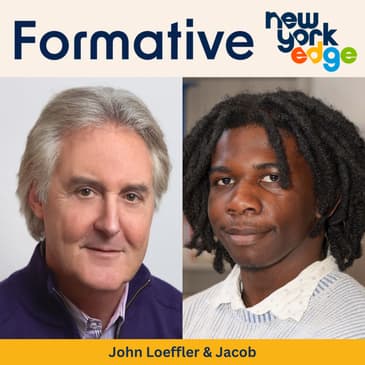

John Loeffler has spent nearly fifty years making music that moves the world, from crafting the unforgettable Pokémon sound to working with iconic bands like Cheap Trick and Earth, Wind & Fire. In this episode, Jacob chats with John about how a few chance encounters in New York set him on a unique path, the many surprising directions a career in music can take, and why following your passion means living beyond the ordinary. Join us for a story about creativity, persistence, and making your own kind of noise.
Downloadable transcript here
Rachael: Welcome back to Formative. On the show today, we're joined by John Loeffler. John has spent nearly five decades in the music industry. You might recognize his work from the iconic Pokemon television series, which his company helped bring to life musically. He's also collaborated with legendary artists like Cheap Trick, John Fogerty, and Earth, Wind and Fire.
Today we talked to him about his determination to live beyond the ordinary, the early days in New York, where chance connections shaped his career and the many paths a person can take within the music industry.
Rachael: Hello and welcome. I'm Rachael Gazdick, CEO of New York Edge, and my co-host today is Jacob from the Community School for Social Justice.
Hey Jacob, why don't you tell the audience a little bit about yourself.
Jacob: Hi, my name's Jacob. I'm a podcaster, community member of my school, a mentor, a scholar, a big brother, and a king of the making.
Rachael: And today's guest is John Loeffler, an expert in the music industry.
John: Thank you. I'm excited to be here. And I'm here to answer any questions you may have about the music business and my illustrious 40 years of sweat and anguish.
Rachael: We're very excited. So let's get to it. Jacob, what's your first question?
Jacob: All right, so my first question for John is where'd you grow up and who inspired you to do music?
John: I grew up in a little farm town called Carlisle, Pennsylvania, and the only thing that's distinguished about the town is that it's very rural and very quiet. But it was relatively close to a city called Lancaster, Pennsylvania, where the Amish live. And then a little farther was Philadelphia. But even in that little town, people loved music. And I was at the age, I was just very impressionable. And I'd turn on Saturday morning television, there's a show called the Dick Clark Show, and uh, every Saturday there'd be some famous pop singer that was on the radio. At that time, my parents said I would just sit there mesmerized. I just wouldn't move. I was just staring at it. And for whatever reason in this little town, music was a really important part of the culture, especially R&B and soul music. I just fell madly in love with the Temptations and Aretha Franklin and, uh, Otis Redding and Wilson Pickett, and that was all the music that I just fell madly in love with. And I just asked for guitar, asked my parents to help me get guitar lessons. And looking back, that little 4-year-old, 5-year-old kid that was looking at television with wide eyes, and I never lost that. When I got outta college, I said, I'm gonna go back to being that five-year-old kid. I'm gonna go back to do the things that I wanted to do when I was five years old.
And, uh, it wasn't really my family except that they nurtured me. They built me a little room in the basement so I could go bang on drums and make music with some friends. They never said don't do it, but they always were hoping that I was gonna become a lawyer or a doctor, and, uh, I just couldn't do that, you know? So…
Jacob: Well, what prompted you to come to New York? And two, what was it like being pressured by other people who were like, oh, do these other things, like maybe you shouldn't have done this. Like, maybe you should have pursued this path instead of this, um, yeah. Did you like go to New York as a way, like to rebel against all these people? Or was it just because like, it was like a home of music or whatever, like a major centerpiece for music?
John: Honestly, it's probably both, to be really honest. For me, being from the east coast, New York was the place where music was being made. I mean, I could have gone to California, but I lived closer to New York, so it made sense. But I would say probably there's a part of me that just wanted to do something different. I just couldn't see myself living a normal, what I would call a normal life. I just couldn't do it. I just felt this need to do something that was unique and maybe exciting and creative, but I just couldn't do a traditional job. I didn't have a drop in my blood that could do it, honestly, I couldn't do it. And I knew it. I, I, one day woke up in college. I said, I cannot do the normal route. I embraced it. I said, well, if I can't do it, then let's do what you can do.
And, you know, with limited skills in the beginning, I came to New York. I knew two people living here. I had never been here for more than an hour at the train station. So I didn't even know anything about New York. I didn't know how the subways work. I knew nothing really. And I came here and, uh, I, I kind of rented a room in somebody else's apartment, and I just slowly, slowly started teaching myself the ways of New York and who to meet and yeah, it just, nothing very magical. It's just a lot of hard work. But I tell you, the other thing is I love people. You know, even talking to you Jacob, and giving you advice. And you know what? I think people picked up on that. When I came to New York, even when I was a waiter, people would say to me, you seem like a good guy. What are you doing? Why are you in New York? I'd say, well, I'm here to be a songwriter. They’d say, well, you should meet my friend so and so, and New York City is such an open place, especially if you give out that kind of energy and enthusiasm and earnestness and people could not have been nicer to me. And people would say, well, my uncle owns this store. He sells records and he knows a guy at Columbia Records. Maybe you should talk to him. I said, okay. And that's kind of how I just started. I'd literally started knowing no one. And I'd go to the restaurant where I worked with a bunch of dimes 'cause back then payphones, you needed 10 cents. And I would sit there with this pile of dimes and just calling these numbers that people would give me in between tables and just say, Hey, I'm John Loeffler, I'm in New York. I really gotta figure out how to make a career as a songwriter and as a musician. Your friend said I should call you. You know, I just started doing that.
Rachael: So you're in New York and you're working in restaurants as a waiter. Is there a moment where your music career really started to pick up?
John: I was like, every two weeks I would take all my tips and go to some small little studio and record my songs. And in the process I met some people that were doing music, actually producing TV commercials. And I was asked mainly 'cause they felt sorry for me, they said, maybe we can give you a little bit of money, you can help us write a couple little songs for commercials. And that led to, over a long period of time, but it led to a career writing music, for TV commercials and jingles. And I'm a singer as well, so I would sing as well as write the songs. And I wrote music for everything from, uh, and sang on everything from, Coca-Cola to I Love Eggs, to Jif Peanut Butter to Kool-Aid, to, you know, Revlon. Three, four, five times a week, I was writing and in the studio writing commercials.
That led to me eventually to have my own recording studio, hiring other composers to work with me, and started doing TV shows and TV series and movie soundtracks. That led to doing cartoon shows and I kind of fell into doing music for cartoons, including Pokemon. And I was the co-writer of all the music for Pokemon, all the songs and underscore for almost 18 years with a one or two years break. That led to me becoming an executive for a record label BMG, which is the last job I had until about 18 months ago, where I'm now freelancing, doing a lot of different projects, one of which is with a great record producer, owner of this studio named Jerry Wonda and he and I have launched a company called Wonda World, and it's all about discovering and developing new musical talent.
Jacob: Would you say that creating music for Pokemon was a game changer in your career? Like was that like what really skyrocketed you into, like, just being successful?
John: No. No.
Jacob: Oh, okay.
John: I was successful for about 15 years before that, and that was just a fantastic opportunity. None of us knew when we were asked to write the music, 'cause don't forget, when I was first asked to work on Pokemon, no one knew what it was. It was a TV series in Japan that supposedly was very popular, and a company in the United States got the rights to reproduce much of it in English, uh, and for the rest of the western world. And the creative director and the producer of that company, he came to me and said, one of the things we wanna do is change the music, because the music probably wouldn't appeal that much to young kids. So he said, would you like to take a shot at re-imagining what the music could sound like? And I already had a studio. I already had a bunch of composers working with me, so we all just jumped in and it just seemed like a fun experience, a fun opportunity, and we just said, well, let's just do it, and if it works, it works. And if it doesn't, we'll go on to the next project. So in hindsight, looking later, I made the most money, to be honest, from Pokemon, and it was an amazing ife changer a couple years later when it really kind of was established and then it became a big phenomenon. But when I first got it, it just seemed like it was just another gig and another job, and I was just happy to get another job. And wherever it led, I was happy with.
Jacob: Can you tell me about some of the mistakes you've made during your career?
John: Well, I, I think my arrogance in the beginning, and maybe that's was covering up fearfulness, not recognizing how much I didn't know. And in hindsight, had I, in my early twenties, recognized how much I didn't know and gone back to maybe taking music classes, which I wasn't doing in college 'cause I was so hell bent on not doing the traditional music thing, but even in pop or rock and roll music or the music scene I was breaking into, there's still so many rules and so many kind of skills you need and, and I think that was really a mistake on my part because in my, probably, fearfulness that I would find out what I didn't know, or maybe I wasn't as talented as I thought that I didn't follow up on that and I, I wish I had been just a little bit more careful and thoughtful and I wish I had kind of kept training myself. You know, in the end, I did okay because I was just educated by so many beautiful, talented people around me and I learned through the experience, but, uh, I wish I had been a little bit more open to continue to learn rather than just try to make it happen on my own.
Jacob: Yeah. Nah, I get that. I'm really hardheaded. I always try to just like do everything by myself, don’t ask for help whatsoever, and it's usually because of that, that I always end up not achieving the results that I want. I end up creating something that's below what I actually want. Like I ended up adding up…
John: Well, it's okay. Look, how great is that? I'm, I'm, I'm sorry to interrupt, but how great is that, that you're already, you're recognizing that as a tendency that you may have. And I will tell you, as we're talking now, and once I started being open to, in music we call collaborating, but that I was open to kind of recognizing there were a lot of things I didn't know and I was open to working with people that were more talented or more capable than I was, that's when I really started to thrive. Because I got so much better because of those people around me, because I was learning from them finally. I wasn't doing it all on my own anymore. I was not just sitting in one little room on this piano, banging out songs. I was actually surrounded by people more experienced, many more talented, and once I, I said, look, I gotta learn, I gotta be open, I gotta meet new people. That's when I started doing better myself. And that was, for me. I mean, that's for a young student who's thinking about it, that's an amazing lesson. And Jacob, you're already thinking about it, which is awesome. I mean, recognizing that, that stubbornness and bullheadedness, which no question I had as well. And if you realize now at your age that you have a tendency to do that, then that's…how good is that? You're gonna like prosper more and you're gonna learn and you'll make adjustments and you'll be more open to learning. It's good.
Jacob: I am someone who's also very much interested in like music and just like I want to become a singer at some point in my life.
John: Mm-hmm.
Jacob: And by some point, I literally mean like right after high school. However, I've just been really struggling to actually get that ball rolling because like I have no confidence in my voice, there's that. So I did a ton of research on like your history and stuff like that. And one of the things you did was you, did you graduate from Williams College?
John: I did. I did.
Jacob: So when you went to that college, it said that you didn't attend any like…
John: Music classes.
Jacob: You didn't, yeah, you wasn't part of any music majors, none of that. And you just like, you just literally just went there with no music, none.
John: Crazy, what can I tell you? I'm insane. And my parents said, I'm insane. And the world said I was insane, but I, I was too stubborn to give up. So first of all, it's not like I wasn't doing music. I was in bands. So I was performing, it just wasn't part of the academic, I wasn't taking classes in music cause all the classes that they were teaching, and maybe I should have, but they just were, they seemed so boring and old fashioned. They were talking about classical composition and, you know, vocalizing for choral groups. None of which I was that interested in. I loved rock and roll. I loved songwriting. And so I figured I'll just get a good education. I'll focus on all the things like English and philosophy and political science, and then I would just keep my interest in music and art to myself.
Jacob: So it was basically a hobby at that point.
John: It was a passion and a hobby, but it was a real passion. I, the more I did it, the more I said, I gotta do this when I get outta college.
Jacob: Yeah, I, I honestly, completely get that. Because for me, just listening to music and hearing the messages these artists have to convey, like it really moves me and like literally music has fundamentally changed who I am as a person. Like Kenrick Lamar's lyrics, they've really changed me. And just like all these other performances and all these singers and rappers, live performances I've seen on YouTube, they've really like shaped who I am
John: Look, you don't have you, the music business is a pretty big business and there's many aspects of it other than being the writer or the singer or even the producer.
Jacob: Yeah.
John: But you could, I mean, look, you could be working for a video company that, that shoots videos of artists. You could work at a streaming service like Spotify as an intern in the beginning and you could, or like Apple Music and you could start learning about how when music is being presented to those streaming services, what they need to listen to and what they're looking for before they select stuff. You could be working as an assistant in a law firm in the beginning, and you could be the lawyer for musicians. You could work for an agency that books clubs, and you could learn about how tours take place and you could work for Live Nation that does that.
There's many different ways that you could participate in a very exciting career, like the music business or the movie making business, or the television business. And you don't have to be the movie star. You don't have to be the guy on the album cover. You know, you don't have to be the actor on the series to still have a very exciting career. It depends on what you love. Now, if you're starting in high school and you really just know generally you love music and generally it's important to you and it really moves you and it even changes your life and maybe gives you comfort when you're, when you're really kind of stressed out at home and you hear some songs and you hear some lyrics and it kind of gives you.
A new perspective on your life and how you can make it better. And if you really feel strongly about it, the truth is, there's many places where you can learn internship programs, you know, you can take classes outside schools themselves. They teach courses like NYU has some courses or Berkeley School of Music.
You just, you just gotta throw yourself into it a little bit and see what you like. 'cause you may find out that the thing you like the best. It, I dunno, shooting photos of album covers or, it's a vast world, but starting with a passion like you're, you love music. That's the first step. And then it's a big step between that and figure out how you can make a living, and that's not easy to figure out.
Rachael: So John, we always end on the same question. We'd love to ask it to you. If you could go back and speak to yourself at 18, what would you say? Knowing everything that you know now.
John: God almighty, because when you're 18, there's so many things going on at the same time, and you have so many thoughts, and it's all about how are you're gonna fit into this world that you're about to step into and you're frightened, you're excited, uh, maybe.
To embrace maybe my insecurities a little bit, rather than just try to block it out and say, I'm just gonna jam this through. I'm just gonna make this happen. Maybe I should have been a little bit more open to admitting my vulnerability, being able to admit and acknowledge that. I was scared. There are a lot of things I didn't know, but I still believed that I had this talent that, that I could succeed eventually.
But to acknowledge that and somehow not being so kind of falsely confident that you let more things happen to you, let nature and let life and let. People around you come to you more. And I think I probably kept people, I blocked people out in the beginning because of my own insecurities. And I dunno if that's answering the question, but if I were speaking to myself as an 18-year-old, that's one of the things I would've said.
And the other. The other is to seek out wiser and more experienced people and learn from them. Try to put yourself in a position where you can be mentored because the, I had three or four men in my career who took me under their wing at different points. And without those four men who all did different things, but without those four men in my life, over a 30 year period, one was a president of a big ad agency, one was a major film and TV director who just took a shine to my music and started giving me all the assignments.
So when he did a TV series called Kate and Ally and he did a couple other shows and I did the music for all the shows, and he just. Love me. He just said, John, you know, I like everything you're doing. I support you. And if I didn't have those three or four people over a course of 30 years who just believed in me and gave me those opportunities, I don't think anything would've happened.
And you only meet those people if you kind of make yourself open enough and vulnerable enough that people wanna help you.
Rachael: Well, thanks so much for giving us your time today. This was a pleasure.
John: My pleasure. Nice meeting you both, and I hope this helped. Okay, this absolutely helps.
CREDITS
Thanks for listening to Formative, a production of New York Edge. I’m your host, Rachael Gazdick. Our production partner for this series is CitizenRacecar. This episode was produced by Hajar Eldaas, post-production by Alex Brouwer, original music by Garrett Tiedemann. Thanks to the whole team at New York Edge for making this series possible. Never miss an episode by subscribing to the series at newyorkedge.org/formative or wherever you get your podcasts.