
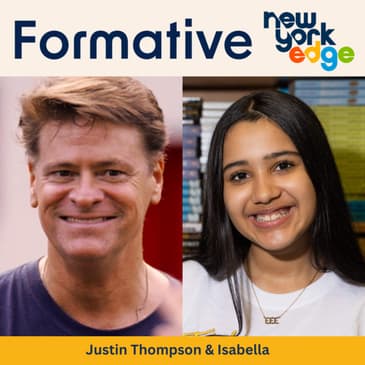

Cartoonist, Justin Thompson, is the final guest for this season’s Formative. He is joined in conversation by 7th grader and co-host, Isabella. Justin and Isabella talk about the importance of doing art, even if not for professional reasons, but just to express our feelings and ideas. Justin also tells Isabella about how, through his art, he was able to become all the characters he had on his list of things to be growing up; a knight, a superhero and a cartoonist.
Downloadable transcript here
INTRODUCTION
Welcome to Formative, the show where today’s leaders are interviewed by the leaders of tomorrow.
Formative is brought to you by the generous support of Macy's Inc. whose purpose is to create a brighter future with bold representation from underrepresented youth so we can realize the full potential of every one of us.
GUEST INTRODUCTION
Justin Thompson is a professional cartoonist, artist, editor, writer and approvals coordinator at Charles M. Schulz Creative Associates. He is also a cartooning instructor and the creator of the comic series, MythTickle. We are so thrilled to get to talk to Justin today about his journey to excellence in his craft.
INTERVIEW
Rachael: Hello and welcome. I'm Rachel Gazdik, CEO of New York Edge, and my co-host today is Isabella from I.S. 318K. Isabella, can you tell us a little bit more about yourself?
Isabella: Hi, My family is from the Dominican Republic. I speak English, some Spanish, and American Sign Language. I'm in the 7th grade, and some of my favorite school subjects are science and English. When I grow up, I have a lot of things I want to be, but mostly I want to be a lawyer, a nurse, or a marine biologist.
Rachael: Wow, that’s impressive! So, who are we going to be speaking with today?
Isabella: We're speaking to Justin Thompson. He is a cartoonist and an artist.
Rachael: Well, great, let’s welcome in Justin Thompson.
Justin: Hi Isabella, it's so nice to talk to you.
Isabella: Hi, Justin. It's so nice to talk to you, too.
Rachael: Okay, Isabella, what's your first question for Justin?
Isabella: So, I saw that you made the cartoon MythTickle, right? And I just want to ask, what inspired you for the name MythTickle? And does it have a secret reason for it that nobody really knows about?
Justin: That’s so funny. Yeah. I'll never forget where I was when I thought of that. I was driving on Interstate 95 through El Cerrito here in the San Francisco Bay area. Every time I drive by there, I think that's where I thought of MythTickle. I wanted to do a comic strip. I had just started working at the Charles Schulz company, at the studio, and I was just immersed in comic strips all the time. So I knew I wanted to do something with a knight and a dragon and mythological characters together. So I thought, mythology, what am I going to do with mythology? There's a name, it's about mythological creatures. And then, I thought of mystical, like mystical. And I went, oh, there are two words, tickle cause it's funny and myth because it deals with mythology. So I'll just combine that into one word, myth-tickle. And it also sounds kind of like somebody saying mystical with a lisp and that's funny in itself. So that's how the name came about.
Isabella: When you said that you remember the exact place where it was named, I can relate to that.
Justin: It's like a lightning bolt, right?
Isabella: Yeah, cause when I walk past somewhere, I remember I did this or, oh, something I'm really proud of myself for doing.
Either I write it down on my phone or I will literally remember the exact time, the exact date, what I was wearing, and everything.
Justin: Yeah. I don't know why we do that at those certain times.
Isabella: I kind of believe us humans are like that. Only because maybe, we think, one day somebody's going to ask us, oh, what are some days you're accomplished for? And it may be, like, some people won't be ready for it, but we will.
Justin: Yeah, who knows? Somebody might want to interview you on a podcast someday, so you better remember some stuff.
Isabella: I will. I also have another question. How long would you say a whole chapter of a cartoon? How long would it take? And after that, like, how long would a whole finished cartoon series take?
Justin: Uh, by chapter, do you mean one comic strip?
Isabella: Yeah.
Justin: Um, I put a lot more detail and color in my comic strip than most comic strip illustrators do because they have to put in something every single day. I don't. Because I'm a web-based cartoonist, I can do whatever I want. I can do whatever size I want, and I have complete creative control. But, for me, they can take me around anywhere from five to eight hours, depending on how complex the drawing is. Sometimes I get a little crazy with backgrounds and stuff like that, but from, you know, lettering in first and then I draw around that in the four frames. From that to the very end, when I'm exactly done coloring and everything, that's anywhere between five to eight hours per strip.
Isabella: I also have another question. So, would you ever just randomly just have an idea and then just start drawing your comic and then adding dialogue? Or does it really take a while to just think about it, think about how this is gonna be placed and like how to plan everything.
Justin: Well, before I did this for a living, I’d just think of something funny and draw it real quick to get it out there. So, I'd have an idea, if I wanted to elaborate on it later, great, but I had to get that idea out there while it was still active in my mind and my heart, you know? So yeah, I didn't bother too much about making it perfect or refining it because I wasn't doing it for publication. Now that I'm older, yeah, I do think about a lot more before I start drawing. I have to because the emotions, not just in the face, but in the body positions. I need to know how these characters are going to react with the body. Will they be jerking back like, oh my god, or will they be depressed, hunched over? I have to see it in my mind first. I can write down the joke, but before I start drawing, I gotta plot it out in my mind.
Isabella: I understand what you mean.
Justin: Otherwise it'll just be a lot of crumpled up paper and wasted time.
Isabella: I totally understand what you mean because you need to know what's going on in the background, what's that character doing, what's this character doing, What's this little part of a page about?
Justin: Yeah, and you first, you can plot all that out once you have the idea, work it all out with stick figures. That's the best way to go. That way you can actually see it down on the page and go, okay, that doesn't work. Let's put this person on this side. What's this character saying in each of the four frames? Working all that out. And there's a rhythm to it too, that really only experience is going to teach you what the rhythms are like and how that works out.
Isabella: I also have another question. So, um, what really inspired you to be a cartoonist and an artist, and how did that change your perspective on some things in life?
Justin: I've wanted to be a cartoonist since I was really small. I loved cartoons and we got the paper in our house when I was a little kid and I would always give all the paper to my mom and dad and then I would take the section that had the comics in it. And I would read every one of them, mostly Charles Schulz's Peanuts was my favorite. And I loved that so much it almost became an obsession. Back in the 60s, the Schultz company published a lot of his older strips from the late 50s in paperback form, little paperback books, and sold them at convenience stores and grocery stores, whatever. And I had about two or three of them. And I would read them all day, every day. I just loved the characters, and I always carried a Peanuts paperback with me in my back pocket or in my lunch pail to school every single day.
I related to those kids so well, particularly Linus and Charlie Brown. I felt they had my voice. But then I started seeing other cartoons here and there as I grew older that I began to really love certain art styles that I would see. And one in particular, I saw it and went, I want to create worlds like that. This was back in the early 70s, and there was a cartoonist called Vaughn Bode. His work is what they call underground comics, not really for kids to see, but the art style that he had, I mean, I'm just looking at this incredible art style that was better than Disney or anything I'd ever seen before and I thought, I want to create worlds like this guy does, because he created all these fantastical worlds.
Isabella: Did you do the same thing in the 60s when you were a child? Because you said that you would also like to express your art by just drawing on paper. So would you, did you also do little cartoons and then add dialogue just like a normal cartoon?
Justin: When I was in kindergarten, I remember drawing, and drawing little animal characters and having them say things. I didn't do it in a three or four panel storyline kind of joke or anything. I would just, you know, all the kids were drawing. But I remember one kid coming up to me and saying something about my drawing and he drew something and I thought it was really good. And we both became the artists of the class. Maybe we were trying to outdo each other. I hope I didn't have a competitive gene at that age, but maybe I did, I don't know. But we were friends and we both liked to draw for each other, and that was in kindergarten.
Isabella: Yeah, I can really relate to when you said that you and your friend were like the artists of the classroom. When I was younger, I think I was in first or maybe second grade. I remember since I used to draw a lot more back then, teachers would always compliment me on my art, and students. And I was just like you, I was called, oh, she's an artist, she's an artist, and, I just just took it because it was a compliment.
Justin: Can I ask you something? Why did you stop or why did it begin to go less and less?
Isabella: So, I stopped and it got less and less only because, for me, I was a person that would draw when I just thought of something. Like, when I had an idea, I would just start drawing it. And since, like, last year, I used, technically, all my ideas. So I stopped drawing little by little. But I still do draw and I still do sketch sometimes. If I'm bored, I'll just maybe do a little doodle. Art has always been one of my hobbies and that will never change.
Justin: Oh, good. Good.
Isabella: Like, it doesn't matter. I will always draw.
Justin: I'm so glad to hear that because I run into people all the time who go, I used to love to draw when I was a kid, and then they'll have some story about a kid in the class, or even most of the time a teacher, gave them some harsh criticism about something they created in class or something, something like, ducks aren't blue, you can't do that.You know, something silly like that for a teacher to do, that one arm is too short or something like that. And what I found out, more times than you would think, this has completely crushed people's spirits because I think drawing is a delicate thing emotionally for kids. And if someone tells them it's bad, pretty much with different words but that's how it gets funneled into a child's brain, they'll never do it again. I think this is so sad and I hear it over and over again.
Isabella: Yeah.
Justin: I’m so glad that didn't happen to you, Isabella.
Isabella: Yeah, I'm really glad it didn't too.
Isabella: You've been doing comics and cartoons since you were really little, right? Have you ever gotten bored of comics and cartoons? Have you ever just thought you wanted to open your horizon, you know, get to know new things and take a break from art?
Justin: I kind of did take a break from art. I got my Bachelor of Fine Arts degree in acting at Arizona State. And then I got a partial scholarship to go to Rutgers in New Jersey for acting, to get my Masters and I did that. That was in the late 80s. And so from there on til about the year 2000, that was my sole focus, trying to get work, trying to keep studying, trying to network and find little nuggets here and there where I could work as an actor.
Actually through that time, I had this strange tendency to write, every once in a while, maybe once in a year, these ridiculously long story poems that were kind of like epic fantasy poems, and I would write something like that overnight. And it would be really long, and it'd be a whole story, usually some kind of heroic story with some humor in it, for no real reason. But I'd get an idea, and I would get ready to do that, and I'd stay up all night and write it up. A couple of those, I did illustrate and published them myself when I sold them in a booth at the ren faire that I worked at.
So even though through that acting time it wasn't my main focus, I still kept myself into it. It's been a creative driving force that I just, I've always had. And even if I try to ignore it, it breaks through and it says, no, you need to do this. You need to create this and you're going to stay up all night if you have to do it, but you got to get it out of you. That's happened several times through that period.
Isabella: Since you brought it up, I saw that you used to be a stuntman and you used to be in soap operas. Were you ever just invited randomly? Or were you in an agency and you had to audition or ask for the role?
Justin: Well, I basically got into stunts because I actually got paid to do stunts. As an actor, I was doing a lot of work for free hoping to get noticed, things like that. And I was starving and I got tired of doing that year after year. I was living in a basement in Brooklyn and, you know, living on one meal a day. I did that for about four or five years. And man, I tell you that wears on you after a while. And I did some sword fights and some shows. Some people I'd worked with in those shows would say, hey, I know a good sword fighter and they give the director my number. So the next thing I know, I'm in Three Musketeers. And so then the jobs started coming more because I could do fights and things like that on stage. Then the more people you meet there, you get a hook into somebody, the casting director at All My Children or something like that, and they bring you in. And I actually did more acting on soaps than I did stunts on soaps. But, stunt stuff would always come through.
Isabella: Would you ever say that going from an actor who was never paid to a stuntman in soaps, would you ever say that it was really good progress for you? And that you would be proud of yourself now for seeing how much you leveled up?
Justin: Oh, yeah, it's funny when you say leveled up. I mean, that's a strange perception for me because I loved doing the acting more than I did the stunts. And I achieved a lot during the acting. I did a lot of Shakespeare and I love doing Shakespeare, I love performing Shakespeare.
And stunts was, I don't know, it kind of came naturally because I was a reckless kid. I rode motorcycles in the desert when I was a little kid and I was always jumping off of things. And that was an easy transition. I liked acting more because it was more difficult. But there were too many other people wanting to do that and so there wasn't enough room, and I didn't get cast that much in high profile, big money things, hardly ever.
But I think I did live stunt shows, more than I ever did any stunts on camera. There was a Batman stunt show at Six Flags in New Jersey. And I did that for about three years. And I was a jouster on horseback, with armor and everything. I did that for 10 years at the New York Renaissance Festival throughout the 90s. That was a lot of fun, it was great. But I really enjoyed acting a lot more.
But I'll say this, that life that I had for 15, 16 years as an actor really helps me out as a cartoonist. And I think that my whole philosophy of putting emotions, full body and feeling emotion, into my cartoons, that comes from my acting experience. When I think of a joke that I want to put into a strip, I live through those characters as I'm drawing them. And I know what's being said, and I have to think, well, how would they react to this? And I will draw that reaction. And I think what I get left with are characters that you can track their emotions throughout those four frames. Like, when I'm drawing now, I'm a director. I design the lighting, the sets. I direct the actors in how to react to the words. And I'm even the script writer. That's kind of fun. It's like a theater world of my own.
Isabella: Would you ever go back to being a stuntman?
Justin: Oh my God, I would love to do stunts again but my body couldn't handle it. That was a good 20 years ago, when I quit. And I've had three full knee replacements and seven operations on my knees throughout all that time.
I never minded any of that. It was just, it was so fun to do. And, um, you know, at the very beginning you talked about what you want to do when you grow up. Don't ever forget that. Because when you do grow up and you get to be 30 or 40 years old, you're going to look back and you're going to remember this list that you have now. You’ll go like, how many boxes did I check? And I do. I remember mine. Mine were made when I was really little. I wanted to be a knight. I wanted to be a superhero. I wanted to be an astronaut. I wanted to be a cartoonist and I wanted to be on TV. I checked every one of those boxes except astronaut. I feel pretty good about that. My superhero stuff was in stunt shows and in meeting kids at a store opening somewhere as Captain America. That was just as much fun, shaking hands. They all looked at me, they thought I was Captain America! It was the best.
Isabella: I can relate to when you said that a long time ago when you were writing about what you wanted to be when you grow up, and you put unnecessary…
Justin: The goofy things.
Isabella: Yeah, the goofy things, being a superhero, a knight. I can really relate to that because I remember when I was younger, I wanted to be a princess or a dragon.
Justin: Yeah.
Isabella: But I can confirm that will never happen.
Justin: Why not? What if you're in a Macy's parade someday and there's some kind of a dragon there that counts.
Isabella: I would love to be a dragon.
Justin: If I can say that going to store openings dressed up as a full official Marvel comics Captain America outfit. I was Captain America, dang it.
Isabella: I can actually check off being a princess because I was a princess for Halloween a few years ago. So that technically counts as being a princess.
Justin: It technically counts. And don't close the door though, cause maybe it'll be in a bigger venue later on, maybe 10 years. Who knows?
Isabella: Who knows.
Justin: You never know. Leave all the doors open. That's all I'm saying. You'll never know who's going to put a hand through that door.
Isabella: So what's something not a lot of people know about you?
Justin: Hmm. Like I said, my background is in acting and performing. And, I quit doing that in 2003. And when I wound up being a full time cartoonist, I was forced to become rather introverted as a cartoonist, and that's been really difficult. As a performer and artist, you're with a community of people who are like-minded and you live out, you live out there. You're expressive. Almost anything is accepted as long as it's loving and caring. I really had to tone down when I started working at an art studio. I couldn't be myself because, and this is the thing that's a bummer about cartooning, most cartoonists I've met are introverted people. I empathize with that a lot because I had that tendency before I started acting. I know where that's coming from. And I think the reason a lot of people do artwork, be it writing, music, visual artwork, any artwork, is because they need to build a world of their own, because the real world has harmed them somehow. And you'll find this in a lot of cartoonists, who create their own world on paper, they live in that world while they're creating, I know, I've been there. Because it's safe, and it's fun, or it's exciting. And then they get out of that, and they don't get out of their house much. They don't, they only have a couple, a very limited number of friends. And that's probably great for them, I shouldn't be framing this as something negative, but for me, I can just say for me, that was a difficult transition for me to go from high to low like that.
Isabella: Yeah.
Rachael: Oh my gosh, this has been so great. The last question we ask everybody is, Justin, if you could speak to yourself at the age of 13, what is the one piece of advice that you would tell yourself?
Justin: Oh my God, when I was 13. Oh my gosh. I was so scared of everything. It was a tough time. I guess I would tell myself that it's okay to be more confident. Let yourself be confident. People will still like you. I was in the belief before, when I was a kid, that if I was confident, nobody would like me. They'd think I was stuck up. So that's what I give myself a slap and go, no, go for it. People will still like you.
Rachael: Wow, that’s super powerful. Thank you both so very much, this has been such a great interview. Isabella, you’re an absolute superstar. And thank you so much, Justin, for being such a generous guest.
Justin: Isabella, oh, you were great.
Isabella: Thank you.
Rachael: Bye, you two.
CREDITS
Thanks for listening to Formative, a production of New York Edge. I’m your host, Rachael Gazdick. Brought to you by the generous support of Macy’s, Inc. Our production partner for this series is CitizenRacecar. This episode was produced by Hager Eldaas, post-production by Alex Brouwer, production management by Gabriela Montequin, original music by Garrett Tiedemann. Thanks to the whole team at New York Edge for making this series possible. Never miss an episode by subscribing to the series at newyorkedge.org/formative or wherever you get your podcasts.