
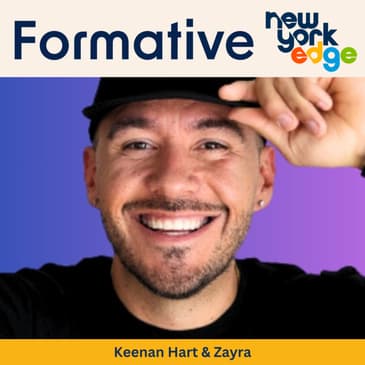
In this season finale, we’ve got Keenan Hart with us! Keenan is the co-founder of Fransis, a company focused on integrating artificial intelligence technology within the healthcare sector. He’s joined by Zayra to talk about why AI should not scare us, the importance of owning our mistakes and why it’s the most fun being in business with family!
Downloadable transcript here
Rachael: Welcome back to Formative, the show where today's leaders are interviewed by the leaders of tomorrow. To help us wrap up this season, we've got Keenan Hart with us. Keenan is the co-founder of Fransis, a company focused on integrating artificial intelligence technology with the healthcare sector. Today he talks to us about why AI should not scare us and about the importance of owning our mistakes. We're thrilled to be learning more about Keenan today.
Rachael: Hello and welcome. I'm Rachael Gazdick, CEO of New York Edge, and my co-host today is Zayra from M.S. 389X. Zayra, what can you tell us about yourself?
Zayra: I'm 12 years old. I am in the seventh grade. My favorite subject is social studies.
Rachael: And who are we talking with today?
Zayra: Keenan Hart.
Rachael: Great. Keenan, welcome to Formative. We're very happy to have you on.
Keenan: Oh my gosh, guys, I am so excited to be on Formative. This is gonna be an amazing conversation. Can't wait to share a little bit about my story and learn more about our amazing co-host Zayra here. This is gonna be fun.
Rachael: All right, Zayra. What's your first question for Keenan?
Zayra: Um, how did you become a founder?
Keenan: So, Zayra, I am an entrepreneur in healthcare. So what I do is I work with healthcare institutions, if those are hospitals, community-based, I would say healthcare organizations, and I develop technology for them.
Specifically, I'm really good at helping people talk to these organizations, like their friends and family, through text messages. And so what I've been doing over the last years is developing conversational AI tools that enable people to reach out to a trusted resource like a hospital or a doctor, just like their friend and family, and get questions answered, guidance or education about what they're going through, 24/7, 365.
When I was 23 years old, I was really thinking about how I can leave my mark on the world, and this is kind of an interesting story. Before I started Fransis, I was actually going to school to be a professional baseball player. When I stopped playing baseball in college, it was really tough for me to find out what I was gonna do next. And I had somebody who I really looked up to who, was one of my mentors, came to me and said, “Keenan, one day you're gonna have to decide to go pro in something other than baseball.” And in that moment I started thinking about what do I want to take all of my competitiveness, all of my love for competition and put that into, and so I created Fransis and I decided that day that I was gonna turn pro at being a business person. And so that's why I started the company and how I became the founder of this company.
Rachael: So what made you think you would be good at it?
Keenan: So my dad was an entrepreneur. He started a supply chain management company for large hospital systems. And one of the things that my dad always like had tried to impress upon me was we are rewarded by the problems that we can solve Now, I always thought that that was really interesting because I didn't come from a healthcare background, but I spent so much time in this space that I realized that I could be impactful in this space. And so when I was thinking about getting into this process with him, he was really somebody who just impacted my life in so many ways to show that even if you don't have expertise in a space, you can still provide value for a marketplace, even like healthcare.
Zayra: Uh, what do you think about AI?
Keenan: Well, I love artificial intelligence. Now, I have a little bit of a different perspective because when people think about AI, they think that it's gonna be something super scary, like it's gonna take over the world or it's gonna take jobs. But I believe in an exact opposite future. I think that artificial intelligence is gonna be something that we're all going to engage with on a daily basis, and we might not even know it. And so what me and my team do is we help organizations create digital team members that you can text like a friend and family member, who's always there to answer your questions, give you guidance, or be able to point you towards resources or give you education that you're looking for.
So I think that there's going to be a beautiful future where AI works with us the same way we do with our other team members in our jobs every single day. And it's gonna be a beautiful mix in the future.
Rachael: Is there anything that, like, scares you about AI and how prevalent it's going to be in our lives?
Keenan: AI, it can be a little bit scary. Why? Because I think we have to be able to think about the information that we're being given. One of the biggest things that they talk about in the world of AI is a term called hallucinations. When you talk to a ChatGPT, a Gemini, or another type of model, those information systems know so much information that sometimes they're in a rush to give you a quick answer, and sometimes they may make things up. And so in order for us to really trust the information that comes out of these systems, we have to really think critically about the information that we're being given. And so that is one of the things that I get scared about, is thinking that AI has all the answers and it's not just an assistant that can help us make better decisions. We have to think critically about the information that these AI systems give us in order to really trust them with trusted information like health information or education or guidance that it's gonna give us as well. So we always have to think critically. That would be my one fear that we could potentially have in the future.
Rachael: Zayra, do you use AI at all? Like, uh, let's say ChatGPT to help with your homework or to study or anything like that?
Zayra: Never.
Keenan: Well, this is my challenge for you, Zayra. I think that you should start experimenting with these tools, right? These are never meant to do our work for us, but to be a starting spot that we can bounce ideas off of, ask questions of, and be able to get better knowledge and understanding about the challenges or the problems that we're trying to solve.So start early and you'll be way ahead of a lot of your other friends by the time you get into the workforce, or start thinking about what you wanna do with your career.
Zayra: How is it like to be a founder of Fransis?
Keenan: Being a founder of Fransis is a lot of fun. Why? Because it gives me an opportunity to build a business that has the ability to impact a lot of people. Now, one of the things that we do here at Fransis is we created a brand, around our personal family experience. So Zayra, you can see I have a little purple gorilla on my hat here. Our logo is actually designed after the first stuffed animal that my dad gave me when I was being born. So when I was born, my dad gave me a stuffed gorilla who I called Key. Now, Key was always somebody who I could come home to, I could talk to. He was never judgemental. He was always there to listen to me, and he was always super nice to me. And so when I thought about the brand that we wanted to create in Fransis, we wanted to embody that same sense of peace, commitment, communication and safety that I got for my stuffed animal. And so I created the brand of Fransis around that personal experience. But also the color of of our business is purple because that's my mom's favorite color. And my actual name of Fransis is actually a split between my first name of Franklin, FRAN, and my sister, who is my co-founder, SIS. So if you think about the name of Fran and sis together, it's me and my sister who created this business.
So being a founder of this company is a really awesome life experience where I can spread positivity to other people.
Zayra: Uh, how many lives did you save?
Keenan: How many lives have I saved?
Zayra: Yes.
Keenan: That, that's a really good question. You know, one of the things that me and my team did in 2021, which will help me answer this question, is we developed a text message tool called Fransis Plus, and what we do is we will send out one daily text message of positivity, encouragement, support or a mental health reframe to focus on the positive things.
One of the most impactful stories that I've heard was actually from one of my sister, uh, one of her friends who was going through a really challenging time in their lives. And what we did is we actually gave him a subscription to our Fransis Plus service where he sent him a positive text of encouragement. Now he was going through a really tough time in his personal life, and he actually said to us that I don't know what I would do if I wasn't receiving these daily positive messages of encouragement. That's the one life that I know that we have impacted in a positive way. But because so many people receive our text messages, that number is really tough to be able to count because I don't have all of those individual’s names, but that's the story that comes to the front of my mind.
Rachael: So to shift gears a little bit, can you tell us about a time when you made a career mistake or how you went about fixing it?
Keenan: Yeah, so at one point in time when I was a younger entrepreneur, I always thought that it was really important to make my customer happy, even if that meant not telling them the truth about what we could do for them as a service provider.
And so I had a meeting with a large healthcare system. We talked about a potential integration, meaning how our software would talk to their software and exchange information. We said that we had an integration completely done, and in order to win the customer, we had to have that done. Well, we ended up potentially winning the customer, but then they found out that we didn't have the integration done.
And so I had to go back to the customer and say, guys, for some reason we thought we had bigger capabilities than what we had at the time. This is back in 2017. And I had to be very honest with them. And one of the things they did not expect in the meeting was for us to be honest. So one thing that I found was when I'm honest about what I can't do, my customers were more willing to support me to help them support how we can work together.
And so I learned a huge lesson that it's really important to tell the truth when you're talking to a customer. And sometimes the truth is the best way to get across the line.
Zayra: Uh, what was your biggest accomplishment?
Keenan: My biggest accomplishment, if I think about it, was never giving up. I know a lot of people think that your accomplishments are gonna be tied to something you accomplish in your career, but one of the things that I've recognized as I've gotten older is that me just not giving up and believing in myself and having confidence to chase my dreams has been my biggest accomplishment to this day.
Rachael: Our last question we ask everyone is if you could go back and talk to your 12-year-old self, what would you tell him?
Keenan: I would tell him to trust the process. Sometimes when we're younger, we think that everything is gonna go to a certain plan, everything's gonna go great. There's never gonna be any hiccups or mistakes that we'll make. But guess what? The way in which we learn is by trying and sometimes failing and then being able to retry at the same problem. And so I would tell my younger version of myself to trust the process. Not everything's gonna go well. Not everything's gonna go perfect, but as long as you keep going, like Zayra asked me in the beginning what would I be most proud about, is not giving up. That would be something that I would say.
Rachael: That's really wonderful advice. Well, thank you so much for being with us today.
CREDITS
Thanks for listening to Formative, a production of New York Edge. I’m your host, Rachael Gazdick. Our production partner for this series is CitizenRacecar. This episode was produced by Hajar Eldaas, post-production by Alex Brouwer, original music by Garrett Tiedemann. Thanks to the whole team at New York Edge for making this series possible. Never miss an episode by subscribing to the series at newyorkedge.org/formative or wherever you get your podcasts.