
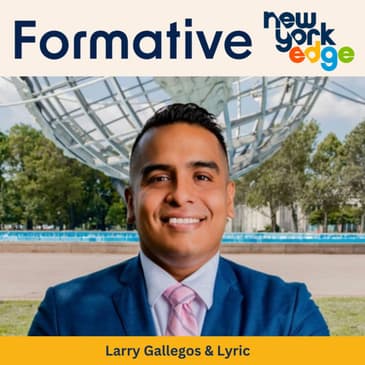

On today’s episode of Formative, Larry Gallegos and middle schooler, Lyric, are joined in conversation. Larry is the Public Policy Manager at Lyft, and they bond over their love of law and debate. Larry and Lyric also talk about how one person can build a better future for generations to come, and how all it takes is someone who isn’t afraid of hard work.
Downloadable transcript here
Rachael: Welcome to Season 8 of Formative, the show where today's leaders are interviewed by the leaders of tomorrow.
On today's episode of Formative, we're talking to Larry Gallegos. Larry is the Public Policy manager at Lyft. In this episode, he tells us about the tremendous work Lyft does to engage with communities and work with policymakers. We also talk about Larry's childhood growing up in Jackson Heights and how he was able to shift his circumstances and create a better future for himself and younger generations. We are thrilled to have Larry on today!
Rachael: Hello and welcome. I'm Rachael Gastic, CEO of New York Edge. And my co-host today is Lyric from M.S. 375X. Lyric, can you tell the audience a little bit about who you are?
Lyric: I like to dance, sing, and debate. I grew up in North Carolina, moved into New York when I was eight years old. I like ELA. That's my favorite subject and I want to become a lawyer when I get older.
Rachael: That's cool. I'm sure you'll become an excellent lawyer. Lyric, who are we interviewing today?
Lyric: Yes, ma'am. And we're interviewing Mr. Larry.
Rachael: All right, let's welcome Larry Galagos then. Thank you so much for being here.
Larry: Thanks for having me.
Rachael: Great. Lyric, what's your first question for Larry?
Lyric: My first question, can you break down, like, what your job entails? Because me, I honestly don't know much. So can you please explain?
Larry: Sure, sure, sure. No, yeah. So my role here at Lyft is to try to figure out ways how a private company like ours can work with the community. You know, that's why we try to partner with community organizations that are doing good work to try to help the communities that they're serving. And at the same time, my role here at Lyft, what it helps me to do is work with your elected officials, like your Congress members, your senators, your Assembly members, your City Council members, to come up with laws and rules that are in the best interest of the drivers, the communities that we're trying to get to and help out the most. You know, and that's, that comes because of my background and the time I've worked in government.
Lyric: Uh, Mr. Larry, how do you feel to be the public manager of Lyft?
Larry: I enjoy it very much. I enjoy it very much. And I think, you know, people sometimes, like, what does a public policy manager for Lyft do? You know, for me, I think what I try to focus on is, like I mentioned before, how can I use my role to help these communities that are historically underserved, who don't, don't have the resource, who, let's say, live in what we call transportation deserts. And what that means is neighborhoods or areas that don't have, you don't have access to trains or buses as much as other neighborhoods do.
So we want to make sure that there's equitable access to transportation and that folks have the ability to get to and from places and that transportation doesn't serve as a barrier to, you know, get to a job interview. If you're an expecting mother to get to your doctor's appointments, um, if you're, you know, if, if you're going to work on a late night shift to get home at a reasonable time to spend time with your family.
So, so I think that's what I enjoy most about my role here at Lyft.
Lyric: Yes, so before you was the manager, were you like one of the employees of Lyftand you became the manager, or were you just, when you just got there, you just became the manager?
Larry: When I just got here, I came in as a manager. Before this, I worked at the MTA. So I worked for our, you know, our buses and our trains. I was the Assistant Director of Government Relations there. And before that I worked in Congress for a little while. And then before that the city council. So I've been, I've been in government. I've slowly changed positions until I got to this point here now. Um, but yeah.
Lyric: That's great. Mr. Larry, so I heard that you was helping the community out in Buffalo, New York because of the shooting in the supermarket. Can you tell me more about that?
Larry: I think, I think my goal is you want to help communities who have historically been underserved, who haven't gotten the resources or the benefits that other communities have had in the past.
So when the Buffalo shooting happened, it happened for terrible reasons. It happened because of a racist mentality. And the first thing that came to mind was how can we help them as, you know, in my current role at Lyft, what do we do? We provide transportation. It's cars to get you to and from places. And in Buffalo, where the shooting happened in that supermarket, that was the closest supermarket to that neighborhood, to that community.
So for folks to get to and from there would have been, was going to become very challenging because it closed down after the shooting for a period of time. So you have to take into consideration who goes to these supermarkets, who are the folks that need these resources? It's people like you and me, it's kids, it's senior citizens who can't necessarily travel that far.
So providing them access to transportation to get to the next closest supermarket was something that we were happy to do. I think that's the goal and that's what inspired me just figuring out ways of how we can use what we do as a company to help the communities we serve.
Lyric: Great. How did you feel in the process of helping your community? How did you feel?
Larry: It was a combination of sad and happy, to be honest with you, because you're sad that these types of things happen. You know, you wish that they didn't happen. Um, but I was happy at the fact that I was, I was able to do something about it, however small it may be. You know, it did, it did provide me the opportunity to do something to help these folks. And to, even if just for a small moment put a smile on their faces or make their lives a little bit easier considering everything that they had just gone through with the shooting in Buffalo.
Lyric: If you did not become who you are, now what would you become?
Larry: So it's funny you mentioned that. I heard that you said you wanted to be a lawyer. Coming out of college, I actually wanted to be a lawyer myself. Um, my senior year, I took the test called the LSAT that's required to get into law school. And it just, you know, circumstances of life and things that I was exposed to during my first job coming out of college kind of changed my, my goals or my trajectory.
I wanted to try something different. I wanted to figure out ways to change things from a society standpoint.
Lyric: That's great. Um, what can you tell kids who want to work in your profession?
Larry: That it's quite an experience and I'll go back to why I changed from wanting to be a lawyer. I wanted to be a lawyer to work on family law and help kids, you know, with whatever family situations were going on, whatever hardships they were going through. And then I found myself not understanding why the laws were the way they were. As a lawyer, you have to uphold the law. So what I thought about after that was, you know what, how do we change the law? How do you do things to make laws different, to better serve these communities, to better serve these kids, to better serve families.
So I was like, let me go into politics. Let me work in government. So I started working in the city council and I worked for a good man named Jimmy Vaca, who to this day is my mentor. He was a city council member at the time. And, you know, he educated me a lot. He taught me a lot. He's the reason I got my master's degree, even as I got older, you know, um, I continued on that journey and what I would tell kids is, is to follow through with it and kind of look at the unlimited possibilities that come with that.
I'll tell you a story about myself. When I was working in Congress, I was in Washington, D. C., and my first day in the chambers, and this is where the president has the state of the union, all these big speeches and all these big laws. And there's so much history around that. I took a picture, and I texted my mom, and I said, hey, mom, did you ever think we'd be here? And she sent back a happy face. She says, no, you know, and it's, uh, it was an extremely, I think, touching moment for me and for her, because I do remember the tough times. Um, I do remember the times where we didn't know if, if we would, uh, have food for the next day. You know, my mother had to go to food pantries and figure out how to put food on the table for my brother and I, or we didn't have electricity at home. So we did homework by candlelight. Um, You know, and that's in New York city. That's not something that you would hear about in most places. So I was able to push through, I was able to push through because of the people around me.
I'll tell kids to, I would tell kids to just stay the course, just stay the course. Don't listen to the outside noise and know that the possibilities are endless for you, whether it be in this field or whatever else you want to do.
Lyric: Did you have a hard, like what was your hardest obstacle that you had to overcome?
Larry: Oof, that was a, that was a deep question. I think that, um, you know, growing up, every family looks a little bit different. Some folks live with their grandparents. Some folks live with their mom. Some folks with their mom and dad.
I came up in a household where it was just my mom. You know, my mom looked out for my brother and I, she worked a lot of hours to try to pay the bills and take care of me and my brother. Oftentimes that would feel a little bit challenging. You know, there was, there was stuff at school and my mother couldn't always be there.
I played football growing up a little bit and not having a dad around, at times became would make me, it would make me sad. So there were, you know. Growing up with a single mother presents certain challenges at times, you know, there, there's things that you feel like you're missing out on and it does upset you but I think understanding there was an additional support system around me, my coaches, my teachers, other folks that I was fortunate enough to have in my life that kind of helped fill that gap a little bit, helped me push through, helped me push through and continued to remind me that although I was lacking one thing in my life, I had other things to help make up for that.
So continuously reminding myself of that and, and keeping in mind that, you know, it's regardless of how bad things may seem, you'll be able to get through it. Tomorrow will be another day. Tomorrow will be another opportunity to get ahead, move ahead and do good.
Lyric: You as an adult now, did you ever reconnect with your father?
Larry: I did. I did reconnect with my father as an adult.
Lyric: How was that experience?
Larry: That experience was tough. That experience was tough. And it was tough because…
Lyric: You had so many questions.
Larry: You had so many questions for him. Um You know, and I reconnected with him when I was older and I had my own son. I had my own son after that point. So it was even tougher for me to kind of understand, like, you know, like I know how I feel about my son. I love my son an incredible amount, you know, so for me to understand that my dad wasn't around as much, it was a little, it was a little tough for me, you know, it was a little tough for me to kind of put that aside and, and be as forgiving as I should be, you know, but I think for me, the important, the reason for which I decided to speak to him when I was older was because it's not always good to just keep those feelings inside. So have those conversations, you might not get the answers you want, even when you're older. To be able to get that off your chest and just not hold on to that for all that time is extremely helpful.
Lyric: Thank you. Um, did anyone tell you that you couldn't be who you are today? Did anyone stop you from being that?
Larry: Um, yeah, I encountered that a few times during my life when I was your age and even younger at times. And I'll tell you, sometimes the first person that said that to me was myself.
There were times in my life where things were getting a little difficult and challenging. You know, and I was like, am I going to, am I going to be able to get through this? Am I going to be able to go to college? Am I going to be able to finish college? There's different times in my life that I encountered that, just trying to find the strength and the grit to push through and get through these challenges and obstacles and lean on the folks around me.
And then, uh, you know, on the other hand, I've also dealt with that from folks on the outside. There's always going to be folks that tell you, you can't do something for different reasons, because maybe they had, they set certain limitations on themselves. So they think that everybody's the same. And what I say to that is as cliche as it sounds, and as often as you'll hear this in the movies, you can do whatever you want. And it's true. You can. It's just a matter of ignoring the outside noise and continuing to push through these things because if you really want something, I think you just have to dedicate yourself to it. Dedicate, dedicate yourself to the work that comes with that because there's always a certain level of work that comes with accomplishing anything and just keep pushing.
Lyric: That's amazing. And you to be the manager for Lyft and didn't come from a lot of money and you came from the bottom, you came to the top and you're now, you know, becoming something amazing. Um, how long did you had, might it be, um, for college? How long you had to go to school for there?
Larry: I went to school for my bachelor's. It took me five years because I couldn't go to school full time. I had to work while I was going to school to pay for my college. So it took me five years to get my bachelor's degree and then I couldn't afford grad school. So I had to work right away. I kept working and I got to a point in my career early in my thirties, I got my master's degree in my thirties where I wanted to do more. I wanted to move up and get a better title and do, you know, provide more for my family. And you couldn't do that without a master's degree in my field. So, um, it took me, I took my master's program, took me two years after that, so all together about seven years, but they were broken up. You know, it's not something that happened immediately. You know, there's uh, like I said, everybody's journey is a little different.
Lyric: Yeah, that's a lot. That's a lot. How did you feel in that moment of doing all that? Working, going to school, because that's a lot to do, and it's a lot on your mental state.
Larry: I wanted to quit. I wanted to quit when I was in my master's program. I was a year into it and you know, I had two kids already at the time and I was working, um, and going to school. I called my mentor, Jimmy Vaca, and I said, Hey Jimmy, you know, I think that I want to take some time off. I have a lot going on at home. It's tough with my family and time and all this stuff. I don't know if I can do this right now, but I'll come back to it. He scolded me. I'm a grown adult at this point. And he said, you listen to me, he's like, if you stop going to school right now, you're not going to finish. So he's at the very least take one course and just stay on that. And I was like, okay. I was like, all right, Jimmy. So I decided to break it up a little bit, but went to school during the summer and took courses then and was able to finish in time, but, but yeah, it was hard. And I wanted to quit. I wanted to quit because of just the time and how stressful it was to do homework and work.
Lyric: I heard that you were raised in Jackson Heights, correct? How was the community over there?
Larry: Jackson Heights is a big melting pot of a bunch of different people. You have a lot of different cultures, a lot of different languages spoken. So for me growing up was a very fun experience. There was a very large sense of community. I grew up on a block where if I was playing outside and if I was misbehaving and my neighbor saw me misbehaving. They would call my mom. They would call my mom and be like, hey, I saw Larry doing this and when I got home, my mom, she scolded me, you know, so I try to make sure that I don't get in trouble and not get caught doing things. But Jackson Heights was very rich in culture and just different languages. And I think the best part about that was the fact that there were so many different types of people there.
There were so many different communities all within, I think, a 10 block radius at times. So that teaches you to be more understanding. That teaches you tolerance. That teaches you things that I probably wouldn't have learned had I lived in a neighborhood where everyone looked exactly like me or where everyone looked another way. You know, this is a, that's the beauty of living in a city like New York, being raised in a city like New York.
Lyric: So is Jackson Heights different from the community you live in now, Woodside?
Larry: Not that different. It's changed a little bit over the years. There has been a lot of new people that have moved into my neighborhood and my old neighborhood.
Um, you know, I think with time comes change, rents have gotten higher. And I think that's a whole nother conversation we could have about people being forced to move elsewhere. Um, but you know, the community is not too different. You have a lot of younger folks like myself, younger professionals who have families and are trying to just get ahead. But I enjoy it. I enjoy it a lot. I think it still has some of that community feel, but I won't lie to you. I do miss Jackson Heights. I do miss the old Jackson Heights. I do miss the neighborhood that I grew up in, all the different smells, sounds, noises, all that fun stuff that came with that.
Lyric: Um, so what was your hobbies growing up in Jackson Heights? And if you still do little hobbies now.
Larry: So yeah, growing up in Jackson Heights, my hobbies were, I love playing sports with my friends. There was a lot of kids on the block, so we would play manhunt, play football, play basketball, things of that sort. And we wouldimprovised. We didn't have the money for a basketball hoop, so we'd put three garbage cans, pile them on top of each other, and shoot the basketball into the garbage cans. And it would have to stop every now and then when the garbage can would tip over. But yeah, so we improvised. I love playing sports. Um, I grew up playing football. I grew up playing football, organized football. I played Pop Warner.
Um, and now I, I'm a little older now. My body can't take the hits I used to take when I was growing up. So I don't play tackle football as much anymore, but when I get a chance to run around a little bit and catch the ball, play and play flag football or anything of that sort, I try to, um, nowadays, I think I've tried, what I try to do is, I'm with my kids. My kids do jujitsu, they do soccer, gymnastics, swimming. So I try very hard to just be very present for them. And, and I'll tell you, I think that what people say about having children and being there for them. The first time my son scored a goal, it was super exciting for me. I'm jumping around on the sideline. Just losing my mind because I was so excited for him. You know, when my daughter's doing her stuff in swimming and in gymnastics, I'm also there just like as her number one fan. So, you know, when I'm not trying to do my own thing, as far as like working out or playing a little bit of flag football, most of the time I'm with my kids and that's where I get my satisfaction from these days.
Lyric: That's amazing.
Larry: What are some of your hobbies?
Lyric: I like to dance. I am in dance. I like to sing. I'm in chorus, I'm in debate. Like I said, I like to debate. I like to draw sometimes, but I'm not a good drawer. I promise you that. I'm not.
Larry: You said that you like to, you like to debate If I'm not mistaken.
Lyric: Yes. I’m on the debate team. Um, I just love debating because it just, I know that it will like. It will improve my speaking skills, help my confidence, and it will just help me become the best I can be.
Larry: That's awesome. That's awesome. I think the fact that you're on this and asking me questions, that's pretty brave in itself. So I think you're doing a good job so far.
Lyric: Thank you. I think you're doing a good job too because it's a lot on helping the community and coming up with great ideas. Of course you have a team, but also it's like really hard to come up with things, and also it's hard to bring different ideas into one, and how, like you said, face obstacles to become who you are today. So I think that's brave of you.
Rachael: Ah, very well said, Lyric. We have one final question we ask all our guests, and it's this, if you could speak to your 13 year old self, what would you say?
Larry: I would tell my 13 year old self, it’s going to be okay. I remember when I was very young, oftentimes problems would present themselves and I would feel like it was the end of the world. I’d feel like that was the biggest issue or the biggest thing going on. Um, so I would just tell myself, chill out, relax, you know, the sun's going to come up again tomorrow. Everything's going to be okay. Just work through it. Um, You know, that's, that's easier said than done at times. I know that life can present some obstacles and challenges, but it's a matter of just pushing through at times and, um, and leaning on the support system around you. If you have, you know, teachers, coaches, you know, your parents or relatives or someone that you could kind of lean on, lean on, just take advantage of that.
Rachael: Well, thanks so much, Larry and Lyric. This has been such a pleasure. Thank you, and bye.
Lyric: Thank you.
Larry: Lyric, thank you so much. That was incredible.
Lyric: Thank you. Have a nice rest of your day.
Larry: You too.
Lyric: Thank you.
CREDITS
Thanks for listening to Formative, a production of New York Edge. I’m your host, Rachael Gazdick. Our production partner for this series is CitizenRacecar. This episode was produced by Hager Eldaas, post-production by Alex Brouwer, production management by Gabriela Montequin, original music by Garrett Tiedemann. Thanks to the whole team at New York Edge for making this series possible. Never miss an episode by subscribing to the series at newyorkedge.org/formative or wherever you get your podcasts.