
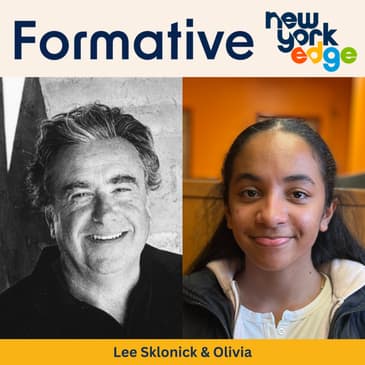
Lee Skolnick visits us today on Formative. Lee is an architect who’s worked on remarkable buildings across the world, including our very own New York Edge Headquarters! Middle schooler, Olivia, joins him to ask questions about the challenges that come with being the boss, why it’s important to remain teachable and what life would look like if we’d chosen a different path.
[00:00:03] Welcome back to Formative, the show where today's leaders are interviewed by the leaders of tomorrow. Today we're chatting with Lee Skolnick. Lee is a founding partner and architect at Skolnick Architecture. His firm has worked on remarkable buildings across the world, including the New York Hall of Science in Queens, the Luxembourg Science Center, and our very own New York Edge headquarters. He talks to us today about the challenges of running an office, getting a head start by leveraging mentorship,
[00:00:33] and what he would be doing today if he wasn't an architect. Hello and welcome. I'm Rachel Gazdick, CEO of New York Edge, and my co-host today is Olivia from IS318K. Olivia, can you tell us a little bit about yourself? I'm from Brooklyn, New York. My favorite color is pink. My favorite subject is history, and I'm 13 years old. So Olivia, who are we talking with today? We're speaking to Lee Skolnick, and I'm very excited to have him here.
[00:01:03] Lee, welcome to the show. We're excited to have you. Thank you. I'm excited too. So Olivia, the mic is yours. What inspired you to become an architect? Very good question. I went to a good liberal arts college called Hamilton College. It's in upstate New York. And I was a music major, actually. I was most interested in music, composition, and theory.
[00:01:30] And then because I was in a liberal arts college, I took all sorts of courses. I took anthropology and music and filmmaking and literature, science, all sorts of things. And I had this big crisis because every subject I took I thought was the most exciting subject. And so on a Tuesday, I might want to be a research physicist. And on Thursday, I wanted to be an anthropologist.
[00:01:58] And Friday, I wanted to be a musician. And then I happened to take a course, an elective course, called Architectic Theory and History. And what I learned was that to be an architect, you have to keep learning about all these different things. So you had to be interested in philosophy, you have to be interested in science, and you got to use all these in your job.
[00:02:25] And also, it was something creative where you would design something and have it built and you would actually have something concrete, something real out there in the world. It wasn't just all academic. And so I like to say that's when the lightning bolts struck me. And I said, so I want to be an architect because then I can continue to learn about all these things. That's a long answer, but that's the truth. That's how it started. What do you like about your job?
[00:02:55] I think the two things I like the best. One is getting to know people. When you work on a project with a client and consultants and engineers and, you know, people who are experts in various fields, you get to know them as people. It's not just business. And a lot of my best friends actually are my former clients.
[00:03:16] Because when you work with someone so closely on creating something, whether it's their home or museum or school, you get to be really close friends. And then usually we remain friends after that. So a lot of my best friends are people who I did projects for in the past. And we just became, you know, really good buddies. That's nice. Very good. Do you have any career mistakes in your life?
[00:03:45] I think one thing I did that was unusual is I worked for a bunch of my professors while I was in architecture school. So when I graduated, I actually had most of the apprenticeship I needed already done. So instead of getting a job in someone's office, I actually opened my own office. On the one hand, that worked out well. And here I am 40 years later and still doing it.
[00:04:14] But on the other hand, I never really learned how to run an office by being an employee. And so there are times when I really think maybe it would have been better to spend the time working in an office for a few years to see how things are supposed to be done. I had to make the mistakes on my own as I went along.
[00:04:35] And like I say, it worked out okay, but it could be that it would have been more advantageous to see how an office runs more and get that kind of experience. You have to make your own path. And you'll run into obstacles and you'll run into conflicts and you just figure out how to learn from them and go on to the next thing.
[00:05:02] Yeah. My next question for you is, what is your favorite building in New York? I have an unusual answer for that. People often ask me that and they expect me to say the Empire State Building or the Guggenheim Museum or something like that.
[00:05:21] But actually, my favorite piece of architecture in New York is Central Park, which isn't really a building, but it was designed by an architect and landscape architect. And I just think it's the most exciting, interesting place in New York City. And it's all designed. You know, people think that it's all natural and it was always that way.
[00:05:44] They built everything, all the hills and valleys and fields and the little buildings like the Belvedere Castle. So I just think that's the greatest piece of design in New York City. And I love it because everyone is comfortable there. No one is excluded. It's not private. You don't have to have money. It doesn't matter who you are. And I love going there and seeing people from all walks of life enjoying it together.
[00:06:13] Because to me, that's what architecture is for. Yeah, see, I love Central Park. It's pretty nice. All the buildings in New York are very nice. Yeah. Next question is, like, do you have a favorite building that you worked on in New York City? Oh, that's a good question. Let me think. I guess. We worked on the New York Hall of Science in Queens Flushing Meadows Park. We did work on that. I'm proud of that.
[00:06:39] We worked on a church on 34th Street in Manhattan, which turned out really great. Just recently, we did 85,000 square feet, which is a lot of space for an organization called the Child Mind Institute. And they offer therapeutic programs and they do research on mental health issues.
[00:07:05] And it makes you feel good because you're doing something that helps a lot of people. Is there any goal that you haven't accomplished that, but you're still working on? Well, the interesting thing, one interesting thing I should say about architecture is you never feel like you know it all. And people often say, like you did, you know, what's your favorite project? And I always say the same thing. And it's not just a cliche. It's not just to be clever. I always say my next one.
[00:07:32] Because I always feel like there's so much more to learn. And every time I do a project, I learn a little more and I can apply it to the next one. And so, you know, I feel like I'm still learning and I'm still getting better. So you're 13, right? Yeah. Yeah. What are you interested in? I'm interested in history right now. My favorite topic is history.
[00:07:58] Any particular kind? World history or American history or? Probably American history. But what I want to do when I get older is probably be a marine biologist. Oh, wow. So why do you want to be a marine biologist? Because I think learning about the ocean is very cool. I like learning about animals. That's exciting. What did you want to do when you were my age? Definitely I wanted to be a musician.
[00:08:26] You know, I know this is, you weren't born yet, but when the Beatles came out in 1964, I just like dove into it. And the next day after they played on the Ed Sullivan show, which was a TV show, I saw them and I just thought they were so cool. And the next day I started playing the guitar. I was 10 years old and I started playing in bands and writing music and working in recording studios.
[00:08:54] So I really thought I was going to be a rock and roll star. But my parents were relieved when I decided to be an architect. Lee, do you still pursue music in any way? I still do to this day. I play guitar and piano. I play guitar and piano. I write songs. And I play at clubs and at events, fundraiser events. I have a band.
[00:09:18] And actually I have a radio show on Sunday nights where I bring on musicians and we play music together. That's nice. So I didn't lose it completely. If I could live a second life, I think I would just be a musician. I mean, I love doing architecture and I'm going to do it as long as I live, but doing music is just so liberating. Do you remember what your band name was when you were younger?
[00:09:48] I had some really silly names. Like we had one that was called Us Two and Them. My best friend. And then we had like three other people. Then we had The Outfit. And then let me see, we had Proofrock, which actually came from, there was a story called J. Albert Proofrock or something. And we thought it was cool because it had rock in the name. You know, we would spend a lot of time just thinking up names.
[00:10:18] And our last question for you is, if you could go and speak to yourself at age 13, what would you say? I might say, don't be so full of yourself. You know, I always had the sense that I could do anything. And on the one hand, it's good because it makes you reach higher and higher. But it can also result in not picking in what other people have to offer and feeling like, well, you know better.
[00:10:48] I mean, one of the reasons I opened my own office instead of working for a firm is I knew I'd be the world's worst employee. Because I knew that if they asked me to do something and I didn't think that it was the right thing to do, I just wouldn't do it. And then I'd probably get fired. So I had the self-awareness to know that it was probably better to go off on my own.
[00:11:10] But at the same time, I probably missed some good, you know, advice and experiences because I just felt like I knew everything. The older I get, the more I realize I don't know. Oh, I get that. Well, thank you so much for sharing with us today. It's been such a pleasure. Great. Well, it's great to meet both of you and best of luck.
[00:11:38] Thanks for listening to Formative, a production of New York Edge. I'm your host, Rachel Gazdick. Our production partner for this series is Citizen Racecar. This episode was produced by Hajar Adas, post-production by Alex Brower, original music by Garrett Tiedemann. Thanks to the whole team at New York Edge for making this series possible. Never miss an episode by subscribing to the series at newyorkedge.org slash formative or wherever you get your podcasts.