
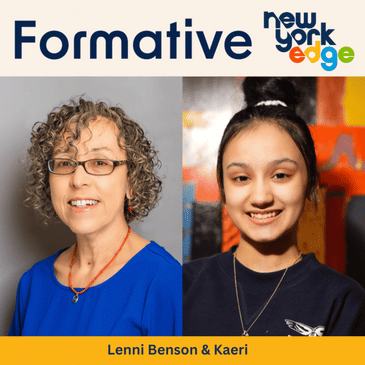

We’ve got Lenni Benson on today’s show! Lenni has been teaching and writing in the field of immigration law since 1994. She is the Distinguished Chair of Immigration and Human Rights Law at New York Law School. 8th grader and co-host, Kaeri, joins Lenni in a conversation about how to be of service— in the legal context and in our everyday lives— and what you gain back in return when you’re thinking of how to improve the condition of the communities you inhabit.
Downloadable transcript here
INTRODUCTION
Welcome to Formative, the show where today’s leaders are interviewed by the leaders of tomorrow.
Formative is brought to you by the generous support of Macy's Inc. whose purpose is to create a brighter future with bold representation from underrepresented youth so we can realize the full potential of every one of us.
GUEST INTRODUCTION
Today, we’ve got Lenni Benson on the show with us. Lenni has been teaching and writing in the field of immigration law since 1994. She is the distinguished chair of immigration and human rights law at New York Law School. Lenni is also the founder of the Safe Passage Project, which recruits, trains and mentors attorneys to assist unaccompanied youth who are facing deportation. We’re so grateful to have Lenni with us today.
INTERVIEW
Rachael: Hello and welcome. I'm Rachel Gazdik, CEO of New York Edge, and my co-host today is Kaeri from M.S. 242K.
Kaeri: Hi, my name is Carrie Ortiz. I'm an eighth grader at Mott Hall V. I live in the Bronx. And my favorite subject is ELA. My favorite hobby is doing my hair. When I grow up, I want to be a model or an esthetician.
Rachael: That’s great. Kaeri, who are we interviewing today?
Kaeri: We're here interviewing Lenni Benson, professor of immigration and law at New York Law School, and founder of the Safe Passage Project.
Rachael: Well, let’s bring her in. Lenni, welcome to our show and thank you so very much for being here with us.
Lenni: Thank you for having me. And thank you, Kaeri, for doing the homework and preparation for our interview today.
Rachael: All right. So Kaeri, what's your first question for Lenni?
Kaeri: May I ask, what is an immigration lawyer?
Lenni: That is such a great question because there's so many different kinds. I mean, sometimes we think, a doctor, a police officer, an immigration lawyer, it must just be one thing. But no, there's so many different variations. So, for example, some of my students work for the federal government. They are immigration judges. They work on policy issues. They're stationed all around the world. Some of them work for the U.S. Immigration Service, and they guide the government on how to make accurate and fair decisions in immigration cases. Some of my students run their own law firms, and they represent individuals. So it might be someone who recently came to the United States, or it might be someone who's contacting them from their home country who wants to find out, can they immigrate to the United States? And within those groups, there are people who specialize in businesses and there are people that specialize in refugees. So, you said in your introduction that you might like to be a model. Did you know there's a special visa just for foreign models?
Kaeri: No, I didn’t know that.
Lenni: So, some of my students represent models. When you look at beautiful models from all over the world, you say to yourself, oh, that's so cool. Look, they get to come to New York. They get to go to Paris. They get to be in a show in Indonesia. They need visas to do all that. So, one thing an immigration lawyer does is how people comply with the law to work and live where they want to go.
Kaeri: Oh, wow!
Lenni: This is a really big field.
Kaeri: What is your personal mission statement?
Lenni: Oh, you know, it changes over time but really, since I became a professor, my biggest mission is to try to make a very complex area of law, which is immigration law, understandable and to motivate people to learn about it and to engage in the work. Because I think a lot of us don't know a lot about it and we learn about it through negative headlines too often.
You know, like, maybe you're walking to school one day and suddenly you see a big long line of people and you say, why is everybody lined up? That might be for something cool like concert tickets, right? Or the best donut in your neighborhood. But it might be that the city has opened a shelter there and it's a lot of people who just arrived in the country, and they're lined up because they're being processed for a room for the night or for the month. That can feel threatening. It can feel scary when you see a group of people you don't know.
I would like us all to step back and realize that New York is a city of immigrants, and the country is a country of immigrants. I don't know if you know this, but one in three people in New York was born somewhere else. So you could go to school there in the Bronx, and you might meet people that everybody was born in the Bronx, but it might be that maybe two or three or four of your classmates were born in other parts of the world and their families brought them to New York. And it might be that if you knew more about their families, you'd find mom, dad, grandma, grandpa, stepmom, stepdad, life partner, they were born somewhere else. And so, the truth is about immigration law, particularly in New York City, it's intertwined into all of our lives, whether you're a Wall Street banker, or you're a dentist, or you're an 8th grader.
Kaeri: Okay, wow. I'm in shock. What is the hardest thing about your job?
Lenni: I think it's staying optimistic because the biggest challenge sometimes is, people throughout the centuries of human nature have said there's too many newcomers. There’s too many strangers. We have to close the borders. We have to send people back. And I think that we need to pause and think. There's a lot of reasons people are on the go.
But certainly, I do worry that a lot of young people come to the United States thinking it will be easy when they get to the United States. Their life will be pretty high standards, easy to get an apartment, easy to get nice clothes, easy to get a good job. But I think those of us who are here know that New York is very expensive. Some good jobs are hard to find. Life is a little bit more complicated than it may look on Facebook or TikTok, right?
So, um, the challenge in my job is to try to get people to have a deep conversation about complex issues like immigration and to also try to protect people from exploitation because if you're scared and alone and vulnerable, you may turn to someone who's not trustworthy to help you, right? And so, I really wish our laws and our information was more accessible to young people.
Kaeri: My next question is, would you ever want to start programs for other people out there in need of help finding a home or shelter?
Lenni: Sure, I do that a lot. For example, in the last three months, I stood up 16 free clinics for people in the homeless shelters at New York Law School, and I got 300 people to volunteer. They were mostly college and law students and some lawyers, some interpreters. We helped over one thousand people, we helped four hundred people apply for asylum and about three hundred people apply for something called temporary protected status, which is a special right to stay here and work. And amongst those people were spouses and little children and newborn babies. And all of these people lived in New York City shelters. When I saw that problem was happening and I knew there were not enough resources to help those people, I called the city and I said, we can do this at the law school. And so we partnered.
And then before that, I created a nonprofit, which is called the Safe Passage Project. The mission of the Safe Passage Project is to help unaccompanied children who are migrants to the United States go through the immigration process and have a free lawyer. Some of the lawyers are staff at the Safe Passage Project and some of the social workers are staff, but we also recruit and train lawyers who want to give their time. We call that pro bono, which comes from a Latin phrase meaning for the public good. And so, we have over five hundred volunteer lawyers, hundreds of volunteer interpreters, lots of students, both social workers and law students. And it has grown from just my desk and my telephone calling people and saying, do you want to help, to now being a staff of fifty one people and we're helping more than 1,600 young people right now. So, we're the biggest provider of free legal services to unaccompanied youth in the New York area.
Kaeri: That's amazing.
Lenni: Thank you. It's really rewarding. It's really fun.
Kaeri: And it took a lot of time.
Lenni: It did, yeah. In fact, I taught night classes for several years just so that during the day I could be completely free to get the Safe Passage Project started. So, I was an unpaid executive director for about five years. And that was okay because I had a salary from the law school and I was able to do it, but my family gave up a lot of time with me because I was always teaching at night in our night program so that during the day I could help get the nonprofit started. But it was worth it.
Kaeri: I bet it is. And I would be very proud if I was you.
Lenni: Thank you.
Kaeri: Okay. What is some advice you would give to the future leaders out there that are struggling?
Lenni: So first, I would say never underestimate how much one person can do. You know, let's take immigration law, right now Congress is considering making it a lot harder to go up to a border and ask for protection to say, hello, United States, I need protection, I can't live in my country safely. And it's a pretty depressing day that we might cut back on our welcoming of people who need protection, but one person can make a huge difference. For example, Kaeri, if in a few years, you go to college and then you go and volunteer at the border, you might go and talk to someone and say, tell me, what are you fleeing? What's the problem back home? And you might be able to help them navigate the complexity of the law right there at the border.
And there's an old saying that to save one human life changes the universe. So, I think that sometimes we think we have to be really powerful. We have to get elected to be president of the United States. We have to be a member of Congress. We have to be rich. It's not true. Any of us learning and educating ourselves and then helping someone else overcome an obstacle in an ethical and legal way can be really powerful.
So I would say, you want to be a future leader and you see a problem? Figure out where you can start taking small steps to make a difference in maybe just one or two people's lives and you'll be surprised that it can expand to much more that you can do on a bigger scale.
Kaeri: I agree. I like that quote, by the way.
Kaeri: What made you interested in learning about immigration?
Lenni: Yeah, so I grew up in Arizona. Arizona is a very big state. It's the sixth largest state in the country. And at the time I was growing up, it was rapidly growing. Lots of new people were moving into the state, even though I was born there. Today, Arizona’s city, Phoenix, its capital, is the fifth largest city in the United States. But when I was growing up, it was pretty small. And one of the things I noticed was that when you were different, like, you hadn't lived there for generations, you really stood out because the population was pretty small. And I always made friends with those people.
But I didn't study immigration law in school. It was after I went into being a lawyer that the law firm I worked with started representing people from all over the world, mostly from businesses. And I just loved it. I loved helping new people navigate and adapt to their life in Arizona and in the United States. So, I spent about half my time doing business cases, another half helping individuals like people who got married to foreign people, or helping people that were in trouble, people that the government said didn't have a right to be here.
And so, I just loved it. It was just a really diverse field. But lots of areas of law, you don't actually have a person as a client. You might have a business as a client. And in immigration law, I got to have people as clients, and I really like that.
Kaeri: What are some challenges you had to overcome to get to where you are today?
Lenni: You know, when you're as old as I am, I'm 65 years old. I've been a professor for 30 years. Sometimes, you forget how frightening it was to be a high school student, a college student, a law student and say, how will I ever realize my dreams? And so, what I want to say about that is there's challenges all along the way, whether it's taking a difficult course or choosing a college or getting along with people that are difficult to get along with. There's always those challenges, right? When you're as old as I am and had as much life experience as I've had, and you look back, sometimes you forget those early challenges that were really powerful at the time.
So my biggest challenge, I would say, is that there were no lawyers in my family, and I grew up on a farm. And so, when it came time to go to college, my parents really wanted me to go to college, and they had gone to college, but they had been veterans in World War II. And so, both of them were able to fund their education because they got money from the federal government. And when it came time for me to go to college, my mother wanted me to join the army. She had been in the army. She really thought it would be great for me, but I didn't want to. And so, I had to work myself through school. There just wasn't enough money being a farm kid to pay for college. So I lived at home in the beginning, and I had one to three part time jobs.
And when I was going through that, I looked at it as a really big challenge to manage my time. And it was difficult but I look back and I think I was really lucky because even though I had to work two jobs to afford college, college wasn't too expensive. Today, if we didn't have good financial support for people going to college, even if you're working part time, or even full time, it can be super hard to afford it. I remember that was a really big challenge for me.
Kaeri: Oh, okay. Okay, my next question is, if you weren't doing your current job, what job would you be interested in doing?
Lenni: Okay, so my hobby is to bake sourdough bread. I love making bread. It is not that easy to do well. It can go wrong and you have to know the weather and the flour, and then it makes people so happy. So, the thing about law is it can take months or years to help someone get their immigration papers. And it's so many meetings and so many pieces of paper and so many delays. But with bread, it's usually, you whip it up, you make it, you put it in the oven and then you get to eat it. And so, I think I'd really like to be a baker and teach people how to be a baker.
Kaeri: I feel like that was one of my accomplishments too, like to bake.
Lenni: Yeah, it brings so much happiness to people, right? And to yourself.
Kaeri: Yes.
Lenni: What do you like to make for other people?
Kaeri: Cookies, chocolate chip.
Lenni: Chocolate chip. Milk chocolate or dark chocolate?
Kaeri: Milk chocolate.
Lenni: Yeah, I'm a dark chocolate person. I think when you get older, the chocolate gets darker.
Kaeri: Yeah.
Kaeri: Okay, ready? I like this question. What was your favorite subject in eighth grade?
Lenni: In eighth grade?
Kaeri: Yeah.
Lenni: I want to say English because I just love reading, but I think it was social studies. When I was in eighth grade, it was a political time where Mr. Nixon, he was president. And he was impeached, or going to be impeached, because he lied to the American public and he organized a lot of crimes to try to keep himself in office.
And so, my dad and I, in the evening, we'd watch the news together and we were just wow, President Nixon's going to be kicked out of office. So maybe that's part of why I went to law school, right? But I wanted our government to be able to tell a president that was breaking the rules that he had to leave. And Mr. Nixon didn't wait for the Congress to kick him out. He actually resigned. So that's about when I was in eighth grade. So, social studies. Civics.
Kaeri: Social studies? I think my worst subject is social studies. I can't.
Lenni: Ah, well maybe you just haven’t had the right teacher.
Kaeri: Yeah, probably. But I like what we're learning now about, like, what you're teaching me right now is very helpful because we're learning about immigrants, so I can take notes about this.
Lenni: That's great.
Rachael: I have a question for you, Lenni. I’m wondering if there’s anything you did when you were in middle school that was kind of random and unrelated to what you do now but it actually ended up becoming useful to you as an adult.
Lenni: So two things, I'm going to give you two things. One is I loved to sing when I was little and I was always auditioning for every school play and every musical. And I think that's really important now because I noticed when people were doing auditions that if they acted like they were nervous, their voice got shaky and it was really obvious to everyone. But if you just put on a show and went out and just spoke with power and sang to the best of your ability, everyone enjoys you. And even if you're not the world's best singer, the ability to try to share the emotion of what you're performing is almost as important as staying on key, right, and singing all the notes. I think that's really true in the work that I do. Like, when I get a chance to speak to students or to lawyers or to judges or to people in the eighth grade, I try to share my feeling through my words in my body, right? Because I really believe in what I'm talking about. And sometimes people, they won't remember all the words I said, but they remember that I was excited and enthusiastic. So singing, I think performing, was really important.
I think the other silly thing was that even when I was really little, I was trying to raise money for various causes. I lived on a farm, right? But I would get my parents to, maybe once a month, let me get junk from different people. Like, they didn't have that many neighbors, so I would ask people at my school and then they would take me to a swap meet, like a street sale. Because again, we live pretty far out of town. So we'd have to drive in and maybe I would make ten cents on something, fifty cents on something, a dollar on something. And then I would donate that money toward the cause that I believed in. And again, the same thing. Like. I might have junk that nobody wanted to buy, but they'd say, why are you raising money, eighth grader? And I would say, oh, I really want to help this pet hospital, or I want to help these children who don't have enough money for food that are in this country or that, or whatever my cause was at the time. And people would just hand me a dollar, which was a lot of money at that time, or they might hand me five dollars.
And so, I became pretty comfortable asking people to give. And when you want to work in an area where you want to have a nonprofit organization and you have to ask people for money, you have to be comfortable giving yourself and asking people to give. And so, I really always think I'm giving people an opportunity to feel good and to do good. And so, I'm not embarrassed to ask a billionaire for millions of dollars or to ask an eighth grader if this week, maybe instead of buying a fudgesicle or a cookie, she might think about donating that to an organization she believes in. Was that a good answer? Those were silly things I did.
Kaeri: Yes. Okay, where do you see yourself in ten years?
Lenni: So because I'm 65 years old, in 10 years, I'll be 75. But I'm not planning on retiring right now. My father lived to be one month short of 100 years old, and my grandmother lived to be 96, and they were both very active until those last few years. I plan on keeping doing what I'm doing.
I'm also working on several books about immigration law. And so, I hope to be able to take the things I've learned and write for different kinds of audiences, not just for lawyers, but also for ordinary people who just want to know more about the field. And so, I'm going to be doing a lot of writing, I think, and teaching.
Kaeri: Oh, you like to write?
Lenni: Oh, and I would like to be a grandma.
Kaeri: Aww.
Lenni: You have to tell my children to get married and have children. Until they get married and have children, I guess I do have a dog, but I'd like to be a grandparent.
Kaeri: Aww, that's one of the greatest things.
Lenni: I think so.
Rachael: Alright, one question that we ask our guests is if you could go back and talk to your 13 year old self, what would you tell her?
Lenni: Stop trying to straighten your hair. When I was that age, the style was girls with really long hair, absolutely straight. So if you think of Cher, she had her long black hair and maybe Farrah Fawcett had her wings, the blonde. You can look up these people, Kaeri. But, I used to spend hours with a blow dryer or a straightener or setting my hair on rollers and wanting it to be straight. I have curly hair. I love curly hair. Curly hair is cool. And I would think of all the hours I would get back of not trying to change myself into something that I'm not. Like, just be really cool with who I am. So I would stop trying to straighten my hair.
Rachael: That’s really lovely advice. Well, thank you Kaeri. You’ve been a wonderful co-host And thank you so much, Lenni, for being our guest today.
Lenni: Oh, sure.
Rachael: We’re so very honored to be speaking with you. Thank you.
Kaeri: Yes, thank you.
Lenni: And thank you for your podcast. You have some amazing people. I’m honored to be a guest.
Kaeri: Thank you. Bye!
CREDITS
Thanks for listening to Formative, a production of New York Edge. I’m your host, Rachael Gazdick. Brought to you by the generous support of Macy’s, Inc. Our production partner for this series is CitizenRacecar. This episode was produced by Hager Eldaas, post-production by Alex Brouwer, production management by Gabriela Montequin, original music by Garrett Tiedemann. Thanks to the whole team at New York Edge for making this series possible. Never miss an episode by subscribing to the series at newyorkedge.org/formative or wherever you get your podcasts.