
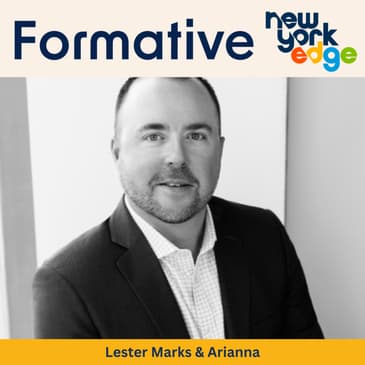

Lester Marks, VP of Strategy and Impact at the Mother Cabrini Health Foundation, joins middle schooler Ariana to share how his career took unexpected turns, from a love of sports and sports broadcasting to a path in government and nonprofit work.
Ariana learns from Lester why being prepared can open doors, how confidence grows over time, and why it’s important to speak up and take chances even when things feel uncertain. He also shares lessons about teamwork, owning mistakes, and finding balance while building a meaningful career.
Rachael: Welcome back to Formative, the podcast where today’s leaders are interviewed by the leaders of tomorrow. Today, our guest is Lester Marks. Lester is the VP of Strategy and Impact at the Mother Cabrini Health Foundation. Today, he talks to us about his career journey from an early interest in sports to a path in government and nonprofit work. He shares advice on being prepared and taking opportunities as they come, along with why it’s important to speak up and find balance in both work and life.
—
Rachael: Hello, and welcome. My name is Rachael Gazdick, and I’m your host and CEO of New York Edge. On every episode of Formative, a student from our after-school program joins me as co-host, and today I’m joined by Arianna from P.S. 122Q. Arianna, can you tell our audience a little bit about yourself?
Arianna: Hi, I’m Arianna, and I like writing stories and poems. I want to become a writer when I grow up, and I love animals. Today, I’m going to be interviewing Lester Marks, who is part of the Mother Cabrini Health Foundation.
Rachael: That’s awesome. All right, I think we’re ready to go talk to our guest.
Arianna: My first question is, when you were in middle school, what did you want to become?
Lester: When I was in middle school, I wanted to be shortstop for the New York Yankees. I grew up in the Bronx, and I was big into baseball at that point. Obviously, that did not pan out for a variety of reasons, but I wanted to be in sports. I was always watching sports, whether it was the Yankees, football on Sunday, or the Knicks.
It was something that was always on, and it was also a part of my childhood with my friends. We would always be playing or watching, and then I would obviously watch with my family and go to as many games as possible. So it was a huge piece of my childhood.
I think the other thing — and I knew probably at that point that maybe shortstop for the Yankees wasn’t a reality — I always thought and maybe wanted to go into some sort of broadcasting or sports talk radio and thought that could be a potential career path for me that would link my interest in sports and also provide a good career path for me.
Arianna: Was there a goal in mind when you were little?
Lester: A career goal?
Arianna: Like any goal in general.
Lester: Yeah, I mean, I always wanted to grow up and have a family. I came from a family of four total, so I had three siblings, and as somebody growing up, I wanted to replicate what we had. So that was always a goal.
And then, when I was younger, aside from the thought of going into broadcasting, I always just wanted to work hard, be successful, and successful is one of those things that is defined differently for a lot of people. Some people define that as being rich and famous. Others define it as finding a career that is fulfilling while also being able to provide for yourself and your family and have some of the things that you may want to do, like travel or buy certain things.
So I think from my perspective, that was my centering point. It was something that I have, throughout my career much later on, always tried to keep as that grounding point where you could always chase careers that might pay more or might be more lucrative, but you give up something on the other end where maybe you don’t have as much discretionary time or you may be highly stressed.
I think it’s trying to find that balance between something that’s fulfilling, something that’s able to support yourself, your family, whatever your situation is, and having that proper balance in your life.
Arianna: Yeah. So was there anyone you looked up to or who you still look up to now?
Lester: Yeah, I mean, there have been a number of people throughout the years. I’ve had coaches. I’ve looked up to my father, who worked and had a good, successful career and had a good balance.
There have always been teachers throughout my life who popped in at the right moment to give guidance, whether it was high school or later on in college or in some of my postgraduate work. There have always been folks who offered guidance and really showed the way.
What I’ve tried to do is model and take a little bit from this person and that person and continue to do that. It’s not something that I think you ever really stop doing.
Arianna: Okay. So is there any advice you would give someone? It doesn’t have to be very specific. It can be really anything.
Lester: Yeah, I think it’s work hard, right? And I always say that you can never overprepare. You don’t have to be the smartest person in the room, but if you walk into that room prepared, then you can feel confident and certainly succeed, whatever it is — whether it’s in the classroom, whether it’s in an internship, or whether it’s in a potential or eventual job.
So I think it’s working hard and being prepared.
I think the other piece is that what I’ve found, and what I’ve found for a lot of people that I know, is that careers aren’t linear. They are winding roads that sometimes you don’t think will ever end up where you are. Certainly, I didn’t think I would end up where I am if you would’ve asked me 20 years ago.
But I think I found through hard work and just showing up and being prepared that doors open up that you would never think would open up. It’s important to take those opportunities when they present themselves.
Arianna: Was there ever a time where you had the chance to take an opportunity that you just never did?
Lester: Yeah. I wanted to go to law school. I’ve always thought about going to law school. Right after college, I thought about it and studied, and I ended up not doing it. I didn’t do it because I was probably scared. There was this fear of failure, and it was something I put off.
I ended up putting it off for another 10 years and going back to school when I was much older. I think having done that earlier in my career, things could potentially have changed differently, and other opportunities would have probably presented themselves through my going to law school earlier.
So that’s something that sticks out to me.
Arianna: So how did you get into the industry that you are in now?
Lester: I’ll go back to college, where I was a communications major with the goal of maybe doing something in radio, sports broadcasting, or something similar. I did that. I went through it and got the degree. I did a couple internships. I interned at a radio station in New York City.
It was a really fun, enjoyable summer where we would go to concerts, do promotions, and I got to be in the studio with DJs and learn from them. It was incredible.
As soon as that summer ended, 9/11 happened. It was obviously an incredible moment and something that sparked my interest in politics. I got more interested in the how and the why — how could this happen?
That propelled me down a path into the political sphere. I took an internship for a congresswoman in Westchester, and I was toward the end of my studies. I was a junior or senior, so it was too late to change a degree or add one on, and communications is one of those degrees that is transferable.
I went down the path of politics and took a couple internships and really enjoyed it. From there, when I was 22, I got hooked into a local county legislator race in Rockland County through somebody who was working in the congresswoman’s office.
That person ended up winning the seat, and he hired me as his legislative aide. That’s how I went from communications and the path of sports broadcasting to entering politics.
Arianna: In your opinion, what makes a good team?
Lester: Yeah, I think playing sports throughout my life, I always say that regardless of how good you are, you don’t need to be the standout athlete or performer. But I think having a good team and knowing how to operate within a team, knowing your role, is really important.
Everybody plays a different role on a team. On some teams you have one role, and on another team you may have a different role. But I think it’s knowing your role and your contributions and your value.
Then it really is having that collaborative spirit. A lot of the work that I do at the Mother Cabrini Health Foundation involves working across three or four different teams, none of whom report to me, but I’m working with them all.
Bringing folks together to be collaborative and to have an exchange or a forum where everyone feels comfortable sharing thoughts and ideas is important when working with a team.
I would say the other thing is: do what you say you will do. There’s nothing worse than having a colleague or teammate who says they will do something and then ultimately doesn’t do it or has an excuse for why it doesn’t happen.
I think when you’re part of a team, it’s incredibly important to be reliable and know that if somebody assigns you something or asks you to do something, or you say you’ll do something, you’ll do it.
That inspires confidence with your teammates.
Arianna: What are some of the biggest challenges you’ve had to face so far?
Lester: I would say throughout the years, especially when I was younger, I always deferred or thought maybe my confidence level wasn’t where it should be.
I came into government and politics at a younger age. I was 22 or 23 when I first got started. There were a lot more older people, more experienced people, who were working on issues, and that was intimidating.
It took several years to get the experience and understanding of some of the key issues, but also the self-confidence to speak up, provide an opinion, and fill that space.
When I first entered those rooms, it didn’t feel comfortable or right to me at the time.
Have you ever experienced that?
Arianna: Yeah. Sometimes when I was little, I would always get scared to raise my hand in school because I thought I would be judged. But now, when I joined middle school, I’ve kind of grown to be confident. I feel like if I don’t voice my opinion, no one else will.
Lester: Right, and it’s similar. I always remember in school sitting there at times, and middle school was always tough. You didn’t want to raise your hand too much and stick out, but then you knew the answer, and you had good, real input that you wanted to share.
It was similar as the venues changed, but the feelings are always there. Being able to overcome that and conquer it is not just something that applies in the classroom. I think it will certainly translate into other environments as you move forward.
Rachael: Lester, are there any mistakes you made in your career, either recently or when you were starting out?
Lester: Yeah. I remember sending out a press release as a communications director that had incorrect information in it.
As somebody who’s the head of communications for an elected official, you strive to get those things right. We sent it out, and it was wrong, and I was embarrassed.
I remember contemplating what I should do. The only thing I could do was, one, admit it. The information was wrong. Own it and correct it.
It wasn’t a huge fatal issue, but I remember it vividly. It’s one of those things where whenever you make a mistake, there’s a lesson that can be applied.
Own it. It’s not somebody else’s fault. As soon as you can admit, “Yeah, I messed up. No problem. I will correct it and hopefully move on,” it minimizes the mistake.
Sometimes it’s not possible to minimize a mistake, and there are varying degrees of mistakes. But I think it’s sometimes less the mistake and more how you respond to it that is really the important part.
Too many times I’ve seen people not take ownership of something they should have. That’s a really important part of character. It’s important to take ownership of what you do, good, bad, or indifferent.
If you want the credit for when things are going well, you should be able to take the criticism or heat if something didn’t go well.
I would also say it’s important that we make mistakes. Finding the right employer, position, or organization that allows you some room for mistakes is probably a good environment.
I’ve seen offices and worked with elected officials where there was no room for error, and they went through staff pretty quickly because it was a high-intensity environment. That’s fine for some people, and people thrive in that, while others don’t.
But I also think it’s important that you find an opportunity in an organization where you’re encouraged to take a little risk. If you take a little risk, sometimes mistakes will happen and things may not go 100%, but it’s a learning experience throughout your career.
Rachael: So our last question: if you could go back and speak to your 13-year-old self, what would you say?
Lester: In middle school, most of you will not know what career path you want, and you shouldn’t. Some people do, and they pursue it, and that’s great.
But as you enter middle school and then high school, you’ve got to explore. You’ve got to try different things out.
You have to be willing to do any job that’s given to you. It may be a small job. It may be going to grab copies or hand out flyers, which is simple but important for whoever’s asking you to do it.
Knowing that you can do it efficiently and that you’ll get the job done will lead to the next task they give you.
I think being able to jump in and understanding that no job is beneath you is important. You’re going to have to start at the bottom, as they say, and work your way up through hard work.
The other piece is trying to explore and find the right thing that makes you happy. You’re not going to get it the first time. Maybe you won’t get it the second time.
But through trying a variety of different things, you’ll get there, because you never know when that next opportunity will come by doing a good job on something somebody gives you.
Rachael: That’s really good advice. Thanks so much for joining us.
Lester: All right. Thank you, Arianna. Thank you so much. Good luck with everything.
CREDITS
Thanks for listening to Formative, a production of New York Edge. I’m your host, Rachael Gazdick. Our production partner for this series is CitizenRacecar. This episode was produced by Hajar Eldaas, post-production by Alex Brouwer, original music by Garrett Tiedemann. Thanks to the whole team at New York Edge for making this series possible. Never miss an episode by subscribing to the series at newyorkedge.org/formative or wherever you get your podcasts.