
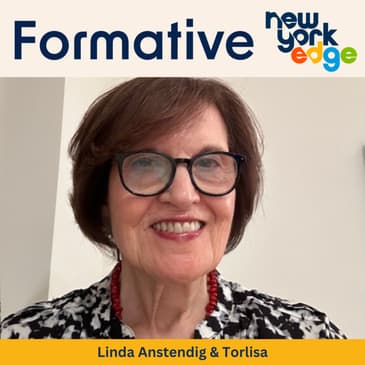
Linda Anstendig, former English professor at Pace University, joins middle schooler Torlisa to talk about the joys of learning and teaching. Torlisa comes into the conversation admitting that English has always been her least favorite subject, but Linda shows her how reaching out to a teacher for guidance can really change the way you learn. Linda also shares why pursuing an English major is a worthy choice, how she learned to become more assertive, and she tells the story of a powerful student experience that stuck with her.
Downloadable transcript here
Rachael: Welcome to a new episode of Formative, the podcast where today’s leaders are interviewed by the leaders of tomorrow. Today, our guest is Linda Anstendig. Linda is a former English professor at Pace University. Currently, she is a volunteer educator at a lifelong learning program. Linda tells us about the importance of English majors, her passion for French, and a student who changed her perspective for the better.
Hello and welcome. My name is Rachael Gazdick, and I’m your host and CEO of New York Edge. On every episode of Formative, a student from our afterschool program joins me as co-host. Today, we’ve got Torlisa from I.S. 522K. Torlisa, can you tell our audience a little bit about yourself?
Torlisa: Well, I’m a seventh grader, and, um, my favorite hobbies are listening to music and playing sports.
My favorite subject is social studies, and I wouldn’t say my least favorite subject, but a subject that doesn’t stand out to me the most is ELA.
Rachael: Okay. So I’m sure we’re going to have a lot to discuss with our guest then.
But before we go do that, we want to remind our listeners that you can support us by making a donation at newyorkedge.org/donate. It would be very much appreciated.
Rachael: Linda, welcome to Formative.
Linda: Oh, it’s a pleasure to be here. Looking forward to our conversation.
Rachael: Torlisa, what’s your first question for Linda?
Torlisa: My first question is, when did you realize you wanted to be a teacher?
Linda: I always loved learning and I always loved being a student, but I didn’t go to college thinking I was going to be a teacher. I went to college—actually, I wanted to major in French, of all things. I had a wonderful teacher in high school, and then I wanted to go to France, and there was a program called The Experiment in International Living. I tried to get my parents to support me, but they just didn’t think I was ready to travel abroad by myself, and I didn’t have the money or the gumption to try to do it on my own.
I loved my American literature professor, so I ended up majoring in English, but I graduated from college and I got married right away. And my husband and I lived in Boston, and he was in school and I was working, and I didn’t like my job very much. I worked for the Automobile Association. I tried to get into publishing, and I couldn’t get a job, so I worked for the Automobile Association. So then I decided, gee, I have to think about what kind of career I could really do, and I had two choices. I was thinking of maybe going to school for library science to be a librarian, or there was a program where I could take some English classes and also get an education degree. I just decided to do that, but I loved it. I loved the school, I loved the education classes, and I liked my student teaching, so I just—I became a high school English teacher. But I, um, I lasted two years because I got pregnant.
You know, in my generation, a lot of women in my generation—very traditional—we were expected to get married right away. So I had two children pretty quickly, and I worked part time. I started working with kids with learning disabilities. I worked as a reading specialist, and I really loved being with students.
It really wasn’t until my kids were teenagers that I decided I wanted to try…and it’s funny because when I was in college, I loved the atmosphere, and I said, gee, maybe I would marry a professor one day. I didn’t see that I could become a professor, which is the way it was in those days. So it took me a while.
I was 40 years old when I really went back for an advanced degree, and I just really was—I feel so grateful because I did have a career that I loved, but I came to it late.
Rachael: Wow, that’s really cool. Um, a lot of people could be great at reading literature or writing, but that doesn’t always mean they can teach. What skills do you think someone should have before deciding to go into education?
Linda: That’s a good question. Uh, I think, well, obviously you have to love being in a classroom. I think that’s really important.
And I think instead of trying to think that you’re going to impose or pour knowledge into somebody, to really try to realize that learning is hard. There’s sort of this equilibrium that comes with learning. You know, I think you have to really appreciate where somebody is starting from, and even in a whole class you’re going to have people at different stages. And being able to be sensitive to using different modalities, because some people do better by reading something, some have to listen, some have to do both, some have to write. You have to be sensitive to the learning process and appreciate that not everybody is going to learn at the exact same time and be motivated, because, you know, a teacher can make such a big difference in a student’s life. It could be a turnoff or a turn-on to learning.
Rachael: Can you tell us about a specific challenge you faced in your career and how you managed to overcome it?
Linda: Well, a few things come to mind, but one thing was, as I was teaching, I took on some leadership roles. I became director of faculty training, so helping faculty teach better, and also director of the writing program, and then associate dean.
One of the things I think really had to learn, the hardest thing for me was being assertive and being able to deal with conflict. I was somebody who always wanted to make nice, and whether it was students having problems with their teachers, professors having problems with other professors, or professors having problems with administration, you know, being able to really resolve conflicts.
But for me, it was really asserting…if I saw something that was really wrong. I actually read some books and went to some workshops on conflict resolution, and it took me a while. I was probably about 50 when I really started being able to be assertive and be a better leader and be able to confront conflict.
Torlisa: Oh. Have you ever had a student that influenced your life?
Linda: Yes. Yeah. And some I still am in touch with. So I had a student—I think it was a survey of literature class—and he was somebody who sort of disappeared in the class, and all of a sudden he literally disappeared, and we didn’t know why.
Six months later, he came back, and he had become blind suddenly. He had one of these diseases that just completely—within six months—he was basically almost blind. Well, he became a star student. I really, um, had such respect for him. There was something about the way that he developed, both in terms of being a student and leadership qualities. He actually became a high school English teacher.
But, you know, I think there are students who are late bloomers. Very often, I find that they come their freshman year and they’re really not sure what they’re doing there. Their parents expected them to go, but they just are not connected to their learning.
You know, sometimes it really takes either taking a gap year or coming back. Sometimes I’ve been able to turn students on to English and learning, but it doesn’t always work.
Rachael: Wow, that’s an amazing story. Um, if you had to make a case for why an English degree is a worthy pursuit, what would you say?
Linda: I would say that, similar to history, but I think even with English, by reading literature and learning how to analyze it and reading widely, you learn so much about what it means to be human. I think you gain empathy, and I think you gain critical thinking skills that, no matter what career you’re in, you can apply.
I think the skills you learn are very transferable. People think it’s not practical—you have to be a business major or a computer science major—but I think you get a much broader perspective, not only empathy, but an open mind. Your mind is opened up, I think, by reading about people who have all different kinds of experiences and struggles in life. So I think it’s a wonderful major.
Torlisa: What advice would you give me as a seventh grader, having ELA class every single day, um, to stay on track and keep my grades from slipping?
Linda: Ah. So you said that was your least favorite subject, right? Can you just tell me what it is about? Before I answer your question, I have a question for you.
Torlisa: Well, it’s not that I don’t like ELA. I just feel that it’s not something that I like so much.
Um, something that I don’t like about it is when we have to do essays and apply multiple-choice frameworks and write short responses and long responses and homework. I feel like in ELA I do good, but I need to do better.
Um, something that I kind of lack in is homework, because it’s, like, a lot, and I feel like I need to stay on top of that and make sure my grades don’t slip.
Linda: Yeah. So it’s really challenging. Do you like to read?
Torlisa: Yes, I like to read.
Linda: And are you able to talk with your teacher when you feel that you’re not maybe doing as well as you can be? I always, um, really liked it when my students would talk to me and say, “How could I do better?” or “I need a little help with this.” Are there opportunities for you to do that in your school?
Torlisa: I’m able to talk, to communicate with my ELA teacher.
Linda: Uh-huh, uh-huh.
Torilisa: Her name is Ms. Gale. It’s really easy to communicate with Ms. Gale because she’s a very nice person, and she understands my point of view.
Linda: Well, that sounds terrific. I think that’s really a key aspect to doing well, to be able to have the support. You know, obviously do your work and stay up to date with it and practice as much as you can.
Do you like to write?
Torlisa: I like to write. The part that I enjoy the most is when I’m free writing or reflecting, because it allows me to look back and look at things that I went wrong—or did wrong—or need help in, or just overall did good in.
When I free write, I don’t have to look back in the text and cite evidence. I can just do it based on me, and I form more questions in my mind and just write more.
Linda: You know, writing is a craft, and as a very famous writer said, the best part of writing—the most delicious part—is rewriting. Even when I’m writing an email or a memo to somebody, I always try to read it over out loud. And, you know, it’s all about practicing writing as much as you can and reading, because if you read, you really get a handle on the language and the way that good writers make their arguments. So I would say that that’s my best advice for you.
Torlisa: Okay. So you said you like reading.
Linda: I do.
Torlisa: And you like writing.
Linda: I do.
Torlisa: What would you say is your favorite book?
Linda: Oh my gosh, that is so hard. So reading is my passion.
When I was probably about your age, I picked up a book by a writer named Willa Cather, and it’s called My Ántonia. It was about a young girl, probably 13 or 14, who was an immigrant from what I guess would now be Romania, and she lived in the Midwest. It just grabbed me for some reason. It was in a place that I didn’t know about. She was very poor and lived almost like in a hole in the ground, but there was something about her resilience, her grit, and the beauty of the landscape that just grabbed me.
So I guess that has remained one of my favorite books, and I think of it because it was one of the first books that really turned me on to reading and literature.
And I love contemporary fiction, too.
Rachael: Our last question is one we ask everyone. Torlisa here is 12, so we were wondering if you could go back and talk to your 12-year-old self, what would you say?
Linda: Oh boy, yes. I’d say to myself, it’s really worth pursuing your dream and not giving up, and trying to have as many experiences, both in your learning and outside, to develop interests that you can have for your whole life.
Um, some things I came to late to, but definitely develop that resilience and that grit. Because everybody has things that get you down or challenges. As you said, you’re not doing as well in something as you’d like to, but you’ve got to believe in yourself. I think that’s really important.
Rachael: Thank you so much. That was wonderful.
Linda: Oh, I loved it. I loved it. Good luck to you, Torlisa. I can tell, I’m confident that you’re a really good student, and you’re going to do really well.
CREDITS
Thanks for listening to Formative, a production of New York Edge. I’m your host, Rachael Gazdick. Our production partner for this series is CitizenRacecar. This episode was produced by Hajar Eldaas, post-production by Alex Brouwer, original music by Garrett Tiedemann. Thanks to the whole team at New York Edge for making this series possible. Never miss an episode by subscribing to the series at newyorkedge.org/formative or wherever you get your podcasts.