

Rachael: Welcome back to Formative, the show where today's leaders are interviewed by the leaders of tomorrow.
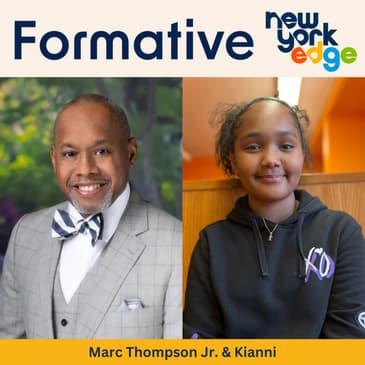
On the show today with us, we have Marc Thompson Jr. Marc is the proud owner-operator of a Chick-fil-A in Queens. In this episode, we talk to Marc about the pros and cons of entrepreneurship and the power of bringing your best self to work every day. We're looking forward to chatting with Marc today.
Rachael: Hello and welcome. I'm Rachael Gazdick, CEO of New York Edge, and my co-host today is Kianni from I.S. 318K. Kianni, do you want to introduce yourself to our listeners?
Kianni: Hi, I am Kianni. I'm an eighth grader at I.S. 318, and I've been a dancer for six years and a cheerleader for three.
Rachael: Oh, that's great. Kianni, who are we talking to today?
Kianni: We're gonna be talking to Marc Thompson Jr.
Rachael: Fabulous. Well, Marc, welcome to our show.
Marc: Thank you so much for having me.
Rachael: So Kianni, what's your first question for Marc?
Kianni: Okay. So what's your favorite thing about your job?
Marc: My most favorite thing about what I get to do every day is that I get to create jobs in the community that I grew up in. It is my job to help create opportunities in my community for young people and not so young people to have their, you know, there's a phrase that Dr. Steven [inaudible] used to use, talked about having the right ladder up against the right wall. And so I believe this business represents the right ladder up against the right wall to help young people and not so young people climb further and faster to achieve their economic and life dreams by working with me. And outside of this sphere, I think it's the same thing. As a leader, my job is to help people discover and develop and deploy what I call their dominion gift, the thing that differentiates them in the marketplace of ideas. And so working here, I try to help people figure it out. And I tell them, this isn't the place to stay or stop. This is a place to develop and grow so you can go into a future that you can be proud of.
Kianni: Can you tell me why does it mean so much for you to employ people in your community?
Marc: Yeah. You know, I think fundamentally America, when it was a manufacturing business, we had, or we, we, we had lots of manufacturing jobs, you had a stronger working class that could rise and get to middle class, upper middle class. Having exported so much of our manufacturing business, we're more of a service economy now, and you don't have a lot of young people, and particularly young black men, that get customer facing opportunities. And so I see one of the ways that we can help shift the economic realities in urban settings is by giving work. And giving work is the thing that helps people develop their potential so that they can improve their economics, improve their lives, and grow, go from where they were to where they want to be over time.
Now the challenge is social media makes young people think they can go from broke to billionaire overnight, and it creates unreasonable expectations and it doesn't give them some of the resilience they need to actually work a day-to-day job and achieve the kind of skill development and maturation they need to be successful long term. And so that's one of the headwinds I face as I try to create jobs in my community.
But I think the history of the world says I'm going to win, because more, more often than not, people are going to want to do what they need to do to achieve what it is they say they want to achieve.
Kianni: That is truly amazing and we're very lucky to have such a great manager and I'm happy I've had this opportunity to talk to such, such a great person like you.
Marc: Oh, thank you Kianni. I appreciate that.
Rachael: You know, speaking to younger people, I've also noticed that, um, many want to be entrepreneurs, which is great. But there seems to be this illusion that to be successful, you have to be the boss or it's beneath you to work for someone else. What would you say to that? And, like, what kind of advice would you give to young people?
Marc: So, let me say this, that being your own boss is a lie, right? They tell you start your own business and you're gonna be your own boss. That is false. I was in corporate America working in a Fortune 10 company and I had, call it one solid line, one dotted line manager that I reported to. I leave corporate America and I become an entrepreneur, and now I have daily north of 1,250 bosses because every transaction is somebody giving me feedback on my performance. You have less freedom because more people get to tell you what to do, but you have more autonomy. Nobody sets my schedule. I set my own schedule. I decide where I am and I decide what I do. But I have a lot more people giving me feedback now that I'm an entrepreneur running my own business than I ever did in corporate America.
So that's one. Two, the idea that you can just graduate high school, graduate college, graduate from graduate school, and run your own business is deceptive. Because you may have the information, but you don't necessarily have the muscle memory, you don't have the skills, you don't have the networks, you don't have the thinking 'cause…
So I was an executive in a Fortune 10 company and I went back to school because I knew how to be an excellent employee but there are things that employees see and care about that are not of the same caliber of what a business owner cares about. And so I needed to elevate and level up my thinking. I knew how to run a finance department, I knew how to run a finance division. But I had never been responsible for payroll. And until you are responsible for payroll, you, you don't really understand how important all the pieces, everything affecting everything else really is. I had all the skills that I had developed throughout my 25 year career in corporate America, and then I was able to bring all of that into this space, and so I had a nice inventory of skills and capability. Fresh outta school, you don't have that inventory of capabilities.
Rachael: For a lot of teenagers, their first job will be a service job. And I know a lot of teens may take their first job a little bit for granted. So what, what is some advice that you would give a teenager entering the workforce?
Marc: Yeah, so obviously when you enter the workforce in the quick service space, retail space, customer service space, you are entering at one of the lower rungs of the ladder, right? And what, what you wanna do, whether it's quick service or accounting or basketball or music or dance or art, what you wanna do is you want to show respect for the craft that you're in. And the reason you wanna show respect for it is because it is the source of a paycheck, right? And so you wanna show respect for the person that is paying you, that you're giving your best.
But then you also wanna show respect for yourself. And this is something I tell my team, right? That my last name is Thompson. You don't know any other Thompson other than me. So I am representing my whole family to you, my grandparents, my great-grandparents, my, my mother, my father, my siblings. I am representing the Thompson brand to you. And whatever I am and however I show up, that is what you think my family is. So care about how you represent your family name in your job, because whatever your last name is that is you representing the whole family in the marketplace at that time, and I just want young people to understand that it matters. Your last name is more important than any title you will ever have, and the quality of you and your work represents way more than you may appreciate now. But I want you to start thinking about it because it is really important how you carry yourself in the marketplace and how you represent your last name.
Kianni: I didn't know that Chick-fil-A was like a small, kind of a small business and owned by one person. Can you tell me how does it go and how does your job work?
Marc: I really appreciate you giving me the opportunity to clarify for lots of listeners.
Your local quick service owned and operated store is a small business. It has a major corporation behind it for function and form and structure. But the day-to-day decisions operationally are made by the owner-operator. The people are employed, they're an employee of my business, not Chick-fil-A. The paychecks are the paychecks that I create for them. I determine their hours, I determine their salaries. So it's, it's a small business connected to a big brand. And so all the challenges of a mom and pop, but some of the help of a big corporation. That's how I would describe it.
Kianni: Wow. Also talking about that, what is a crazy or memorable interaction you've had with a customer or your workers at Chick-fil-A good or bad?
Marc: So fortunately I have lots of very good interactions with my team members and customers 'cause the community loves the brand, they love the product. But I have had some, we'll call them special interactions with some customers. There was one time I had a customer who, for whatever reason, thought that I could give them a refund on a credit card that they had shut down, and she spent more than one hour in my store berating me and being unpleasant because she couldn't get done what she wanted to get done. And she told me she wouldn't leave my store until she got it. I offered her the money in her hand. She did not want the money in cash, and so she stayed a very long time making a lot of noise, but she was not reasonable in that, in that experience.
Rachael: Marc, since you have a lot of experience in customer service, what are some tips you have for dealing with, uh, difficult people?
Marc: Yeah, the most important thing is that you keep the main thing, the main thing, and you never let your personal behavior become part of the conversation, right? So, um, in my experience, people have lots of times where they feel unseen, unheard, and they don't feel powerful. And so it is in quick service retail experiences where people really try to exert their power and their presence and they wanna feel very significant and so they can be very demeaning to other people. And so you just have to make sure you understand who you are, what you are doing, and you wanna make sure, especially me as the owner of the business, I set a good example for the team members and the rest of the community that they don't see me allow myself to become distracted by somebody else's behavior.
Rachael: I agree. I always say that everyone in their lifetime should do some sort of customer service job.
Marc: You know, it's so funny you say that because the last couple of weeks, if you look at the Wall Street Journal, they're talking about how lots of CEOs on their journeys to the pinnacle of their careers have made stops in quick service, fast food, retail, customer service facing jobs. And I think there's three main reasons: You develop people skills, you develop decision making skills, and you develop communication skills. And those three things, people, skills, decision making and communication are transferable skills you can take anywhere at any time and they will pay you dividends.
Kianni: Um, talking about the role you have to, at your job and to your coworkers, do you ever regret not saying something to a customer, but to your workers when you have first started that now you wish you could have said different or put in a different way?
Marc: Oh, for sure. One of the things, Kianni, about communication is you'll always get better and you'll always find more of language. One of the things I encourage you to do as an eighth grader, uh, a mentor taught me this, I was much older than the eighth grade when I learned this. I wish I would've learned it in the eighth grade, but readers are leaders and one of the things about reading that's so important is it gives you vocabulary and it teaches you how to say things. And so the more you read, the more command over the English language you have, the more vocabulary you have, the better you can articulate your ideas.
And so I'm sure there's countless times in the 25 months I've been running the business that if I replayed the tapes, there's a better way to have said something I said in the moment. But that's something you are always working on, your communication and your articulation of your ideas.
Kianni: So I'm in middle school, so can you tell me how were you in middle school?
Marc: Uh, I was in junior high school, I.S. 8. It was in Intermediate School 8. And my favorite subject was Spanish, so I was an A student in Spanish, but I was…If I'm being honest, I was a very undisciplined eighth grader. I had a very strong relationship with the Dean's office because I got in trouble a lot and I probably caused my parents more agita than they deserved, just because…As Biggie says, I might have been the stereotype of the black male, misunderstood, or I was just cantankerous and undisciplined. Depends on how, depends on how you wanna take it.
Kianni: Wow.
Marc: So what is your favorite subject as an eighth grader?
Kianni: Um, my favorite subject has been math, and it's always been math.
Marc: Always. So what are we, what are we anticipating? Because loving math is not something a lot of eighth graders do. So what are we thinking about for math in our future?
Kianni: So many people always tell me that, especially my older brother and my parents, that I won't stick with math. But even in eighth grade, I'm doing AP, which is like ninth grade, which is…
Marc: [claps]
Kianni: Thank you! Which is pre-algebra. And at first I didn't understand it. I've never been like, I'll say, since seventh grade, the best at math. But I always try my hardest and I hope that in the future it'll stay my favorite subject.'cause I've always just been great and since math is like a visual subject and I'm such a visual learner, I think it's just always been easier for me to understand.
Marc: Now you said something that was very interesting. How did you come to understand yourself as a visual learner? That's pretty mature for an eighth grader.
Kianni: So ever since I was younger, I wasn't the best at kind of, when people are talking to me, focusing. So I've learned many different kind of tiny things, like fidgeting and not trying to make noise and try to focus, especially looking at people in their eyes, but not in a creepy way.
So when usually I'm at school and we're taking notes, I'm not the best artist, I've never really been an artist. So I just try to make things where it's appealing and cute to me, and so that will make me wanna go back and actually understand what's happening and what's going on.
Marc: Kianni, I wanna, I wanna applaud you on developing the skills you need to achieve in the academic world because those traits and qualities are very good indicators of how you'll show up in the marketplace, that you will figure out ways to figure it out and get it done and excel. So kudos to you as an eighth grader figuring out how to make things work for you. That's really, really impressive.
Kianni: Thank you.
Marc: Yeah.
Kianni: Talking about when you were a kid, is Chick-fil-A your favorite fast food now? And when you were a kid, was it your favorite fast food, or what was your favorite fast food?
Marc: So Chick-fil-A has been in New York City less than 15 years. And so growing up, Chick-fil-A wasn't available for me. I would only have Chick-fil-A when I went south to visit my grandmother in Florida, or my grandparents in Texas, or family in North Carolina. That, that would be my only opportunities to have Chick-fil-A. But obviously now that I have joined the ranks of Chick-fil-A owner-operator, it is absolutely the only quick service restaurant I spend money in at any time. I tell my family they are spending money with the enemy anytime they buy food, any place else. And I, I love our brand. I love what we do, and I think we are the best in not just the customer service, but our product. We serve the best food.
But growing up, I have to admit, the golden arches is a place I frequented a lot.
Rachael: All right. Well, Marc, the last question we ask everyone is if you could go back and speak to yourself at the age of 13, what would you say?
Marc: So there's three things I would tell my 13-year-old self, and I mean this with all sincerity: stick with Spanish because knowing multiple languages is going to be a competitive advantage when you get older. Get a passport early so that you could travel and see more of the world so that you could have a better appreciation for culture and people and language. And third is, believe in your dream. Believe in your dream. There's gonna be a lot of people, Kianni, that may be around you that don't support you in your dream, but you have to believe in your dream when nobody else does, so believe in your dream. It is possible because dreams do come true.
Rachael: Amazing. Thank you so much. This has been such a pleasure.
Marc: Well, it was my pleasure. Thank you guys so much for the opportunity to share with my friends at New York Edge and Formative. I appreciate it so much.
CREDITS
Thanks for listening to Formative, a production of New York Edge. I’m your host, Rachael Gazdick. Our production partner for this series is CitizenRacecar. This episode was produced by Hajar Eldaas, post-production by Alex Brouwer, production management by Gabriela Montequin, original music by Garrett Tiedemann. Thanks to the whole team at New York Edge for making this series possible. Never miss an episode by subscribing to the series at newyorkedge.org/formative or wherever you get your podcasts.