
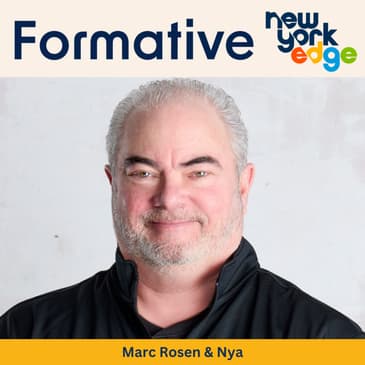

Marc Rosen, Senior Director of Corporate Sales & Concierge Services at FreshDirect, joins middle schooler Nya for a lively chat about what it takes to thrive in sales. Marc opens up about the skills that have shaped his career, what keeps his ambition burning, and the one thing he wishes he could do over. Tune in for an inspiring conversation about growth, goals, and getting better every day.
Rachael: Welcome back to Formative. On the show today we're joined by Marc Rosen, Senior Director of Corporate Sales and Concierge Services at Fresh Direct. In our conversation, he shares the key skills that have helped him succeed in sales, what drives his ambition, and the one thing he'd go back and do differently. We're so thrilled to get to know Marc better.
Rachael: Hello and welcome. I'm Rachael Gazdick, CEO of New York Edge, and my co-host today is Nya from M.S. 452K. Nya, do you wanna tell us a little bit about who you are?
Nya: Hi, I'm Nya. Something about myself is that I’m in the sixth grade, 11 years old. I really like the sport, cheer. And I'm very excited that I get, I am on this episode today.
Rachael: Awesome. And who are we speaking with today?
Nya: We are here speaking with Marc Rosen.
Rachael: Marc, welcome to Formative.
Marc: Oh, what a pleasure to be speaking with both of you. Thank you so much for having me.
Rachael: Thanks for joining us. So, Nya, what's your first question for Marc?
Nya: My first question for you is, was this the first thing you wanted to do? Like, was this a career you wanted since a child?
Marc: When I grew up, I played hockey since I was six years old. It was what I loved. Uh, so, huh. All along I had the dream of becoming a professional hockey player and my father kept telling me, if you work hard at it and you commit yourself and you give it all you got, you probably, you know, will have a shot but it's a small shot because there's only a small percentage of people that make it there. But I was pretty good in my day. I made a lot of all-star teams and won some state championships and national championships and really thought I had a shot. But when I went to college to play hockey, I went to college for an education, but also to play hockey. And I ended up getting hurt, I blew out my knee and that was pretty much the end of that.
So, unfortunately going into sales and sales management was never in my, kind of, my lens when I was younger, but quite frankly, I'm really glad it worked out. It's, it's really been a blessing.
Nya: Can you tell us a little bit about your career and how you started sales and customer care?
Marc: Great question, thank you. So first of all, my first job out of college was to be a salesperson. I had the opportunity and figured I'd give it a shot. I lived at home with my parents at the time, so it was kind of easy for me to take a chance. But honestly, I didn't go to college for sales.
So I'll take you back a little bit. My father owned his own store and his store was basically a repair shop. Back in the day, people didn't just buy new things all the time. They repaired their handbags, their luggage, their jackets, their zippers. And so, I used to go to work with my dad when I was a kid. My father taught me how to deal with the customer. My father always told me customer first, and so I always watched him when a customer would come into his store and ask questions and need a price. Watching how my dad interacted with the customer and with the people really taught me a lot 'cause ultimately what he was doing was trying to explain to them why they should repair their bag and it would be better than buying a new one, and the bag would be better than it ever was. And so that taught me a little bit how to sell, working with my dad and seeing him own his own place. And when we went to the flea market, we owned our own space. And so I really wanted to be a manager. I wanted to be a leader. I wanted to be an owner. And that's kind of, uh, outside of my sports that really helped my current and my past career path was to learn about all that stuff.
And so, yeah, you know, again, I knew sports was a, a stretch and a reach. It might not be a pro, so I needed to have something else, and that's what it was.
Nya: That's amazing. Now, what is some skills that you think are important to have in customer care and sales?
Marc: I love that question. I have a small team here at Fresh Direct and these are the things I speak with them about and try to help them with and educate them on, only because I've got over 30 years experience doing what I'm doing so I've learned from my mistakes. Um, and by the way, that's one of them. It's okay to make mistakes. So whether you're in school or whether it's with your family or whether you're at work, it's okay to make mistakes, we're all human beings. It's how you handle the mistakes. I kind of have a saying, my family laughs at me when I say it: Life is not about what happens to you, it's what you do about what happens to you that counts. And so when I make mistakes or people make mistakes, it's how do you deal with it? How do you avoid it in the future? How do you overcome it? So that's one of the things.
But I think probably the biggest thing, Nya, is thinking of the customer first. You know, sometimes people think of salespeople as just trying to take their money and trying to sell them something they don't need. And there's no doubt there are some industries that are like that, that all they care about is just how to get your business but not really take care of you. I think one of the greatest attributes of a great salesperson is someone who is more consultive than selling, and caring about who they're speaking to, understanding what they're doing, what's working well for them, where are their pain points, and then ultimately, how can we help them be better tomorrow than they were yesterday by working with us. Love when customers tell me that I've taken great care of them, that tells me I've done my job because it was about them first, Nya. I can't help myself and my company until I help the customer. And if I'm helping the customer and they're giving us more business, then I can help myself and help the business. But it's always customer first, and if you start there, I think you usually end up winning.
Nya: Now another question would be, as someone who worked in customer care for many years, how do you deal with bad customers or just, like, very like non-okay situations.
Marc: Again, I mean I…Maybe I sound like a broken record, Nya, but I love that question. Um, because I do that occasionally and, and listen, you know, we have a very strong customer retention because of the products and the service that we told you we try to provide is really to be the best we can be. So overall, our loyalty, our brand, our customer awareness.
Most customers are prospects, people who aren't customers, and we say we're calling from Fresh Direct, it's so amazing to hear them say, oh, Fresh Direct, I know you. So people know Fresh Direct. People love Fresh Direct, but because we deal with thousands, hundreds of thousands of consumers, we can't make everybody happy all the time. We try, we really do try to be perfect, but we know we're not. And so when we're not and these situations come up and you get the customer who we've really disappointed, the customer who we've really let down, um, some people run from those situations, Nya, I embrace them. Those are the people who are crying out for help. Maybe they're really upset, maybe they're kind of raising their voice a little bit. But I've learned throughout my career, again it's all these years of experience, that you have to be sympathetic. You have to be understanding. You have to be apologetic. You have to listen to them to understand exactly what's happening, and then at the end of the day, my job is to do all things I just said and show them how we won't let that happen again. Show them how I'm going to make sure this won't happen to you. Show them how I'm gonna get a credit in your account, which not only says we're sorry, but shows you we're sorry. I'll waive your entire order charge if I have to, if we really drop the ball. Um, if they don't want the credit, but they need the product, get it to them right away, sometimes it's the same day.
It's hearing them, understanding to them, apologizing, being sympathetic, but eventually turning it to how do I fix this? And by the way, isn't that what life is all about? You can't always make your friends happy. You can't always make your family happy, whether it's your immediate family or your relatives. Sometimes you have to work through difficult situations and it's being calm, it's being patient, and it's truly trying to find a way where, again, everybody wins.
Nya: Now after what you said about the mistake, what was the biggest mistake you've made and how did you fix that?
Marc: Oh boy. We're gonna probably need another hour or two to go through that.
Nya: Um, you can shorten it down if you need to.
Marc: I'm only kidding. You know, I think the biggest mistake that I made is actually going back to my hockey. So, you know, I'm pretty humble. This may not come across that way, but I was always pretty good. As I said earlier, I was on All Star teams. I won national championships, state championships. I was always the first string goalie, or at least most of the time, so I was never cut, like, things just kind of came naturally to me. My father was an athlete, so it came to me. And so, for better or for worse, a lot of my success when I was younger was because I was good to really good, but I didn't really put my best foot forward to work harder, to get in better shape, to do exercising and practice at home, to do things that would've helped me become better, because it just came so easy. So I just sometimes went through the motions. And I was still good, but I really believe, I look back and say, if I would've given it more effort, more time, more focus, more commitment then I would've been better and who knows where I would've ended up. So that lesson, to me, lasts with me, whether it's at work or with family, is always trying to be the best I can be and not looking back and saying, oh shoot, I should have. I like to try to get things done in advance as best I can.
Nya: And speaking of your work ethic, what's a couple things that motivates you every day in your work?
Marc: Okay, I'll start with the first one that comes to mind. I love sports. I played all sports when I was a kid. I played hockey, I played soccer, I played baseball, O played intramural football. But being an athlete is also kind of being a competitor. And when you're a competitor, whether it's in sports or at work, you wanna win, you wanna be successful. In every career and in every industry there's different definitions of winning and success, um.
And so the first one for me is just knowing, this may sound corny, but knowing for me that I come to work every day and the person that I work for appreciates what I do every day, how I do it, because I'm a pretty loyal, passionate guy. I am with Fresh Direct for 17 years, and so I give it all I got. I give it all I got for the customer, but if I do that and I win, then the company sees the success from that. So that's the number one thing that truly motivates me, Nya.
Certainly having a good compensation to take care of myself and my family, I have two children. I was very fortunate enough when I was younger to be able to buy a home that, you know, has a basement and a backyard and private property, and that was one of the happiest days of my life when I saw the look on my kids' faces that they were moving into this house that they had all this great space in. And so compensation matters. That's what rewards you for the job you do, but you don't get rewarded for the job you do until you do it well and you win.
And I think the last thing that really motivates me is the people I work with, my colleagues, my teammates, my coworkers. I feel like building strong relationships, to be comfortable going to work, to enjoy who you work for, who you work with, to, to work together towards a common bond and a common mission. It's probably like when you're in a classroom and you're working with three or four people at a table on a project, you have to work together. You can't fight, you gotta figure it out. When you disagree, that's okay. But how do we figure out what is the plan and who's gonna do what to win? I love putting all that together with people I work for. That's another way to win and be successful, is to constantly think about how we can be better and how we can do things better, whether it's on our tech side, whether it's on our product side, whether it's on our service side, whether it's my sales team side or my customer service team.
So those are the things that motivate me. Being successful and having people appreciate what I do, definitely making money so I can take care of my family because that makes me feel good, and having great relationships at work. You know, you don't get along with everybody all the time, but I do with most, and it's really one of the things I love about where I work. I love working with the people I do 'cause everybody kind of has the same goal in mind, is how do we provide the best product and service for our customer and our business.
Rachael: So Marc, we always end our show with the same question. And I know you hinted at it earlier, but if you could go back and speak to yourself at 11 years old, what would you tell yourself?
Marc: As a dad, you know, you want to try to help your children be the best they can be in life. And many times my kids are like, dad, stop, you know, I don't need to hear it, I'm good. It doesn't stop me from trying my best to be a great dad and, and teach them from my experience. And so that experience that I told you about, Nya, where I was good, it was kind of a natural skill I had in sports and hockey, um, and even to some degree in baseball. Like I was good. I was just a natural athlete, but I just didn't, I didn't go the extra mile. I didn't run on my own. I didn't stretch on my own. I didn't practice on my own. Like when I went skating with my friends, I would just skate around with them leisurely rather than occasionally, like, you know, try to skate fast, try to practice my techniques, do everything I could do constantly to be the best I can be.
So, Nya, whether that's in school with your studying, by the way, I was a good student. I wasn't a great student, I was good, probably B, B+, had some A's here or there, probably had some C's along the way, but I probably didn't study as hard as I should have because it was okay to be okay. And as I got older, it's not okay to be okay. It's okay. But to be better, to be great is what I think we should all strive to be. And if you strive to be great and successful in whatever you do, whether it's in school or with your friends, or your sports, or your extracurricular activities, if it's playing an instrument, practice, practice, practice, work on it, study it, and try to be the best you can be. Because at the end of the day, you'll never look back and say, I wish I would've done that differently or I wish I would've done that better. And that's easier said than done. For all of us in life, it's not always easy to be the best you can be at everything all the time, but the more you think about that in the most important things in life, just do it. Just give it all you got. Spend an extra hour studying, spend an extra hour practicing. Do whatever you can do to be the best you can be. And to me that's, that's the biggest thing in life that I look back and wish I would've done it different, but it was too late. The good news for me is I was able to figure that out and apply some of that to my work experience and some of that to my family experience as well.
Rachael: Oh, thanks so much. It's been such a pleasure getting to hear your story.
Marc: Thank you so much for having me. My adrenaline is pumping as I've really enjoyed this conversation. And Nya, I hope you get, even if it's five or 10% of what I was able to share with you there. I hope it helps you tomorrow and in a month and years to come.
Nya: Yep. I've enjoyed everything.
Marc: Thank you so much.
CREDITS
Thanks for listening to Formative, a production of New York Edge. I’m your host, Rachael Gazdick. Our production partner for this series is CitizenRacecar. This episode was produced by Hajar Eldaas, post-production by Alex Brouwer, original music by Garrett Tiedemann. Thanks to the whole team at New York Edge for making this series possible. Never miss an episode by subscribing to the series at newyorkedge.org/formative or wherever you get your podcasts.