
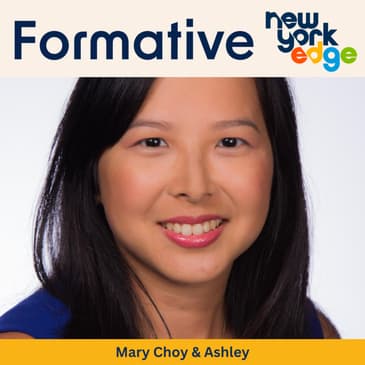

For our last episode of this season, Mary Choy, board-certified pharmacist and author, joins middle schooler Ashley to talk about the lessons she’s learned along her career journey. She shares how her mother planted the idea of becoming a pharmacist, how she pursued it with determination, and how her mistakes taught her valuable lessons. Mary also talks about blending science with creativity, her love of performance, and giving back to her Asian American community.
Downloadable transcript here
Rachael: Welcome back to the final episode of this season’s Formative, the podcast where today’s leaders are interviewed by the leaders of tomorrow. Today, our guest is Dr. Mary Choi, a board-certified pharmacist and author. She shares how her mom influenced her health, science, and creativity can go hand in hand, and the lessons she learned from mistakes along her career journey.
Hello and welcome. My name is Rachael Gazdick, and I’m your host and CEO of New York Edge. On every episode of Formative, a student from our afterschool program joins me as co-host, and today I’m joined by Ashley from MS 588K. Ashley, can you tell our audience a little bit about yourself?
Ashley: Hello, my name is Ashley. I’m from Middle School for Arts and Philosophy. I am in an entrepreneurship class. I do cheerleading, majorette, and I am a student ambassador of my school.
Rachael: Whoa, you do so much, Ashley. That’s very cool. Are you excited to get to know today’s guest?
Ashley: I’m very excited, too.
Rachael: All right. I think it’s going to be a great conversation. But before we bring Mary in, we want to remind our listeners that you can support us by making a donation at newyorkedge.org/donate. It would be very much appreciated. Mary, welcome to our show. We’re very happy to have you today.
Mary: Thank you. I’m so excited to be here today.
Rachael: Well, let’s get started then. Ashley, what’s your first question?
Ashley: My first question is, did you want this job when you were my age?
Mary: Absolutely, yes. So one of the things that I thought about when I was your age was becoming a pharmacist because my mom actually had inspired me to think about pharmacy and the health care field. A simple question of what do you wanna do when you grow up? And I actually didn’t have really a big idea, but I knew that I wanted to write. And I also love being in the arts, being into dancing and just music. But you know, she had said you have to be able to find a job after that as well, too. So I decided to go into pharmacy, which she had suggested to me, but I also thought about it as I’m into health care, then I thought about how can I help people?
Ashley: Um, what was it like on your first day of the job? Were you nervous or excited?
Mary: So my first day of the job, I think I was probably both a little bit nervous and, of course, excited. And as a board-certified pharmacist with a doctor of pharmacy degree, I’ve been lucky to have the opportunity to be in a residency as my first day at a job post-graduation, and it was my first day rounding with doctors, nurses, and social workers, and being able to have a voice and to provide my input for patient care. I think that was really important for me and getting to meet the team as well. Managing patients’ medication safety, that really was exciting, as well as a bit nervous in meeting the team, but I think it all worked out really well, and I was actually in that position for quite a while.
Ashley: Were you, like, really, really scared that you might mess up or something?
Mary: Um, so I think that fear actually holds us back. And of course, there is an element of being nervous, but then what I try to do is that I try to think to myself, in order to build confidence, I would try to think I’ve got nothing to lose, right? And what’s the worst that can really happen? So I know that if I do my job in terms of caring for patients and doing the best that I can and making sure that their medications are accurate, I think that’s really the best that I can do. And with teaching, because that role also had a teaching position and I was also a professor at major universities, um, and teaching 200, 300 students at one time, that can also be very nerve-wracking as well. So I remember with my first class, of course, I was more nervous stepping into the role, but then after having done it for 10 years, I think I can speak to a whole different platform of students. And then I also know that my role there is also to educate and to teach people. So there really isn’t a reason to be nervous. And if it is nervous nerves, then I can overcome it as well.
Ashley: What skills do you need for your job?
Mary: So I think currently, well, currently my job entails a lot of different things. I’m also a medical expert for Verywell Health, and what that is, is that I review their health content to make sure that it’s accurate and easy for people to understand. So I do use my clinical pharmacy skills for that and my writing skills for that particular job. But then my other flip side of it is that I also am working on books, and also I recently co-published a book with my co-author, Pharmacology: An Introduction, and that book is with McGraw Hill, and that book goes deeper and it’s geared towards students who want a stronger foundation on how medications work. And so by doing author visits and just reaching out and speaking to people, I think that’s how I’m able to do all of that.
Ashley: What feedback do you get from people reading your books?
Mary: So some of the feedback that I’ve gotten from students who have read the book is that they were really interested in one area and following their parents’ footsteps, which was, uh, nursing. And they knew they wanted to be a nurse, and really almost nothing could change their mind. And then they read my book, and then they decided that they wanted to go into physical therapy. So still health care, but something different. So I feel that it’s the knowledge. If the knowledge is out there, it’s really meant for people to just gain an understanding and to see whether or not that’s something that they want to pursue. And every day I look at something and I think, oh, that might be interesting, and I would do some research into it as well, too. So I think that just kind of, like, helps people open up their eyes and just share knowledge.
Ashley: Is there any fun parts of your job, like when you go on vacation, do you miss it?
Mary: So I love traveling, going on vacation, and I am constantly being inspired while I’m on vacation as well. So I’ll think of different ways to write something or just being in the moment while on vacation, but also just constantly thinking about different books that might inspire kids. And recently, I had wrote five children’s books focused on STEAM, whether it’s based off of, uh, doing laundry or even just being at the museums. And that museum book was actually inspired by bringing my kids to different museums and learning about health care. And so I get inspired by traveling, and I think that goes hand in hand with the things that I do.
Rachael: Students often decide, you know, early on whether they’re a math and science person or more of a literature person. Do you have any advice for students to keep exploring science, even if they feel intimidated or think it’s not for them?
Mary: So what I love to do personally is to really encourage students to go to the different museums and just see the science museums and the math museums. They teach it in a way that’s fun. So one of the museums that actually inspired me with the book talking about museums and doctors and nurses was I got to see an exhibit on health care, and that was a children’s museum. And I thought museums shouldn’t just be for the elementary school kids. It should be for also the middle school kids and even high school kids. And I’ve seen different events at the museum. So I think that could be one of the ways to draw students in, is to have resume workshops there or STEM careers, or maybe not even label it as STEM careers, because then people get kind of afraid of that word. Like, I know I’m not gonna be into STEM, so why am I doing this? Because I myself was really just not really into chemistry, but yet I became a pharmacist. So I don’t think that you have to be, um, interested or be really interested in science and that’s all you know you wanna be, ’cause I was the opposite. I was into arts and I was into literature and calligraphy and just performing. And so I think there’s just so many different ways that people can get there, and I think just being exposed to different things.
Ashley: How well would you say, on a scale of one to 10, that you’re pretty good at your job?
Mary: I, I would love to give myself a 10. That would be amazing, right? So have that confidence going in. But I would have to say that I would go with my lucky number, which is eight. And I think that there’s always room for improvement with everything, and every instruction that I have, I think I learn from them. So even with the author visits that I do, I learn from the author visits with high school versus elementary. I had to modify the presentations a little bit. I do scavenger hunts with the kids with my books, so I have to look at what and see what they would find interesting and modify that.
Rachael: So informative. We love talking about mistakes because we want kids to know everyone makes them and can bounce back. So can you share a story about a time you made a mistake at work and how you fixed it or overcame it?
Mary: Sure. I think with making a career mistake and also a personal mistake, probably the biggest one would be when I felt like I had to do everything on my own. And I actually worked through my maternity leave with my first child. So was it really necessary? No, it wasn’t. And then there could have been a better work-life balance for that. And I had surgery, and then the next day I was working on my laptop and submitting a publication to an editor, and it was the final stages of publication, and that was what the editor needed from me. And then, so I did it, but that was just something that I think needed to establish better boundaries. And then, so for my second maternity leave, I learned from that mistake, and I realized that wasn’t sustainable or healthy. And then I had a very different approach, and then I stepped back and allowed myself the time to truly recover and really focus on my family. I was really thankful for my colleagues that stepped up to volunteer to take over some of those responsibilities.
Ashley: If there is, like, a structure of, like, balance, would you choose it?
Mary: I would absolutely choose it at this point in my career. I think the work-life balance is really important, and also being healthy is also a big thing for me. Fitness and just doing a lot of classes. I’m really into yoga and Pilates and total body conditioning now and just making sure that it’s kind of like going to a meeting, like a work meeting. I think of it that way so that I don’t really back out at the last minute, that my presence is needed there.
Ashley: Any role models that impacted your life?
Mary: I think the biggest role model would be my mom, who made a big, big impact on my life, and she was just one of the most hard-working people in the world. And I think that I see the type of work ethic that she has, and I think that’s really had an impact on me and the things that I do. And she’s just always interested in helping people and kids. So that’s something that I feel inspired by every day.
Ashley: Did your community impact how you wanted to be?
Mary: Absolutely. So as a first-generation Asian American, I did not have many resources growing up, and one of the biggest things that I wanted to do was to spread knowledge. So one of the different things that I did was to be on speaker panels talking about health care and pharmacy or helping people with interview prep and reviewing their resume. Everyone always needs a mentor, and over the years I’ve helped students do that as well and even collaborate with them to publish their work. Partnering with nonprofit organizations, like getting invited to partner with either Homecrest Community and also with the Very Asian Foundation, I think just being able to speak to people, for them to learn about what it was like growing up as a first-generation Asian American and what my story entailed with coming from a place where there weren’t as many resources and what I was able to do with that. And that story, I think, is something that is very meaningful. And it also helps that I went to Chinese school growing up, so I do know how to read and write Chinese, uh, fluently. And so I’m also able to give presentations in Chinese, and I did that for senior citizens and talking about medication safety for them. And I think that was very impactful for them.
Rachael: Lastly, if you could go back to your 14-year-old self, knowing everything you know now, what would you tell yourself?
Mary: Going back to my 14-year-old self, I would tell her to be strong and to take chances and opportunities for things. And even if you feel that you’re not comfortable in taking some of those chances, just seek out the different opportunities that are available and to not be so worried in life. The worrying part of it is what holds people back, and I think that’s what I would say, is to just take the leap and just do it.
Rachael: Awesome. Well, this has been great. Thank you so much for joining us today.
Mary: Thank you so much, Ashley, for your questions and inspirational thoughts.
CREDITS
Thanks for listening to Formative, a production of New York Edge. I’m your host, Rachael Gazdick. Our production partner for this series is CitizenRacecar. This episode was produced by Hajar Eldaas, post-production by Alex Brouwer, original music by Garrett Tiedemann. Thanks to the whole team at New York Edge for making this series possible. Never miss an episode by subscribing to the series at newyorkedge.org/formative or wherever you get your podcasts.