
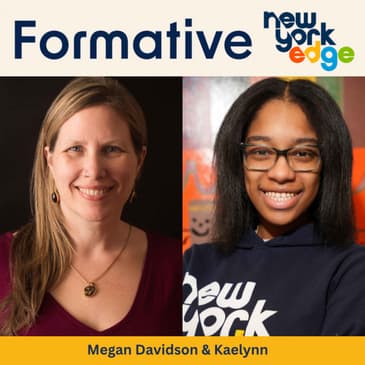

Megan Davidson joins us on today’s show! Megan is a certified labor doula and childbirth educator. 8th-grader and co-host, Kaelynn, learns that sometimes the perfect career looks unconventional from what you imagined. Following our curiosity can lead us to exactly what we’re meant to do. In this episode of Formative, Megan shares the story of how she went from studying anthropology to becoming a doula and how despite her career’s unpredictable hours and circumstances, she always feels like she is doing exactly what she is meant to be doing.
Downloadable transcript here
INTRODUCTION
Welcome to Formative, the show where today’s leaders are interviewed by the leaders of tomorrow.
Formative is brought to you by the generous support of Macy's Inc. whose purpose is to create a brighter future with bold representation from underrepresented youth so we can realize the full potential of every one of us.
GUEST INTRODUCTION
We’re joined by Megan Davidson today. Megan is a certified labor doula, childbirth educator, lactation counselor and postpartum doula. She also is the author of Your Birth Plan, a guide to navigating all of your choices in childbirth, as well as several essays about doula support and body size in pregnancy. We’re thrilled to have Megan on the show today.
INTERVIEW
Rachael: Hello and welcome. I'm Rachel Gazdik, CEO of New York Edge, and my co-host today is Kaelynn from M.S. 242K. Kaelynn, can you tell us a little bit about yourself?
Kaelynn: Yeah, I'm in the eighth grade. My favorite subject is algebra. I love reading. And I'm obsessed with animals, and that's the reason why I want to be a vet when I'm older.
Rachael: Awesome! So Kaelynn, who will we be talking to today?
Kaelynn: We are going to be talking to Megan today. And I am actually very excited to be speaking to her because not only is she, like, a caretaker in some way, I know very little about midwives and I would like to know a lot more.
Rachael: Well, let's bring her in. Megan, welcome.
Megan: Thanks for having me. I will clarify, I'm not actually a midwife. I'm a doula, but it has some overlapping space between those two professions. It is a question that a lot of people have about what doulas do and how they are similar to or differ from midwives.
Rachael: I'm excited to hear about that. So Kaelynn, what's your first question for Megan?
Kaelynn: You were talking about how there's a difference between midwives and doulas, do you mind, like, explaining the similarities or differences between them?
Megan: Yeah, so midwives and doulas are definitely both folks who help people have babies. But midwives are healthcare providers ultimately. Here in New York, for example, all the midwives here are midwives who've gone through, usually, nursing school. And then have gone on from there to get essentially another degree in midwifery. And then they work, in lieu of an obstetrician, right? So, an obstetrician is a surgeon who helps people have both cesareans or vaginal deliveries. Um, midwives are people who help people have vaginal deliveries, right? They're not surgeons, so they don't perform that surgical aspect of it but they are experts in normal birth.
So a midwife you would see instead of a doctor, but a doula is somebody that you would see alongside your doctor or alongside your midwife. Doulas help people with emotional, physical, practical kinds of support. So, I do a lot of education for people about what to expect, about what to expect with their own body, about what to expect inside of a hospital context. I help people navigate, sort of, the changes that they're experiencing. I help them navigate what it's like to have a newborn. I help them navigate lactation or their own healing in their body. And I advocate for them inside of a health care system which even on the best of days is super overtaxed.
Kaelynn: Okay, that, like, really cleared some stuff up. Um, I wanted to ask where did you study to become a doula?
Megan: It's an interesting profession because it's not a regulated profession. So, most people who work as doulas certify through some sort of certifying agency. A lot of the training to be a doula ultimately is about doing the work. We learn when we do it. So, I've helped 819 People have a baby and I've helped about 2,000 people with lactation and newborn care and things like that. So, I've been doing the work for about 20 years. So as doulas go, I'm one of the most experienced doulas in the country. But I also, at some point, was attending my first birth. And so, what I had done for training at that point was a childbirth class, like the type of class taught for people who are having a baby. I had done a three-day long workshop. I'd read, I think, five books that were required from the list, but then I'd read a bunch of other ones cause that's my style. and then me personally, I also have gotten a PhD in anthropology. So, I have a lot of training in understanding the methodology of studies or things like that. And so, I read medical journals and could talk to you about the half life of a drug and why that might matter to you and all those kinds of things. But that kind of training isn't required as a doula.
Kaelynn: You said you've read multiple different books on how to be a doula and books about taking care of babies and dealing with birth. Do you feel like reading is like, not better, but reading and studying about it has almost the same benefits as actually getting a hands-on thing, actually trying to help people?
Megan: I think that what reading does for people is give them a lot of background information, right? I think that when you're training to be a doula, the reading is really important because I think for most of us, very little in our lives have actually trained us to know anything about birth prior to the moment for most of us who are pregnant, right? Like, I even worked in women's health in a variety of ways before becoming pregnant. And I was like, I don't know anything about being pregnant. I don't know what happens in your body. I don't know what birth is like, you know. It was a huge space of knowledge that I just didn't have.
So, I think that training to become a doula, it's incredibly important to understand: What's the difference between a midwife and a doula? What's the difference between an OB and a midwife? Why would you pick certain hospitals? Why would you want an induction or not an induction? Like, all of that stuff, I think it's really important to know because people are looking to you to have that kind of information and to be able to help them think through all the kinds of decisions that they're going to make.
But, definitely, my clients have always been my greatest teachers. It's one thing to understand what, like, a severe pregnancy complication like preeclampsia looks like intellectually. It's one thing to read about it or how we navigate it. It's another thing to be with somebody who's having an eclamptic seizure and you're worried that they're going to survive. Like, childbirth is such an interesting field and also such an intense thing that happens to our bodies. On some level, it's like people give birth every day, right? A hundred thousand babies are born a year in New York City alone. So, obviously in some ways, it's this kind of deeply normal thing that we do with our bodies, but it's also really fraught. It can be really scary. It can be really traumatic. People die in childbirth, right? So, helping people navigate making really good decisions inside of that process, helping people identify if things are going wrong, helping the staff see red flags, if there's a problem at a birth, like, those things are really important. And I think you learn how to do that by being with people in birth.
Rachael: So, in the movies they make it seem like the moment of birth is very chaotic and everyone is screaming all over the place and running around. For someone who has never attended a birth in real life, would you say that’s an accurate representation?
Megan: Well, I will say, I think that TV and movies do a terrible job of representing birth. So, you probably just have a lot of bad information about birth if you're consuming it largely in those ways. Um, you know, it isn't like your water breaks and then there's this mad screaming dash to the hospital and you're like, you did this to me. That's not really a very accurate representation of childbirth.
For most people, childbirth is a long, slow process, right? It's a lot of six minute apart contractions where you're contracting for a minute and then we have five more minutes where we're all just hanging out. And then there's a lot of back rubbing and breathing and changing positions and thinking about when it makes sense to call care providers or when it makes sense to get your dog walker to come over or what snack we could get in you even though you're nauseous.
A lot of childbirth is a very mellow kind of experience of being with people who are really going through something in their bodies in a way that, like, being with somebody who had the flu or something might be similar in some ways, right?
Kaelynn: I wanted to ask, let's say you had a client and they went into labor early and they can't really make it to the hospital. Would you be able to help them give a home birth? Or, like, birth their child in the house?
Megan: So, it's never my first choice, right? I mean, one of the things that I know a lot about is how to help people make decisions about things like when to call their care providers or when to head to the hospital. I have a lot of expertise in navigating every sort of kerfuffle that can happen with New York City transit. I've gotten a bridgemaster to reopen the Pulaski Bridge to get somebody through to a hospital. I've gotten NYPD to open barricades to get through a marathon with somebody in labor. I've gotten film crews to clear the street to let us to a hospital. I have a lot of expertise in getting people to where they're planning to give birth and I help some people who are having planned home births. So, I also help people who are not leaving their homes.
But yes, on a few occasions, I have had to catch a baby where a baby had other plans and we did not make it to a hospital. So, I have definitely caught a few babies in my day, but I try really hard not to. That's never my first choice. And I've even caught a couple babies in the hospital where we have made it to the hospital but the doctor wasn't there or the nurse left the room to get somebody and just the baby came so fast that no one made it back into the room. So yeah, I've done it a few times, but mostly, like in those 800 plus births, the number of babies who were accidentally born into my hands is only four.
Kaelynn: Four? I honestly thought it would be, like, at least ten. I honestly thought this happened way more.
Megan: No, I have a pretty good track record. I have a pretty good track record, I will say. I'm relatively good at reading the signs.
Kaelynn: Why did you become a doula?
Megan: I started off actually, in college, I became a rape crisis advocate. I worked through a place called the Albuquerque Rape Crisis Center, and that was in the late nineties, I guess. And so, for six years I worked through that organization and then in New York as an on-call advocate for people who'd been sexually assaulted. And I would go to hospitals or police stations or sometimes just talk to people on the phone depending on the situation. And I did that for six years until I was pregnant with my first son and I went on my last call here in New York when I was eight months pregnant with my son and nothing makes police officers more uncomfortable than an eight month pregnant person while they interrogate somebody. This was a really wild scene.
And then I gave birth and giving birth really made me feel like people need advocates in childbirth and that childbirth is a moment where the kind of advocacy that I was providing in this other field, like literally two floors away in the same hospital, that kind of advocacy is really important inside healthcare systems, right? Because a doula's work, essentially, is adjacent to healthcare workers but don't work for the institutions. They work for the patients or the clients themselves. So that's what drew me into the work.
I love being a doula because I get to spend so much time helping people navigate really intense moments in their lives and a lot of spaces that feel really intimate and vulnerable for people. And because ultimately it's a moment where people are becoming parents, it's really lovely to start that journey in a place where you feel confident about what you've done and what you're doing because it's a moment where people feel a lot of fear.
Kaelynn: Yes, that is essentially a moment where people do feel a lot of fear.I want to ask you if you think, like, being a mother has helped you in any type of way with your clients?
Megan: You know, I think it's a really interesting question because I think there is definitely an assumption among most of my clients and, honestly, among a lot of my colleagues and sometimes myself that my experiences in motherhood really have informed my experiences of helping people. And I think there's a lot of truth to that.
You know, I think that for me the journey into this work is so intimately tied to having been a pregnant person, to having been a lactating person, to having parented a newborn. But I also work with a partner, another doula, who I work really closely with. And she and I started working really closely together maybe 15 years ago, when I was mentoring her and she was first starting out. She had a reproductive loss and that had been a really intense experience and the way that she was treated in that process really brought her into this field of advocacy. And then after doing the work for a couple of years, she got pregnant and I was her doula and she gave birth when she was 23 and a half weeks pregnant to twin girls. And when you give birth at 23 and a half weeks pregnant, the baby, or in this case babies, rarely if ever survive. So, both of her daughters died within a couple of hours of being born and she's been a doula for 600 births and those are the only children that she has ever given birth to.
And I think it's such a reminder in this work that what it looks like to have reproductive experience does not necessarily mean that you have children, right? That some people have children and have no reproductive experiences, right? Some people became parents through step parenthood or they became parents through adoption or foster care systems or all sorts of ways that people parent other people. And that people also have a lot of reproductive experience that isn't visible to people, right? Whether that's abortions or miscarriages or stillbirths.
So, I do think that for me, the experience of motherhood has been very informative to my experiences of being a doula and the ways that I am with my clients, but I also am really clear that the kind of care that you give people inside their reproductive experiences isn't necessarily about your shared experiences but more about what it looks like to be somebody who cares for other people and that care work is itself actually so much about separating your own experiences from other people's experiences, right? So I don't tell people what my births was like. You know, routinely I don't tell them about the decisions that I made in my own births because the truth is most people have a lot of people in their lives to give them their own experiences and their own opinions about those experiences and what people rarely have in their lives are people who do the work of really listening and trying to help people navigate their own choice-making and to really be present with people in a very caring way and that's a really different kind of thing
Kaelynn: That was honestly very beautiful. Um, was there ever a time where you just felt like you couldn't be a doula anymore? You felt like you were gonna give up?
Megan: No. I mean, I will say it's interesting because this is a work that has a really high burnout rate. There's a really high turnover and most doulas don't make it to more than 50 births, if even 50 births, right? The threshold to enter the profession is really low but the work is very intense, right? Working in a healthcare context but not working for the institution can be really hard. Getting up in the middle of the night, going to a 40 hour labor and abandoning your whole life while you're gone can be really hard. I did that when I had babies who were at home. Like, it requires a certain capacity to do those kinds of things in your life, which structurally, for some people, it's just not possible. It requires a lot of emergency childcare. It requires a lot of other people in your life being willing to give you a lot of grace around never showing up to things that you promised you'd be at.
So, there are certainly challenges in this work but I will say, for me, I think one of the reasons that I have done this work for so long is that I have never actually really felt like I couldn't do this work. When I show up at somebody's birth, I always feel like I'm exactly where I need to be and whatever it was that I was going to be doing or had planned for then or whatever, that's not where I'm supposed to be and so I do the work. I'm really good at staying up really late and at working really long hours. My mom will tell you I wasn't a great sleeper as a kid, so maybe it was an occupational bonus eventually in my life.
Um, and so, the kind of insaneness of doing this work is something I'm so grateful for. I feel like I have the best job imaginable and that every other job would like, when I'm like I could get up at 7 a.m. every morning and go to an office job, like that sounds insane to me. I don't want to do that. But I do sometimes, you know, sleep on concrete floors for 20 minutes because I've been awake for 40 hours. So, you know, we all make our choices, I guess, right? And this is the one I chose.
Rachael: Our final question is one we ask all of our guests. If you could go back and speak to yourself at the age of 13, what would you say?
Megan: Oh, I mean, that's so interesting. I don't know that I would tell my 13 year old self anything about my profession. I mean, maybe I would. Maybe I'd be like, it's going to be great. I think I would tell my 13 year old self that it gets better, that middle school is, maybe for some people great, but I think for a lot of people it's really hard. And that, like, all the kind of really intense insecurities and fears about the future and things that maybe you're navigating when you're 13, that all of that gets better. Yeah, I met my future husband when I was 13. Maybe I would have told myself that you're gonna stay with this guy forever and it's gonna be awesome. I don't know. I don't know what I would have told my 13 year old self, I think, yeah, I think that if at 13 I liked myself a little more, it probably would have been gentler for me. But maybe those experiences are also really formative.
Rachael: Well, thank you so much for joining us today. And thank you, Kaelynn, for being such a wonderful co-host.
Megan: Absolutely, my pleasure.
Kaelynn: Thank you for having me.
CREDITS
Thanks for listening to Formative, a production of New York Edge. I’m your host, Rachael Gazdick. Brought to you by the generous support of Macy’s, Inc. Our production partner for this series is CitizenRacecar. This episode was produced by Hager Eldaas, post-production by Alex Brouwer, production management by Gabriela Montequin, original music by Garrett Tiedemann. Thanks to the whole team at New York Edge for making this series possible. Never miss an episode by subscribing to the series at newyorkedge.org/formative or wherever you get your podcasts.