
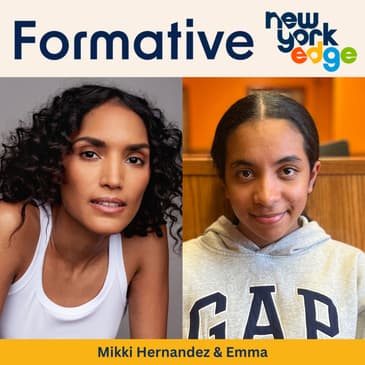
On the show with us today is Mikki Hernandez. Mikki is an actress, voiceover artist and author of the book, Cake Mix: Learning to Love All Your Ingredients. Emma, middle schooler and co-host, joins Mikki to have a conversation about why you should pursue the career that you most feel called to and how to cultivate an abundance mindset in a creative field. Oh, and why hiphop dancing rules!
Rachael: Welcome back to Formative, the show where today's leaders are interviewed by the leaders of tomorrow. On the show with us today is Mikki Hernandez. Mikki is an actress, voiceover artist and author of the book Cake Mix: Learning to Love All Your Ingredients. In our conversation with her, we talk about why you should pursue the career that you most feel called to and how to cultivate an abundance mindset in a creative field.
Rachael: Hello and welcome. I'm Rachael Gazdick, CEO of New York Edge, and my co-host today is Emma from I.S. 318K. Emma, tell us a little about who you are.
Emma: Um, my name's Emma. I go to I.S. 318 in Brooklyn, New York. And my favorite hobby is dance.
Rachael: Awesome. Now, who are we talking with today?
Emma: Mikki Hernandez.
Rachael: Mikki, thank you for joining us and welcome to our show.
Mikki: Hi, thanks so much for having me. Happy to chat today.
Rachael: So Emma, the mic is yours.
Emma: Okay. Um, why did you start doing voiceovers?
Mikki: I started doing voiceover because I was in an improv class and was doing improv a lot. And my coach at the time was like, “Hey, you have a really, you know, cool, interesting voice. Have you ever thought about doing voiceover?” And I hadn't, I didn't really realize that was a job. I kind of thought, oh, yeah, cartoons, video games, commercials. But I didn't realize that it was a totally different genre that actors could get into. So after that, I started taking classes and really got an immersive look at all of the different genres in voiceover that…you can be a cartoon animated character or you could do commercials and there's just a lot of opportunity across the board in different areas. So, got into that, learned how to train my voice, learned how to do some different accent work or different volume work. Efforts is what we call it in video games, learning how to fight or say if you get hit, you know, like a gut punch or throwing a punch or having a sword fight, there's all these different efforts we call them, or like sound effects that you do to kind of put yourself in that environment and imagine what that would sound like.
Uh, so yeah, it's been like a really fun area of acting to get into and I continue to learn and grow and expand my own skillset.
Rachael: So, um, do you prefer to do commercials or video games?
Mikki: It's interesting. To be completely honest, I love commercials because they pay pretty well compared to video games, which people might not know that, is that video games don't pay as much as I think they could pay, right? We have these big companies that come out with games like Call of Duty or the Halo games or all these like huge franchises, Fortnite. And those actors who go in and perform, they might have a four hour long session. You go into a studio, you have an engineer, the script is up there, and you do all of the script in that session, and then you get paid just for that one session and for them to use the game forever and ever. And so compared to commercials that you get residuals. Every single time it airs, you know, that's like tallied up and then I get paid for that.
So video games I enjoy doing, but not as much because A, they don't pay as much and B, they're really hard on your voice. You might be in a session yelling or screaming or fighting over and over and over and it's not as, I guess, safe for your voice to do. Definitely it's cooler than a commercial, but for me personally, I prefer to do commercials. So, yeah.
Emma: Okay um, and I wanted to know, how do you prepare for a role in voice acting?
Mikki: I prepare for a role in voice acting by using my imagination and also understanding what type of environment this character is in. So is this character living in the reality that you and I know? Is it in the future? Is it on a different planet? Is it in a post-apocalyptic world? So really getting in tune, okay, what's the environment look and feel like? And really engaging all of my senses, and then understanding the relationship that character has to the environment, and then anyone else in that scene. Because you know, in voice acting, you don't really have your body language to showcase to the audience. You have to use all these different inflection, tone volume. So if it's someone that I'm kind of eerie about, I might not have much of an open kind of vocal quality to me. I might be more to myself and more shy. Or if it's someone who's a good friend that I'm talking to in that moment, I might be more animated and more relaxed and more comfortable. So really taking into account all the different relationships in the script that I have, the environment, and then the type of world that we're involved in, and then those I build on my own. But then if you have a director to work with, definitely have conversations with the director to make sure I'm like on the right track and in the right kind of vibe that they envision for the character as well.
Emma: Okay. And what are some challenges you face as a voice actress?
Mikki: There's quite a bit. I think being a freelance artist is difficult because there isn't really a separation between yourself and the art. It's, I'm using my voice to audition. Or I'm using my voice to convince somebody that I'm the right person for the job. And I think a challenge for me is training my brain of like, okay, I'm not convincing them of anything. I am enough, fully as I interpret this. And to audition in a way that is quick and confident. And I trust my own instrument, I trust my skillset. And I think the challenge with that is not letting my brain kind of overthink or doubt myself or come up with reasons why I am not right for the job. Those are all things that can get in the way of just me being a free actor and a free artist. So I think it's a, it's kind of like a mental challenge of just keeping those negative voices out and not letting them be as loud as they could be.
I think another challenge is, pre-COVID, we used to have a lot more opportunities to go into a studio and have a director, uh, like a session director. And they would give us notes or feedback or be like, “Hey, what if you try it this way?” And that was really helpful. I love having a director giving me feedback and making adjustments. And now all of my auditions are on my own. So I get an email from my agent, they send me the script, they send me what's called specs, which is a description of the type of role and what the client or the director is looking for, and then I am on my own. I record it on my own, edit my favorite takes, and then send it in, and don't have any feedback unless I get the job. And so I think it's hard to direct myself, that's something I'm still kind of growing and learning of how to do it in a way that…that, again, isn't like overthinking and just being quicker, of being like, okay, like I'm just gonna be really confident and give myself five to 10 minutes to work on this audition, and then I'm gonna move on with my day and not think about it anymore.
Emma: How did you come up with the idea for your children's book?
Mikki: So my children's book, Cake Mix: Learning to Love All Your Ingredients, came to me after a couple of years, I was volunteer reading in a kindergarten class in Hollywood and was driving all around Los Angeles, different public libraries, and was realizing that a lot of the children's books that I was reading, they didn't have characters that really reflected the classroom I was reading to. It was primarily Hispanic Latino kids or Asian American kids and I, you know, I don't mind reading stories that have characters that don't look like me, but it's always nice to just have a variety of diverse characters. And so after reading probably hundreds of books, I kind of thought to myself, I'm like, “Hey, I'm an actor. I'm a storyteller. I enjoy reading. What if I wrote my own book? What's something that I kinda wish I had as a kid?” And I am very mixed, I'm multicultural, mixed ethnic background. My mom is black and white, specifically African American, Polish Jewish. And my dad is Mexican American with Native American heritage. So it's a lot of things to cover and something that I've experienced a lot as a kid but also as an adult is getting this question of ‘what are you’ if people are talking to me and they wanna be able to classify, am I black, am I Hispanic, am I Indian? You know, like, ‘what are you’ has been a question that's made me really insecure and confused in the past. And I thought, okay, other kids might get that question or what's a story that I could tell to maybe prevent kids from asking that question or teaching them in a way that's fun and not too preachy of just how to talk about identity and how to talk about ethnicity in a safe way that makes people feel more comfortable.
So the question, ‘what are you,’ is kind of like the space of the story and the book was originally titled that and I thought, okay, what's like a fun way to talk about this? And I really enjoyed baking as a kid, especially with my mom. So I thought, okay, baking could be really cool 'cause there's like a lot of ingredients that go into making a cake. And that felt like a nice metaphor and illustration to talk about being mixed. During the editing process is where my editor actually was like, “Hey, what about the title cake mix?” And I thought, that is such a good idea. So it kind of proves that if you are writing a story, it's, yes, it's your own, but it takes a lot of collaboration, a lot of other people's input to really make it the best it can be.
Rachael: As an actor, even as a writer, you are getting a lot of nos, and I'm wondering if you can pass on wisdom to a young person who may have not yet experienced that many nos about how they can deal with rejection.
Mikki: Yes. So rather than having a scarcity mindset of thinking like, oh, there aren't enough jobs out there, I like to think that job, there is one person who is best for the job. And so, if someone else gets it, that isn't taking anything away from me. It wasn't necessarily mine to begin with, it's just they are the one that is literally fit for that role. There can only be one person. And so I think it helps to know that there is one person for each opportunity, and I am more than worthy of being that one person for whichever opportunities I get. So I like to think of it as there's enough opportunities to go around.
And I also think that if you aren't used to getting nos, it kind of, I think the yeses are sweeter when you get the nos, if that makes sense. I appreciate the yeses more because I have gone through a lot of rejection. So I kind of know what it feels like not to get it, and it's always kind of having that perspective shift of being super grateful when you do get the yeses and really cherishing those moments and making the most out of them.
I think also too, it helps to, which is really hard, but I encourage any young people out there, to try not to compare yourself to other people. I, I saw a quote that an actor said once of thinking about like, uh, race horses. A lot of them, they have blinders that they have to wear in order to race ahead and be as fast as they can be and stay in their lane. And I really think that's true of like, you can't necessarily be looking side to side of what other people are doing because everyone's path is unique because we are all unique with what we bring to the table. We are the only ones that understand our own experiences, our own imagination, our own background. And if we're busy kind of like looking from side to side and comparing, that can take away from our own confidence. And so I think it's really important to celebrate people who are having successes around you because that's unique to them, but also not letting yourself get too caught up in comparing because it really can take away a lot of joy from the process of being a creative. We're all offering our own unique creativity, and it's really a shame if you focus too much on what other people are doing.
Rachael: So what were you like when you were in middle school and did you already know what you wanted to be?
Mikki: Ooh, that's a tough question. So I grew up in Central California, which is basically in the middle of the state. So I grew up three hours away from San Francisco, three hours away from Los Angeles. And it was a very small town, it was like a farm town. And I think for me, I always kind of felt like there was a bigger world out there. I wanted to be in the big city. I would watch movies and TV shows, and I was obsessed with Hollywood or TV or just having more opportunities or like being around more people than I knew. And so when I was 13, I was very…I talked a lot, I got in trouble a lot in school for chatting all the time. And I was a bit of a rebel, I will say. I was smart so I did well in school and I applied myself with my homework and all of that. But when it came to authority figures or doing things the way that the teachers wanted to do, like, I always had questions of, well, why do we have to do it that way? I kind of like to push the envelope and kind of push the boundaries a bit because I didn't really, and I still don't, I don't think that there's one way that we could, should do things. I think we're humans. As a 13-year-old, I'm sure that you are constantly learning new things about yourself, and how you think and how you wanna do things is not gonna be the same way that maybe your sibling wants to do it or your friends or your teacher. So I was quite philosophical, I would like to say as 13-year-old.
And I definitely, uh, you mentioned dance earlier. I was a dancer growing up. So dance was my main love and my main passion. I really wanted to become a professional ballerina. But actually when I was 13, I quit ballet for a couple of years. I decided to do cheer, which I did not enjoy at all. I like really, it was not my thing. I love watching it, but like doing it, I was like, this is just not the same as like ballet and jazz and hip hop, like I loved kind of more like traditional styles of dance. And so, when I was 13, I kind of like, I wanted to try something different, so I stopped dancing for a little bit and then I came back to it. And I think I was just trying to find a way to express myself through dance after having such a negative experience with cheer. I like really kind of honed in on like dance being what I really love to do and that's what made me feel the most alive.
So what kind of dance do you like to do?
Emma: Well, last year in school I did hip hop for J-Lo.
Mikki: Fun. Oh my gosh, so fun.
Emma: Yes. And this year, in December, I am doing a dance. It's not like a theme, it's just like the eighth grader saying bye to the school.
Mikki: Mm-hmm.
Emma: And then in the spring we're gonna do another dance, it’s based on Barbie. We're gonna come out of Barbie boxes. It's also hip hop.
Mikki: That's so fun. Nice. And what do you like about hip hop dance? Do you like the music or what's your favorite thing about it?
Emma: It's faster than lyrical.
Mikki: Yeah. Yeah. And I feel like the counts to hip hop are so much more fun 'cause you get to use like noises, like ka ka ka or like, pa dum dum. It's just a lot more musical, I feel, than lyrical. I don't know, lyrical can be sad sometimes, but hip hop feels more fun and, like, happy.
Rachael: Yeah. I feel like often people discourage teens, um, you know, from pursuing careers in the arts or things like acting because it, you know, seems unrealistic. Have you ever had an experience like that and how were you able to silence all that noise?
Mikki: Yes, I love this question. If you have a strong sense of purpose of what you feel you're meant to do, that, you should definitely pursue it. My parents were not super supportive of me going into acting. I don't think they really saw like dance as a realistic career either. And I think I listened to them because they're my parents and they also helped me pay for college, which was really helpful 'cause my dad's in the military, so I got like scholarships from that. And I think for them they had a different upbringing where they really valued stability because they didn't have stability growing up. So for them, they thought it was like a protective thing of, yeah, do the stable thing, get the job with benefits, worry about making money. And I, I don't know. I feel like you can always do the safer thing like that will just, I don't know, people do it all the time. But I think it's a lot harder to do the creative thing or to pursue your passion. And I think it's definitely more fulfilling, especially when you're young, you don't really have as many responsibilities to worry about.
So I think, go for it.
And I think what I saw working in a job that like made my parents happy and that felt more stable is I worked with a lot of people who weren't very happy. I had a lot of coworkers who honestly seemed, like, really miserable and I would see them and I was like, I don't, that just doesn't look like fun and it doesn't seem, like, for me, you know. I, I really had to kind of see it for myself. And so I would encourage you that if you're young and if you know what you're passionate about to like fully a hundred percent go for it. And if you find out that's not the thing that makes you happy, you can always change your mind.
I think try things too because for a long time, I think I knew acting was what I wanted to do, but I wouldn't let that be at the forefront. I would always push it down. So I tried a lot of other things, and if that's your path, then that's what you have to do too. Sometimes it helps to know what you don't wanna do to kind of like eliminate. And I just took the long route to get to acting and sometimes I do wish that I took a quicker route by just going for it when I was 18.
But yeah, I would say even though it's hard, I think it's worth going for your passions because money, yes, it can make life seem easier, but I think at the end of the day, I wanna live a life where I feel fulfilled and that I'm like leading with purpose and passion. And I'm way happier pursuing acting than I was getting a paycheck doing something that I wasn't passionate about. So, it might sound cliche, but I say go after what you wanna do.
Rachael: I totally agree. So we have one question we always end with, and it's this, if you could go back and speak to yourself when you were Emma's age, so 13, what would you tell yourself?
Mikki: Whoa. That's a big question. I would tell my 13-year-old self that it's important to learn and explore and experience as much as you can. So I would tell her that traveling is amazing and it's totally worth to travel as an adult. I would say read all the time, learn things, and I would also tell her that you can build a beautiful life that you wanna build, that doesn't have to be determined by anyone else but you. I think oftentimes I was like influenced by the people I was around just because my town was very monotonous in terms of everyone did the same thing. But yeah, I would tell my 13-year-old self keep being a rebel, keep staying true to who you are and what you wanna do, and it will pay off.
Rachael: Awesome. Thank you so much. It's been such a pleasure, and thank you, Emma, for being such a wonderful co-host.
Mikki: Thanks, Emma!
Emma: You’re welcome.
Mikki: I hope you keep dancing and exploring, and I’m excited for you.
Emma: Thank you.
CREDITS
Thanks for listening to Formative, a production of New York Edge. I’m your host, Rachael Gazdick. Our production partner for this series is CitizenRacecar. This episode was produced by Hajar Eldaas, post-production by Alex Brouwer, original music by Garrett Tiedemann. Thanks to the whole team at New York Edge for making this series possible. Never miss an episode by subscribing to the series at newyorkedge.org/formative or wherever you get your podcasts.