
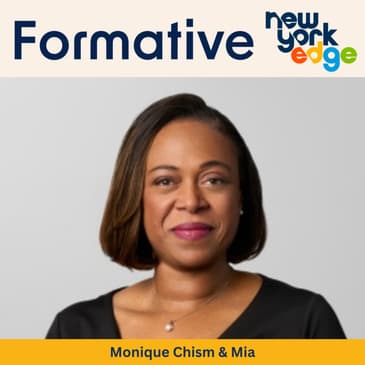

Dr. Monique Chism, the Smithsonian’s Under Secretary for Education, joins middle schooler Mia for a conversation about the power of learning. Dr. Chism reflects on the teachers who had a lasting impact on her, her love for dance and performance, and why she values being in rooms full of people who know more than she does. They also discuss how making tough decisions is a part of life and growth.
Downloadable transcript here
Rachael: Welcome to a new episode of Formative, the show where today's leaders are interviewed by the leaders of tomorrow. With us today is Monique Chism. Dr. Chism is the Smithsonian's Undersecretary for Education. She joins us today to talk about making tough decisions, being a lifelong learner, and the importance of equity in education. We're very excited to get to know Dr. Chism today.
Rachael: Hello and welcome. I'm Rachael Gazdick, CEO of New York Edge, and my co-host today is Mia from M.S. 389X. Mia, can you tell us a little bit about yourself?
Mia: Um, I'm 13 years old. I'm in the eighth grade. My birthday's in January and my favorite color's green.
Rachael: Great. And who are we talking to today?
Mia: Today we're gonna be speaking to Dr. Monique Chism and I'm so excited to be speaking to her.
Rachael: Dr. Chism, thank you so much for joining us today. We're very, very excited to have you on the show.
Dr. Chism: Hi, thank you so much for having me.
Rachael: So Mia, what's your first question for Dr. Chism?
Mia: What was something that almost knocked you down during your career?
Dr. Chism: Oh, wow. So, I'm an educator. I've been in education my entire career. And so, I first started off as a teacher. I then went on to work at the state level, at the Illinois State Board of Education. I then went to the US Department of Education, the United States Department of Education. And now I'm at the Smithsonian.
And I, I would say probably as I reflect on that length of my career, one of the most challenging points in my life was a mix of both my professional and my personal life. So about five years ago, my father was diagnosed with brain cancer and it required me…he still lived in Iowa. He lived in Davenport, Iowa. So in order to be there for him, it required that I would make frequent trips from DC to Iowa to DC, back and forth. And so it was just very stressful. At the same time, professionally, the administration was going through a transition. This was the end of President Obama's term and the beginning, uh, of President-elect Donald Trump's term. So we were going through a transition at the agency, which has also, in many ways, brought its own stress and difficulties. So I had to make a decision about my own wellbeing at that time and what I was gonna do that was best for myself. And so I knew that I wanted to focus on being with my father during the last month of his life. So I made a decision to leave the Department of Education and take a different job, which could have been a really detrimental move for my career path, um, but it was the best move for my personal wellbeing. So, um, that was a difficult decision.
Mia: What's your favorite part about doing, like, your job?
Dr. Chism: Oh, I'm glad you asked me that. So have you been to any of your local museums?
Mia: Yeah.
Dr. Chism: Okay. Well, I love it when people come into our museums and they get to see all of the galleries and the exhibits and all the things that are going on. And I kind of eavesdrop on them sometimes. And I love when I hear people say, wow, I didn't know that. Like I love it when people come in and they find a new like connection or a curiosity or something they wanna know more about. If it's dinosaurs or if it's history or if it's something cultural or music. We have something for everybody. So I just love when people find connections or sparks that I get to see.
Mia: Do you get frustrated or overwhelmed when you're doing your job?
Dr. Chism: Yes. Um, you know, I love my job. I love everything about the work that I do here at the Smithsonian, and it's probably the best career position that I've had in my entire professional career. But there are still things that on occasion frustrate me or become overwhelming.nAnd the good thing about it is that's not the majority of my job. That's, uh, a small part of my job. But yes, there are still things that frustrate me and overwhelm me at times.
Mia: And like, do you think that, like, the atmosphere that you're in determines on how you work or how you act that day?
Dr. Chism: Yes, that's a good question. Um, and I'm a leader in my organization, so I have a lot of responsibility for setting a positive climate and culture. And so I hope that my team would say that I do that well. But if I come in grumpy, then sure enough, my team members are gonna be grumpy. If I come in with a positive attitude and a positive outlook, I think that helps them have a positive attitude and outlook.
Mia: Do you, like, still wanna learn more things about your job or do you think, like, you know everything about your job?
Dr. Chism: I am learning every single day. And I think that's one thing to remember as you are going through any pathway in life, like, there's always something more to learn. There's always something new to learn. You're gonna get to a place where you kind of know what it is that you have to do on a day-to-day basis and you know your job. But you should always look for ways to challenge yourself, to help grow your skillset, to really expose yourself to new things.
So if you ever feel like you get to a point in your profession or your job where you're the person in the room who knows everything then you're in the wrong room.
Mia: If you went back in time, do you think that you would do, like, would change things?
Dr. Chism: Hmm. I think that the things that I've been through, both the mistakes and the successes have made me the person that I am today and I feel very blessed and fortunate for the things that I have opportunities to do. They say that, like, hindsight is 20/20, which just means you can see the past more clearly because you've already lived it. So yeah, like knowing what I know today, I might go back and make different decisions, but then that actually might change the person that I am. And it might not make me a better person. So I think that our life lessons are important and they're there for us to learn and grow from. We all make mistakes, but it's about how you recover from your mistakes.
Mia: What was your childhood like?
Dr. Chism: So I, um, I have a sister, so it was just me and my sister and I grew up in the Midwest of the United States. So I was born in South Bend, Indiana. And then at the age of five, my family moved to Iowa and I lived in Iowa until I was 14. And then my parents actually divorced when I was 12 years old. And so at 14, my mom, my sister, and I moved to Cincinnati, Ohio, which was a much different experience than living in Iowa. And so, during that time of my life when I was in elementary school, middle school, and high school, I had many different experiences. 'cause I was moving around a lot from different city to city. So oftentimes I would make friends and then I'd go to a new location, I'd have to remake friends. My mom made sure we were very active in community events, so we did like community theater. I studied dance for 10 years, so I took tap, jazz, ballet and point. So I was involved in many of those things. Um, we did local shows and production. Um, so growing up was complicated, but it was fun.
Mia: And, um, what made you wanna study dance and theater?
Dr. Chism: You know what? For dance, it was just like, it was a fun way to express myself. You know, I've always loved music and it was fun to be able to learn new choreography, be with other dancers. It was just, I loved the productions that we would put on together. For theater, you know, theater was fun because I think, you know, I wasn't…When I was younger, I wasn't the strongest reader. So I think that I would do a lot of memorization rather than actually reading. You know, like I was psyching my teachers out a little bit. So memorizing things came really naturally to me. And so when you'd have to memorize your lines for play or memorize a monologue, that actually came very naturally for me. And then the idea that I could, like, temporarily pretend like I was somebody else and act, that was just fun to kind of be outside of my shy self and be able to kind of go on stage and be a different person or a different personality. So that was fun.
Mia: Okay, so this question, it's like what teacher that you had in school or like in high school impacted you to be what you are today?
Dr. Chism: I had wonderful teachers. I really did. Uh, they really were transformative in many different ways. So there's a couple of teachers that I can remember that were like, I think very influential. One was my botany teacher. So this was in high school. I had a chance to take, um, a science course, which was botany. I didn't know anything about botany. I didn't even know if I liked trees and leaves and all those things. But my teacher, his name is Mr. [inaudible]. He made it so interesting and it made me feel like a smart kid, like because I was doing science. And I never thought that I had the smarts or the capacity to be able to do something like that. And he helped me see that I actually could, given the right resources. So he gave me confidence in myself.
Because I went to a performing arts school, I also had the chance to work with teachers who were performing artists. I had a dance instructor and I also had a, a drama teacher. And those teachers really helped me understand that anything you want in life, you have to work for, you have to work hard for it. And that you're only gonna do it if you work with others to accomplish it. So working, you know, on productions and working, um, on theater shows. You never do it alone, you have to do it with other people. So I think those are like three examples of teachers that really helped to instill confidence in me, but also teach me that you really have to know how to work with people to be successful.
Mia: So was there a specific moment when you realized that you wanted to be an educator?
Dr. Chism: There was, yeah. My family moved from Iowa to Cincinnati. I was 14 years old at that time. How old are you, Mia?
Mia: I'm 13.
Dr. Chism: 13, so I was right about your age.
My family moved and it was a huge transition for me because going from Iowa, we were like a very stable middle class family. When I went to Cincinnati, I'm now my, you know, it's a single parent household. Everything shifted dramatically. We lived in a public housing community for the first part of my time there in Cincinnati. And my mom was very concerned about the schools in our neighborhood, and so she worked really hard to send my sister and I to an alternative school, which was the School for the Creative and Performing Arts. And very early on, I didn't have the words at 14 to be able to articulate it and describe it, but very early on, I knew that the education that I was getting at my school, at the school for the Creative and Performing Arts, was much different than the education that my friends in my neighborhood were getting. And I knew that was not fair and that was not right because everybody deserved access to a really high quality education.
So I would say it was at 14 that this passion for equity and education really started for me. And then different opportunities then just started to reveal themselves that kind of helped me move further into the path of being an educator.
Mia: What's something you would tell your 13-year-old self?
Dr. Chism: I would tell my 13-year-old self first, don't worry. Everything's gonna be okay, like you are gonna do fabulous. I'd first tell her to calm down, relax, don't worry, everything's gonna be fine.
And then I would tell her to, um, to really not put relationships off to the side while you focus on your goals. You know, I was the type of person going through college in the first part of my career who said, I just wanna focus on my studies and I just wanna focus on college, and I just wanna focus on getting that first job. And then I'll worry about relationships later. I'll worry about, you know, boyfriends and husbands and all those things later. Later never comes 'cause there's always something that you're focused on achieving and accomplishing.
So I think I would tell my 13-year-old self to make sure that you find balance in life. You have to have goals, you have to work hard to reach those goals, but that can't be at the expense of friendships and relationships. You have to work equally as hard at maintaining and cultivating those relationships.
Rachael: Wonderful advice. Thanks so much. This has been such a pleasure.
Dr. Chism: Thank you. And it's been such an honor to talk with you. Mia, you did a great job.
Mia: Thank you.
Dr. Chism: Bye-bye.
CREDITS
Thanks for listening to Formative, a production of New York Edge. I’m your host, Rachael Gazdick. Our production partner for this series is CitizenRacecar. This episode was produced by Hajar Eldaas, post-production by Alex Brouwer, production management by Gabriela Montequin, original music by Garrett Tiedemann. Thanks to the whole team at New York Edge for making this series possible. Never miss an episode by subscribing to the series at newyorkedge.org/formative or wherever you get your podcasts.