
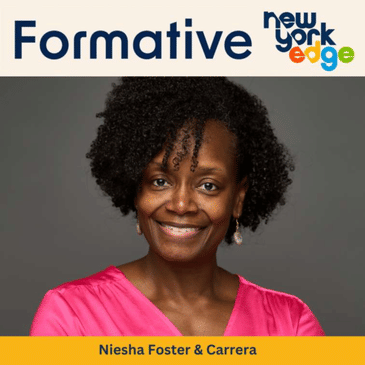

Niesha Foster is Vice President of Product Access, Global Health & Social Impact at Pfizer. Her work is focused on addressing patient affordability challenges and driving community engagement. Today, Niesha is joined by 8th grader, Carrera, to talk about what it means to be successful. In this episode, Carrera learns how the challenges she meets at every stage of life will require her to develop skills and come up with solutions that will propel her toward her own unique vision of success.
Downloadable transcript here
Rachael: Welcome to Formative, the show where today's leaders are interviewed by the leaders of tomorrow.
Niesha Foster is Vice President of Product Access, Global Health and Social Impact at Pfizer. Her team is focused on addressing patient affordability challenges, creating product access solutions and driving community engagement. Niesha joins us on today's episode of Formative to talk about her personal challenges and what she believes are the challenges that face the healthcare industry today. We're so very excited to be speaking with her.
Rachael: Hello and welcome. I'm Rachael Gazdik, CEO of New York Edge, and my co-host today is Carrera from P.S./I.S. 116. Hey Carrera, can you tell the audience a little bit about yourself?
Carrera: Well, I'm in 8th grade and, um, I like to just spend time with myself most of the time, but I like to dance a lot.
Rachael: Oh yeah, and also what's your favorite subject in school?
Carrera: English, for sure.
Rachael: So who are we interviewing today?
Carrera: Today we're going to be interviewing Niesha Foster. I'm excited to interview her today.
Rachael: I'm also very excited. Niesha, welcome to Formative.
Niesha: Thank you so much for having me here. I am excited to be here.
Rachael: Well, let's get started. Carrera, take it away. What's your first question for Niesha?
Carrera: Okay, so I have some questions to ask for you because as I said, I'm excited to interview you. So my first question to you is, can you explain a bit more on your job?
Niesha: So my role at Pfizer is multifaceted. I work in a group that's called Global Health and Social Impact, and there are two primary parts of my job.
One is to make sure that patients are able to access our medicines regardless of where they live and what they make as far as their income. And then the second part of my job is around something we call health equity, and that involves partnering with organizations, mostly not for profit organizations here in the U.S., who are interested in improving health outcomes for underserved communities. So, I'll give you a couple of examples. On the product access piece, I have a responsibility for one of our signature programs, and it's called the International Trachoma Initiative. Trachoma is an eye infection that after repeated infections causes the eyelashes to to curve in, scratch the cornea and can cause blindness. This condition only exists outside of the U.S. where people do not have access to clean water, indoor sanitation, and things of that nature. So the World Health Organization has a strategy where they seek to eliminate this condition and Pfizer is one part of that. And my team is responsible for donating the antibiotic that clears up the infection so that the blindness does not occur.
Rachael: What were your biggest struggles, um, that you had to deal with in your job during the past few years, especially with COVID and all the obstacles that brought on?
Niesha: Yeah, I would say probably the biggest challenge that I had during COVID was being the mom of two young elementary school kids. Um, but from a career standpoint, it really was an amazing time to be at my company in that we were part of a partnership that brought a vaccine to the world. And I got to be a part of that by partnering with U.S. organizations to help educate and make sure the materials were culturally appropriate, as I talked about earlier, around enrolling in our clinical trial and getting the message out to make sure that those who were most impacted by the disease would be willing to participate in the clinical trials, and then hopefully spread the word about the importance of being vaccinated against COVID as well. It was hard and everything moved very quickly, but I was so proud to be part of that effort, even the small part that I was able to play.
Rachael: Oh my gosh, I can only imagine.
Carrera: Yeah. Um, what challenges does your vision for future healthcare face?
Niesha: I would love for more people in the healthcare industry to stay focused on simplification and accessibility of healthcare. You know, healthcare in the U.S. is so complex, from the many different providers to the packages that you're offered in your healthcare. And my vision for healthcare would be just to simplify it for people so that they don't have to read dozens and dozens of pages to better understand what their benefits are, and that they are able to afford the services that they need. I would love to see better transparency in all different aspects of cost in the healthcare system.
I find that people are mostly focused on what they pay out of pocket, but there are so many other costs that are hidden to patients and I would love for them to be able to better understand those costs so they can make informed decisions about their health.
Carrera: Yeah. What inspired you to be in healthcare?
Niesha: It's a very good question. Healthcare was not on my radar screen when I was at school. It really came on my radar screen as I sought to get my Master in Business Administration, my MBA, down at the University of Virginia's Business School, which is called Darden school. We did a lot of case studies at our school. And so what that means is you have, I don't know, five sheets that basically start with you're in this situation, here are the challenges. How would you get it done? And a lot of our cases were on healthcare. And that's where I really got interested in more about the healthcare field and not just about what goes well with it, but also the challenges. And so, I decided to pursue healthcare coming out of business school.
Carrera: I think I want to go into the medical field too. So hearing this stuff and the tips or that, it just, it inspired me.
Niesha: That's awesome. I thought I wanted to be a doctor at one point in time, but I was horrible at labs so I gave up. So you don't give up because we need more doctors who are going to look like you and think like you and, um, work with patients every day.
Carrera: What college did you attend? And, like, why did you attend it? What was your major?
Niesha: Sure, so I attended Syracuse University, up in upstate New York. And I chose Syracuse for a number of reasons, um, mainly because someone that I knew had a great experience going there. And I thought that she and I had a lot in common and if she was going to enjoy it and enjoy her studies, I might as well. And so, I thought that Syracuse would be a nice fit from a social perspective and also from an educational perspective. I didn't think about the weather perspective. Had I, I might not have gone there.
Carrera: So what was your, like, major? Like, what were you so interested in?
Niesha: So coming out of high school, I knew that I wanted to go into corporate America, and I was very good with understanding rules and very, very good in math. And so I thought the combination of those two would make me successful in accounting. So I chose to major in accounting and I did quite well, from a study standpoint. But also while I was there, I got to start an organization, a student organization of the National Association of Black Accountants, called NABA. And so, I was president of the first chapter there at Syracuse University where we supported each other in learning our studies, but also supported each other as we sought to get into the professional world and interview for different companies. And I think that leadership experience at Syracuse set me up nicely to work at Price Waterhouse, which was my first job out of undergrad.
Carrera: Oh, was there any challenges during this journey?
Niesha: Yeah, that's a great question, right? Because I always think about challenges, but also what opportunities those challenges present. Being the first person from my family to go away to college was definitely challenging. I didn't have a ton of financial resources while I was there. So there was a challenge of balancing my schoolwork with my work study program.
But also, Syracuse is a huge school with a lot of students. Um, so really finding what I now call my tribe, finding the people who could be my support system and who I could support was something that was really important to me going to a school as large as Syracuse. And so, I was fortunate enough to find, like, a small group of people, some of whom I'm still in touch with today, to support me during my journey at Syracuse.
Carrera: What obstacles or lesson have you learned in your childhood that is most memorable today?
Niesha: Childhood, it feels like so long ago, but I would say probably my best lesson from growing up is that you really can do anything as long as you stay curious about the area that you're interested in, excel at your field, but also make sure you have a strong network around you.
And so, I think that is what has made me successful in my career over the years. I'm always trying to make sure that I am the very best at what I'm doing, but I never take my eye off making sure my support system is around me as well. So be it, you know, colleagues here at the company or outside of the company. I'm always making sure that I'm staying connected to those who can help me, support me, but also whom I can also help.
Carrera: Yeah, I agree with that because being in 8th grade is a lot, and I know there's a lot more to come, so…
Niesha: That's right. So like you have a good perspective that there's a lot more to come, right?
Carrera: Yeah.
Niesha: But you're going to have so much to offer that you'll be able to take on the challenges just as I have. What did you think being in 8th grade was going to be like, and how has it differed from what your expectations were?
Carrera: That's a great question because when I was, since I was in 5th grade, I always used to say, like, I wanted to be in 8th grade, I was ready to be that age. But now that I'm actually in the grade, it's crazy because the time, it flew. And the work got harder, so all I can do is just keep trying.
Niesha: Yeah, and so what would you say to 5th graders who are saying, oh, I just want to be in 8th grade. What advice would you give them?
Carrera: Enjoy the youth. Enjoy it.
Niesha: But you're young, enjoy the youth.
Carrera: Enjoy the youth.
Niesha: I love it. No, I have a 5th grader and she's always saying she wants to be older and makeup and this. So yeah, I will for sure make sure she knows that I spoke to a very wise 8th grader who said to enjoy her youth.
Carrera: Thank you. What were you like in the 8th grade?
Niesha: For me as an 8th grader, I was a total nerd. Just, you know, into the books, didn't really care about having friends or what I was dressing like. I was just only focused on getting the best grades. So, I probably could have used some balance coming up and having a little bit more fun, but just coming out of, you know, where I lived and the pressure of being the oldest child and the oldest grandchild, I always wanted to just succeed academically and then professionally. So I was hyper focused on my studies.
Carrera: If your childhood dream came true, what would you be?
Niesha: Yeah, so when I was in the 8th grade, I wanted to be the head of a school district. I wanted to be a superintendent and involved in education. Uh, so that was my dream.
Rachael: Carrera, I'm curious, and it's okay if you don't know, but do you think you know what you want to do or how you want your life to look when you get older?
Carrera: Well, I have a few things in mind but overall, just success. Being successful is my biggest dream.
Rachael: And what does, um, success look like to you?
Carrera: I want to get on honor roll. I want good grades. I want to, I just want to achieve everything. I want to be successful. Every goal that I made, I want to be able to achieve my goals.
Niesha: That is awesome.
Rachael: That's a really great answer. What does success look like for you, Niesha?
Niesha: Uh, so for me, success looks like freedom. It looks like having a lot of options, regardless of where I turn. And so, it's not about making the most money of anyone. It's about, can I live the life that I want to live? Can I live that life, not just working at one place, but do I have the skills and talents to take that somewhere else and still have the same freedom of choice and opportunity? So it really is about being able to be content in what I'm contributing to the world, but then also what I'm able to support for my children and my family, etc.
Rachael: Well, we always end our show with one question that we ask all of our guests. So Niesha, if you could go back in time and speak to yourself at 13, what would you say?
Niesha: Yeah, so if I had to look back on my 13 year old self, I would say, don't take yourself so seriously. Life is a marathon and you'll have a lot of opportunities to fix small mistakes. Uh, so be more gentle with yourself and have more grace. Give yourself more grace, uh, like you would give others.
Rachael: Thank you so much. This was really a wonderful interview.
Niesha: Carrera, I hope this isn't the last time I hear from you.
Carrera: Okay.
Niesha: Bye. Thank you!
CREDITS
Thanks for listening to Formative, a production of New York Edge. I’m your host, Rachael Gazdick. Our production partner for this series is CitizenRacecar. This episode was produced by Hager Eldaas, post-production by Alex Brouwer, production management by Gabriela Montequin, original music by Garrett Tiedemann. Thanks to the whole team at New York Edge for making this series possible. Never miss an episode by subscribing to the series at newyorkedge.org/formative or wherever you get your podcasts.