
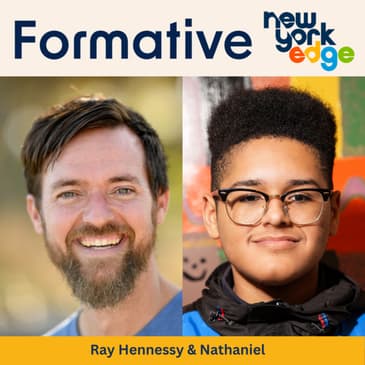
Ray Hennessy joins us on today's show! Ray is a wildlife photographer who specializes in bird photography. 8th grader and co-host, Nathaniel, asks Ray about the grit and nimbleness it takes to succeed in a creative field. Ray’s biggest lesson? Don’t be afraid to showcase what sets you apart. Your instinct may be telling you to blend in and do everything your peers are doing, but all that makes you different will also make you memorable, and that’s how you make the path enjoyable for yourself too!
Downloadable transcript here
INTRODUCTION
Welcome to Formative, the show where today’s leaders are interviewed by the leaders of tomorrow.
Formative is brought to you by the generous support of Macy's Inc. whose purpose is to create a brighter future with bold representation from underrepresented youth so we can realize the full potential of every one of us.
GUEST INTRODUCTION
We’ve got Ray Hennessy with us today. He’s a nature and wildlife photographer with a focus on bird photography. Ray’s photographs have been featured in magazines like Living Bird and Wildlife Photographic. He’s also the host of Wildlife Photo Chat, a podcast about the craft of wildlife photography.
INTERVIEW
Rachael: Hello and welcome. I'm Rachel Gazdik, CEO of New York Edge, and my co-host today is Nathaniel from M.S. 242K. Nathaniel, can you tell us a little bit about yourself?
Nathaniel: Hello, my name is Nathaniel Santiago. I come from eighth grade in a school called Mott Hall V. I love to study science. And I also love going into wildlife. One of my dreams is to definitely become a professional race car driver.
Rachael: Well, if you love wildlife, I think we’re talking to the right guy today. Nathaniel, who will we be interviewing today?
Nathaniel: Today, we're going to be speaking to Ray Hennessy, who is a wildlife photographer. I'm actually really excited because I've seen some of his photos online before, and being able to meet somebody that has gotten great success is truly outstanding.
Rachael: Well, let's bring him in. Ray, welcome and thank you so much for being on today’s show. Glad to have you here.
Ray: Hey, nice to see you guys. Thanks so much for having me.
Rachael: Alright, Nathaniel, take it away. What's your first question for Ray?
Nathaniel: My first question would be, what is your personal mission statement?
Ray: I don't know that I have one. But if I were to think about trying to sum it up, for me right now, my goal is to share beautiful, creative, and unique bird and wildlife photography, all while helping others learn to achieve their own goals with their wildlife photography. I really enjoyed the teaching and sharing process. Every photo I share, I try to include some helpful information in it that can maybe help somebody that doesn't have as much experience as me get more experience or grow faster. Yeah, so I would say that's probably it for me.
Nathaniel: Very nice. What inspired you to start this photography fantasy?
Ray: So, I grew up actually with my father always out in nature. My family and my dad and I always had this connection to nature. And he actually started with just backyard bird photography, so feeding the birds in the backyard. And then we got him a camera for Christmas once, and he was always into photography, but when digital came around, we got him a camera and he just started shooting stuff in the backyard.
And at that point, I had already been working as a photographer. but not photographing nature at all. I've tried all kinds of different types of photography just as a hobby and for fun. My first job was working for a wedding and portrait photographer. And so, I've had jobs that worked in other genres of photography and tried a lot of different types of photography. And so my dad started, got into it and I was kind of like, oh, that seems really cool. I love it. You know, just connecting us back to nature. I got into doing that with him. And so, he and I just started slowly just going out, and it started in the backyard. And then it was, let's go to this nearby park and then it's, let's go to the nearby national wildlife refuge. And it just grew from there. And, Nathaniel, instantly I was just hooked on it, just being outside, getting out in nature, and then just seeing all these animals. And then being able to photograph them and then share that as well with others, uh, just became a massive passion.
Nathaniel: Very nice because I think it's really inspiring that it portrays a message perfectly that you have to start somewhere. You have to start somewhere small and then you'll end up someplace big. Just as how you were talking about starting up in your backyard with your father.
Ray: Yeah, it definitely took me a long time and there's, you know, I talk to a lot of students of mine and people that message me all the time about the growth in this. And today it's like, especially with social media, it's the age of instant success, overnight success, virality. And that was so far from my experience. It was the complete opposite for me. It was just years of sharing. And I actually just looked it up the other day, but I've been sharing a photo every single day for the most part, every once in a while I miss a day, I think it has been 11 years now. So that's the kind of consistency for me it took to grow. But like I said earlier, I love sharing.
Nathaniel: Very nice. I love that.
Ray: Yeah.
Nathaniel: Where did you study to become a photographer, or was it, did you guess it on yourself?
Ray: Mostly self taught. It was right in high school, actually. So like I said, my dad was always into photography. He was like one of those guys that back in the day, because it's not so common anymore, but he had a dark room in his basement and stuff like that. And, um, he was always just into it. So as I was around it and exposed to it, pardon the pun there.
But, I didn't really connect with it until I was in high school and the reason being, I never considered myself very artistic. I was always much more technically oriented. And so when I actually got into photography, I got into it just on the computer side of things. This is going to date me here, but it was 1999, my senior year in high school, and digital photography was just becoming a thing. And so it was, like, the first year that school ever offered a class in digital photography. The teacher gave me a book called the Photoshop Bible, and it was like an 800 page book. I read it cover to cover. And at that time in my life, I had this weird ability to retain it, most of it. And within a month, I was teaching the class. He was like sending other students to me to answer questions and stuff like that.
So that Photoshop Bible book got me started on the computer side of things, and then, I never took any more formal education other than that it was my jobs that taught me. So, I learned on the job. You know, I learned at my first photography studio how to be a little bit better with weddings and portrait photographers. And wedding photography in general is a little bit of everything. As a wedding photographer, you're photographing the people you're doing group portraits and couples portraits. And then you're photographing the details and then you're documenting a live event. So there's event photography in there. So there's a lot of different kinds of genres kind of mashed into wedding photography. And so that was a good experience for me to learn a lot about different things. And then I transitioned into working with an architect photographer, and that was a whole different thing. I did all the post processing, the editing on the computer, I was sitting there in Photoshop for 40, 50 hours a week for eight years, just sitting at the computer. So I got really good at editing photos and making them look their best. And so, a lot of it is self taught, just learning, but working around others that have taught me and guided me along the way.
Nathaniel: I love how when you were talking about the books you were looking at, and that you read cover to cover. I love how that kind of gives an example of studying and reading and how important it is as, like, a message to students today. And it shows that even though you might not love it, it's gonna get you somewhere. It's gonna get you a job.
Ray: Well, I can tell you too, Nathaniel, from my experience, what helped me really learn that and connect with it is that I did love it. That was the thing, I loved that so much. So it was really easy. I was eager to learn it. There was nobody over there telling me I should learn it or put in this many hours. I got that book and I think I read the whole thing in a month and I just, every night I wanted to do more. And this was separate from school. I was just doing this on my own. And so I think when you find that thing that connects with you, you're going to be eager to learn it.
Nathaniel: Very good.
Nathaniel: What type of places have you traveled across the world to take your photos?
Ray: So I haven't done too much international stuff, but just to give you an example, this past year, I started the year with a road trip from South Carolina all the way out to Texas and then back and down into Florida. And then from there, I went to New Jersey to do a little bit of work. From there, I went to Quebec to photograph some songbirds that only nest up there. So me and my girlfriend went up there and then I came back down to the States, flew to Alaska for two weeks and went to a bunch of places there. And then came back. Then we drove to New Hampshire and I worked there with some loons. I do some workshops there every middle of the summer. Then I went up to Newfoundland back into Canada, which is as far east as you can go. That island is way out there. It's like the one weird place that has an hour and a half time zone. They're an hour and a half ahead of us. Isn't that weird?
Nathaniel: Yeah, really weird.
Ray: It's an hour and a half. I didn't even know there were half hour time zones until I got there. So anyway, I get there and I spent about a month and a half there doing some work. And then my girlfriend and I got in our van. Uh, I live in a van. I've done that for two, a little over two years now. And so that's my home. I have no other home. And so we went from Newfoundland, in through Canada and down into Michigan. We went to Wisconsin, went to the great salt lake out in Utah, then went out to California and then slowly worked our way back down into Arizona, back into Utah and hit a bunch of states along the way there.
So I’ve been all over the place. I just looked it up the other day. I think I have 40 of the 50 states I've been in, uh, in the past few years, doing some photography and stuff like that. And so, I'd love to branch out internationally. It just takes time and money. But eventually I'll start traveling to some more places like that.
Nathaniel: Yeah, out of those 40 states, what would you say has been your favorite place to take your photos?
Ray: It's impossible, man. They're all so great, and so unique. They all have something that stands out to them. I will say though, I do love the U.S., but Canada is awesome. Up in Newfoundland, it was great. The scenery up there is amazing. There's times that I was parked on the side of a cliff and there's birds right there and you get to photograph them and that's where I get to sleep for the night and wake up there the next morning. It's amazing. And so it's just great with wildlife, beautiful scenery and nature, tons of hiking and mountain biking. I love to do that too. And so it just kind of has everything there. And in the summer, it's just beautiful weather, not too hot. It's really nice there. It's kind of made for the way I live too, with the van living. There's a lot of free places you can camp and just pull off on the side of the road and legally stay. So I'd say in the last year, that's kind of one of the standout places for me is actually all the way up in Newfoundland.
Nathaniel: How much do you usually spend on your photography trips?
Ray: Uh, lately, almost nothing because I live in my van and that kind of, like, takes me there. So that's the beauty of that, you know. I was just in, like I said, Arizona and Utah and stuff like that. When I'm parked there, it doesn't cost me any more to park there than it does when I'm parked right outside my mom's house or, in this case, my girlfriend's house down here in South Carolina.
Uh, so that's the beauty of living that way is it allows me to travel much cheaper and really not have any additional costs no matter where I'm at, other than just the gas it takes to get there. But I would normally be driving around in the areas I live in anyway. So, that tries to keep things down a little bit.
The other way I've traveled that I've been really lucky enough to do is I've met a ton of people that I've connected with and become friends with. And they've made the mistake of offering, hey, if you're ever in the area, you can stay here and I take them up on it. So I've traveled to the Great Salt Lake, I traveled to Newfoundland the first time, I traveled to Alaska the first time, all on just the flight cost to get there. The people I knew, these friends, picked me up and allowed me to stay in their home. So I didn't have to rent a car. I didn't have to rent a hotel or a place to stay or any of that. And so, the kindness of others has really allowed me to travel to a lot of places. It's just really, really nice to see the generosity of people that has allowed me to travel to places that otherwise, honestly, I wouldn't have been able to afford.
Nathaniel: What has been your closest encounter with an animal without using a zoom lens?
Ray: I mean, I've had birds land on my head. I had a bird land on my hat once. I'll go back to Newfoundland cause I love Newfoundland there. So I'm on the cliff, it's a 300 foot cliff straight down to the ocean, right? You're able to walk right up to the edge of this cliff. Don't make a wrong step because, no joke, you're dying. But, uh, we're photographing these seabirds, so these really large seabirds, their wings are almost longer than my hands are stretched out, really big.
Nathaniel: Very big wingspan.
Ray: Yeah, there's 10,000 of them there, right? So that's the seabird colony. They're nesting there. And then there's 10,000 other types of birds there too. So there's like 20-30,000 birds just flying around all over the place. And so a lot of them fly really close to this cliff. And so I put a wide angle lens on. It's a 24 to 70. And I had it set at 24 millimeters, so showing the whole scene off in the background. And I'm sitting there just kind of crouched down in between a couple of rocks, just trying to hide. And so, they don't really see me standing out. So, they're going to fly close by over my head. I'm going to snap a shot when one flies nearby, right? All of a sudden I'm looking through my lens and I just hear and feel this like, whoosh, whoosh over my head. And I feel a wing hit the top of my head. And I look up and one of these gannets had landed on the rock right next to me. And so I'm sitting here pointing my camera straight ahead. The bird is just to my right, and I just sort of peek up and look, and it's like, he's right there. It's crazy. And so, all of a sudden I just slowly move the lens up and just hope, in my head, I'm saying, don't move, don't move, don't move, you know. He stayed and I was able to get some shots there. So I got this beautiful shot of this gannett really close up. It was kind of intimidating. The bird was so big and just right in my face. They got, like, a big bill. I'm like, man, he could really probably poke me in the face if he wanted to there and hurt me, but he just relaxed. I moved really slowly. He just didn't care about me being there. And I was able to photograph him with the whole colony of these 10,000 other birds in the background that you can see. And so, yeah, I've had a few encounters like that where things come really close, um, and either land on me or right next to me, which is pretty amazing. And you do not need a lot of expensive stuff for that, but it doesn't happen often.
Nathaniel: You're lucky to have those encounters because it makes it easier for you to take the photos.
Ray: Yeah, definitely.
Nathaniel: I really appreciate wildlife, especially birds. I feel like very colorful birds with a good mix of color. That's what I really like, like tropical birds.
Ray: Yup. I'm getting ready to go to Costa Rica in January.
Nathaniel: Oh, nice.
Ray: So, I’ll be seeing some tropical stuff down there, yeah.
Nathaniel: If you had a rare type of bird or any animal that's rare that you would want to photograph, what would it be and why?
Ray: You know what? I really want to photograph and have some experience with penguins and I want to do it in Antarctica because that's, like, my dream location is to go to Antarctica. I haven't been there yet. All the photographers I've talked to that have been there say it's a life changing experience just because that place looks so unique. Understandably, there's nowhere else on the planet like it. It's an extreme location, uh, lots of snow. And one of the things I like in my photography is to keep things clean and sort of a minimalist style. And you certainly get to do that there with a lot of white everywhere and snow.
And also the fun part is a lot of the animals there aren't used to humans, so they're not afraid. And so you get to have a lot of these closer encounters potentially. And penguins are just like, they're really pretty and cute and goofy and silly, and I've never even seen one in the wild. So, I think it would be a fun experience to photograph some penguins down in Antarctica at some point. So hopefully I can make that happen.
Nathaniel: Very nice. Do you have any special techniques that help you take your wildlife photos?
Ray: Yeah. There's a lot. Um, the biggest piece of advice, I think the best piece of advice I give to a lot of the students I work with is to just practice. There is just, like most things, right? There's no one thing that just makes it great. You have to practice, you have to be well rounded, you have to learn all aspects of it.
But for me, what I try to put into my photography is something unique and I try not to follow the trends as much as possible. And at first it seems counterintuitive because it's like, oh, this trend is popular now and it's popular for a reason, right? And so popularity means more views and more likes and all of that stuff, right? But what I realized a long time ago is, if you do the same thing everyone else is doing, you blend into all of that.
And for me, what I've done from the beginning is I've tried to be unique. And the main way I've done that is I use a lot of my compositional techniques and the sort of small in frame thing which I learned with my wedding photography. My wedding and portrait photography is where I learned that, and I brought that into my wildlife photography. And for me, if you think about photographing a bird in a place, um, let's say you're in a beautiful place. You have this beautiful mountain scenic background, right? And you have this big zoom lens and you zoom in crazy close on the bird and you photograph the bird and the bird fills the frame and you see nothing else, the background's blurred and it looks clean. You can show off that bird, but where is that bird? We have no idea. It could be in my backyard in New Jersey, right? Or it could be in some amazing place. Well, if it's in this amazing place. Don't we want to show off that amazing place along with the bird? And so, that's my approach to it. I try to, when possible, show off the bird or whatever wildlife subject I'm working with in its habitat. I'd like to show off that beautiful habitat and make it look beautiful, like almost a landscape that you would just hang on the wall, but it has wildlife in it.
And so, that approach from the beginning wasn't the most popular approach, but it's what I liked. And so I stuck with it, and now I'm known for it. And people appreciate it. And so my point there, if you find an approach to your art, whatever it is that you like, and it's maybe not what everyone else is doing, that's probably a good thing and stick with it. If it brings you joy, if you're passionate about it, if you stick with it, sometimes I think if you work hard at it and stick with it, you're going to stand out for that and therefore become known for that and just stand out from the crowd. And for that, I'm grateful when people point that out for me. And I'm glad I have a following because of that.
Nathaniel: Ten years ago, where did you see yourself in 10 years?
Ray: Ten years ago, I was deep into running my own wedding photography business. And so, at that point, I thought that was going to be it. I had these small dreams here and there, like these wishes, these like daydreams I would say, cause I was doing wildlife photography on the side as my hobby. And I would think every once in a while, wow, wouldn't it be cool if I could make a living doing this? But at the time I wasn't far enough into it or experienced enough to really think I had anything to offer other people or to be able to make that switch. I didn't know how on earth I would ever make any money from just taking pictures of birds compared to weddings. Weddings are pretty straightforward, you know. A lot of people get married, they want a wedding photographer. There's a business model there that's kind of obvious. With wildlife, anytime I thought about it was like, how would I be making a job from that?
And so, it was always just like a quick passing dream and not something I ever really thought about too seriously 10 years ago. So, I think if you asked me 10 years ago, I probably would have just assumed I was going to keep doing the wedding thing because I was enjoying it to an extent. I didn't hate it and I was still my own boss, which was great, running my own business with my ex. That was still a wonderful thing. I had control over my schedule and when I wanted to work and how often I wanted to work. So that was a nice bonus. And so I would have been happy doing that, but I certainly am happier doing this.
Rachael: Hey, I have a question for you, Nathaniel. You just asked Ray what he thought he wanted his life to look like in 10 years. Do you know what you want your life to look like in 10 years? You know, you’re 13, right?
Nathaniel: Yes, I'm 13.
Rachael: So, let’s see, you’ll be 23.
Nathaniel: Ten years ahead, I think I would imagine myself being in some sort of college or school that can help you get knowledge on cars since that's really my dream. I want to be able to know how to fix cars and how to work on it. So not only can I do whatever I want when I get a car, but also to help my family, because my family's helped to raise me and I also want to be a huge benefit for my family since they've cared for me and I want to return the favor.
Rachael: I love that!
Ray: I wanted to jump on that 10 year thing. I just did an “Ask Me Anything" on Instagram the other day, and I had a bunch of questions come in, and somebody asked me the same thing. They said, where do you see yourself in 10 years? And I took a moment to think about it and I realized how grateful I am right now because I got to answer it completely honestly and say, I don't want to change a thing. Like I'm there, like that's a great feeling. And I've never been able to really say that in my life. There's always been something that I've been looking for, working towards, stuff like that. And so, to feel like I've gotten to where I'm just so happy with where things are, it's just a wonderful feeling.
Nathaniel: Very nice. If you didn't go down this path of being a photographer, what do you think you would be doing these days?
Ray: Oh, I have no idea. I know I wouldn't like it as much as this. Boy, that's tough because I had no idea in high school what I wanted to do with my life. I just didn't have anything, like a career that I was passionate about, and boy, I don't know. I really don't know where I would have ended up. If not for the wildlife photography, I'd still probably be doing the wedding and portrait stuff, or just maybe working for another studio doing that computer stuff, but I enjoyed that to an extent. But I got tired of just sitting behind the computer. You know, it didn't get me outside. It didn't have me being active at all. And it's not something I'd want to spend my life doing, even though I certainly enjoy that aspect of it, but I don't know. I don't think I have an answer for you really. Cause I can't think of anything else outside of photography that I'd want to be doing.
Nathaniel: That's alright. You should always stick to your dreams. That's what I believe.
Ray: Yeah.
Nathaniel: Is there a specific practice or discipline that has helped you achieve your success?
Ray: Yes. The easiest answer for that for me is just never stopping. So it's just, like, fortitude. Just keep pushing, keep pushing and not giving up. I don't consider myself and never have considered myself good at advertising my own business. In fact, I know I suck at it and I don't like doing it. I don't like promoting myself and kind of talking about, you know, hey, work with me, hire me, buy my stuff. I'm just not good at that. It doesn't feel right to me. So instead, I've just continued. I just keep doing what I'm doing and it's paid off. The challenge is that it doesn't pay off quickly. It takes some time, and I've been lucky enough to have supportive others around me that have allowed me to really explore this. And I know a lot of people don't get that chance. I know a lot of people don't have a supportive family or a supportive spouse or significant other that maybe can both, um, emotionally and conceptually support them as well as sometimes financially help ease the burden as you try to transition into a new career and stuff like that.
And so, you know, there's some lucky circumstances there but in the end, it all came from just not stopping, just keep doing it and not giving up and it paid off for me.
Nathaniel: My parents have always taught me not to give up, and even though I know it's a really hard process, because there's going to be some struggles, troubles in your way that you have to triumph through, if you keep doing it, you're going to get where you want to be. Because I believe that nothing is impossible, just as long as you have faith.
Ray: And if you love it, I think you have to love it, right? Because if you're not enjoying it, if you really don't have a passion for it, what's the motivation to push through those uncomfortable times? Because they will come up just like you said, you know, there's going to be challenges. And if it's just like, yeah, I'm doing this for a little cash on the side, like, there's no reason to push through that. Whereas if you truly love it and have a passion for it, it's going to be easy to push through it because it's something you would do in your spare time anyway. And that's how it's been for me.
Nathaniel: I love that.
Rachael: So Ray, our final question is one we ask everyone at the end of the show. If you could go back and speak to yourself at 13 years old, what would you say?
Ray: That's pretty easy, actually. It goes into what I like to apply to my photography, which was to be unique. It's a good thing, like to stand out and be unique in a certain way. I really see that genuinely is such a good thing now, instead of blending into the masses. And my 13 year old self, all I wanted to do was just, you know, the whole fit in, blend in and be doing the same thing as all the cool kids and all that stuff.
And I mean, I realize now, especially in a creative industry, an artistic industry, that sameness really does not help you in any way stand out as far as both the career and for me, at least for fulfillment. And so I think if I would have been able to pass along that advice, it's okay to be different. It's okay to be unique. And it's actually a positive thing, like embrace it and own it and stick with it. Because I think at some point down the road, others will appreciate you for that and appreciate whatever it is you do, whether it be artistic or not
Rachael: You know, a lot of people feel that way. And it’s something you can only learn by growing up.
Ray: totally. Yep. There's no way to learn it other than experience.
Rachael: Yeah, exactly. Well, I really enjoyed this conversation. Thank you, Nathaniel, for being such a wonderful host. And thank you, Ray, for being such a generous guest.
Nathaniel: I appreciate it.
Ray: I really enjoyed it. Thank you. Yeah, this was fun.
Nathaniel: I loved it.
CREDITS
Thanks for listening to Formative, a production of New York Edge. I’m your host, Rachael Gazdick. Brought to you by the generous support of Macy’s, Inc. Our production partner for this series is CitizenRacecar. This episode was produced by Hager Eldaas, post-production by Alex Brouwer, production management by Gabriela Montequin, original music by Garrett Tiedemann. Thanks to the whole team at New York Edge for making this series possible. Never miss an episode by subscribing to the series at newyorkedge.org/formative or wherever you get your podcasts.