
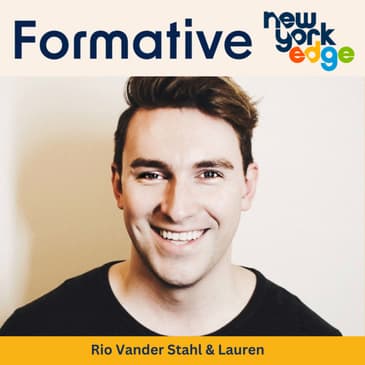

Rio Vander Stahl’s childhood dream was to become a cellist in the ranks of the great Yo-Yo Ma. But his career didn’t turn out that way, which makes his story much more fun. On this episode of Formative, 8th grader and co-host, Lauren, learns that your career path doesn’t have to be linear and that your experience ends up being more magical when you’re not following a strict blueprint.
Rachael: Welcome to Formative, the show where today's leaders are interviewed by the leaders of tomorrow.
We're joined today by Rio Vander Stahl. Rio is the Director of Digital Strategy at Artechouse, the nation's first innovative art organization dedicated to the intersection of art, science, and technology. Rio leads all digital efforts at Artechouse, including marketing, content, and audience development. We're so very excited to learn more about Rio's background and current work.
Rachael: Hello and welcome. I'm Rachael Gazdik, CEO of New York edge. And my co-host today is Lauren from M.S. 61K. Lauren, can you tell me a bit about yourself?
Lauren: Hi, my name is Lauren. I really enjoy running track, doing art, and cosmetology.
Rachael: Oh, that's lovely, Lauren. Who are we interviewing today?
Lauren: We're going to be interviewing Rio Vander Stahl.
Rachael: Awesome. Well, let's welcome Rio. Thank you so much for being here.
Rio: Of course. Hi, really excited to be here.
Rachael: Lauren, take it away. What's your first question for Rio?
Lauren: Can you, like, um, explain to me what a digital strategist does?
Rio: The company that I work at is called Artechouse. And at Artechouse, our goal is to push the boundaries of art and how we experience it. And we do that in a bunch of different ways, but one of the main ways is by supporting artists who primarily use technology to create. So, so much of what we do is about presenting art in new and different ways. And for me, um, as the Director of Digital Strategy, I think about all the different ways that Artechouse interfaces or connects with people through digital channels. That includes social media, the website, email, um, you know, how are we telling our story? Are people excited to come and visit? Are people learning? Um, how are we connecting with people through digital channels?
Lauren: Yeah. So, another question is what is your favorite thing with working with artists and your least favorite thing?
Rio: My favorite thing is that art is differentiating. I mean, art is one of the most important things that we have as humans. It's how we connect, how we can communicate and process the things that are inexplicable and that are challenging and that are painful and are joyous. And it's also, you know, being able to help create opportunities for people to have those experiences, I think is so incredibly valuable. It's so rewarding. It's so amazing to help people walk into a space, you know, walk into Artechouse, you don't know anyone else. You have the one person that you came with. You don't know anyone else. You all sit there together and you share this collective experience that is both with everyone, but also completely isolated.
And there's something, I think, incredibly powerful that we can learn about that, about how we can get along and have these shared experiences and empathize and learn from each other. Um, and I think the hardest part is that art is, for art to be good, it usually has to be very personal. And when it's very personal, you have to protect it.
So artists have to protect themselves. They have to make sure that their vision or their creative energy or their product, however, you know, whatever component it is, it's, it can be delicate. And you have to make sure that they're taken care of. Um, and that's, you know, that is, I think one of the great misunderstandings of artists or people who might be labeled as difficult to work with or divas or that kind of thing, but it's like, they are that way because they, cause they ultimately have to protect themselves and make sure that they can continue creating in the way that they create.
It's really funny because when we think of creative people, we think of artists, right? We think of people, someone standing at a, an easel painting or drawing or singing, and I, you know, I started out there. I started out as a cellist. That was where I began, um, began my journey. I went, studied it really intensely in high school and I went to school and I studied it and I wanted to become a performer. And then I realized that I don't practice very well and I wanted to be a classical cellist and you have to practice constantly and you have to be so dedicated to being alone. And I really liked collaborating with people and connecting. And what I've discovered over the, you know, the past chunk of my working career is that the people who are the most creative are oftentimes not the people in the most sort of traditionally creative environments, that creativity comes in all forms and shapes and I feel like I'm incredibly creative. I'm not performing or practicing cello as much anymore. Um, I've lost my calluses and so admittedly, it hurts every time that I start trying to play again. But I still feel like I am a very creative person in terms of how I navigate my work day.
But at the same time, I also do a lot of other stuff. Like I, I crochet and I do yarn and I paint and I keep busy with other art, fun, different art projects, but it's not like part of my work.
Lauren: Speaking of artists, what do you think makes a good artist?
Rio: I think the most important thing to being a good artist is about having something to say. That ultimately, whether it's happy or sad or confused or dark or bright or whatever it might end up feeling like, it's about having a clear idea of something. Sometimes it's conscious. Sometimes you know what you're trying to say. Sometimes you don't. So, for instance, uh, this exhibition that we just opened, which is called Ase: Afro Frequencies, and, um, it features visuals by this UK based digital artist named Vince Fraser, who's amazing.
He's an Afro surrealist. In surrealism and Afro-surrealism, it's not about a clear narrative. It's not about knowing what happens at the beginning, the middle and the end. It's about communicating the emotional part of it. It's about creating a feeling. And so, I was talking to Vince last week and he was saying, sometimes I don't know what it is that I'm creating or why I'm creating it, but I create it and then it's right and it's incredibly impactful and it feels incredibly strong. So I think it's having, having something to add, having something personal, having something unique.
What do you, when you make art, what is important to you? What do you think? What do you look for?
Lauren: Well, most of the times when I'm making art, I don't even know what I'm going to draw. I just go with the flow. I do circles, shapes, any shapes and whatever it turns out to be, I do it.
Rio: I love that. Do you ever start looking at it and you're just like, this isn't good enough?
Lauren: Yes, I just start second guessing it. I'm like, I think I should just start over or just leave it alone.
Rachael: Rio, I know you work with artists all the time, but do you consider yourself an artist too?
Rio: So I think that's one of the best things that for me that I've discovered after not playing cello as seriously, letting go of that and coming back to art late, you know, now I have a different job and coming back to art and doing things like crocheting or draw or painting or any of those things is that it doesn't matter. Like I'm not doing it for someone, I'm just doing it for myself. And so it's given me the space to take away that judgment and just keep going.
There's a really amazing quote from an artist named Teresita Fernandez, who's incredible. She's an incredible installation artist who does sculpture works. And she talks about art being something that you've given yourself the space to go make it so uniquely your own that it couldn't be anyone else's. And I think about that a lot. I think about that with work. I think about that when I'm drawing something. I think about that when I walk into Artechouse and see our spaces. Good art is that, like, you've given yourself the permission to push past your fears and continue to just make it your own, to continue just like making it something that only you could have done that only reflects you. And, and that I think resonates with people. People connect with that.
Lauren: What's a mistake that you have made, like at your job, at work and how did you fix it?
Rio: So, I think something that has been very interesting for me is that I've worked in a lot of different environments. So I've worked in really conservative environments where it's very structured and very sort of, um, it's a certain way that you work, you have to dress in a certain way and I've worked in startup environments that are very different, very much the opposite.
And, you know, you work with a lot of artists, you work with a lot of people who are either emotional or excitable or get frustrated or, you know, and there are all of these times when I wish that I could have just act frustrated or act, act how I felt and roll my eyes or do whatever it was when I didn't feel like I could. And so, I'm in a position now where I am able to lead and I can now. And what's interesting is that I've been able to kind of see how it doesn't help, how I've been able to like, let myself have my reaction and then get to learn for myself that it's like, that doesn't help the situation. It doesn't help people get done what needs to get done. It doesn't make them feel better. It doesn't make you feel better. Um, and I think that's been the biggest thing is that everyone that I work with, we're all hurting in some way. We're all dealing with things. We've all got baggage and we wake up and you know, you get a text from your parent and it pisses you off or it's frustrating or it's challenging. And then you go into a meeting and you have to deal with that whole scenario. And we don't stop being ourselves when we walk into a workspace or when we hop onto a Zoom call. And so it's really trying to have empathy and have grace for people who may not be able to be their best selves at that moment.
Lauren: Another question is what is your favorite part of your work day?
Rio: I love helping people to make connections that they may not be expecting. And that's always sort of been the case. I mean, my title is digital strategy, but what that means on a day to day basis is really varied. Sometimes it means that I'm helping to train teams on the exhibition material. Sometimes it means that I'm editing content and figuring out how we're going to tell the story to audiences. Sometimes it's going through analytics and understanding who's responding to what and how it's working, what's going to be the most effective. But I think ultimately it all centers around that moment when people make a connection that they've never had before, that they learn something, that they understand something, um, or the most powerful when art that they experience unlocks something inside of them, when they, when it was art that they needed or an experience that they really needed to have.
Lauren: So where do you see yourself ending up in 10 years?
Rio: You know, what's interesting is that I think, I think that we have this idea that the moment that we're in is how life is going to be, that the thoughts that you have now, the context that you have, the framework, your feelings that you have right now is how you are going to be for the rest of your life. And we kind of forget that it's constantly, you know, every minute, every second that's changing a little bit. And, and when you have days, weeks, and months of those little changes, suddenly in six months, you feel differently about everything. And I think I don't know who I want to be in 10 years. I don't know what career I want to have in 10 years or in 15 years.
And I still ask myself what I want to be when I grow up. Like it still feels like I'm kind of making it up as I go. So my… selfishly, and this is not particularly helpful, but like, I hope that in 10 years, my life is something that I couldn't even imagine now. Right? Like it is more unique and specific and feels better than I could hope for.
Um, I want to keep doing things where I have the chance to learn. I think that's the most important, one of the most important things for me. I want to laugh a lot. I mean, it sounds silly, but, like, ultimately the people that you work with, the people that you spend your time with, if you're not having fun, like, what are you doing? You know, you should, you should be laughing. You should be having fun because the day is so much harder if you're not laughing about everything. Um, and then I want to make sure that my family is, you know, taken care of and that we're all healthy and that, um, we have the chance to, you know, be safe and sound.
So whatever, whatever combination of those things, you know, it's not a set career path, but I think if you have too rigid of a career path, if you plan everything out and you have your 10 year career, you can achieve that. But ultimately, what are you trying to achieve? Are you trying to build out a resume or are you trying to build a life and an experience that you want?
And if you're trying to build a life, then your tastes change. You might decide that you don't love doing this one part of your job. You might realize that you don't like sales and you actually want to write proposals or do art or something like that. And if you don't listen to that and you just focus on creating your resume, then you rob yourself of the opportunity to grow and to change and to evolve. And if you're doing things right, you should be, you should be changing. You should be evolving and growing.
Lauren: So where are you from?
Rio: So I'm originally from California. I am from Santa Cruz. I was born in the mountains, uh, in a hundred degree weather at home. And I originally went to school sort of in the mountains. And so, Santa Cruz as a place, as a city, is really expensive. It's a very high cost of living. And I, in talking to my parents later, basically, they said that the only reason that they stayed in Santa Cruz was because there was a really good school that I went to for junior high and high school. They said that the education was the most important thing. And so they stayed, uh, there versus moving somewhere that was going to be maybe easier to live in because I was able to go to a really good high school. Um, and that environment I think is really what shaped and pushed me and helped me grow from the people that I was around because you end up being a result of the people that you surround yourself with. You learn from them, you become like them, whether you think about it or not.
Lauren: What were you like in middle school? Did you have hobbies? Did you play games? Did you play any sports?
Rio: That is a great question. So I played cello, and that was, a lot of my energy was carrying my cello around. And the school that I went to was very focused on academics. It was a charter school. It was junior high through high school, so 7th through 12th grade. And that's all that you were doing was just, like, focusing on school. We didn't have sports. We didn't have, it was just like, get ready for your tests. And so I had the opportunity in middle school to kind of learn how unprepared I was for that. How, you know, neither of my parents are really, um, neither of my parents finished college and so, uh, they didn't teach me necessarily how to study. Um, I was also so headstrong, they tell me that they couldn't have helped me study, you know, even if they did have advice for me. So I think that it was about, like, learning and understanding how I was going to fit in that environment and making sure that I was, like, doing the best that I could there.
Um, I was kind of, like, morphing to fit the space that I was in. Yeah. But trying to practice and then also trying to stay awake and then also trying to like get all my homework done and you know All those I feel like all those normal things, but I was really I guess I was really like career quote unquote career focused or really focused on music and school and, you know, what worked for me.
Lauren: My middle school, like, offers a lot of activities you can do. So, I would never say I was bored at school. It's not like work, work, work, work, work, work, work. But when the time to work comes around, we do the work, get it done.
Rio: I love that. Did you, have you had a chance to, cause you said you love to run track, you love cosmetology, you love all these different things. Have you gotten to try all those in school or is that, is, or some school and some not? Like what have you gotten to do in school?
Lauren: Cosmetology? Yes. Our afterschool program does, um, offer cosmetology and sometimes I do it.
Rio: That's awesome. What part of cosmetology do you love?
Lauren: I love everything about it, but I like doing hair the most. I love doing hair. I love doing my sister's hair, anybody's hair.
Rio: I love that. You've got someone to practice on at home, which is perfect. Um, I, I think that that's like, you know, the best, that's the best thing that you possibly can hope for is having the opportunity to do lots of different things.
Um, I would say that like, that was something that was really, I have grappled with now that I'm not in that environment that was really specialized, which is like how much my brain doesn't do school particularly well. Like, I love learning and I love trying things and I'm constantly, like, trying to learn as much as I can, but, like, the school environment was never the best for me and I think, like, getting to try different things. It lets you really figure out what clicks with you because like, ultimately you're going to end up doing those things. Like, the things that click with you is where you're going to end up spending your time, whether it's your job or not. And so letting your, being honest with yourself about like, if you love cosmetology, go, do it, keep practicing, keep doing it, keep following that. Um, but if you love science, go do that, Math, you know, whatever the subject, whatever it might be, because that's how you are able to learn enough to find a job in it or to just continue growing or to continue evolving or continue sort of, um, um, with your path on it and not end up spending your time on things that make you tired or that you don't like.
Lauren: If your middle school dream came true, would you be doing the cello right now?
Rio: Yeah. So, if my middle school dreams came true, I would, um, well, it's, so it's interesting. So there's two things that come to mind. One is that yes, I would be a cellist. It would, you know, Yo Yo Ma was the cellist that everyone knew about who I'd had, I have a classic Yo Yo CD that I can probably sing you all of. I've listened to it so many times, and ultimately that was what I wanted to do, was to be a soloist, to go around, play with orchestras, to be that kind of a performer. But the thing is, that has to happen for you when you are like, 4 years old. You have to, that's something that happens very young and you have to, very specific environment and end up with a very, it's almost luck that all of the components come together. And that was looking back, that was never going to happen, um, for me to have that happen in that way, but the other thing that I really wanted was one, I love the idea of being on stage and connecting with people. And so it's funny because it's different now, right?
When I was in middle school, I really just wanted to connect with people. And through stage was the way that I've found that through performance and I still feel like I do that to some degree. Um, sometimes it's, yeah, giving talks, sometimes it's trainings and it's panels, you know, whatever it might be. Like in trainings, when you're standing up in front of people, you're still connecting with them. You're still performing. You're still making sure that they're understanding. You still get a little bit of applause at the end. It's not thousands of people. It's 15, 20, but it still is that same sort of feeling. It's that same connection. I ended up still doing that, even though the medium changed, even though it stopped being cello.
Rachael: Rio, it has been such a pleasure to be with you today. To wrap this up, we have one last question we ask all of our guests. If you could go back and speak to your 13 year old self, what would you say?
Rio: I knew this was coming and I, I thought about this and I thought about how I shouldn't be too, I shouldn't think about it too much, but I probably should have thought about it a little bit more.
I think it would be to say it's going to be okay. Like, things might be hard. Things might not make sense. These pieces might not feel like they have a place, but you're going to find somewhere where they do. Um, and the other I think is to trust yourself. I think we come up in school. Um, we come up in these environments where there's a very specific way to succeed.
There's a very specific way that you need to operate to, to, um, you know, get an A, right? You have to be able to memorize, have to be able to work in a certain way, analyze in a certain way and a certain way that you have to act. And if you don't act in those ways, you kind of grow up feeling like something might be off or something might be wrong or, or that your brain works in a different way. But I think that that's a huge part. It's that like, don't try to remove parts of yourself that might not fit in the environment that you're in. Make sure that you listen to what feels right and what sounds right to you and you might not be able to to fully unfurl your wings where you are but you don't need to chop them off you can wait and then unfurl them when you're in an environment that has more space that is ready for yo.
Rachael: Thank you. We appreciate you spending time with us.
Rio: Yeah, of course. Well thank you so much for the questions. Um, thank you, Lauren and um it was great to meet you.
Lauren: You too. Bye!
CREDITS
Thanks for listening to Formative, a production of New York Edge. I’m your host, Rachael Gazdick. Our production partner for this series is CitizenRacecar. This episode was produced by Hager Eldaas, post-production by Alex Brouwer, production management by Gabriela Montequin, original music by Garrett Tiedemann. Thanks to the whole team at New York Edge for making this series possible. Never miss an episode by subscribing to the series at newyorkedge.org/formative or wherever you get your podcasts.