
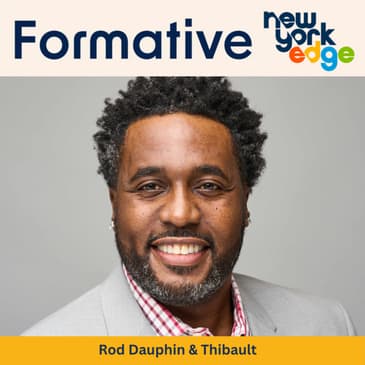

Rod Dauphin joins us today to kick off this season’s Formative! Rod is an educator and entrepreneur. He is the Education Services Director at Goldman Sachs 10,000 Businesses Initiative at Laguardia Community College. 8th-grader and co-host, Thibault, learns that in order to grow and challenge ourselves, we should be willing to make mistakes and fail. In this episode of Formative, Rod shares his practice of encouraging entrepreneurs to think like kids who are playful and willing to think outside the box and make a mess to find valuable ideas otherwise overlooked.
Downloadable transcript here
INTRODUCTION
Welcome to Formative, the show where today’s leaders are interviewed by the leaders of tomorrow.
Formative is brought to you by the generous support of Macy's Inc. whose purpose is to create a brighter future with bold representation from underrepresented youth so we can realize the full potential of every one of us.
GUEST INTRODUCTION
To start this season of Formative, we’re speaking with Rod Dauphin. Rod is an educator and entrepreneur. He is the Education Services Director at Goldman Sachs 10,000 Small Businesses initiative at LaGuardia Community College. And we are thrilled to be kicking off this season with Rod.
INTERVIEW
Rachael: Hello and welcome. I'm Rachael Gazdick, CEO of New York Edge, and my co-host today is Thibault from I.S. 318K. Thibault, can you tell us a little bit about yourself?
Thibault: Yeah, so when I grow up I want to be a historian because I think that the study of our past is very important. And I think that the best thing about podcasting is being able to be heard by others.
Rachael: Amazing! And Thibault, who are we going to be speaking with today?
Thibault: Today, we're going to be interviewing Rod Dauphin, who made the 10,000 Businesses. I'm very excited to speak to him.
Rachael: Hey, Rod. Welcome to Formative. Thanks so much for joining us today.
Rod: Oh, thank you so much. Thanks for having me. Great pronunciation of my last name. I truly appreciate that. I can tell you worked at it.
Rachael: Alright Thibault, take it away. What’s your first question for Rod?
Thibault: Yeah, I was wondering, what exactly is 10, 000 Businesses?
Rod: Great question. So, 10, 000 Small Businesses is actually the Goldman Sachs 10,000 Small Businesses. It's a $750 million investment into small business owners across the United States. And the goal is to help these small business owners grow their businesses so that they can create more jobs and help the US economy. So, my role is I am the education services director out of LaGuardia Community College, so, I'm responsible for the metro New York City area and I put together the team of instructors and I oversee the team of business advisors that support business owners from an education and implementation perspective.
Thibault: That's really interesting. I was wondering, when I was doing my research about you, I was very confused. Like, why is it Goldman Sachs?
Rod: So sure, Goldman Sachs is an investment bank and they're the ones providing the money. Since they're paying for it, they get to name it.
Thibault: What advice would you give to a business owner who's trying to apply for 10,000 Small Businesses?
Rod: Think beyond your constraints. We teach people how to think entrepreneurially beyond the box. Think like a kid that has no restrictions. If you think of a six year old, they'll jump off a couch thinking they're Superman.
Kids got it right. But as you get older, life beats you up sometimes. It's just a necessary part of growing up. But those punches that you receive ding your imagination, your creativity sometimes.
And instead of being fearless, you start thinking within fear. And to be a successful entrepreneur, you almost need that mindset where everything is your playground.
I remember when I was younger, I'd turn a hanger into nunchucks. Anything at my disposal became a toy. I figured it out, right? And so, I would tell business owners, almost become childlike where everything can become anything if you just put your mind to it. And when they come into our program and apply with that mindset, the most amazing things happen. I can tell you stories for days of how we've impacted so many people's lives. I know in my particular location, we've worked with over about $1.4 billion worth of businesses.
Thibault: Wow.
Rod: Right? And the jobs we've created, because we just help people just think outside the box.
Thibault: Yeah, my mom's an entrepreneur. She came from France and she made a ceramic studio.
Rod: Really?
Thibault: Because that's what she liked a lot. She went to l'Ecole des Beaux Arts.
Rod: Ah!
Thibault: She has a mindset similar to yours. But,could you give, like, a few examples of businesses that were able to thrive and why you saw they had the potential to thrive?
Rod: I'll tell you one story. We have a trucker, right? Trucker, what this person does is they go to construction sites and remove debris and things of that nature, okay? And, in our program, we're talking, think outside the box. How do you think outside the box when your purpose is to just go haul debris?
Now, this is during the very beginning of President Obama and there was this huge initiative for green, going green and recycling. So, one of the programs was for recycling.
So, what the trucker noticed was that he would haul, from certain locations, batteries, dead batteries. So, then he had the bright idea, because the government is looking for contracts. He just bought a battery recharger, bought his own labeling machine, recharged the batteries, labeled them, the government was paying for him to go green. And he added about a quarter of a million dollars to his business.
Thibault: Wow.
Rod: Simply by looking at what's next to you. It's as simple as that.
Thibault: Because also, lithium can be very bad for the environment or cobalt or things of that nature.
Rod: Exactly! But just keep your eyes open. So another one, This is a very simple one. So, we had a business that was dealing with branding, right? So they would do branding and some level of marketing and they were doing decent, I think maybe two, three hundred thousand dollars a year but this was someone that said, I'm really good at this. I'm really good but the people who I want to sell it to won't pay what it's worth, right? So, if your mother does ceramics, she says it's worth this, someone may say I don’t want to pay that. Common thing in business. Now, this is as simple as it can be. We said, “Don't sell to those people, find someone different to sell to.” And she said, “It's not that easy.” Why is it that hard, right? So, after some convincing, instead of selling to just smaller businesses, she went after a larger business. On her last day with us, she signed a $7 million contract. So 300,000 to 7 million, I’ll let you do the math but that's a huge increase.
But the point of that was just, find who values what I do. So, sometimes it's the creativity. Sometimes it's just the way you think. But it's never as hard as you think when you start seeing what it took to get there.
Thibault: Yeah, where did you get inspiration?
Rod: My inspiration actually starts with my father. My father was a cab driver in New York City and I consider that to be entrepreneurship. I consider that to be someone who is taking responsibility for their own future, determining their own hours and is directly responsible for how much money they bring home. My father inspired me to say, wow, he provided for me and my sister and my extended family. And so I want to be able to do the same thing. So, I decided to go down this path of just studying business. Some of my degrees are in business, and then really studying entrepreneurship. I'm an entrepreneur as well. So I'm a small business owner as well as an instructor in this program.
Thibault: You mentioned that your dad was a taxi driver, how did that affect you personally?
Rod: So, a couple of things, because being a taxi cab driver is not a glamorous job but it's a much needed job. But watching my dad get up, for maybe 25 years, at the same time every day. He worked seven days a week consistently, taught me work ethic, integrity and discipline. Seeing him never complain taught me positive attitude, right? Because there's so many things we can be sad about in the world but it really taught me, okay, there are bigger priorities here. And then, seeing how hard he worked and everything that I was able to do is because of him and my mother. It just really made me say, I want to do just a little bit better to make him proud and my mother proud. And then, I also decided that because my father had to work so many hours and my mother as well, that I would never let a job take me away from my family. So, I decided to try and become as rich as possible so that I could spend as much time with my kids as possible.
Thibault: That's a very good ethic. In France, Paris, where my mom is from and where I visit every summer, there's a shortage of taxi drivers and they're all moving to Uber because Uber is better. But since it's an American-owned company, it's not really benefiting the French economy, so what they're doing is they're giving stamps to these French taxi drivers so they get benefits from those.
Rod: Oh, wow.
Thibault: Yeah.
Rod: Oh, look at this. I'm learning. Thank you.
Thibault: Why do you think students should seek higher education?
Rod: So here's the thing, once you are able to learn how to learn and once you embrace the concept of learning, no one can ever take your future away from you. Education is the one thing that can always help you create a path for yourself.
I'm going to paraphrase this, Frederick Douglass, one of the famous freedom fighters for people of color, teach a slaves how to read and he's no longer fit to be a slave, meaning that once someone knows how to become educated, you can never hold them in bondage.
So, that's why I believe anyone, any color, any gender, any belief, education is critical.
Thibault: Yeah.
Rod: I used to be an adjunct associate professor at LaGuardia Community College. LaGuardia Community College is very special in the fact that it accepts all students who apply to it, and it's really looking to make a difference in minority students and students who are economically disadvantaged. So, the average student at LaGuardia’s family, the household family, makes about $25,000 a year. So it's education for those who can't afford education and it really does move the needle in changing their families forever. I hope I answered your question.
Thibault: You did very well.
Rod: Well, thank you.
Thibault: Recently, I saw a Neil deGrasse Tyson clip, and I really like Neil deGrasse Tyson because I think that galaxies and supernovae are incredibly interesting, and all of the gasses that come together to form such a thing, and the creation of our earth and our universe. And he was talking about how, especially when you get older, creativity is more boxed up, and that's because when you're younger, they tell you not to be as creative. And that's not, like, the fault of your parents or anything because that's also how they were raised. And so, he used an egg as an example and he said that if a toddler picked up an egg, their mother would tell them to put it back down when instead, she could show the many ways in which an egg functions or how an egg is made or how you cook an egg and that'll blow their mind. And that's one of the reasons I think education is important.
Rod: I've seen a lot of deGrasse videos and he said, let the kids experiment, so, let them make as many mistakes. And his house is a complete mess, so I definitely love the story you shared.
Thibault: Yeah. Why did you decide to become a teacher?
Rod: I don't know if I decided to become a teacher as much as teaching chose me. I fought being a teacher. I didn't see the value in it per se. Especially when I was younger, I wanted to be a millionaire, billionaire, tech startup. I remember in college I had a class and you take this test, it's called the Myers-Briggs test where it takes your personality and matches you against careers that will be good for you. And I wanted to be a CEO but this assessment kept on telling me that I will be a counselor or a preacher or a teacher and I said, I don't really want to do that because financially it doesn't make sense to me. And then fast forward, I've been a preacher, a counselor and a teacher. So, it was almost divine intervention, but I still got to pursue my dreams, and I still pursue them. And I am still a CEO and I am still working in technology and I still teach.
I was just meant to do this. I enjoy doing this. I believe the greatest form of leadership is serving people. I think the best thing I can do for my children is for them to see me serve other people. And it's something that I'm glad that I finally embraced.
Thibault: Another thing I wanted to ask you is because I'm in middle school. I've been applying for a lot of high schools. Thankfully, it's over now. I was wondering, what was your middle school experience like?
Rod: So before I answer that, what high schools are you applying for?
Thibault: I applied to Bard, Brooklyn Tech, Stuyvesant, Townsend Harris, and of course LaGuardia.
Rod: One of the schools you mentioned was my high school.
Thibault: Yeah?
Rod: Yeah, I went to Brooklyn Tech.
Thibault: You did!
Rod: I did. Yes, I did.
Thibault: That’s a big deal.
Rod: I'm the child of immigrants. I went to an ESL school, English as a Second Language. So, I was in the same school from kindergarten through 8th grade so I learned English fairly young. It became my dominant language but my parents still spoke Haitian Creole, I'm Haitian American. And I think my middle school experience is a lot different than other students because I've had the same friends from 6 years old through 13 years old.
Thibault: Really?
Rod: And in middle school, I was in an advanced class. Once I found the right teacher, she's no longer here but her name is Nubi Russo. Whenever I get a chance to say her name, I do. She changed my life. In the third grade, she changed my entire life. Up until then, I didn't know I was smart. That's why I have such a fondness for teachers, because their impact on people is tremendous. She changed my life.
And by the time I got to 8th grade, I'd already done calculus. And it was a no-brainer that I was going to get into a specialized high school because we were just taught so many things far ahead of our other classmates. So I got into Tech. I went to Brooklyn Tech, then went to play college football
Thibault: Really?
Rod: Yes, sir.
Thibault: I was wondering for my dad who might listen, what position did you play in football?
Rod: I was a wide receiver.
Thibault: Oh, really? So you could run fast?
Rod: I thought I could. I thought I could run, I was a bit stockier. So, my college football experience is a funny one. So, when I went to college, it wasn't for a football scholarship in the beginning. I got a lot of educational aid because of my high school grades. I didn't plan to go to college because my parents said we don't have any money. I said, fine, no problem. I'll just go work in sanitation. I'll get a regular job, and this is after graduating Brooklyn Tech.
I get a call from the University of Buffalo and my first question, because I played high school football, my first question was do you have a football team? They said, yes. Okay, I said, I'm gonna play for you, right? He said, are you? I said, yes. I said, one of my teammates is coming here and I'm gonna play for you. A few weeks later, I get a letter in the mail saying, all right, come to football camp. And then I started playing football in college and then eventually got a full scholarship. Needless to say, my dream was to become a professional football player. And in hindsight, when I look at some of my friends that did go pro, I say, wow, I didn't have the skills to play at that elite level. But not thinking about what it took to get to that level, only that I wanted to get there got me a free education and then eventually, it led to one door and then another door and another door, and then now, I get to be interviewed by my favorite interviewer.
Thibault: Thank you.
Thibault: I was wondering, why did you accept to talk to me and by doing that, talk to my community and by doing that, talk to all of the DOE schools in our area?
Rod: Now you just scared me. I didn't know I was talking to all the DOE schools in your area. No, but I was asked if I would do it, and I'm a father of three children. Fifteen years of my life has been spent working with children, volunteer-wise, mentoring, you name it, coaching sport teams. And I just want to change the world, and the best way to do that is through children. So looking to the future and seeing what I can contribute, and this is actually very vulnerable for me because my parents didn't necessarily speak English. I made it most of my life without mentorship.
Thibault: Yeah.
Rod: And I don't want another kid to have to go through that. Getting into high school, getting into college. If I can help as many kids as I can figure this out, I'll do it.
Let me ask you a question, right? Cause you're asking me some good questions. You mentioned some pretty prestigious high schools. What do you want to be when you get older?
Thibault: I really want to be a historian because
Rod: You mentioned that.
Thibault: Or an astronomer because I find those things just absolutely incredible, how giant our universe is and how we actually know what a few stars look like and what planets look like and how beautiful anything can really be.
Rod: I love that.
Thibault: And I like history because it's, why?
Rod: Yeah. So, I know you've mentioned that but what do you want your contribution to the field to be? That means, when you start, it’s one thing to study it, but it doesn't end with just learning it. What are you going to add to it?
Thibault: I think I want to be one of the foremost experts in the field of the First, Second and Third Crusades, because I feel like those are very underrepresented topics that really shifted many things, that influenced a lot in Islam as well as Christianity. And I feel like it's a really interesting topic. Or the Lutheran Revolution because my grandma was a Lutheran. And I have friends who are Lutherans. And I feel like there are a lot of really interesting parts of history that should be much more taught. For example, recently, last night actually, I was listening to a podcast about the War of the Triple Alliance. And that's just so interesting because it's something we barely know about but it was the bloodiest war on the whole South American continent. So, something we should know about.
Rod: So, when you learn about this, who do you talk to about it? Like when you're learning all this, who are you sharing it with? What conversations are you having?
Thibault: A friend named Oliver, and he looked just like me, except he wore a kepi, which is a French field uniform used in Morocco and then was used in the Civil War. And he was very into history, but then he moved to Hunter middle school. But I still have a lot of friends that are also very interested in history that I can talk to about this subject.
Rod: Awesome, all right.
Thibault: What do you think that the people listening should take away from what we've been talking about this whole time?
Rod: I think the first thing they should take away is that our future is bright. The fact that we have young children that still care about history and willing to learn from previous mistakes, that we have young children that are brave enough and bold enough to speak with adults and articulate amazing questions. So, I feel very good about the future. That we still have schools and administrators that provide opportunity for our young kids to become leaders, that there really isn't much difference between you and me. We both have dreams and we're both excited about certain things and we're both willing to put the best foot forward to get there. And then lastly, don't forget what it was like to be a kid. I spent a lot of my days playing with my kids, laughing, because you have one life.
Now, if you want to talk about professionally, I would tell anyone listening who has dreams of becoming an entrepreneur, don't worry about what you don't have. Don't think about the constraints. Don't think about how hard it is. Think about what you want and move towards it. And whatever happens will happen for your benefit.
What would you want our listeners to walk away from with this conversation? I'm a complete stranger that you've met for the first time today. You treated me so graciously, you asked me amazing questions, but what would you want them, from your perspective, to walk away from this conversation understanding?
Thibault: Thank you so much. I feel like, make your ideas a reality as long as you push for it. Because you pushed for being a professional football player and you were able to get an education out of that. So even if things don't work out, you made the best of your situation and you looked on the bright side. And I feel like that's really inspirational. And also how you were able to do so much, I want to be able to do that much.
Rod: Awesome. Awesome. Thank you for the honest answers, and I'll remember your answers for the rest of my life. I appreciate them.
Thibault: Thank you.
Rachael: And I have one final question for you, Rod. If you could go back and speak to your 13 year old self, what would you say?
Rod: That's easy. Drop the attitude. Drop the attitude. And I tell my children this. I said, when you're younger, it's hard to listen. When I got into Brooklyn Tech, I was in a program called Pulse, and Brooklyn Tech had five thousand kids. So, when I went in, my inauguration class had one thousand students. They take sixty of them and put them in a special program called Pulse, it's a gifted program. And I got into that program and I was doing well, but my attitude got me kicked out. And when I talked with my father and I realized, I could have went to Harvard if I just checked my attitude, if I knew how. So, I always tell myself, check the attitude. I tell anyone who's young, talk to therapists. Learn how to manage the emotions.
Your attitude will open or close doors for you. If I can go back and tell myself is to figure out, Rod, how to get beyond yourself, even as a teenager, which is hard because that's the age where we do that. And the world is yours. The world will be yours because people like working with people they like, right? And that's just an honest answer. That's the one piece of advice I would give myself. Now, would I have listened to myself? Then that's the dilemma, right?
Rachael: Well, thank you so much for joining us. It was a lot of fun learning about you.
Rod: Alright, thank you so much.
Thibault: Thank you.
CREDITS
Thanks for listening to Formative, a production of New York Edge. I’m your host, Rachael Gazdick. Brought to you by the generous support of Macy’s, Inc. Our production partner for this series is CitizenRacecar. This episode was produced by Hager Eldaas, post-production by Alex Brouwer, production management by Gabriela Montequin, original music by Garrett Tiedemann. Thanks to the whole team at New York Edge for making this series possible. Never miss an episode by subscribing to the series at newyorkedge.org/formative or wherever you get your podcasts.