
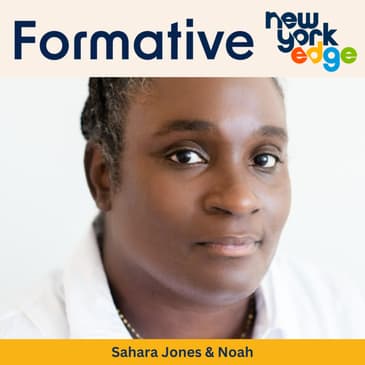

Sahara Jones, Vice President of Affordable Compliance and Management at the Albanese Organization, joins middle schooler Noah to talk about the tough decisions she’s had to make over the years, why mistakes can be lessons in disguise, and how a moment from her teenage years helped shape her career path. She also shares her love of books and what she might be doing if she weren’t working in housing.
Downloadable transcript here
Rachael: Welcome to a new episode of Formative, the podcast where today’s leaders are interviewed by the leaders of tomorrow. Today our guest is Sahara Jones. Sahara is the Vice President of Affordable Compliance and Management at the Albanese Organization. She talks to us about the toughest part of her job, what she’d be doing if she weren’t working in affordable housing, and why she believes making mistakes is such an important part of growth.
Hello and welcome. My name is Rachael Gazdick, and I’m your host and CEO of New York Edge. On every episode of Formative, a student from our afterschool program joins me as co-host, and today I’m joined by Noah from MS 42Q. Noah, can you tell our audience a little bit about yourself?
Noah: My name is Noah, and I like reading and math, and I like playing basketball.
Rachael: Great. So I think we’re ready to bring in Sahara. But before we do that, we want to remind our listeners that you can support us by making a donation at newyorkedge.org/donate. It would be very much appreciated.
[END OF INTRO]
Rachael: Sahara, welcome to our show. We’re so happy to have you on. Thank you. I appreciate it, and—
Sahara: I’m glad to be here.
Rachael: Noah, what’s your first question?
Noah: Can you explain your job for me?
Sahara: So what my job entails is helping people to see if they’re eligible for affordable housing. So when people apply for apartments, I collect their documents, make sure that they income qualify for the house, the apartment that they’re going for, and we greet them and bring them into the unit as well.
Noah: Uh, how do you build houses?
Sahara: So my company, actually, Albany’s organization is the developers of apartments. So they actually go to the state and ask for funding, give them a proposal of how many apartments, what the building would look like.
We have an architect that then comes in, he draws up the drawing of what our idea may be, and then we start to build on, we have the construction team build on that end.
Noah: Was there ever a moment when you give up when you was doing something in your job?
Sahara: There are a lot of moments where you get frustrated at work where you want to give up or you feel as if you’re not appreciated, you know, helping people.
But I always think about how many people I helped along the way, and if one person is not appreciative or one person doesn’t do what they’re supposed to do, I can’t forget about the other people that I’ve helped that appreciate it and that is continuing to live and strive and do well because of the services that we provide.
Noah: What was the hard part of doing your job?
Sahara: The hard part of doing my job, I would say rejecting people from an apartment. There’s times where people don’t meet the income qualifications for a unit, and it’s hard to tell them no when I know they in need of an apartment. So that’s the hard part.
Noah: Have you made any mistakes at work?
Sahara: Um, I think in life I don’t consider anything as a mistake because I feel like everything is a learning, is a lesson learned, right? So I don’t feel like there’s mistakes. I feel like we have to go with our judgment sometimes, and we don’t understand necessarily why we do the things that we do. So that would be a lesson.
So for me, one thing that I can say, and I don’t think of it as a mistake, but it could be a lesson learned for me, was I originally felt like a person wasn’t an applicant, wasn’t suitable for the building, and I just didn’t feel like he was the right fit.
And we had run a credit check on him, and it had come back that he had a record. So I had denied him because it was just like a freshly new record.
He appealed, and he had people vouch for him and write me letters and say, “This is not who he is.” And I was like, “Okay.” And we gave it a try, and it was an epic fail because he then had unwanted guests in the building, you know.
So that was the mistake, that what I would consider a poor…you know, I tried. I tried to give someone a chance.
And so those are the hard moments where it’s like you try to give someone a try and chance, and you still trust your instinct when it tells you to do something the right way.
We try our best to protect residents and try to make them have the most enjoyable living experience, right?
And then other people may not have the same concept as you, and then we hear to complain of, “Why did you move this person in?” Because this person deserve a place to stay, too.
When you’re sitting in this chair, you have to make hard decisions, and sometimes you just don’t want to make the wrong one, and then you also want to give people a try.
Rachael: What’s a part of your job that you wish people understood better?
Sahara: I think what people don’t realize is that a lot of times when they get to these apartments, they don’t realize the opportunity that they have.
I think that people take it for granted and they get lax, and they don’t understand the opportunity and I think financial stability and what the whole idea of the original program was because I think people don’t understand the original idea of low-income housing, what the idea or the fundamental core of what it was supposed to be.
So the fundamental cost of these apartments was originally, it’s supposed to just start you off. They have low rent for you to be able to financially support yourself and save and then move on.
So as your income goes, you’re supposed to be able to save and financially depend on that and move on and go into housing and to buy a house.
That’s the original goal, is to grow your income. You outgrow the apartment. If you go into a house.
And I think that some people get complacent, and I also believe that people don’t take the opportunity as they should. Take advantage of the opportunity.
Noah: If you can change anything about affordable housing, what would it be?
Sahara: I think I would change some of the financial burden on people. I think that ideally our goal is to provide housing, affordable housing, and I think some people just can’t afford it.
I think that we need to understand that some people, and I know I have a whole senior building right now that’s 62 and over, and some people just get social security, and some of that is just not enough.
It’s not enough for somebody to get 900-and-something dollars a month for social security and have to pay $600 for rent. So where does the food, where does the light?
So I think just understanding we have to do more to help. We have to do more to help.
Noah: What’s the easiest part of doing your job?
Sahara: The easiest part, turning over the keys when they sign their lease. That’s the easiest part.
Noah: What was your dream job when you was younger?
Sahara: My dream job, let me think. I think my dream job was actually to be a teacher. That was my dream job. I wanted to be a teacher, and then I became involved in real estate and fell in love.
Rachael: I was wondering if there was anyone you looked up to growing up, someone you wanted to model your life after.
Sahara: I have two. So my mom was one. I was very influenced by my mom. My mom was a hard worker. She did a lot. She always made time for when she came home from work with the children.
So as a mother, she was my go-to. She was my mom goals. I wanted to be just like my mom.
But I did have a teacher that I ran across in sixth grade. She was my sixth-grade teacher. Her name was Mr. Paris, and she was my role model.
When I say everything I wanted to mirror was her, she was caring, she was loving, she took time with the children and with us, you know, to make sure that we understand everything.
So I was fortunate to have the best teachers growing up. So my teacher was one of my role models, and even as an adult I’ve seen her and met her and conversated with her and always told her the impact that she made in my life.
So I do have a very—one of the reasons I wanted to be a teacher was because of her, because I always wanted to make sure that I was that person for someone else.
Noah: When you was young, did you have an experience that shaped your career?
Sahara: Yes. So, um, I want to say about the age of 13, I had a neighbor who became a developer.
She developed a project in Brownsville, Brooklyn, and I saw the impact that it had on the community and how many people that helped as far as, you know, the change of the atmosphere when it came to the children and with the parents, because when they have stability in housing, it changes the whole dynamic of the family.
And I think at that particular moment in time, and that’s when it changed my outlook of what I wanted to do, because I’ve always wanted to help children.
So that’s when you come to a teacher, but then this way helps them as well, giving them a stability, a stable housing.
So at that point, I think at the age of 15, 16, I was in high school. I was at James Madison, and they had a summer program, and it was Cornell University.
I went to Cornell University for the summer, and the course I took was urban studies, and so that changed the whole dynamic.
Noah: What was your personality when you was younger?
Sahara: Outgoing. I was very outgoing, and I loved to be involved in different things. So I was a cheerleader. I was in dance, so I always used to be involved in different activities in school.
Noah: And what was your favorite hobby like when you was young?
Sahara: So I had a couple. One was crocheting. Reading has always been a hobby of mine that I loved, and jumping rope was one of my favorite activities as a kid.
What’s your favorite hobby?
Noah: Jolene.
Sahara: Oh, you like to—you are art. You like to draw?
Noah: Yeah.
Sahara: My daughter used to be an artist. What grade are you in, if you don’t mind?
Noah: Sixth.
Sahara: You are in sixth grade. What do you want to do when you grow up?
Noah: Be an actor or be a cop.
Sahara: You want to be a police officer, but you don’t want to do anything in the art, like you draw, you don’t want to do anything with art, anime?
Noah: I might like work for, like, a show.
Sahara: To do the back, the back work of animation.
So I have a brother, one of my many, who actually draws as well. He’s an artist, and he paints and he draws figure.
And my youngest daughter went to fashion industry fashion. My oldest daughter, I’m sorry, she went to fashion industry and she draws.
Noah: What is the hardest thing of raising your kids?
Sahara: Letting them make their own mistakes.
As a mother, you want to protect your child from making mistakes, and letting them make their own mistakes is the hardest thing that you can ever do, but you have to let them do it so that they can grow.
So I’ve always wanted to protect my daughters. I didn’t want any harm. I didn’t want anybody to make them cry. I didn’t want them to feel any pain, but that’s a part of growing up, so they had to do it.
What’s the hardest thing about being a kid now?
Noah: Uh, taking a lot of tests.
Rachael: At school.
Noah: Yeah.
Rachael: Our final question that we ask every guest is, if you could go back and talk to yourself at age 11, knowing everything you know now, what advice would you give?
Sahara: Knowing everything that I know now, I would tell my 11-year-old self not to grow up so fast, enjoy being a kid because adulthood is hard.
I would tell myself don’t take everything as a mistake. It’s a learning, a lesson learned.
And I would also tell myself to allow yourself grace, allow yourself to have grace. Don’t punish yourself for little things. It’s not the end of the world. It’ll be better.
So, Noah, if there’s one thing I can tell you, it is enjoy being a kid. Don’t grow up too fast because you’re not going to like paying bills, but also allow yourself grace.
Noah: Thank you.
CREDITS
Thanks for listening to Formative, a production of New York Edge. I’m your host, Rachael Gazdick. Our production partner for this series is CitizenRacecar. This episode was produced by Hajar Eldaas, post-production by Alex Brouwer, original music by Garrett Tiedemann. Thanks to the whole team at New York Edge for making this series possible. Never miss an episode by subscribing to the series at newyorkedge.org/formative or wherever you get your podcasts.