
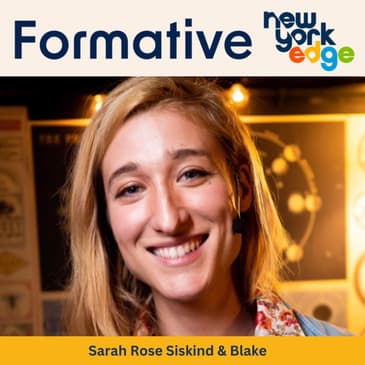

On this episode of Formative, Sarah Rose Siskind and middle schooler, Blake, talk about how our world is full of wonder and silliness. Sarah is a science comedy writer and she’s fascinated by astrophysics and robots. She shares with us what happens to your body when you fall through a blackhole, why she’s optimistic about artificial intelligence and how being a huge fan of making mistakes has helped her learn and grow.
Downloadable transcript here
Rachael: Welcome to another episode of Formative, the show where today's leaders are interviewed by the leaders of tomorrow.
We're very excited to be speaking to Sarah Rose Siskin today. Sarah is a science comedy writer. She's written jokes for the White House Correspondence Dinner and Neil deGrasse Tyson’s Star Talk. Sarah is also a big fan of robots. And she talks to us today about her experience living with one. She also tells us about her favorite science subject to joke about and what spaghettification is all about.
Rachael: Hello and welcome. I'm Rachael Gastic, CEO of New York Edge, and my co-host today is Blake from M.S. 61K. Blake, can you tell me a little bit about yourself?
Blake: Hello, everyone. My name is Blake. I represent the New York Edge program of M.S. 61K. I'm 11 years old and some of my favorite hobbies are playing basketball and video games.
Rachael: And Blake, who are we here with today?
Blake: Today, I'm here with Sarah Rose Siskind. Siskind?
Sarah: Yeah, bleh, either one. I don't know. It's nice to meet you, Blake.
Blake: Nice to meet you, too.
Rachael: Sarah, thank you so much for coming on the show. So let's get started. Blake, what's your first question?
Blake: So, my first question, why did you decide to mix science with comedy?
Sarah: Great question. Why did I decide to mix science with comedy? Well, I actually didn't decide per se. I was involved in a TV show. I got hired. I was interested in comedy and I, like many people, didn't think it could combine with science. I was very interested in science in elementary school, middle school, and college.
But the thing is, after about fourth grade in the United States, we see a drop off in an interest in science, like when you take polls of students, you see that after fourth grade, like it's 70 percent of girls and boys are interested in science. But when you go to high school, it drops to 30, like cuts in half. And then when you get to college, there's just a huge drop off after that until you have a very small percentage that actually choose a major in sciences. And I was one of those kids because I was like, science is really fun and very interesting, but it's also really hard and competitive. I just didn't feel very maybe welcome or that I was very good at it.
And once I got to college, I was able to take a lot of classes I just really wanted to take because I didn't want to go to grad school. And so I determined, okay, I got into this good school. I'm going to take as many electives as I want. And so I took a lot of science electives, you know, when I didn't have any requirements.
And then, later in my career, I focused on comedy, and I was shown this opportunity to write for a science comedy show. And I was just overflowing with enthusiasm because of having taken a lot of science classes. And that enthusiasm, I think, showed up in my work because I was excited to tell people about science and get people excited about science. And then TV shows, they don't last forever. The TV show was canceled after a number of years. And so I started my own company where we help directly to make scientists more entertaining, to communicate better with the public. And this way I get to hire other comedians and get to meet scientists. So I'm very lucky to be very happy doing what I'm doing.
So that's how I got interested in science and comedy.
Blake: Okay,so my second question is, What science topics do you like to joke about?
Sarah: Oh my gosh. Okay, so I have to say my favorite subject to joke about has to be astrophysics. And the reason it's my favorite to joke about is because I used to write for a TV show called Star Talk, hosted by an astrophysicist named Neil deGrasse Tyson. And I first fell in love with the concept of science comedy, just hearing Neil, this huge, famous astrophysicist, talk about the cosmos in this grand way, and then saying something very surprising. He would say things like, when you look out into the cosmos, you realize that everything is made of stardust, and that we are also made of stardust.But so is trash, so calm down. And I love that.
Blake: Oh my gosh.
Sarah: Yeah, it's great because it's like, you know, sometimes you feel so small looking up at the stars, but then that can also be a funny thing because, you know, it's just surprising. And I had such a great time joking around with him. Do you know who Neil deGrasse Tyson is by any chance, Blake?
Blake: I do. I remember I went to a space museum one time and they had a biography of him, I believe, because he's definitely a big astrophysicist and he's definitely a funny guy.
Sarah: He's hilarious. And one of the parts of my job was that I had to, um, take people on set. And one of the problems was, Neil loved talking about the stars so much, it would delay production significantly. Because he would be talking with the audience, random people, makeup ladies about black holes, and it would delay production. But it was great because he really cares about the stars. And Blake, like when you really love what you're doing, that's like a huge sign of success because this man found a way to make a lot of money and a lot of people very happy doing the thing he really loves doing, which is talking about stars.
Blake: Very, very inspiring.
Sarah: Very inspiring.
I mean, I love joking about all different types of science, but astrophysics has a really big place in my heart. I'm working on a TV show now that's all about physics and comedy because physics is very absurd. Like you learn certain things about physics that really make you think, like really advanced physics. Like we're learning that the universe may be comprised of tiny vibrating strings. And it's just crazy thinking about like how many smart people are out there in a room are coming up with these totally crazy theories. Like, if you fall through a black hole, do you know what happens when you fall through a black hole? What happens to your body?
Blake: Does it evaporate?
Sarah: Close. Good guess. Because black holes are really powerful. It doesn't evaporate but it takes all the tiny atoms of your body and puts them into one long string of atoms, like one giant line. And do you want to know what this process is called?
Blake: Ummm…
Sarah: He's thinking about it. You gonna take a guess?
Blake: I don't know.
Sarah: It's called spaghettification.
Blake: Wait, really?
Sarah: Yeah, really!
Blake: They actually call it spaghettification?
Sarah: They actually call it spaghettification. These are like, adults, adult physicists with a lot of years in college and school and grad school, and they call it spaghettification.
So clearly, if you're that good at physics, you can have a sense of fun and get away with it. So that's, uh, don't get spaghettified, Blake. That's my next piece of advice for you.
Blake: Okay, I definitely watch out for black holes now.
Sarah: Yeah, I know you were tempted before to touch one, but I don't recommend it.
Blake: Okay, what does success mean to you in your career?
Sarah: This is a really, really great question, um, especially to talk about when you're at your age in middle school, and, you know, there's a lot of different types of success. I'm sure a lot of people in your class are trying to get good grades, they're, you know, trying to win trophies, they're trying to do a lot of things your parents and your teachers are telling you, and just mean a lot to your friends.
But I think success really means something that's valuable to you. Like, it's hard, but as you get older, you have to think about, what are the things that actually are valuable to me? So that you're not just successful by somebody else's definition of success. And for me, one of the most successful things about my life is just that I'm able to do what I love, and I think that anybody who can do that, that's a success.
I'm curious, what do you think success is, Blake? I'm going to turn this around on you.
Blake: I think success, in my opinion, means that, like you said, you're doing something that you enjoy doing, and you're somewhat good at it.
Sarah: Yeah, and it's, sometimes it can actually be hard when you're pursuing something that other people might not see as successful or as valuable, but you think it's valuable. And it's, it's good to understand like mainstream successes, like good grades are important for a reason. Trophies are useful for a reason. I'm not dissing those things, but it's also useful to think about like, outside of those, what matters to you and like to dance by the beat of your own drum it's like an expression I love.
Like I used to make silly videos in middle school at your age with my friends. You probably don't, like, you wouldn't find this as fun because everybody has a camera now. But when I was 11, if you had a camera, like a camcorder, that was a big deal. And we would make these stupid videos where we would edit things, do these jump cuts and make it look like objects were appearing or disappearing in claymation and that was very fun and has really helped me later in my career, understanding the small basics of film. So random things that aren't necessarily seen as like, you know, getting a trophy can later turn out to be useful.
Blake: Definitely going to take that into consideration.
Sarah: Oh, yeah. Oh, what are some of your hobbies, Blake?
Blake: So some of my hobbies are playing basketball and playing video games. So my hobby with playing basketball, it's my dream. My dream is to be in the NBA. Some of my like, role models or idols are Kobe Bryant, Michael Jordan, Jamal Crawford, some of the big names in the NBA.
Sarah: Did you see the documentary about Michael Jordan?
Blake: No, I did not see it, but I'm definitely gonna watch it.
Sarah: It shows why he's so good at basketball. And one of the reasons is he's just like, he's a very competitive guy and that really comes across clearly in the documentary. So I recommend it because it shows the advantages, but also some of the costs of being really competitive.
Blake: Thank you for that.
Sarah: Yeah, sure. Definitely gonna watch that.
Blake: Okay, so my next question was, did you have any mistakes or were there any lows in your career that you felt like you wanted to give up on your dream?
Sarah: Oh my gosh. So many. Too many to count. There are so many mistakes in my career. But in some ways, like, it's important to realize, like, there's a lot of them that I don't regret because I've learned from every mistake I've made, and they've all been very useful.
Let's see. So, on the small end, um, gosh, I'm embarrassed saying this. When I was working on the TV show, we were up until, like, 3 a. m. I was exhausted, and I was, like, sitting off the side of the set and I fell asleep accidentally because I was just so exhausted and I wasn't needed right then. And then I heard an applause break. And so I just woke up and started clapping and there was no applause break. I had heard it in my dream, but it wasn't real. And so I had, like, interrupted a take because I just started clapping. Oh God. You can see right now, Blake, my face is very red. Um, so that was really, that was very embarrassing. And I just learned to drink a lot of coffee on set to never do that again and not embarrass myself again. So that was pretty bad. That's like on the lower end is embarrassing.
But then there are some really deep mistakes. Like, for example, I used to run this business with a co-founder. And we worked well together for many years. But then after a while, it got really tough because she wanted to make one business decision, and I wanted to make another. And we were in lock for a while, like we were in like, we couldn't find a solution. And so eventually, we had to talk to somebody, like an outsider, like a therapist for business, and figure out that I would essentially pay for her to do something else and I would run the business by myself. And that was really hard cause I actually loved working with her, but I, the mistake was that I wanted to keep her on the project when I think she really wanted to leave at a certain point. And that was a really, that was kind of like a very emotional, complicated mistake, but I learned a lot about myself in the process.
And when it comes to making mistakes, I've made so many. All you can do is learn from them. And the best way to learn from them is not to hide from them. Like, it's so important to be able to say, I made a mistake. We all make them.
I think there's a thing that happens sometimes, Blake, when you get older, where you think, oh, I have aged out of making a mistake. And that never actually happens. People just think they have. And I, when I run a company, I have like a super big rule where I love when people say I made a mistake because It's so important. That's the way you learn. In some ways, if you're not making mistakes, that's a mistake because you should be trying things and, and failing. Like in comedy, we have a lot of sayings about how, like, most of your material should fail because you should be trying new things and you should be trying new materials, should be also like having a high bar for what is successful. So I'm a big fan of mistakes.
Blake: Can you share a joke that I can share with someone my age?
Sarah: Oh man, I didn't know this would be, this feels like a pop quiz, Blake. Um, I'm going to try to think of a good one. What is like some of my favorite jokes? One of the hard parts of sharing a joke out of context is they can't be that funny if they're out of context.
I always think about jokes as having two forms. There's airplane jokes, and there's helicopter jokes. So airplane jokes are jokes where you need to have a conversation, you need to have some baseline, like, relationship, and it's like an airplane where it takes off where it has to, like, go down a runway for a really long time. Like, it has to, like, drive and gain speed, and then when it takes off, it goes really fast and goes off and up and off in a direction. Helicopter jokes, they go straight up. But because they go straight up, they can't go that fast. They don't go as fast as planes. And so I always think like helicopter jokes are like knock knock jokes. And you know, that like those kinds of jokes, because they are good, they're out of context, but they, you know, can't go as fast. They can't be as funny.
All right, let me think of a good one that's appropriate for 11 year olds. Um, How about this, Blake? I'm going to, I'm going to do a bit of showmanship here, and I'm going to tell your audience, if you stick around to the end, I will share this joke with you, and it will knock your socks off.
Blake: All right. So, did you expect to become a science comedian when you were younger?
Sarah: Absolutely not. I had no idea what I was going to do when I was your age. I think I wanted to be a veterinarian when I was your age or maybe be in the military. I had a lot of crazy ideas. I pursued many in different ways, but it's good to have an open mind.
I also don't think science comedian was a thing when I was your age. That's another thing is like the world that you're in now is not going to be the world that you're in when you're 32, my age. There are some timeless things and some of those timeless things are what you're interested in and how you like to learn. And for me, I really like to learn through storytelling. And I like to learn about a lot of different things. So I found a job later in life that I was able to combine.
So sometimes it's useful to think about how you like to learn, you know, like if you're a very, if you're like a strong basketball player, like maybe you're a bit of a, what they call a kinesthetic learner where you learn by moving and by doing. And that's really useful. Like I used to tutor kids. And if they were kind of fidgety jocks like you, I would teach them how to throw flashcards across the floor and they'd have to sort them as quick as possible and things like that.
So, you know, partly understanding what kind of stuff you like will help you later in life, but yeah, life is long and you really, you don't have to know when you're young. Like, you know, history, you know, that like hundreds of years ago, people had to learn what trade they were going to be in when they were your age. That's crazy. Now, present day, we have the huge privilege of choosing what we're going to do much later in life. And that's great because you can also adapt and evolve to the times. So I think it's really good to have an open mind throughout your life. And I think what it seems like, Blake, is as the world evolves, there's a lot more opportunities for jobs that combine fields like mine, as, um, people become more specialized, like they can go deep on something, like the, the basic part of a job sometimes gets automated so people can go deep. You could also bring in other aspects of other fields, like, like me.
Blake: I think I'm definitely going to take comedy into consideration. I don't know if I'm going to mix it with science.
Sarah: What is, what would you say is your favorite subject in school now?
Blake: So some of my favorite subjects are social studies, math, and technology.
Sarah: Social studies, math, and technology. Wow, that's exciting. I didn't know you have a technology class. What do you learn in your technology class?
Blake: We learn how to use, like how to properly use a keyboard where you're supposed to put your hands in order to just to help you type better. And also we learn what certain keys are for on your keyboard.
Sarah: That's great. That's super exciting. So do you think that you'll go into technology? Maybe like a crossover between the NBA and technology?
Blake: Honestly, if I'm not an NBA player, I want to become a historian.
Sarah: A historian? Boy, your interests are all over the place. Impressive.
Blake: So, I feel like I might have to, well, hopefully in the future, there's some way to cross technology with history.
Sarah: Oh, I'm sure there will be. I mean, do you ever use, um, AI or ChatGPT to learn more? Yes, I do. So that's a really great way technology is helping us learn even about the past. Like, I was reading an author recently who was like a Japanese author from like the 60s, and he was really controversial. And I wanted to know what he would think about certain counterarguments. And so I used chat GPT to talk with him, quote unquote, to talk with the author because ChatGPT could take on the perspective of the author and answer with everything it quote unquote knows about that author. And that was a cool thing I've never been able to do before in school.
Blake: I think it's, this is definitely cool how like the AI can be so realistic. It's also kind of scary because you, like the AI will know certain stuff that most people won't know about that person.
Sarah: Yeah. Why do you get scared?
Blake: Honestly, I'm just scared of the future because the big topic with robots is they're going to take over the world in the future. So I'm scared, but I'm also proud, especially of the human race, because we've evolved and developed so much. That's another reason why social studies is one of my favorite subjects because it just helps you understand where we came from and how we evolved to become what we are now.
Sarah: That's a really great perspective because, you know, one thing we've learned from social studies and history is like in the history of humans, we're always adapting to stuff like we're adapting to the ice age, we're adapting to heat waves, we're adapting to new technology. There's always something. Like if you were a farmer in the American Midwest during the 1930s, there was a huge amount of dust that like ruined a lot of crops and those people had to move, you know. It's hard, it's hard to change, but we always have to because that has defined our species ever since we learned how to walk, we're always adapting.
And so I guess, I, when I learn about history, I feel comforted because I think about how strong we are, like how much we have overcome and adapted as a species. So I don't get too worried about AI because I think about the history of humans adapting to new challenges. I am a big fan, a big fan of humans, Blake.
Blake: It kind of persuaded me. I'm still not too sure, but I'm not as scared.
Sarah: I'm seeing, I'm seeing that smile creeping in. Okay, I'm going to tell you one more story about robots that hopefully will make you less worried about robots.
So I worked with this robot. Her name is Sophia. She looks like a human and the back of her head is all wires. It's crazy. And I was just writing for her chat dialogue system. So I was like coding and stuff like that. But during the pandemic, the robot itself got trapped in New York City where I'm from. And so she had to stay in my apartment, my personal apartment, for five months instead of the lab where she belongs in Hong Kong.
So she stayed in my personal apartment for five months and I had to learn engineering maintenance, like how to fix her eye because one of her eyes was drooping, and the other one was open and she looked like there was something wrong with her. She looked like she was having a stroke or a huge stomach ache, Blake. It wasn't a good look for a robot. And you know how long it took me to figure out how to get one of her eyelids to go up? It took me six hours. It took me six hours and a phone call with many different engineers. And when that happened, I became a lot less afraid of robots, Blake, because there are some things we do that are very easy that robots just cannot do.
And then there's some things robots can do that we can't do. Like she can do, she can do any math instantaneously, but she cannot hold a glass of water. It is incredibly hard for a robot to hold a glass of water and to not break it because she's clutching it so hard or so loose that it falls to know how to tip it so the water doesn't tip over. Like this is something that you can do since the age of four, but a robot, it's very difficult for a robot to do that. Um, so I don't worry so much. I don't worry too much about robots taking over the world.
There are some safety concerns, but there's also so many cool things already these AI programs are being used to catch things in medical images that doctors can't see. So if you get an x-ray, for example, like there are certain AI software that can catch a problem that a doctor would miss. And that's really exciting. Plus there's all the learning applications. I don't know. I'm very optimistic. I'm glad I'm maybe changing your mind a little bit. I'm seeing some smiles so I feel like maybe I'm getting there.
Blake: Yeah, you are.
Sarah: I'm warming the iceberg.
Rachael: We have one more question for you, Sarah. If you could go back in time and speak to your 13 year old self, what would you say?
Sarah: Okay, 13. One, good luck on the bat mitzvah. Don't worry about it. Nobody knows when you're wrong when you're speaking in Hebrew. That's one thing I would tell my 13 year old self.
Um, let's see the big advice for my 13 year old self. Okay. You know what I'm going to combine the joke that I promised earlier with advice to my 13 year old self. Okay?
Blake: Okay.
Sarah: Here's what I would tell myself and every 13 year old out there. In life, make sure never to sweat the petty things. And never to pet the sweaty things.
Blake: Wait, never to sweat the petty things and and never to pet the sweaty things,
Sarah: That's right. Don't sweat. Don't worry about the petty things, the small things. And also, don't pet the sweaty things because they're sticky. You know, Blake, one piece of advice about jokes. It doesn't help a joke if you have to explain it at the end. That's the number one rule of comedy.
Rachael: That's a good one. Well, it's been a pleasure having you with us today. And Blake, thank you for being such a great host.
Sarah: Yeah, thank you, Blake.
Rachael: Bye bye.
CREDITS
Thanks for listening to Formative, a production of New York Edge. I’m your host, Rachael Gazdick. Our production partner for this series is CitizenRacecar. This episode was produced by Hager Eldaas, post-production by Alex Brouwer, production management by Gabriela Montequin, original music by Garrett Tiedemann. Thanks to the whole team at New York Edge for making this series possible. Never miss an episode by subscribing to the series at newyorkedge.org/formative or wherever you get your podcasts.