
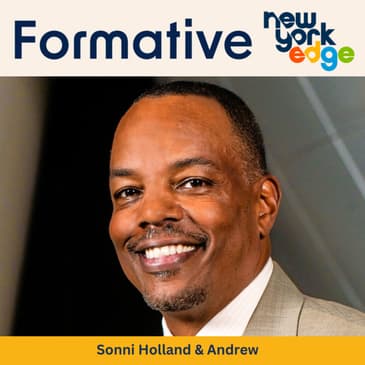

From playing basketball professionally to becoming CEO of the Charles Hayden Foundation, Sonni Holland joins our co-host, Andrew, to talk about the choices he’s made in his career that have led to an enriching life. Andrew learns about the difficult work of making critical decisions and the grace we must give ourselves when we make mistakes.
Downloadable transcript here
Rachael: Welcome to Formative, the show where today's leaders are interviewed by the leaders of tomorrow.
Today on Formative, we're joined by Sonni Holland. Sonni is the President and CEO of the Charles Hayden Foundation, which seeks to promote the mental, moral and physical development of youth in the metropolitan areas of New York and Boston. We speak to Sonni today about his upbringing, playing basketball professionally, And his work at the Charles Hayden Foundation. We are so thrilled to welcome Sonni Holland today.
Rachael: Hello and welcome. I'm Rachael Gazdik, CEO of New York Edge and my co-host today is Andrew from M.S. 116Q. Andrew, before we bring in our guest, I would love to hear a little bit about you.
Andrew: I like a lot of things. I like sports. I like arts. I'm diverse. I have mixed emotions. Just like an average teenager, you know what I'm saying? Um, working out my endurance is something I like to do too, because I'm working to be on a sports team, so I have to do certain things.
Rachael: Great. Thank you for the introduction, Andrew. So who will we be interviewing today?
Andrew: I'm speaking to Sonni Holland today.I'm very excited to have this conversation.
Rachael: Ah, fabulous. So let's bring him in. Sonni, how are you today?
Sonni: Excited, and it's a pleasure to meet you both.
Rachael: We're very excited to be speaking with you. So Andrew, take it away. What's your first question?
Andrew: My first question is, can you explain to me what the Charles Hayden Foundation does and explain to me what your role is?
Sonni: So what the Charles Hayden Foundation does is we support nonprofit youth serving agencies in Boston and New York. Those agencies serve young people between the ages of 5 and 21. Um, and the types of organizations that we support run everywhere from the sports space, youth development, all the way to SAT, college prep, college access, and to some connected learning programs also.
Uh, we give away anywhere between 15 and 18 million dollars a year. Um, and my role is to lead the foundation, right? I'm the President and CEO of the foundation. And so, uh, I oversee a staff of folks that go out and evaluate those programs. I go out and evaluate programs also, and we make decisions on who we're going to give money to and who we're going to help.
Andrew: Is there a person or people or a group that started the business?
Sonni: The foundation is called the Charles Hayden Foundation, and Charles Hayden was an investment banker who, um, made a lot of money on Wall Street and the stock market, and he never married and he never had any children, but growing up as a young person in Boston, he, like me, like you, had a youth development organization that took him in and made sure he stayed on the straight and narrow and provided him with guidance and advice and things like that.
And so when he made all of his money and he realized he wasn't going to be able to leave it to his children or his spouse or what have you, he decided to create the foundation to help the very people that are growing up in areas like he grew up. And so, uh, he started the foundation to help young people in Boston where he was born and raised and the city of New York where he made his fortune.
Andrew: Okay, Okay. Um, why did you choose this career choice?
Sonni: Uh, I think this career choice actually chose me in a lot of different ways. I'm a product of a youth development organization of the Boys & Girls Club. Growing up I always had a safe place to go after school, and I had some people that cared about me to look after me and guide me.
And so when I got to the opportunity to play professional basketball, I was looking back on my life and really questioning and wondering how I was able to be so lucky and how I was able to have the different opportunities that came my way. And everything always came back to two places. It came back to my mother and my family. And it also came back to those youth development organizations that, uh, you know, helped me along the way. And so I, I realized at that point in time that when I decided to stop playing basketball as a profession, I would like to go back and work at those very places that help young people like myself, like you to be able to have the opportunity to do whatever it is they want to do with life.
Andrew: Okay, I respect that. I see that you wanted to be the people that took care of you. You wanted to be the person that other people didn't have. You wanted to help them and motivate them to be the person you are now. I respect that.
Sonni: Absolutely, absolutely. And I started off working at a youth development organization, the Boys & Girls Club, and I was the Director of Operations there for a long time, and then I had the opportunity to come and work with the Charles Hayden Foundation, which is where I am now, and I've been here for going on 24 years now.
Andrew: Um, like, I know it was 24 years ago, but, like, what was the work criterias and stuff like that, things that you needed to be as a worker, some qualifications that you need to have to be in this position?
Sonni: When I was hired to work here, the president at the time recruited me because he realized that the people that he had going out to be the program officers at the time never had any real life work experience in working at the organizations that they were actually going out to evaluate. And he wanted somebody like that on staff. I not only grew up in a Boys & Girls Club, but I also was Director of Operations of a Boys & Girls Club for about five years. And so he recruited me as a person who had experience in running an organization.
And he understood how in a lot of nonprofits, you have to wear a lot of different hats and it's a team mentality and me being an athlete, I understand that, right? And so, the executive director or the director of operations could also be the lifeguard one day, could be the van driver another day, could be the games room coordinator another day, could help with homework another day and still had to go into the boardroom and present and do things like that on a business level. And so he wanted someone who understood that. Nonprofits, it's kind of an all hands on deck. Everybody has to pitch in to make the program successful. And so having some people like that on staff who understands all of these different things and the way things work, it gives us a better view in order to evaluate the program and make decisions accordingly, as opposed to looking at it and saying, oh, this is a chaotic situation or the program is not organized because people are running around doing a whole bunch of different jobs. So, we're not going to give them money. Instead, understanding that's just the nature of the work. Sometimes it makes it better for us to give people money and make more positive decisions.
Andrew: Okay. And what was your best high? Like, what was the best high of the business and what was the lowest low?
Sonni: Listen, I have the unique and special opportunity to work at a place and do something that I truly love.
And so, just about every single day I come to work, um, I'm giving money away. When people ask what I do for a living, I say I give money away, right? So how could you not enjoy that? Not only am I giving money away, but I'm giving it away to help young people have access to opportunity to do something that they enjoy or something that's going to provide them the opportunity to have a better life somewhere down the line.
And so, um, I would say the hardest part of my job is that there are so many fantastic organizations to choose from that are doing terrific work. I can't say yes, or we as a foundation can't say yes, to everyone. And so it's really difficult sometimes to go and see a fantastic organization but that might not quite fit perfectly into what our mission is. And so to have to say no to those organizations means that we might not be able to provide access to a particular program for a certain young person or what have you. And so I'd say those are some of the most difficult days that I have.
Andrew: Okay, okay. Now, similar to the question before, like, I understand that you hate saying no, and I hate saying no too, but has there ever been a time that you, like, it was a desperate need for somebody else, but you had to stay in and stay with the business.
Sonni: Yes, and those are difficult decisions to make. But to bring it out as simply as we can, you know, if you only have 20 dollars, right, and you're going into the store and you see something that costs 25 dollars, or a collection of things that are going to cost 25 dollars, you realize that you'd have to put 5 dollars worth of items back on the shelf, right? And so that's exactly how I look at it. And you're going to say here, I want everything, but what do I need? Right? And so from the foundation's perspective, that ‘what do I need’ means what fits squarely into our mission and our goals as a foundation, and then we have to make a decision based on that.
So we can't fund everybody. But of these 25 organizations, we have to cut it down to 20, which of those 20 could fit squarely in our mission statement. And then I have to go through that and I have to be, you know, unapologetic in the no because those 5 don't fit squarely in.
Now, I understand that means that organization might not be able to stay open. They might have to close at 4 o'clock instead of closing at 5 o'clock. They may now only be able to help 50 kids as opposed to 75 kids. They may only, you know, they may not be able to do any of it, but it's a decision that we have to make and it's a tough decision. But nonetheless, there's only a limited amount of money that we have to give out. And so we have to stick within that parameter.
Andrew: Now, you used to, you used to play basketball. Has this always been your career choice or you wanted to, like, make it to the NBA or stuff like that?
Sonni: Yeah. Funny enough, I grew up in a basketball family, um, and I'm 6'7. You can't see me stand up right now because we're over Zoom, but I'm 6'7” tall, and so that lends itself to being more successful in playing the sport of basketball, and I happen to be halfway decent at it. But I never had that burning desire where I woke up every single day and wanted to go play basketball, right? I played with friends. I enjoyed it, but I didn't have that passion for it. And so when I, uh, I got a scholarship to go to college and I played well and I played the NCAA tournament and had some success there.
Um, but my idea after college was to get a job and go to work. And so I had no preconceived notion or desire to play professional basketball. It was just something that, um, there was an opportunity for me to do it. We went deep into the NCAA tournament, I got recruited by some, uh, NBA and teams overseas. And so I had the opportunity to go overseas and play for about five years. And I bounced around between about 10 different countries and doing that, and loved that aspect of it. But in order to do all that travel and live in all these different foreign places and have a good time, I had to play basketball in order to do it.
And so, I decided that that was going to be the way I saw the world and made a little money but because it wasn't my passion, I knew it wasn't something that I was going to do for the rest of my life. But um, yeah, basketball has been a major part of my life growing up.
Andrew: What is your secret?
Sonni: What is my secret?
Andrew: How do you get so tall? 6'5. 6'7? That's too much height.
Sonni: What sports do you play? I know you said you were trying to get your endurance up, so what sports do you play?
Andrew: Yeah, I'm trying to practice for basketball. I'm a fiend for football.
Sonni: Okay.
Andrew: Something I'm recently trying to get into is a little bit of baseball cause, honestly, I feel like most baseball players physically are healthy. Most of them, they're fit, they're ready, they got speed. I always love myself some speed. I like running too. I was trying out for track, but I ended up not doing track for some reason. Honestly, I don't know. I might get back on track. You saw what I did there?
Sonni: Yeah, I saw what you did there.
Andrew: Yeah, yeah.
Sonni: You got a life in comedy also, perhaps.
Andrew: Yeah, um, I gotta get back on track and yeah.
Now, this is like a more modern thing, but like, do you have any modern day rappers or, like, singers, RB&B artists and stuff like that, that you listen to?
Sonni: I'm an old school guy. And so I grew up in the, you know, when I first started becoming aware of rap music it was probably in the late eighties, uh, you know, 86, 87, 88. And so that genre was around Run DMC and LL Cool J and people like that, that were coming up. And then A Tribe Called Quest after that, De La Soul, and things like that. And so I’ve come to appreciate some of the folks that are out now, but I’m probably not as up to date as you are. I'm still a fan of Jay Z and Nas and folks like that, but I'm not really…
Andrew: Okay, okay. That's valid, that's valid. Now…
Sonni: What do you listen to? Maybe you can turn me on to…
Andrew: What I listen to? I kind of like, like, I don't really know rappers, but I like beats. And I like those meaningful songs, somewhat meaningful.
Sonni: Yeah.
Andrew: And one of my favorite things to do is when I'm listening to a song is to see, like, see if there's like a, it's like a weird habit, but like, I try to see and turn around the words of the singer and like, see if there's like a hidden message beyond it, you know what I'm saying?
Say I'm listening to one of my favorite rappers, you probably don't know him, but like, XXXTentacion or like Juice WRLD, those are pretty decent rappers. RIP to both, but especially them, I just started listening to this one guy off my uncle and his name was XXXTentacion. I was like, what? Tentacion? That sounds like something. But like, he's like a, he does good things and he's a good person. He does have a little bit of curse words here and there, but most rappers do nowadays.
One of my last questions is, how old are you?
Sonni: I'm 53 years old.
Andrew: That's a nice age.
Sonni: That's a nice age. Do you think so? Not too old?
Andrew: Comfortable. Not too old. Not too young.
Sonni: How old are you?
Andrew: I'm 12. Next year, turning 13. Now, is there anything that you feel a lot of young people do wrong?
Sonni: No, no, that's an interesting question, the way you phrase that. I don't think, unless you're breaking the law, I think the decisions that young people make is all a part of them growing up, right? And so when you're doing it, you know, you're learning about what it is, and you're taking some chances, and you're trying to explore the boundaries of life or what have you.
And so, I don't necessarily look at it that young people are doing things wrong. They just might have made a mistake or be misguided or something like that. And I think it's our job as adults to mentor and help and just be there for advice because we were all young once upon a time and I try not to forget that fact, and I think a lot of adults run into issues with young people when they forget they were also young once upon a time and everybody needs somebody to provide them with some guidance sometimes, with some advice, and with some compassion, right, also in helping them learn and grow and expand. But in terms of if I think young people do some things wrong, no, I wouldn't say that.
Rachael: You know, that's a really wonderful way to look at it. And kind of similar to the last question, we always end our interviews asking our guests, if you could go back and speak to your 13 year old self, what would you tell him?
Sonni: Learn by other people's successes and learn by other people's failures or mistakes if you see them, right? There's no need for you to have to stumble and fall if you don't have to, right? And so, you can learn from what other people do right or do wrong, and so pay, you know, as close attention to that as you can.
And ask questions. If you see someone who's doing something or has something that you want or has gotten to a place or stage of life that you want to achieve, don't be bashful about asking them, hey, how'd you get there? What are some of the things that I might be able to do to help me get to the stage of life that you are? Or something like that. Don't be shy about it. Most people would want to help, um, and I find the more questions that you ask, the more interest that person might have in you and helping you achieve your dreams.
Rachael: Thank you both for being here today. It has just been an absolute pleasure.
Sonni: It's been great for me. Andrew, it's been a pleasure meeting you.
CREDITS
Thanks for listening to Formative, a production of New York Edge. I’m your host, Rachael Gazdick. Our production partner for this series is CitizenRacecar. This episode was produced by Hager Eldaas, post-production by Alex Brouwer, production management by Gabriela Montequin, original music by Garrett Tiedemann. Thanks to the whole team at New York Edge for making this series possible. Never miss an episode by subscribing to the series at newyorkedge.org/formative or wherever you get your podcasts.